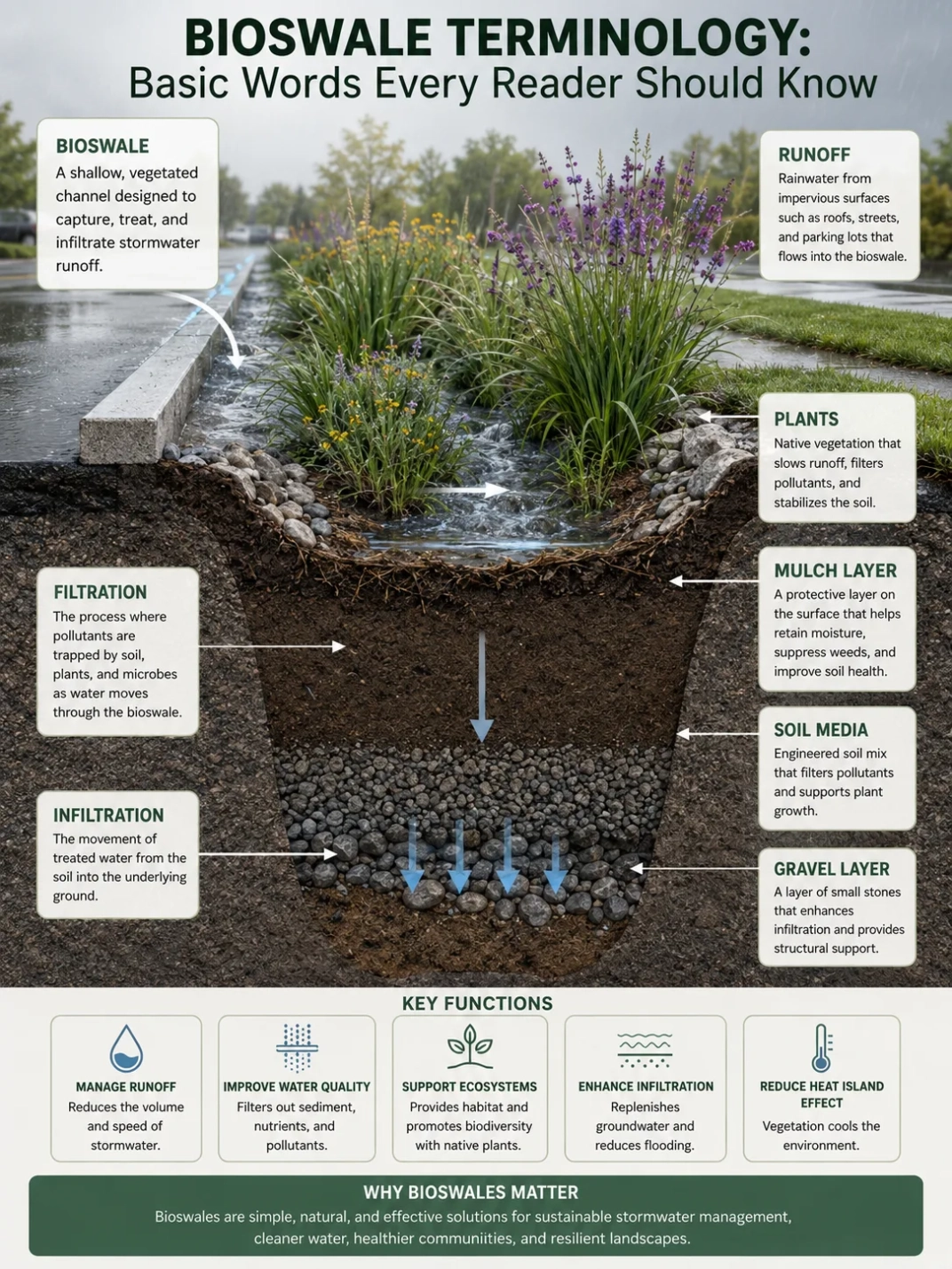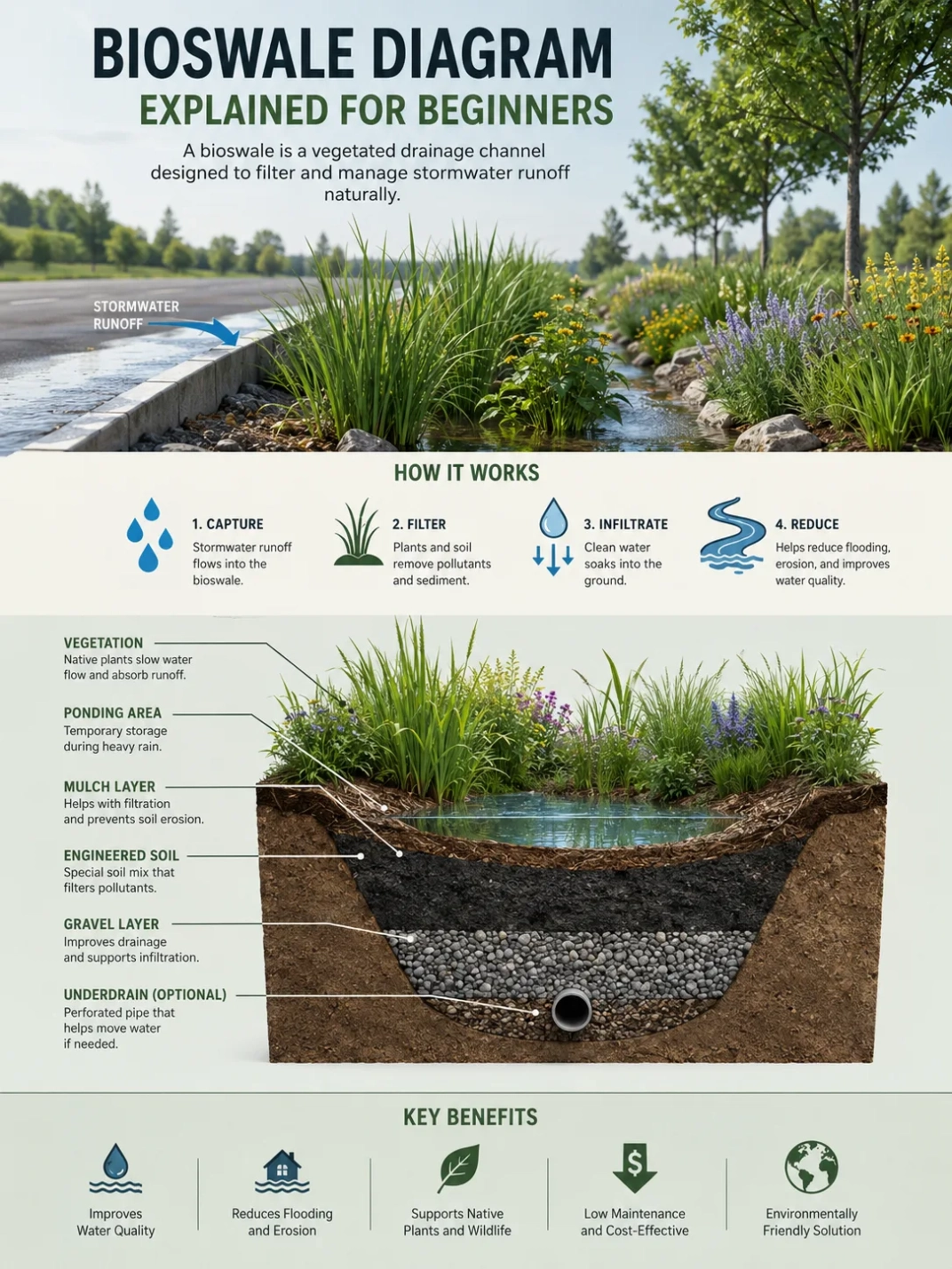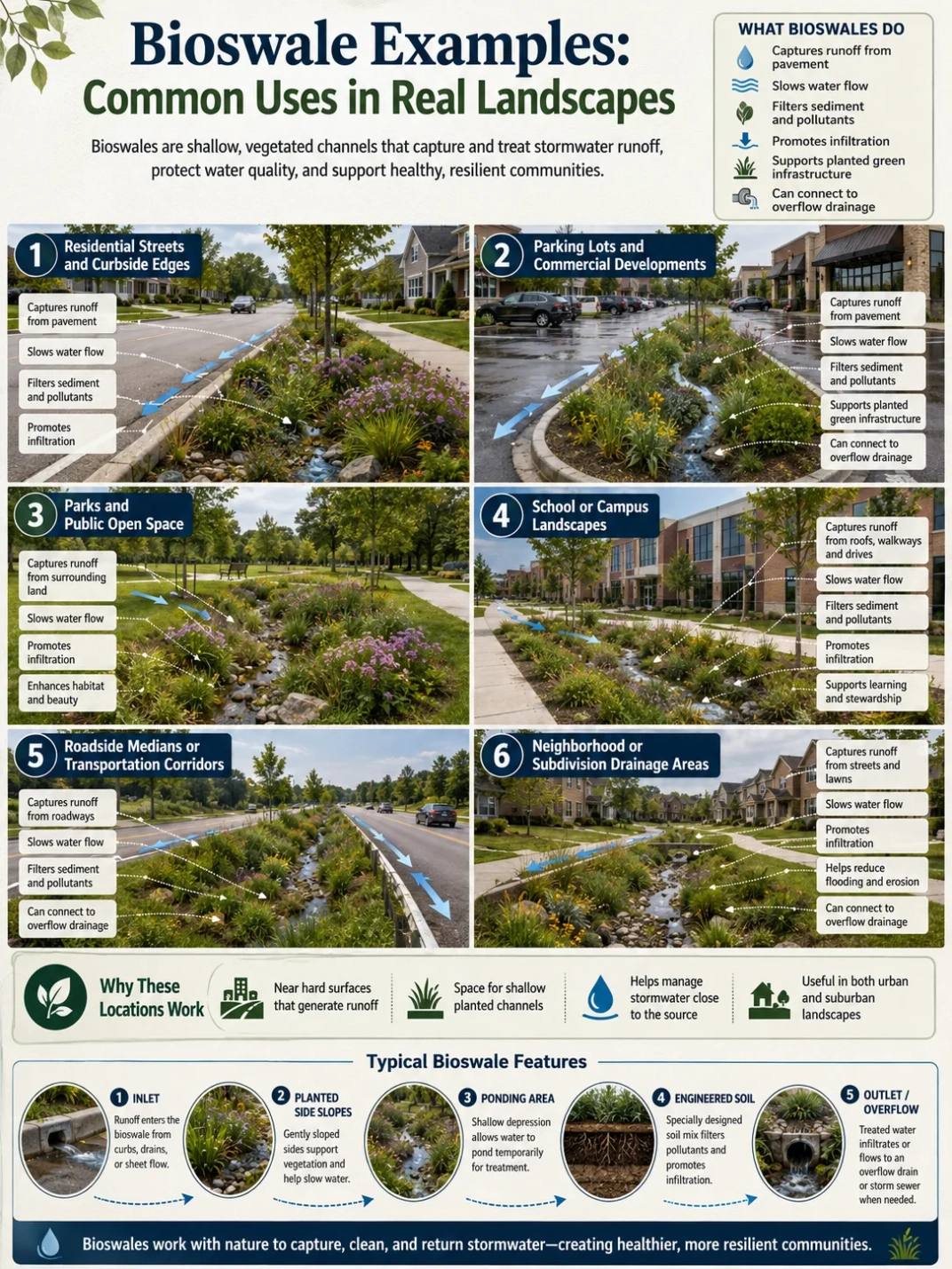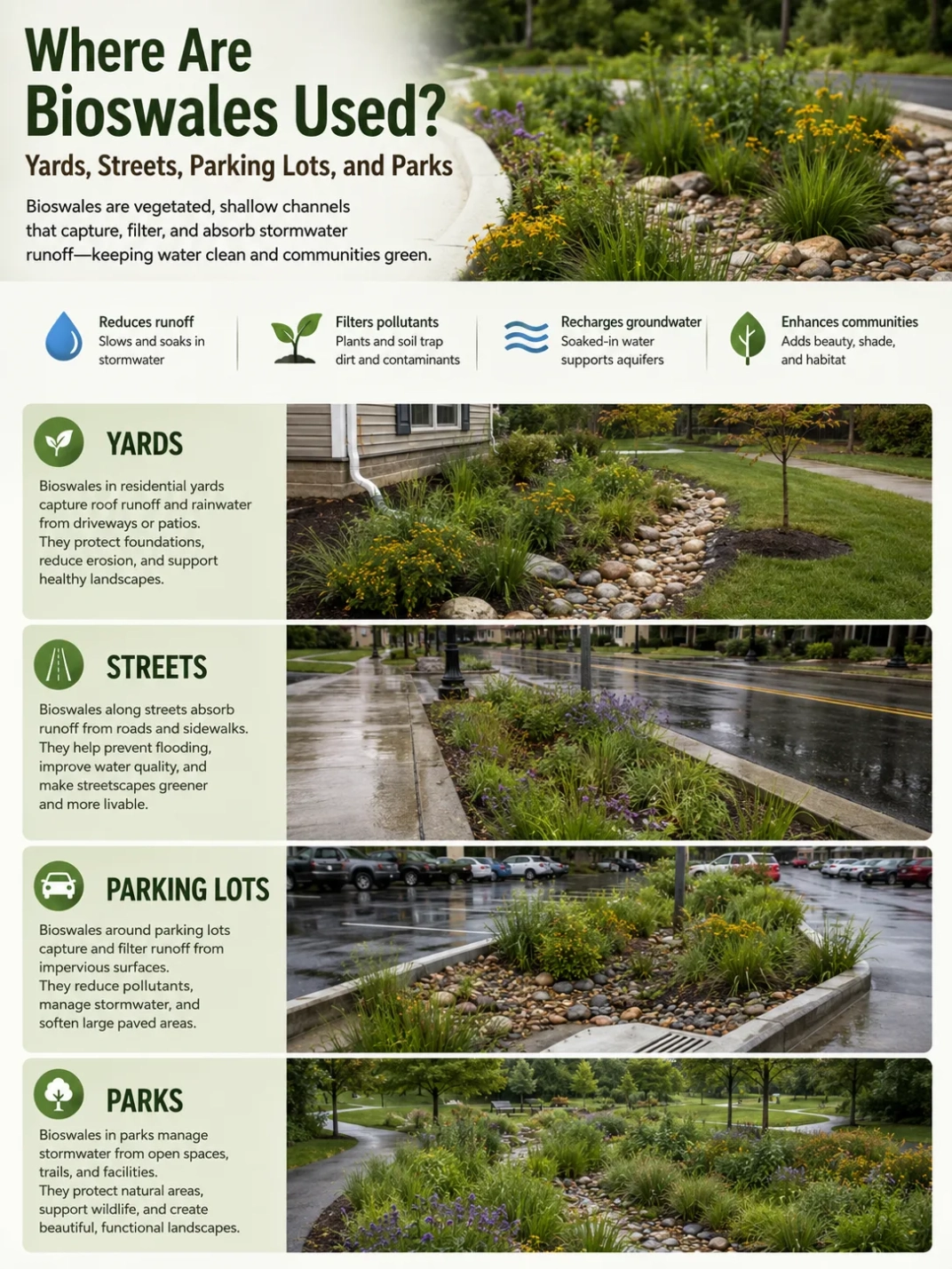
Bioswales are used where rainwater needs a visible, planted route instead of moving straight from hard surfaces into pipes, gutters, or low spots. They often appear beside yards, streets, parking lots, sidewalks, schools, parks, campuses, and public buildings, but their role changes by setting: a small yard bioswale may handle roof or driveway runoff, while a street or parking lot bioswale often manages runoff from pavement with more sediment, oil residue, trash, and fast-moving flow.
A bioswale is not simply a planted ditch. The location shapes the whole system: where runoff enters, how water slows down, how soil accepts or filters water, where overflow goes, and how maintenance crews can reach the inlet, plants, mulch, and outlet. A well-placed bioswale supports stormwater runoff control without hiding the drainage process underground.
Common Places Where Bioswales Are Used
Bioswales work best where runoff can be collected, slowed, spread across vegetation, and released safely. They are often placed between an impervious surface and a downstream drainage point, not randomly in the landscape.
| Site Type | Common Runoff Source | Main Purpose | Planning Detail to Watch |
|---|---|---|---|
| Residential Yard | Roof runoff, downspouts, patios, driveways | Move water away from wet lawn areas and support infiltration where soil allows | Keep overflow away from foundations, basements, and neighboring properties |
| Street Edge | Roadway runoff, curb flow, sidewalk runoff | Slow water before it reaches storm drains or roadside drainage | Plan safe curb openings, sediment capture, and public maintenance access |
| Parking Lot | Pavement runoff from parked vehicles and drive aisles | Filter sediment and pollutants before overflow leaves the site | Protect inlets from clogging and prevent vehicle damage to planted areas |
| Park or Campus | Paths, roofs, plazas, lawns, compacted recreation areas | Combine drainage, planting, and visible green infrastructure | Balance public access, plant durability, and safe overflow routes |
| Commercial or Civic Site | Roofs, walkways, service areas, paved courtyards | Manage runoff near buildings while improving the landscape edge | Coordinate drainage with site grading, utilities, and local review rules |
Site Planning Note: A bioswale should have a planned inlet, a stable flow path, and a safe overflow route. Without those three parts, it may behave like a wet depression rather than a stormwater feature.
Why Location Matters
The same bioswale concept can look very different from one site to another. A residential bioswale may be narrow, informal, and tied to a downspout. A parking lot bioswale may need curb cuts, stone protection, pretreatment for sediment, and a more durable plant mix. A street bioswale may need to fit between pavement, utilities, trees, and pedestrian space.
Location affects four things more than almost anything else:
- Runoff volume: Larger hard surfaces can send more water into the swale.
- Runoff speed: Steeper pavement or curb flow can cause erosion if water enters too fast.
- Sediment load: Streets and parking lots often carry more grit and debris than roof runoff.
- Maintenance access: A bioswale that cannot be reached is harder to inspect, clean, and replant.
These details do not mean bioswales are only for engineered public projects. They mean the setting should guide the design. Soil, slope, rainfall pattern, surface area, and local drainage rules all shape whether a bioswale is a good fit.
Bioswales in Residential Yards
In yards, bioswales are often used to guide runoff from downspouts, driveways, patios, compacted lawn areas, and small slopes. Their purpose is usually simple: slow the water, spread it out, help some of it soak into suitable soil, and move extra water to a safe outlet.
A yard bioswale may be planted with grasses, sedges, rushes, or shrubs that tolerate both wet and dry periods. It may also include mulch, amended soil, small check dams, or stone at the inlet. The exact layout depends on the yard, not on a one-size plan.
Where Yard Bioswales Fit Best
- Along the lower edge of a driveway, where runoff can enter evenly
- Below a downspout, if the flow is not aimed at a foundation
- Along a side yard with a gentle grade and a clear outlet
- Near a patio or walkway where water currently collects
- At the edge of a lawn where soil is not heavily compacted
A yard bioswale should not be treated as a cure for every drainage problem. Water near a foundation, basement wall, retaining wall, septic area, or neighboring property line deserves careful review. In those cases, safe overflow matters as much as plant selection.
Drainage Note: Roof runoff can be clean compared with road runoff, but it can still arrive fast from a downspout. A splash block, stone apron, or widened inlet area can help reduce erosion where water enters the bioswale.
Bioswales Along Streets and Roads
Street bioswales are used along road edges, curb extensions, medians, sidewalks, and sometimes between the roadway and pedestrian space. They help manage roadside runoff before it reaches a catch basin, storm drain, culvert, or downstream channel.
Street runoff behaves differently from roof runoff. It often carries fine sediment, leaf litter, tire residue, small debris, and winter grit where that applies. It can also enter the swale through curb cuts in concentrated bursts. For that reason, street bioswales often need more attention to inlet protection, erosion control, and maintenance.
Street Locations That Often Use Bioswales
- Curbside planting strips
- Traffic-calmed curb extensions
- Road medians with managed drainage
- Sidewalk edges near public buildings
- Neighborhood streets with suitable grades
- Transit stops or civic streetscapes where drainage and planting can share space
Street bioswales must also fit real site limits. Utilities, sight lines, pedestrian crossings, snow storage, tree roots, driveways, and curb geometry can all affect placement. In public rights-of-way, design review and local standards often apply.
How Street Bioswales Handle Flow
A street bioswale usually receives water through one or more curb openings. The inlet may include stone, a concrete edge, or a sediment forebay area to reduce erosion. The planted channel then slows the water and gives soil media and vegetation time to filter runoff. If water exceeds the bioswale’s capacity, it should leave through a planned overflow structure or downstream outlet.
The safest designs do not rely on the swale holding all runoff during every storm. They allow the bioswale to treat and slow frequent runoff while still giving larger flows a controlled path.
Bioswales in Parking Lots
Parking lots are one of the most common places for bioswales because they produce runoff from broad, impervious surfaces. Water moves across pavement, collects sediment, and often reaches the lowest curb line quickly. A bioswale placed along an island, perimeter, or low edge can intercept that runoff before it leaves the site.
Parking lot bioswales are different from decorative planting beds. They need to handle water movement, pavement edge conditions, sediment, occasional trash, vehicle overhang, and maintenance access. Location is the design control: the swale must be where water can actually reach it.
Parking Lot Placement Options
- Perimeter bioswales: These collect runoff near the outer edge of the paved area.
- Median or island bioswales: These divide parking rows while accepting runoff through curb cuts or flush edges.
- End-of-row bioswales: These capture flow where drive aisles drain toward planted areas.
- Building-edge bioswales: These may manage roof and pavement runoff together, if grading allows.
Parking lot runoff can carry more sediment than a roof or small patio. If that sediment reaches the soil surface unchecked, it may clog the upper layer and reduce infiltration. This is why many parking lot bioswales include a stable inlet area, a shallow sediment zone, or a maintenance-friendly edge where debris can be removed.
Maintenance Note: Parking lot bioswales often need inspection near curb openings, inlets, and overflow points. These are the places where sediment, leaves, and trash most often collect.
Bioswales in Parks, Campuses, and Public Landscapes
Parks and campuses use bioswales to manage runoff while keeping water movement visible. They may collect drainage from paths, roofs, plazas, playground edges, sports areas, picnic shelters, and compacted lawn sections. In these settings, a bioswale can also help shape the landscape by guiding people around wet areas and planted zones.
Public landscapes need a careful balance. A bioswale should drain safely, support plants, and remain understandable to maintenance crews. It should also avoid creating awkward barriers, hidden drop-offs, or muddy shortcuts where people are likely to walk.
Common Public-Space Uses
- Along paved park paths
- Near parking areas at trailheads or recreation centers
- Beside school buildings and campus walkways
- At the edge of plazas, courtyards, or civic lawns
- Near athletic fields where overflow can be directed safely
- Within open green infrastructure corridors
Plants in public bioswales usually need to be tough. They may face foot traffic, drought between storms, temporary ponding, mowing conflicts, road salt in some climates, and seasonal debris. Native plants can be useful where they match the site’s soil, moisture, sun, and maintenance plan, but local suitability still matters.
How Runoff Source Changes the Bioswale
A bioswale’s location matters because each runoff source brings a different mix of water, sediment, and maintenance needs. Roof runoff is not the same as street runoff. A park path is not the same as a high-use parking aisle.
| Runoff Source | Typical Behavior | Bioswale Detail That Often Matters |
|---|---|---|
| Roof | Concentrated flow from downspouts or roof drains | Energy control at inlet and safe routing away from buildings |
| Driveway | Moderate pavement runoff, sometimes with fine grit | Gentle entry, stable edge, and clear overflow direction |
| Street | Fast curb flow with sediment and debris | Curb opening design, sediment capture, and erosion control |
| Parking Lot | Broad impervious runoff with grit, leaves, and surface pollutants | Pretreatment, durable planting, and maintenance access |
| Park Path | Shallow runoff from paved or compacted surfaces | Plant protection and safe crossing points |
Where Bioswales Are Less Suitable
A bioswale is useful only when site conditions support the idea. Some places need a different drainage tool or a professionally reviewed design. The issue is not whether bioswales are good or bad. The issue is fit.
Locations That Need Extra Care
- Areas directly beside foundations or basement walls
- Steep slopes where water may erode soil before plants can slow it
- Highly compacted soils that cannot drain without soil improvement or an underdrain
- Sites with contaminated soil, where infiltration may not be appropriate
- Places where overflow could reach a neighbor’s property or public walkway
- Very narrow strips where maintenance access is poor
- Areas with heavy pedestrian shortcuts that may damage plants and compact soil
Clay soil does not automatically rule out a bioswale, and sandy soil does not automatically make one easy. Clay may need underdrainage, amended media, or a different outlet strategy. Sandy soil may drain quickly but still need erosion protection and plant choices that can handle dry periods. Soil testing and local review can prevent weak assumptions.
Soil Note: Infiltration is not only about soil type. Compaction, depth to restrictive layers, seasonal groundwater, construction disturbance, and sediment buildup can all change how a bioswale performs.
Bioswales and Other Drainage Features
Bioswales often sit near other stormwater tools, but they do not all do the same job. The location often decides which system makes more sense.
How a Bioswale Differs from a Rain Garden
A rain garden is usually a planted basin that collects water in one area and lets it soak into prepared soil where conditions allow. A bioswale is more linear. It moves water along a flow path while slowing, filtering, and sometimes infiltrating it.
In a yard, either system may be useful. Along a street or parking lot edge, the linear shape of a bioswale often fits the movement of runoff better.
How a Bioswale Differs from a Drainage Ditch
A drainage ditch mainly conveys water. A bioswale is planted and usually designed to slow water, reduce sediment movement, and support filtering through vegetation and soil media. Some bioswales still convey overflow, but conveyance is only part of the job.
How a Bioswale Differs from a French Drain
A French drain moves water through gravel and perforated pipe below the surface. A bioswale works at the surface with plants, soil, and a visible flow path. In some designs, an underdrain may sit below the bioswale, but that does not make the whole feature a French drain.
Details That Shape Performance by Location
The most useful bioswale locations share a few traits. Water can enter without cutting channels into the soil. The bottom and side slopes are stable. Plants match the wet and dry zones. Soil does not seal over with sediment after a few storms. Overflow has somewhere safe to go.
Inlets
The inlet is where runoff enters the bioswale. In a yard, this might be a downspout extension or shallow channel. Along a street, it may be a curb cut. In a parking lot, it may be a flush curb opening or a protected gap in a raised curb.
A weak inlet can cause erosion, clogging, or uneven flow. A better inlet spreads water and slows it before it reaches planted soil.
Flow Path
The flow path is the route water follows through the bioswale. It should be long enough to slow and filter water, but not so flat that water sits for too long where drainage is poor. Check dams, shallow grade changes, or wider planting zones may help manage flow in some designs.
Soil and Filter Media
Soil media affects infiltration, filtration, plant health, and maintenance. Some bioswales use amended soil or engineered filter media. Others rely more on existing soil where it is suitable. No single soil mix fits every yard, road, parking lot, or park.
Plants
Plants help slow water, hold soil, support root channels, and keep the surface from becoming bare. They need to match the moisture pattern of the bioswale. The bottom may stay wetter after storms, while upper side slopes may dry out faster.
Overflow
Overflow is the route water follows when the bioswale is full or when rainfall exceeds its intended capacity. This may connect to a storm drain, another landscape area, a surface channel, or a designed outlet. Overflow should be planned, not guessed.
Common Mistakes in Bioswale Placement
Many bioswale problems start with placement rather than plants. A beautiful planting layout cannot fix water entering too fast, flowing the wrong way, or leaving without a safe outlet.
- Putting the bioswale where water does not naturally drain: If runoff cannot reach the swale, it cannot do much work.
- Ignoring overflow: A bioswale should have a clear path for larger storms.
- Placing it too close to buildings: Water should not be directed toward foundations or basement walls.
- Skipping sediment control: Street and parking lot runoff can clog soil surfaces over time.
- Using plants that fit the look but not the moisture pattern: Bioswale plants need to tolerate changing conditions.
- Forgetting maintenance access: Inlets, outlets, and sediment zones need to be reachable.
Residential, Public, and Commercial Uses Compared
A yard bioswale, a street bioswale, and a parking lot bioswale may share the same basic idea, but their demands are not equal. The larger and harder the drainage area, the more attention the design usually needs.
| Setting | Main Benefit | Typical Limit | Review Level |
|---|---|---|---|
| Yard | Helps manage small runoff sources and wet lawn areas | Must protect buildings, neighbors, and safe overflow routes | Simple sites may be planned at small scale; complex drainage needs professional review |
| Street | Slows and filters curbside runoff | Must fit traffic, pedestrian, utility, and maintenance needs | Usually requires public review or design standards |
| Parking Lot | Treats runoff from broad pavement areas | Higher sediment load can clog inlets and soil surfaces | Often needs site-specific drainage design |
| Park | Combines drainage with visible planting and public landscape design | Foot traffic and maintenance patterns can affect performance | Depends on site size, public access, and local rules |
What to Check Before Choosing a Bioswale Location
Good placement starts with watching how water already moves. During or after rainfall, runoff patterns show where water collects, how fast it moves, and where it wants to leave the site. That observation is often more useful than drawing a swale in the most visually open area.
Practical Site Checks
- Identify the runoff source. Roof, driveway, street, parking lot, path, or lawn runoff each behaves differently.
- Trace the flow path. Water should be able to enter the bioswale without crossing unsafe or unsuitable areas.
- Check the slope. Very steep or very flat areas may need design changes.
- Look at soil behavior. Compacted soil, clay layers, or very fast-draining sand can change the design approach.
- Plan the overflow route. Extra water needs a place to go that does not create a new problem.
- Leave access for maintenance. Inlets, outlets, sediment zones, and plants need periodic care.
Design Note: A bioswale location should be chosen from the water’s point of view first, then refined for planting, appearance, access, and long-term care.
When Professional Review Makes Sense
Some bioswale locations are simple. Others involve buildings, public drainage, large paved areas, steep slopes, utilities, or unclear soil conditions. Professional review is sensible when a bioswale may affect structural drainage, public rights-of-way, road runoff, commercial parking areas, or neighboring properties.
This does not make bioswales overly complicated. It means they are real drainage features. They can look like landscape elements, but they still handle water, soil, grade, and overflow.
FAQ
Where are bioswales most commonly used?
Bioswales are commonly used in yards, street edges, parking lots, parks, campuses, commercial sites, and public landscapes. They are placed where runoff from roofs, pavement, roads, paths, or compacted ground can enter a planted flow path and drain safely.
Can a bioswale be used in a small yard?
Yes, a small yard can use a bioswale when the site has a suitable runoff source, enough space for a planted channel, soil that can support the design, and a safe overflow route. Extra care is needed near foundations, basements, property lines, and steep slopes.
Why are bioswales used in parking lots?
Parking lots create runoff from large paved surfaces. Bioswales can help slow that runoff, filter sediment, support planting, and guide water toward an outlet. Parking lot bioswales usually need durable inlets, sediment control, and easy maintenance access.
Are street bioswales different from yard bioswales?
Yes. Street bioswales often handle faster runoff with more sediment and debris. They may need curb openings, erosion protection, public maintenance access, and review under local design rules. Yard bioswales are usually smaller and more closely tied to roof, driveway, or lawn drainage.
Can parks use bioswales for both drainage and landscape design?
Yes. Parks, schools, and campuses often use bioswales to manage runoff while adding visible planting. The design still needs to account for foot traffic, plant durability, safe overflow, mowing edges, and maintenance access.
Where should a bioswale not be placed?
A bioswale should be used carefully near foundations, basement walls, steep slopes, contaminated soils, heavily compacted areas, utilities, or places where overflow could affect neighboring property or public walkways. These locations may need a different drainage system or professional review.