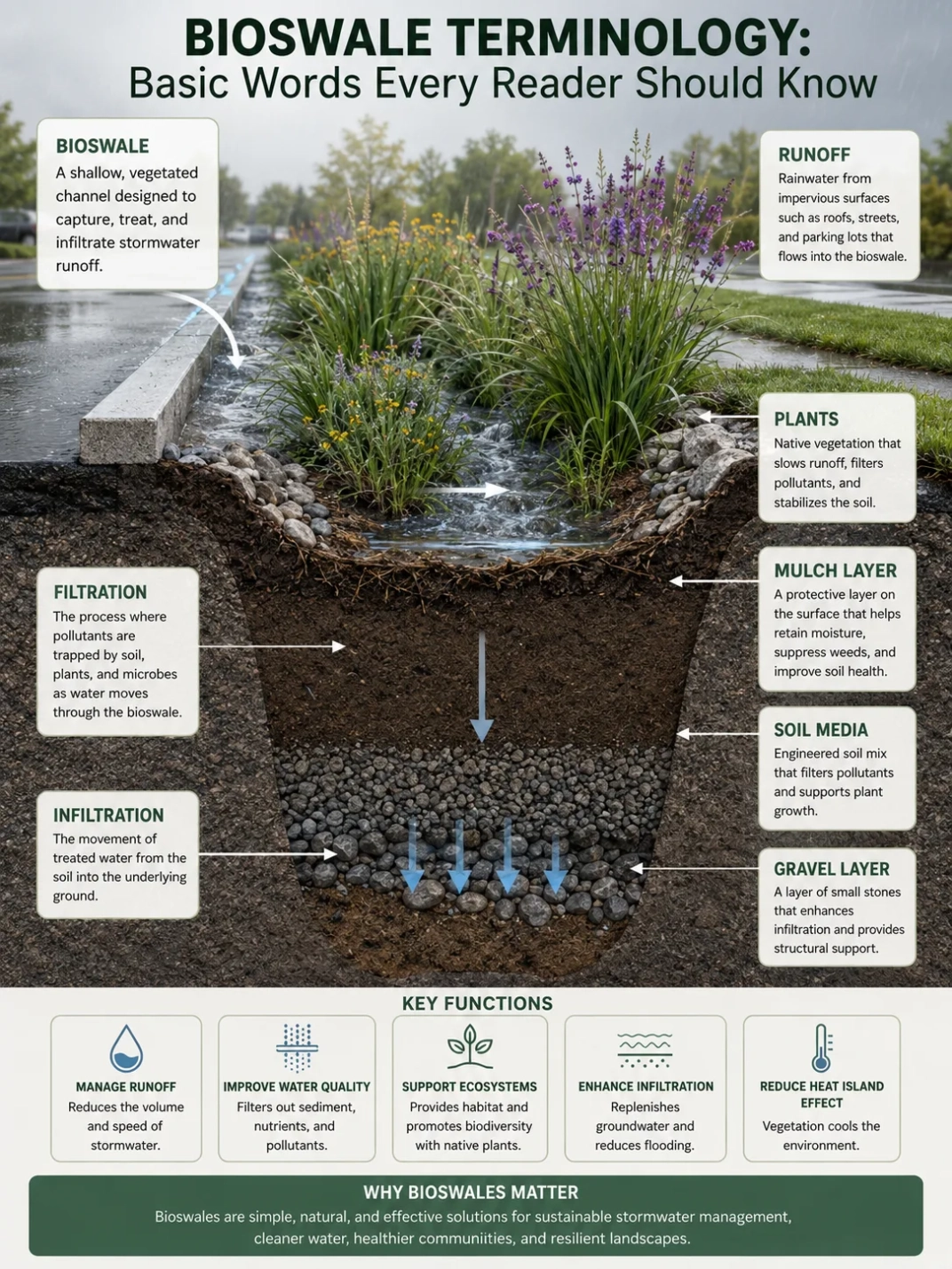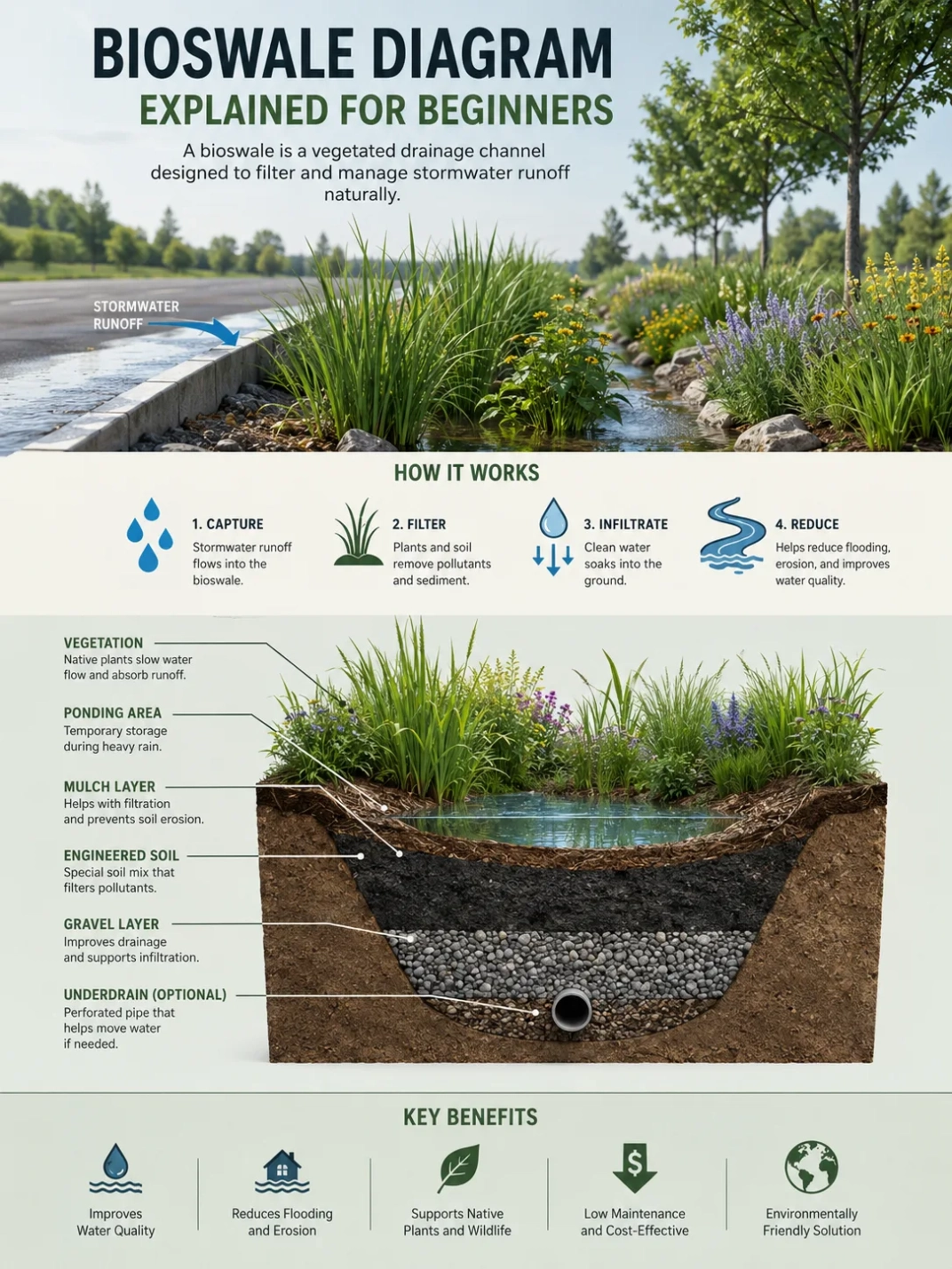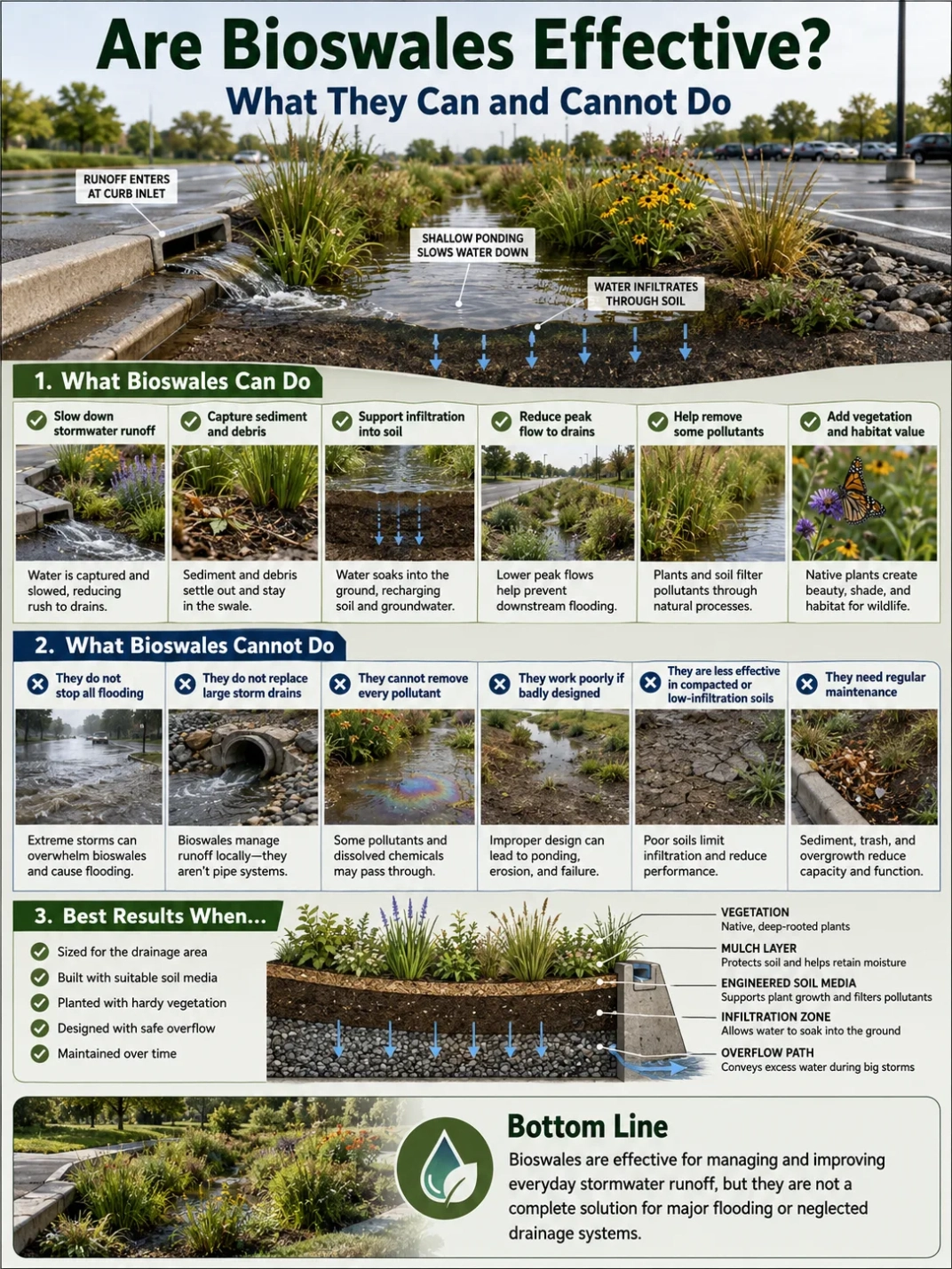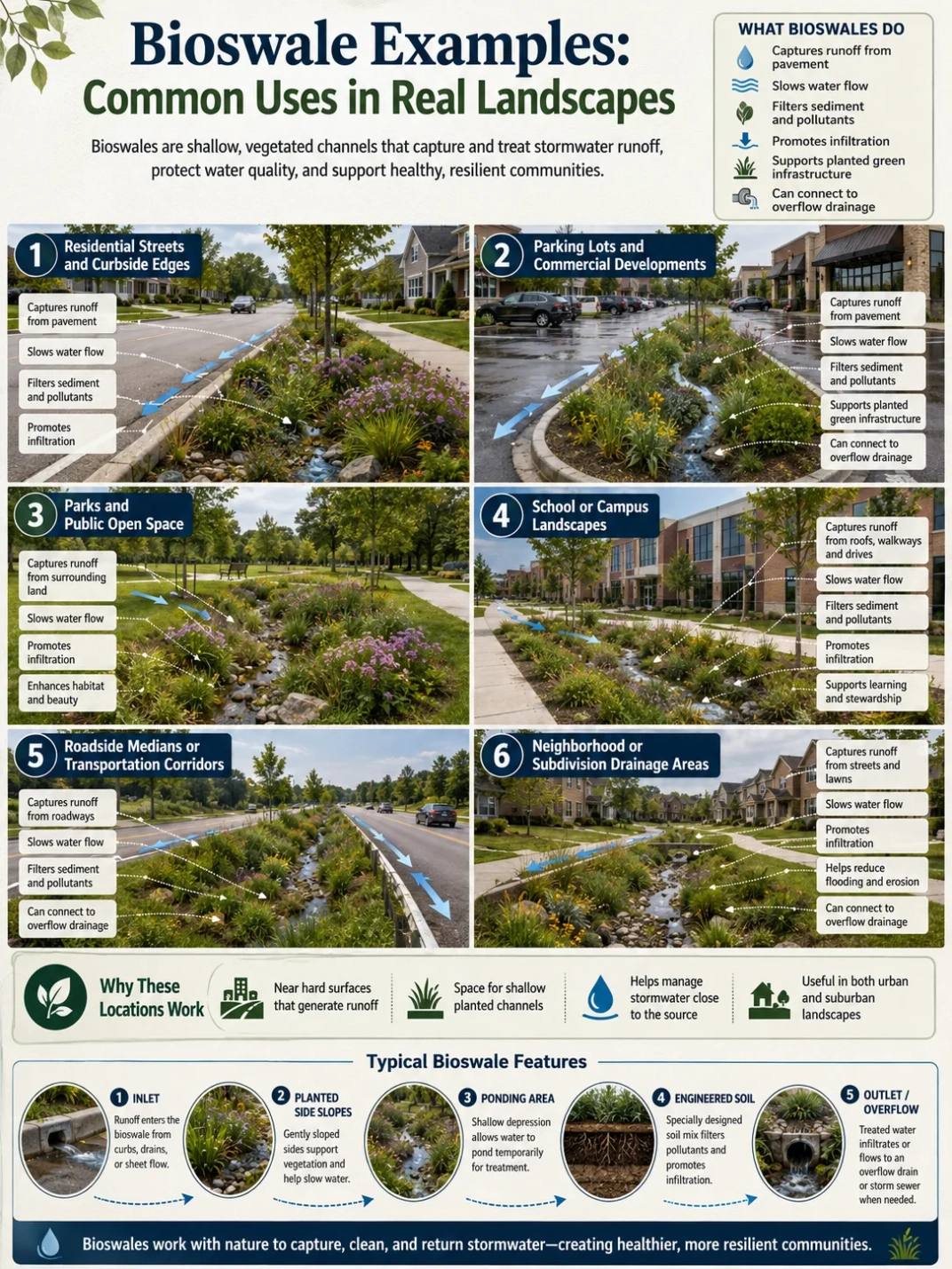
Bioswale examples are easiest to understand when they are tied to real runoff sources: a roof edge, a driveway, a parking lot, a street curb, a school walkway, or a low place in a public landscape where water needs a safer path. A bioswale is not just a planted ditch. It is a shaped, vegetated drainage feature that can slow stormwater runoff, spread flow across soil and roots, trap sediment, and move excess water toward a planned outlet when the soil or rainfall cannot absorb it all.
Good examples show the same idea in different settings. The runoff source changes, the planting changes, and the maintenance needs change, but the basic purpose stays clear: collect water from hard surfaces, reduce fast surface flow, support infiltration where conditions allow, and keep overflow predictable.
Site Planning Note: Real bioswale performance depends on soil texture, compaction, slope, rainfall pattern, inlet design, plant cover, and the overflow route. A bioswale can help manage runoff, but it should not be treated as a cure for every drainage problem.
Common Bioswale Examples in Real Landscapes
Bioswales appear in many places where stormwater moves off roofs, pavement, lawns, roads, and public surfaces. Some are narrow and formal. Others look more like long planted depressions in a park edge or parking lot island.
The best examples are not defined by style alone. They are defined by water movement: where runoff enters, how it slows, how it touches soil and plants, and where it goes during a larger storm.
| Landscape Setting | Typical Runoff Source | Main Design Focus | Common Detail to Watch |
|---|---|---|---|
| Residential Yard | Roof runoff, downspouts, patios, driveways | Slow water and guide it away from sensitive areas | Safe overflow route and distance from structures |
| Driveway Edge | Small paved surface with sheet flow | Capture shallow runoff before it reaches the street | Sediment buildup near the inlet edge |
| Parking Lot Island | Large paved area with curb cuts | Filter runoff, collect sediment, and reduce fast flow | Clogging, curb opening condition, plant survival |
| Roadside or Streetscape | Street runoff, sidewalks, curb gutters | Receive flow safely while fitting public access needs | Inlet erosion and planned overflow during heavy rain |
| School or Campus Landscape | Walkways, roofs, plazas, play areas | Combine drainage function with visible landscape learning | Maintenance access and clear edges near foot traffic |
| Park or Trail Edge | Paths, compacted turf, small paved areas | Spread runoff into planted soil without damaging paths | Erosion at concentrated entry points |
Residential Yard Bioswales
A residential bioswale is often used where roof runoff, driveway runoff, or slope-driven yard drainage needs a more controlled route. It may look like a shallow planted channel that follows the natural fall of the land.
The goal is not to hold water forever. A residential bioswale should slow, filter, and drain water in a way that fits the site. Where soils drain well, more water may infiltrate. Where soils are compacted or clay-rich, the bioswale may need a different design approach, a planned overflow, or professional review.
Where It Fits Best
Residential examples often work best in places where runoff is shallow and predictable. Common locations include:
- Below a downspout outlet, where water can enter through a splash pad or stone-lined entry point
- Along the side of a driveway, where runoff can move into a planted swale instead of racing to the curb
- Across a lawn edge, where water already follows a natural low line
- Between a patio and a lower planting area, when the grade allows safe flow away from the house
Drainage Note: A bioswale near a home needs a safe overflow route. Water should not be directed toward foundations, basements, crawl spaces, neighboring property, or public drainage areas without checking local rules and site conditions.
What Makes This Example Work
A useful residential bioswale has a clear inlet, a shallow flow path, stable side slopes, dense planting, and a visible place for extra water to leave. The planting does more than decorate the swale. Roots help hold soil, reduce erosion, and create small spaces where water can move into the soil profile.
Mulch may be used in many designs, but it should not float away or block the outlet. Washed stone, turf reinforcement, or planted groundcover may fit better at some entry points, depending on water speed.
Driveway Bioswales
A driveway bioswale is usually narrow and practical. It receives runoff from a paved surface and helps break up fast sheet flow before it reaches a street, sidewalk, garage apron, or low spot in the yard.
This example often needs careful attention to the inlet edge. If water drops from pavement into bare soil, erosion can start quickly. A stable transition matters.
Typical Design Features
- A shallow depression along one or both sides of the driveway
- A smooth entry edge where runoff can spread instead of cutting a trench
- Plants that tolerate wet soil after storms and dry soil between storms
- A clear outlet or overflow point for larger rain events
- Protection from vehicle tires, snow storage, or repeated foot traffic where relevant
Driveway bioswales can be simple, but they are not just garden beds beside pavement. The grade, edge condition, and outlet behavior decide whether water spreads gently or cuts through the planting.
Maintenance Note: Driveway bioswales often collect grit, leaf litter, and fine sediment near the pavement edge. Removing this material before it buries plants or blocks flow helps the swale keep its shape.
Parking Lot Bioswales
Parking lot bioswales are common in commercial, institutional, and public landscapes. They are usually placed in islands, perimeter strips, or long planted channels that receive runoff through curb cuts or sheet flow from pavement.
These bioswales often manage a heavier sediment load than residential examples. Tires, pavement wear, winter materials in some regions, leaves, and dust can move with stormwater. Because of that, the inlet area and pretreatment zone matter.
How Parking Lot Runoff Enters
Many parking lot bioswales receive water through a curb opening. The opening may lead to a stone apron, concrete forebay, shallow depression, or vegetated entry zone. The exact detail varies by design and local requirements.
The important point is simple: runoff should not enter as a damaging jet of water. It should enter in a way that slows flow, drops sediment, and protects soil media from being washed out.
Why These Examples Need Maintenance Access
A parking lot bioswale can look finished on opening day and still fail later if maintenance access was not considered. Sediment may build at curb cuts. Trash may collect at inlets. Plants may struggle where heat, salt, reflected sun, or compacted soil conditions are strong.
For this reason, parking lot examples often need:
- Visible inlets that can be inspected without searching through dense growth
- Stable entry zones where sediment can be removed
- Plant species suited to heat, wet-dry cycles, and site exposure
- An outlet or overflow structure that stays clear
- Room for crews to reach the swale without damaging the planting
Design Note: Parking lot bioswales may use engineered soil media, underdrains, check dams, or overflow structures in some designs. These details should match the site, not a one-size recipe.
Roadside and Streetscape Bioswales
A roadside bioswale receives runoff from streets, sidewalks, bike lanes, curb gutters, or small public paved areas. In a streetscape, the bioswale must handle water while also respecting access, visibility, curb lines, utilities, trees, and pedestrian movement.
These examples often look more formal than park or residential swales. They may have curb cuts, defined edges, overflow grates, check dams, stone inlets, and planting zones that tolerate both water and urban stress.
What the Landscape Has to Balance
Roadside bioswales sit between stormwater function and public-space design. They may need to:
- Receive water from a curb without causing erosion
- Keep ponded water within a planned area
- Protect soil from compaction near sidewalks
- Maintain sight lines where drivers, cyclists, or pedestrians need clear views
- Allow maintenance crews to reach inlets, outlets, and plantings
- Fit local rules for public drainage, accessibility, and safety
Because streetscapes are public environments, roadside bioswales usually need design review. The exact requirements vary by place.
Campus, School, and Public Building Bioswales
Campuses and public building sites often use bioswales near walkways, roofs, plazas, courtyards, and parking areas. These examples can make stormwater movement visible without turning the landscape into a technical exhibit.
A school bioswale might receive roof water from a small building wing. A university bioswale might run along a walkway and collect runoff from several paved surfaces. A library or community center might use a planted swale near a parking edge or entrance landscape.
Why These Examples Are Useful
Campus bioswales can show how green infrastructure works in daily life. Students, staff, and visitors may see water enter after rain, move through plants, and drain through the soil or toward an outlet.
Clear edges matter in these settings. A bioswale near foot traffic should be easy to see, easy to avoid, and stable enough to prevent tripping hazards, informal shortcuts, or soil damage from repeated crossing.
Planting Note: Public-site plantings need more than stormwater tolerance. They also need to handle visibility needs, maintenance routines, seasonal appearance, and local growing conditions.
Park and Trail Bioswales
In parks and trail systems, bioswales often handle runoff from paths, small parking areas, compacted lawns, shelters, restrooms, or trailheads. They may be less formal than streetscape bioswales, but they still need a clear drainage role.
A park bioswale might follow the edge of a path and collect runoff before it reaches a stream buffer, meadow, wetland edge, or lower turf area. A trailhead bioswale may receive water from a small paved lot and spread it through grasses, sedges, rushes, and shrubs.
What Can Go Wrong
Park settings can make bioswales look natural, but water is still forceful when concentrated. The most common trouble points are often simple:
- Runoff enters too fast from a path or paved edge
- Soil becomes compacted from foot traffic or maintenance vehicles
- Sediment buries the inlet area
- Plants thin out, leaving bare soil exposed
- Overflow cuts around the end of the swale instead of following the intended route
These are not reasons to avoid bioswales. They are reminders that natural-looking drainage still needs design logic.
Roof Runoff Bioswales
A roof runoff bioswale receives water from gutters, downspouts, scuppers, or roof drains. This example is common around homes, schools, offices, and small public buildings.
Roof water may look clean compared with parking lot runoff, but it can still arrive quickly. A single downspout can concentrate flow into one point. Without a stable inlet, that point can scour soil, displace mulch, or form a small channel.
Useful Details for Roof Runoff
- A splash pad, stone apron, or other stable entry point can reduce erosion
- A level spreader may help distribute water across a wider planting area in some designs
- The swale should move overflow away from structures
- The planting should tolerate dry periods as well as short wet periods
- Gutter debris should not block the inlet or bury the soil surface
Soil Note: Roof runoff examples should still consider infiltration capacity. If soil drains slowly, water may need a larger surface area, amended media, an underdrain, or a different drainage approach depending on the site.
Bioswales Around Plazas and Courtyards
Plazas and courtyards often create runoff because they include paving, compacted subgrade, roof edges, seating areas, and narrow planting zones. A bioswale in this setting may be more linear and architectural than one in a park.
The swale may sit along the low edge of a paved area, behind a seat wall, beside a walkway, or within a planted strip. The challenge is not only to collect water. It must also fit people movement, paving grades, accessibility, and maintenance routines.
Design Details That Matter
Courtyard bioswales often need careful grading. A small error in pavement slope can send water around the swale instead of into it. Too much concentrated flow can damage plants or carry sediment into the soil media.
In these examples, a visible overflow is helpful. When water exceeds the swale’s temporary storage capacity, it should move to a planned drain, outlet, or surface route rather than ponding near doors or gathering on walkways.
Residential Subdivision and Neighborhood Bioswales
Neighborhood bioswales may run along shared streets, open-space edges, small parks, or common drainage corridors. They often receive runoff from several lots, sidewalks, alleys, or small road sections.
These examples sit between private drainage and public or shared maintenance. The design may need to account for repeated inflow points, long-term access, mowing edges, plant replacement, and community expectations about appearance.
Why Shared Bioswales Need Clear Ownership
A bioswale can look simple, but someone must keep inlets open, remove sediment, manage weeds, repair erosion, and replace failed plants. In shared landscapes, unclear responsibility can lead to clogged inlets or bare soil even when the original design was sound.
Clear maintenance roles help the system keep working.
How Bioswale Examples Differ from Similar Landscape Features
Many real landscapes include features that look similar to bioswales. Some are drainage swales, some are rain gardens, some are bioretention cells, and some are decorative dry creek beds. The difference is not always visible at first glance.
| Feature | Typical Form | Main Function | How It Relates to a Bioswale |
|---|---|---|---|
| Bioswale | Long, shallow, planted channel | Slow, convey, filter, and sometimes infiltrate runoff | Designed around surface flow from one point to another |
| Rain Garden | Planted basin or depression | Collect and infiltrate runoff in a basin-like area | Often holds water in place more than it conveys it |
| Bioretention Cell | Engineered planted treatment area | Filter runoff through soil media and drainage layers | May include underdrains, media layers, and formal outlets |
| Drainage Swale | Shaped channel, often grassed | Move surface water along a route | May lack the planting, soil media, or filtration intent of a bioswale |
| Dry Creek Bed | Decorative or functional stone channel | Guide occasional water or create a dry stream appearance | May move water, but often has less vegetation and soil filtering |
A bioswale can overlap with these features. For example, a bioswale may include bioretention-style soil media, or a rain garden may receive water from a short swale. Still, the main identity of a bioswale is its linear flow path through vegetation and soil.
Design Parts Shared by Most Bioswale Examples
Different bioswale examples may look unrelated, but the same parts appear again and again. These parts explain why one swale works smoothly while another becomes a muddy trench or clogged planting bed.
Inlet
The inlet is where water enters. It may be a curb cut, downspout outlet, sheet-flow edge, stone apron, or shallow channel. A good inlet slows water and spreads it enough to protect soil and plants.
Flow Path
The flow path is the low line of the bioswale. It guides water through the planted area. The path should be stable and shaped so water does not short-circuit around the planting or cut a narrow groove through the soil.
Soil or Filter Media
Soil affects infiltration, plant health, pollutant filtering, and drainage speed. Some examples use existing soil. Others use amended or engineered media. Compacted soil can reduce performance even when the swale shape looks correct.
Plants
Plants help slow runoff, hold soil, improve surface roughness, and support infiltration. Many designs use grasses, sedges, rushes, shrubs, and locally suitable native plants. Plant choice should match moisture zones, sun exposure, maintenance capacity, and regional conditions.
Outlet and Overflow
The outlet handles water that cannot infiltrate or be held temporarily. In larger storms, overflow behavior matters as much as normal performance. Water should leave through a safe route.
What Real Examples Teach About Planting Zones
A bioswale is not equally wet from end to end or side to side. The bottom may stay wetter after storms. Side slopes may dry faster. Inlets may receive more sediment. High edges may act more like normal planting beds.
This creates planting zones.
- Bottom zone: often needs plants that can tolerate short wet periods and dry intervals
- Side slope zone: needs erosion-resistant roots and tolerance for faster drying
- Upper edge: may support plants closer to normal landscape conditions
- Inlet zone: needs tough planting or stable material where water first enters
- Outlet zone: should remain visible and clear enough for inspection
Planting success usually comes from matching plants to zones, not from choosing one “bioswale plant” for the whole feature.
Where Bioswale Examples Often Fail
Bioswales usually fail for practical reasons, not mysterious ones. The shape may be wrong, water may enter too fast, soil may be compacted, plants may not establish, or maintenance may stop after installation.
Clogged Inlets
Leaves, sediment, trash, mulch, and gravel can block the point where water enters. Once the inlet clogs, runoff may bypass the swale and flow across pavement or turf.
Soil Compaction
Compacted soil limits infiltration and can weaken plant growth. Construction traffic, foot traffic, and repeated maintenance vehicle access can compact the swale after installation.
Unplanned Overflow
If overflow has no clear route, water may find its own path. That path might cut around the swale, pond near a walkway, or move toward a place where water is not wanted.
Plant Loss
Plants may fail when moisture, soil, sunlight, sediment, salt exposure, or maintenance routines do not match their needs. Bare soil then becomes more open to erosion.
Too Much Sediment
Runoff from bare soil, construction areas, gravel surfaces, or heavily used pavement can carry sediment into the swale. A small forebay or stable inlet area can make sediment removal easier in many designs.
What to Check Before Planning a Bioswale Example
Before choosing a bioswale type, the site should be read like a drainage map. The most useful question is not “Where would a bioswale look good?” It is “Where does water come from, where can it slow down, and where can extra water go?”
- Find the runoff source. Roof, driveway, parking lot, road edge, path, plaza, or slope.
- Watch the flow path. Note whether water spreads as sheet flow or concentrates into a channel.
- Check the soil. Texture, compaction, and drainage behavior affect design choices.
- Look for safe overflow. A larger storm needs a route that does not create a new problem.
- Think about maintenance. Inlets, outlets, sediment areas, and plants need access.
- Review local limits. Public drainage, property lines, utilities, and building setbacks may affect what is allowed.
Site Planning Note: A small landscape bioswale may be simple, but sites near foundations, basements, steep slopes, public streets, utilities, or neighboring property may need professional review.
How to Read a Bioswale Example in the Field
A real bioswale can be studied in a few minutes by following the water path visually. Start at the highest nearby hard surface. Look for the inlet. Then trace the lowest line through the planting and find the outlet.
A working example usually shows several clues:
- The inlet is visible and not buried
- The bottom is shaped, not random
- Plants cover most exposed soil
- There is no deep erosion channel through the middle
- Mulch or sediment is not blocking flow
- The overflow point can be identified
- The swale fits the surrounding grade instead of fighting it
Some water after rain is normal in many bioswale designs. Long-lasting standing water, odor, bare soil, dead planting, or bypass flow may point to a soil, grading, inlet, or maintenance issue.
Bioswale Examples FAQ
What is the most common use of a bioswale?
The most common use is to collect runoff from hard surfaces such as roofs, driveways, parking lots, streets, sidewalks, and paths. The bioswale slows the water, moves it through vegetation, and may support infiltration or filtering depending on soil and design.
Can a bioswale be used in a small residential yard?
Yes, a bioswale can fit some residential yards when there is enough space, a safe flow path, suitable soil conditions, and a planned overflow route. It should not direct water toward foundations, neighboring property, or areas where ponding could cause problems.
Why are bioswales common in parking lots?
Parking lots create runoff from large paved areas. A bioswale can receive water through curb cuts or sheet flow, slow it down, collect sediment near the inlet, and support planted stormwater treatment when properly designed and maintained.
Is a roadside bioswale the same as a drainage ditch?
No. A drainage ditch mainly moves water along a channel. A roadside bioswale is usually designed with vegetation, soil contact, stable inlets, and overflow control so it can slow and filter runoff as well as convey water.
Do bioswale examples always need native plants?
Native plants are often a good fit because they may support local ecology and adapt well to regional conditions, but plant choice should still match moisture, soil, sun, salt exposure, and maintenance needs. No single plant list fits every site.
What is the biggest mistake in real bioswale projects?
A common mistake is focusing on the planted appearance while ignoring water entry, soil compaction, and overflow. A bioswale needs a clear inlet, stable flow path, suitable soil, healthy plants, and a place for excess water to go.