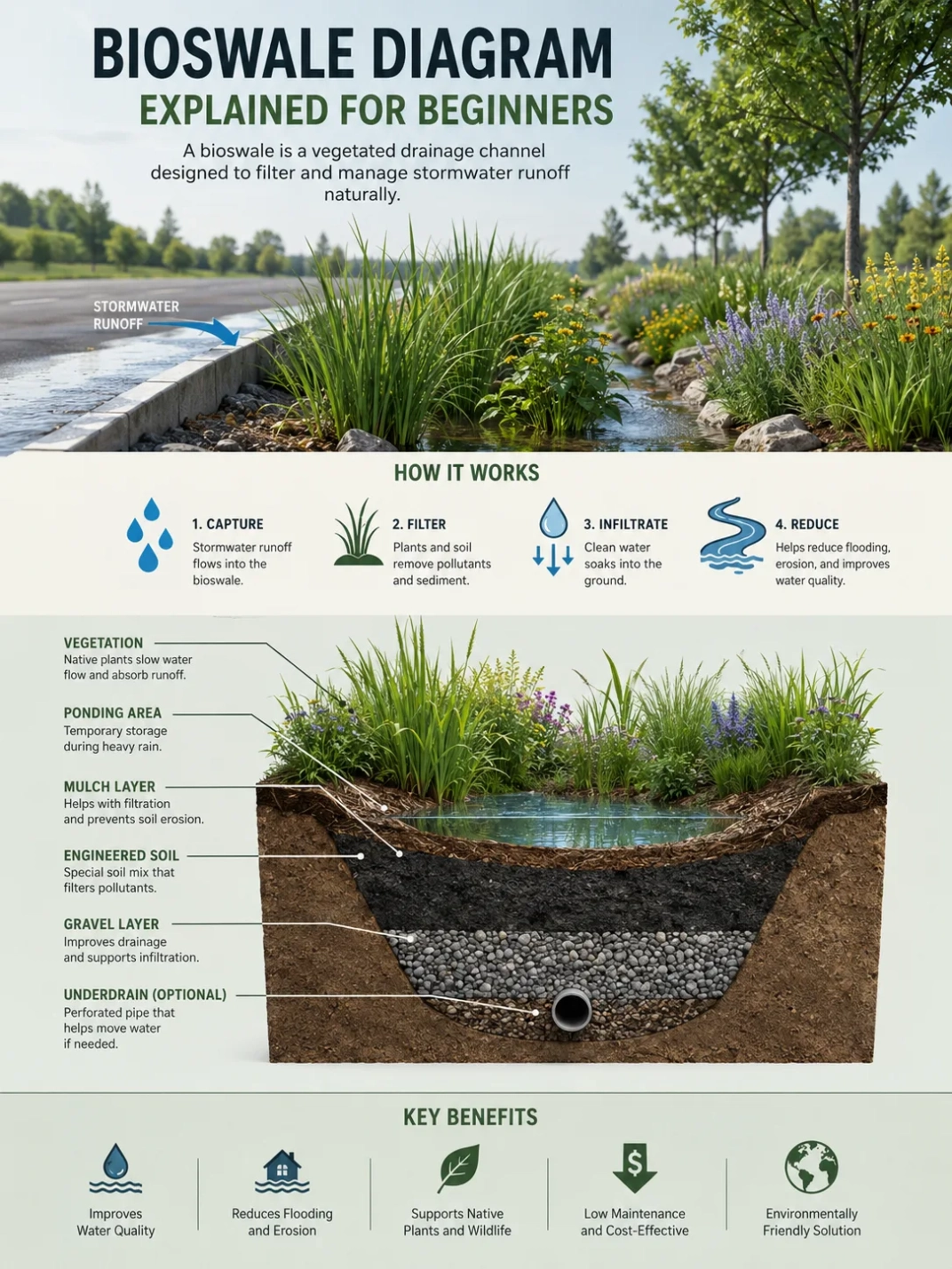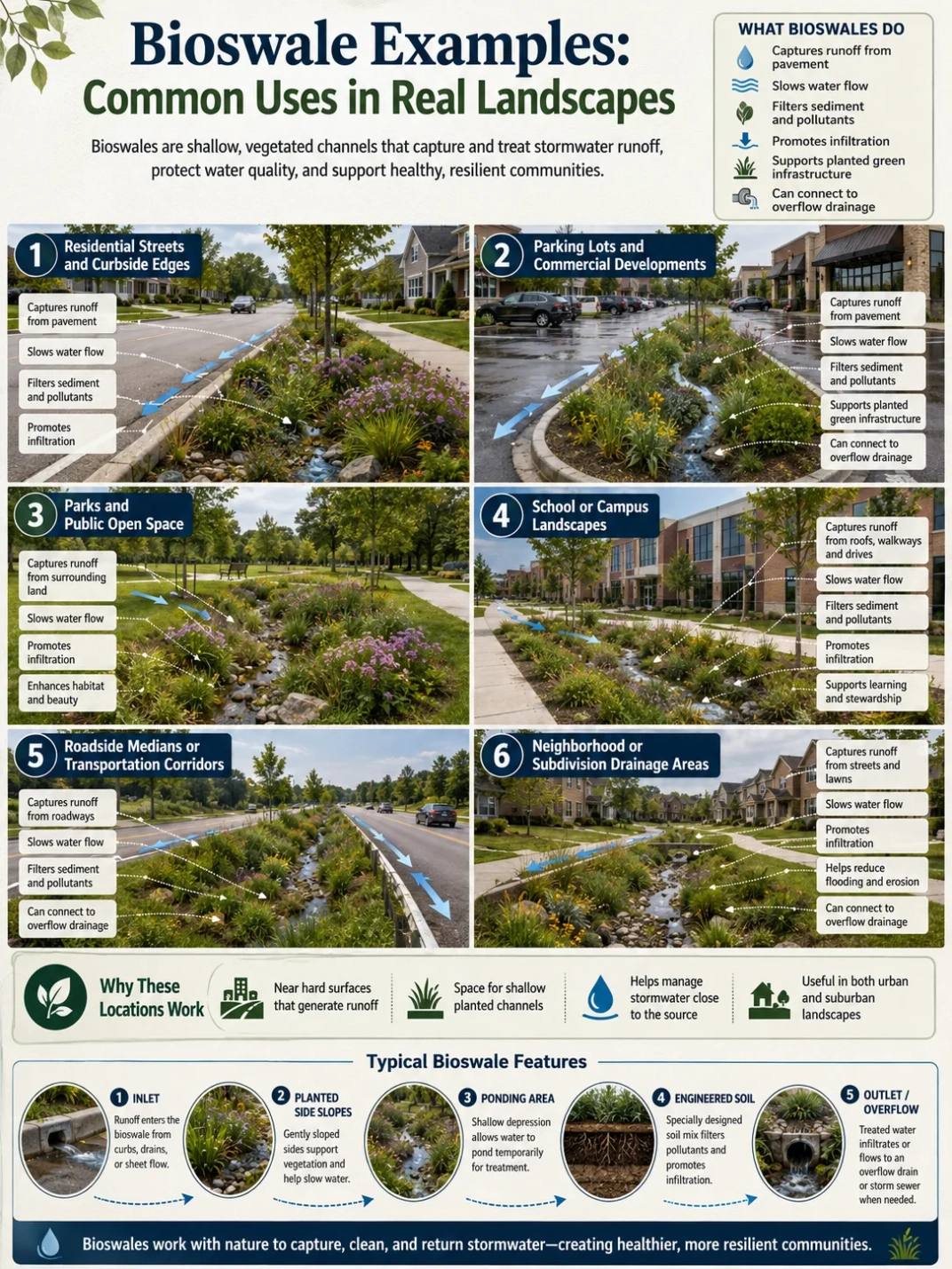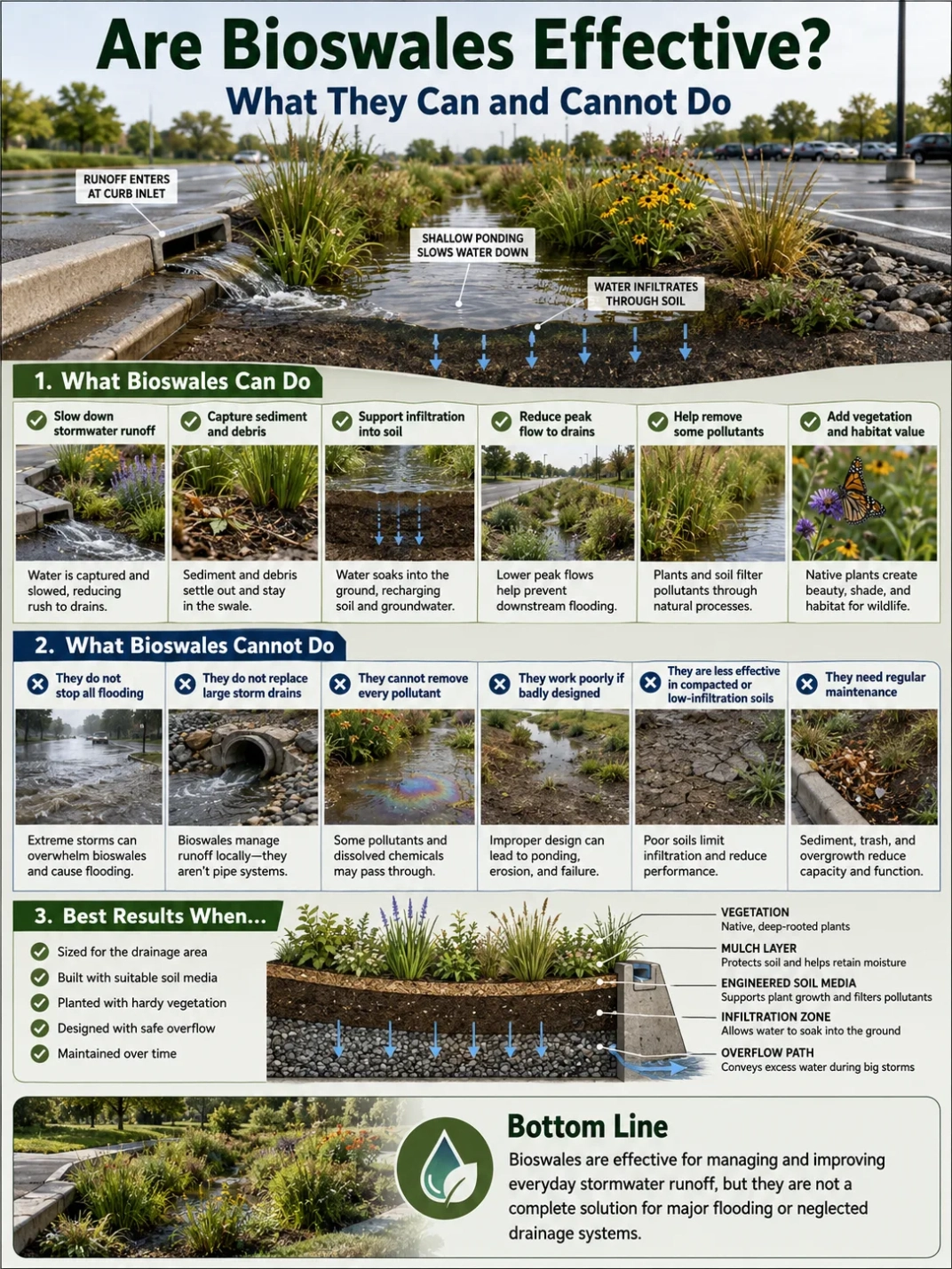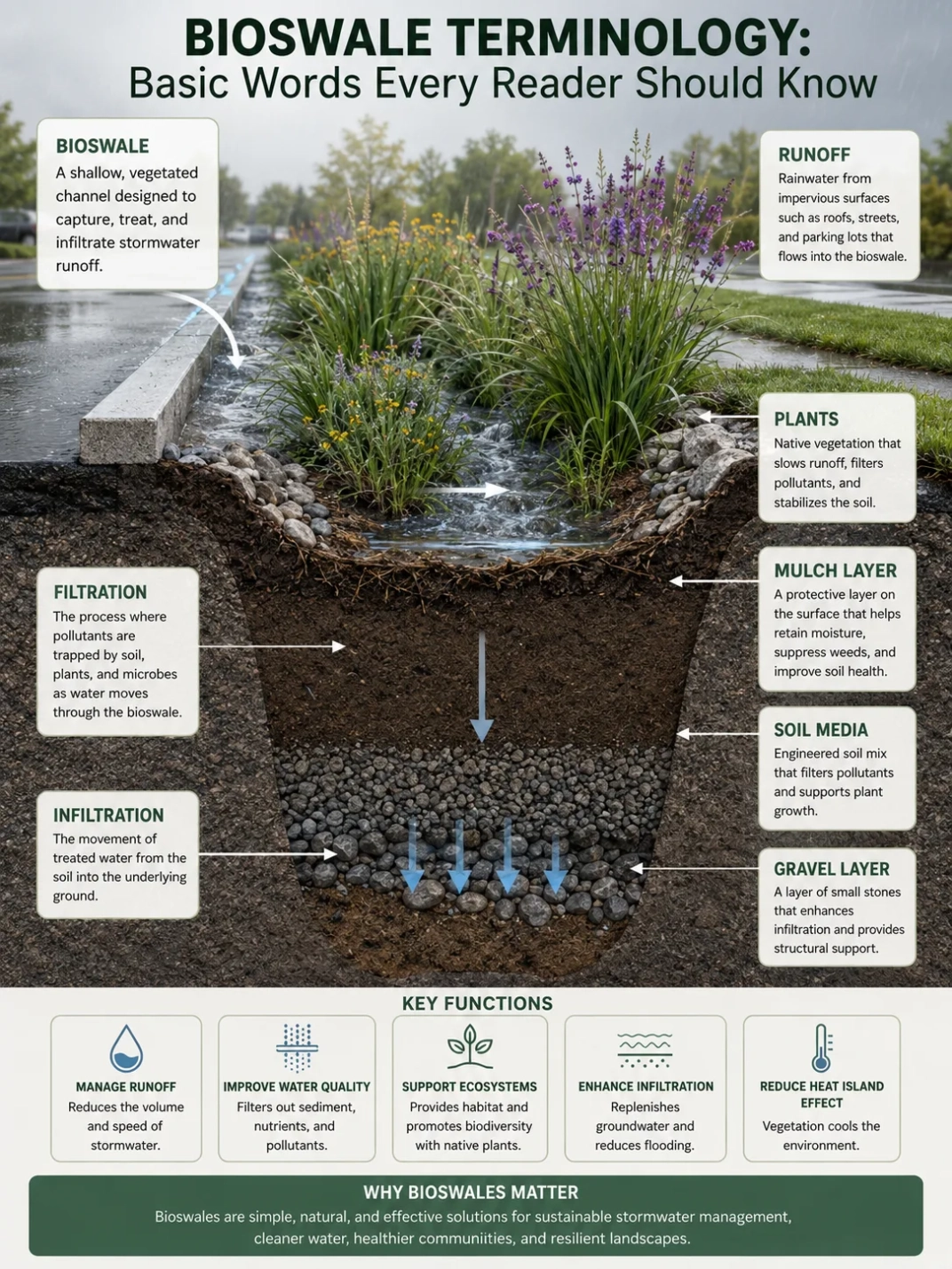
Bioswale terminology becomes much easier when each word is tied to what water actually does on a site: it moves, slows, ponds, filters, soaks into soil, or leaves through a safe overflow route. A bioswale is not just a planted ditch. It is a shaped, vegetated drainage feature that uses surface flow, soil infiltration, plant roots, and planned outlets to help manage stormwater runoff from roofs, driveways, streets, parking areas, and other hard surfaces.
These basic terms help readers understand bioswale articles, design notes, maintenance advice, and local drainage discussions without getting lost in technical language. Some words sound similar, but they do not always mean the same thing. A vegetated swale, a rain garden, and a bioretention area can overlap in purpose, yet their shape, flow pattern, soil profile, and drainage details may differ by site.
Reading Note: Many bioswale words describe one of four things: where runoff comes from, how water enters and moves through the swale, how soil and plants treat the water, and how excess water leaves the system.
Core Bioswale Terms
The terms below form the plain-language base for most bioswale topics. They are useful before reading about design, maintenance, plants, soil media, or residential drainage.
| Term | Plain Meaning | Why It Matters |
|---|---|---|
| Bioswale | A shallow, planted drainage channel built to move, slow, filter, and sometimes infiltrate stormwater runoff. | It combines drainage shape, soil, plants, and overflow planning. |
| Stormwater Runoff | Rainwater or snowmelt that flows over land instead of soaking into the ground. | Runoff is the water a bioswale is meant to manage. |
| Green Infrastructure | Site features that use soil, vegetation, and natural water movement to help manage drainage. | Bioswales are one form of green infrastructure. |
| Vegetated Swale | A planted swale that carries runoff along a shallow channel. | Some vegetated swales are simple conveyance features; others include deeper filtration layers. |
| Bioretention | A stormwater practice that uses engineered soil, plants, and drainage layers to treat runoff. | Some bioswales include bioretention elements, but not every swale is a full bioretention system. |
| Infiltration | The movement of water from the surface into soil. | It affects how long water remains in the swale and whether an underdrain may be needed. |
Words About Runoff and Water Sources
Stormwater Runoff
Stormwater runoff is water from rainfall or melting snow that travels across the surface. It often comes from roofs, paved driveways, sidewalks, roads, compacted lawns, and parking lots. The harder and less absorbent the surface, the more runoff it can send into a drainage path.
In bioswale planning, runoff is not only about volume. It also has speed, direction, sediment, and possible pollutants such as fine soil particles, oils from paved areas, nutrients, or organic debris. A bioswale can help slow and filter some of that flow when the system is shaped and maintained well.
Impervious Surface
An impervious surface is a surface that does not let much water soak through. Roofs, asphalt, concrete, and some compacted gravel areas are common examples.
Impervious surfaces matter because they can send water to one place faster than soil or planted ground would. That is why many bioswales sit near curb cuts, downspouts, driveway edges, road shoulders, or parking lot islands.
Runoff Source
A runoff source is the place where water starts before entering the bioswale. It may be a roof downspout, a sloped driveway, a paved walkway, a parking area, or a roadside gutter.
Knowing the source helps explain the design need. Roof runoff may carry little sediment but can arrive quickly through a downspout. Parking lot runoff may carry more grit and debris. Roadside runoff may need careful inlet protection and easy access for maintenance.
Drainage Area
The drainage area is the land surface that sends water toward the bioswale. It may include both paved and planted surfaces.
This term is easy to overlook. A small swale receiving runoff from a large roof, long driveway, or broad paved area may behave very differently from the same swale receiving only light yard runoff. The drainage area helps shape size, inlet layout, overflow planning, and maintenance needs.
Site Planning Note: A bioswale should not be judged only by how it looks when dry. Its real test is how water reaches it, where the water spreads, how long it ponds, and where it goes during a larger storm.
Words About Shape and Flow
Swale
A swale is a shallow, shaped channel that moves water across land. A basic grass swale may only carry water. A bioswale adds planting, soil function, and filtering intent.
The word can be confusing because not every swale is a bioswale. A roadside ditch, a turf drainage channel, and a planted stormwater feature may all be called swales in casual speech. The difference is in purpose, soil profile, planting, and water treatment function.
Flow Path
The flow path is the route water follows through the bioswale. It begins at the inlet, moves along the bottom or through planted zones, and ends at an outlet, overflow, underdrain, or infiltration area.
A longer and calmer flow path can give water more time to slow down, drop sediment, and interact with soil and plant roots. A short, steep, or poorly protected flow path can cause erosion or bypass much of the planted area.
Longitudinal Slope
Longitudinal slope means the slope along the length of the swale, in the direction water flows. It affects water speed.
If the slope is too flat, water may sit longer than planned. If it is too steep, water may move too fast and damage soil, mulch, or young plants. Exact slope needs vary by site conditions, local standards, and design goals.
Side Slope
Side slope describes how steep the sides of the swale are. Gentle side slopes are often easier to plant, inspect, mow near, or walk beside. Steeper sides may need more careful erosion control and may not fit all public or residential sites.
This is a shape term, but it also affects safety, access, plant establishment, and maintenance.
Bottom Width
Bottom width is the width of the flatter base where water moves or ponds. A wider bottom can spread flow and reduce water depth in many layouts, but the right width depends on available space, runoff load, soil, and outlet conditions.
Ponding Depth
Ponding depth is the temporary depth of water held on the surface after rain. Bioswales may allow shallow temporary ponding, but they are not meant to act like permanent ponds unless designed as a different type of feature.
Short-term ponding can help water slow, settle sediment, and soak into soil. Standing water that remains too long can point to compaction, clogging, poor outlet function, or soil that drains more slowly than expected.
Inlet, Outlet, and Overflow Terms
Inlet
An inlet is where runoff enters the bioswale. It may be a curb cut, pipe opening, downspout connection, driveway edge, sheet flow area, or small stone-lined entry point.
Inlets often collect sediment first. That makes them a common place for clogging, erosion, and debris buildup. A good inlet spreads or slows water before it rushes into the planted channel.
Curb Cut
A curb cut is an opening in a curb that lets street or parking lot runoff enter a bioswale. It is common in public-space and commercial hardscape settings.
Curb cuts need careful placement because they receive concentrated flow. They may also collect leaves, litter, sand, or winter grit depending on the site.
Outlet
An outlet is where water leaves the bioswale after moving through it. It may be a surface spillway, pipe, drain structure, or connection to another drainage feature.
The outlet helps control how high water can rise and how excess water exits. If the outlet is blocked or set poorly, the swale may pond longer than expected or send water where it should not go.
Overflow Route
An overflow route is the planned path for water when a storm is larger than the bioswale can hold or infiltrate. This is one of the most practical terms in bioswale planning.
A bioswale can help manage runoff, but it should not be treated as a feature that makes excess water disappear. Larger storms need a safe route away from buildings, foundations, neighboring property, public walkways, and erosion-prone slopes, depending on the site.
Check Dam
A check dam is a small barrier placed across the swale to slow water and create short ponding zones. It may be made from stone, wood, or other suitable materials used in the local design.
Check dams are often used where the swale has some slope. They help reduce water speed, but they also need inspection because sediment can build up behind them.
Drainage Note: The inlet, outlet, and overflow route should be read together. A bioswale that receives water well but lacks a safe exit path can still create site problems during heavy rainfall.
Soil and Drainage Words
Soil Media
Soil media means the soil layer used inside the bioswale, especially when the swale is built or amended for stormwater treatment. It may include a mix of mineral soil, sand, composted organic matter, or other materials allowed by local design guidance.
There is no single soil media recipe that fits every site. The right mix depends on drainage goals, pollutant filtering needs, plant selection, local rainfall, native soil, and whether an underdrain is used.
Filter Media
Filter media is soil or engineered material used to filter runoff as water passes through it. The term is common in bioretention and stormwater design.
Filter media should balance two jobs: allow water to move through and hold enough structure, organic matter, and root support for plants. Too much fine material can slow drainage. Too much coarse material may drain quickly but offer less support for certain plants.
Native Soil
Native soil is the existing soil already on the site. It may be sandy, loamy, clay-rich, rocky, compacted, or mixed from past construction activity.
Native soil affects infiltration and plant health. A bioswale built over compacted or clay-rich soil may need a different design approach than one built over well-draining sandy soil.
Infiltration Rate
Infiltration rate describes how quickly water enters the soil. It is usually checked through site testing rather than guessed from appearance alone.
This term matters because surface water should not remain in a bioswale longer than the design allows. Local rules or project standards may set drainage expectations, especially for public, commercial, or engineered sites.
Soil Compaction
Soil compaction happens when soil particles are pressed together, reducing pore space. Compacted soil can slow infiltration, limit root growth, and make plant establishment harder.
Construction traffic, repeated foot traffic, heavy equipment, and working wet soil can all contribute to compaction. In bioswales, compaction can turn a planned filtering area into a slow-draining surface.
Underdrain
An underdrain is a pipe or drainage layer placed below the soil media to collect water that has filtered down through the swale. It is often used where native soil drains slowly or where the design needs more control over outflow.
An underdrain does not make a bioswale “fake.” It simply changes how water leaves the system. Some bioswales infiltrate more water into native soil, while others filter water through soil media and then release it through an underdrain.
Clogging
Clogging means water can no longer pass through a surface, inlet, soil layer, or outlet as intended. Fine sediment, leaves, trash, compacted mulch, or washed-in soil can all contribute.
Clogging often appears as slow drainage, shallow standing water, bare patches, or water bypassing the intended flow path.
Soil Note: A bioswale is not only a surface channel. Much of its performance depends on what happens below the mulch and plant stems: soil pores, root channels, media texture, compaction, and drainage layers.
Plant and Root Terms
Native Plants
Native plants are plants that occur naturally in a region and are adapted to local climate, soils, and ecological conditions. They are often considered for bioswales because many native grasses, sedges, rushes, shrubs, and perennials can support soil stability and habitat value.
Native does not automatically mean suitable for every bioswale. A plant still needs the right moisture range, sun exposure, salt tolerance where needed, root structure, mature size, and maintenance fit.
Moisture Zones
Moisture zones are the different wet and dry areas within a bioswale. The bottom may receive more water. Side slopes may dry faster. Upper edges may act more like normal landscape beds.
Plant selection often works better when plants are matched to these zones rather than spread evenly across the whole swale.
Root Structure
Root structure describes how plant roots grow: fibrous, deep, spreading, dense, or shallow. Roots help hold soil, create small channels, and support biological activity in the soil.
Dense grasses and sedges can help protect swale bottoms and slopes. Shrubs may add structure in larger designs, but they need enough room and should not block inlets, outlets, or inspection access.
Plant Establishment
Plant establishment is the period when new plants are getting rooted and stable. During this time, they may need watering, weed control, replacement, mulch adjustment, and protection from strong flows.
A bioswale can look unfinished during establishment. That does not mean it has failed. But bare soil, washed mulch, and dying plants should be corrected before erosion or clogging becomes harder to manage.
Mulch
Mulch is a surface layer used to protect soil, reduce weed pressure, and help retain moisture during plant establishment. In bioswales, mulch must be chosen and placed with flow in mind.
Light mulch can float or wash away in fast-moving water. Some designs use stone, dense planting, erosion-control material, or other approaches in areas where flow is concentrated.
Planting Note: The best bioswale planting plan is usually zoned. Plants near the bottom need more wet-and-dry tolerance; plants near the rim may need to handle drier soil.
Maintenance and Performance Terms
Sediment
Sediment is soil, sand, grit, and fine mineral material carried by runoff. In a bioswale, sediment often settles near inlets, behind check dams, or in low-flow areas.
Some sediment capture is expected. Too much buildup can cover plants, reduce ponding depth, block inlets, and clog soil media. Regular removal helps keep water moving through the intended route.
Erosion
Erosion is the wearing away of soil by moving water. It can appear as rills, gullies, exposed roots, undercut side slopes, or washed-out mulch.
Erosion often points to water moving too fast, entering at one concentrated point, or flowing across bare soil. A bioswale should slow water, not create a narrow channel that cuts through itself.
Standing Water
Standing water means water remains on the surface after a storm. Temporary shallow ponding can be part of bioswale function. Persistent standing water may suggest slow infiltration, clogged soil, blocked outlets, poor grading, or an undersized overflow route.
The acceptable drainage time depends on site conditions and local design rules. It should not be guessed from a general article alone.
Maintenance Inspection
A maintenance inspection is a basic check of how the bioswale is functioning. It often includes looking at inlets, outlets, sediment, erosion, plant cover, weeds, mulch movement, clogging, and signs of bypass flow.
Inspections are most useful after storms, during plant establishment, and before seasonal leaf or sediment buildup becomes heavy.
Bypass Flow
Bypass flow happens when runoff avoids the intended treatment path. Water may skip the planted area, flow around the swale, cut through one narrow channel, or leave through an unplanned low point.
This term is useful because a bioswale can look planted and still fail to receive or treat much water if the flow path is wrong.
Related Systems Often Confused With Bioswales
Several drainage and landscape systems share terms with bioswales. The differences are not always sharp, and local naming can vary. Still, the basic distinctions help readers understand what a page or plan is actually describing.
| System | How It Relates | Main Difference to Notice |
|---|---|---|
| Rain Garden | A planted depression that collects runoff and lets it soak in or filter through soil. | Often more basin-like, while a bioswale usually has a clearer flow path. |
| Drainage Swale | A shallow channel that moves water across a site. | May focus on conveyance, without the same planting or filtration goals. |
| French Drain | An underground gravel-and-pipe drainage system. | Moves water below the surface rather than through a planted open channel. |
| Dry Creek Bed | A decorative or functional stone channel that can carry runoff. | May not include soil media, dense planting, or water-quality treatment goals. |
| Detention Basin | A basin that temporarily stores stormwater and releases it slowly. | Usually larger and more storage-focused than a typical bioswale. |
| Permeable Pavement | A paved surface that lets water pass through into layers below. | Treats runoff where it falls, while a bioswale receives flow from nearby surfaces. |
Terms That Show Where a Bioswale Can Fail
Undersized Feature
An undersized feature is too small for the runoff it receives. It may overflow often, erode, pond for too long, or push water into areas not meant to receive it.
Size depends on drainage area, rainfall patterns, soil, slope, and local requirements. A small residential swale and a parking lot bioswale should not be judged by the same simple rule.
Poor Grading
Grading is the shaping of land surface elevations. Poor grading can send water away from the bioswale, trap water in the wrong place, or create a fast channel through the middle.
Even good plants and soil media cannot fix a flow path that sends water around the feature.
Concentrated Flow
Concentrated flow is water entering or moving in a narrow, forceful stream. It is common at pipe outlets, curb cuts, downspouts, and steep paved edges.
Concentrated flow may need stone protection, level spreaders, check dams, or other calming details, depending on the design. Without that, it can cut through soil and mulch.
Blocked Inlet or Outlet
A blocked inlet keeps runoff from entering the bioswale. A blocked outlet keeps water from leaving as planned. Both can change the system quickly.
Leaves, trash, sediment, mulch, ice, plant growth, or damaged structures can cause blockage. These are maintenance issues, not just design details.
Residential and Public-Space Terms
Downspout Disconnection
Downspout disconnection means roof water is redirected from a pipe or paved area into a landscape or stormwater feature. A bioswale may receive downspout water where site conditions allow.
This needs careful overflow planning. Roof runoff should not be directed toward foundations, basements, neighboring lots, or unstable slopes.
Parking Lot Runoff
Parking lot runoff is water that flows from paved parking areas. It may carry sediment, grit, leaves, and small amounts of vehicle-related residue.
Bioswales in parking lots often need clear inlet design, sediment forebays or pretreatment areas where used, durable plants, and maintenance access.
Roadside Runoff
Roadside runoff comes from streets, shoulders, and curbs. It may arrive through curb cuts or along the road edge.
Roadside bioswales often face compacted soil, sediment, salt in some climates, foot traffic, and safety constraints. They are usually more site-specific than a small yard swale.
Maintenance Access
Maintenance access means people can safely reach the bioswale to remove sediment, clear inlets, inspect outlets, manage plants, and repair erosion.
A bioswale that cannot be reached is harder to keep working. This matters in public spaces, commercial sites, and residential yards with fences, steep slopes, or narrow side yards.
Common Misunderstandings About Bioswale Words
A Bioswale Is Not Just a Decorative Planting Bed
A planting bed may be attractive and support pollinators, but a bioswale has a drainage job. It receives runoff, guides flow, uses soil and plants to slow or filter water, and needs a safe overflow route.
Infiltration Is Not the Only Goal
Some bioswales are designed to soak water into native soil. Others filter water through soil media and send it to an underdrain or outlet. Both may be valid where local rules and site conditions allow.
Plants Do Not Replace Drainage Design
Plants help stabilize soil, support filtration, and improve the living function of the swale. They do not replace grading, inlet protection, soil testing, or overflow planning.
Standing Water Is Not Always Failure
Temporary shallow ponding after rain can be normal. Water that remains too long, smells unpleasant, kills plants, or blocks use of nearby areas may need inspection.
One Term May Mean Different Things Locally
Words such as bioswale, bioretention swale, vegetated swale, and drainage swale may be used differently by cities, designers, contractors, and educational resources. The best clue is the described function: conveyance, infiltration, filtration, storage, or a mix of these.
Design Note: When a bioswale term seems unclear, ask what the feature is doing with water. Is it carrying flow, holding it briefly, filtering it through soil, soaking it into native ground, or sending extra water to an outlet?
Mini Glossary for Fast Reading
- Bioswale: A planted drainage channel that slows, filters, conveys, and may infiltrate runoff.
- Runoff: Water that flows over land instead of soaking in.
- Inlet: The place where water enters the swale.
- Outlet: The place where water leaves the swale.
- Overflow: The planned route for extra water during larger storms.
- Soil media: Soil or engineered mix used to support plants and filter water.
- Underdrain: A subsurface pipe or layer that collects filtered water.
- Check dam: A small barrier that slows water inside the swale.
- Ponding depth: Temporary water depth on the swale surface.
- Sediment: Soil, sand, and grit carried by runoff.
- Compaction: Pressed soil that drains poorly and limits root growth.
- Flow path: The route water follows through the swale.
When These Terms Need Professional Review
Basic terminology helps with reading and planning, but some situations need site-specific review. Professional input may be needed when runoff is directed near a building foundation, basement, retaining wall, steep slope, public sidewalk, roadway, neighboring property, or existing drainage structure.
Review may also be needed where local rules set requirements for stormwater sizing, soil testing, underdrains, overflow connections, setbacks, or permitted discharge points. The terms are simple; the site behavior may not be.
Bioswale Terminology FAQ
What is the most basic bioswale term to understand first?
The first term to understand is runoff. A bioswale exists because rainwater or snowmelt flows from a surface and needs a planned route. Once the runoff source is clear, terms such as inlet, flow path, soil media, outlet, and overflow become easier to understand.
Is a bioswale the same as a vegetated swale?
Not always. A vegetated swale is a planted channel that moves runoff. A bioswale usually has a stronger stormwater treatment purpose, often involving soil filtration, plant roots, sediment control, and planned overflow. In some local documents, the terms may overlap.
What does infiltration mean in a bioswale?
Infiltration means water moves from the surface into the soil. In a bioswale, infiltration may happen through the bottom and side areas, through engineered soil media, or into native soil. The amount depends on soil conditions, compaction, design, and drainage layers.
What is an underdrain in simple words?
An underdrain is a buried drainage pipe or layer that collects water after it moves through the bioswale soil. It is often used where native soil drains slowly or where the design needs controlled outflow rather than relying only on infiltration.
Why is overflow such an important bioswale word?
Overflow describes where extra water goes when a storm brings more runoff than the bioswale can hold, filter, or infiltrate. A safe overflow route helps prevent water from spreading toward buildings, unstable slopes, walkways, or other areas where ponding is not intended.
What does soil media mean in a bioswale?
Soil media is the soil layer or engineered mix used in the bioswale to support plants and help filter runoff. It is not the same everywhere. The right media depends on local soil, rainfall, plant needs, drainage goals, and any local stormwater rules.