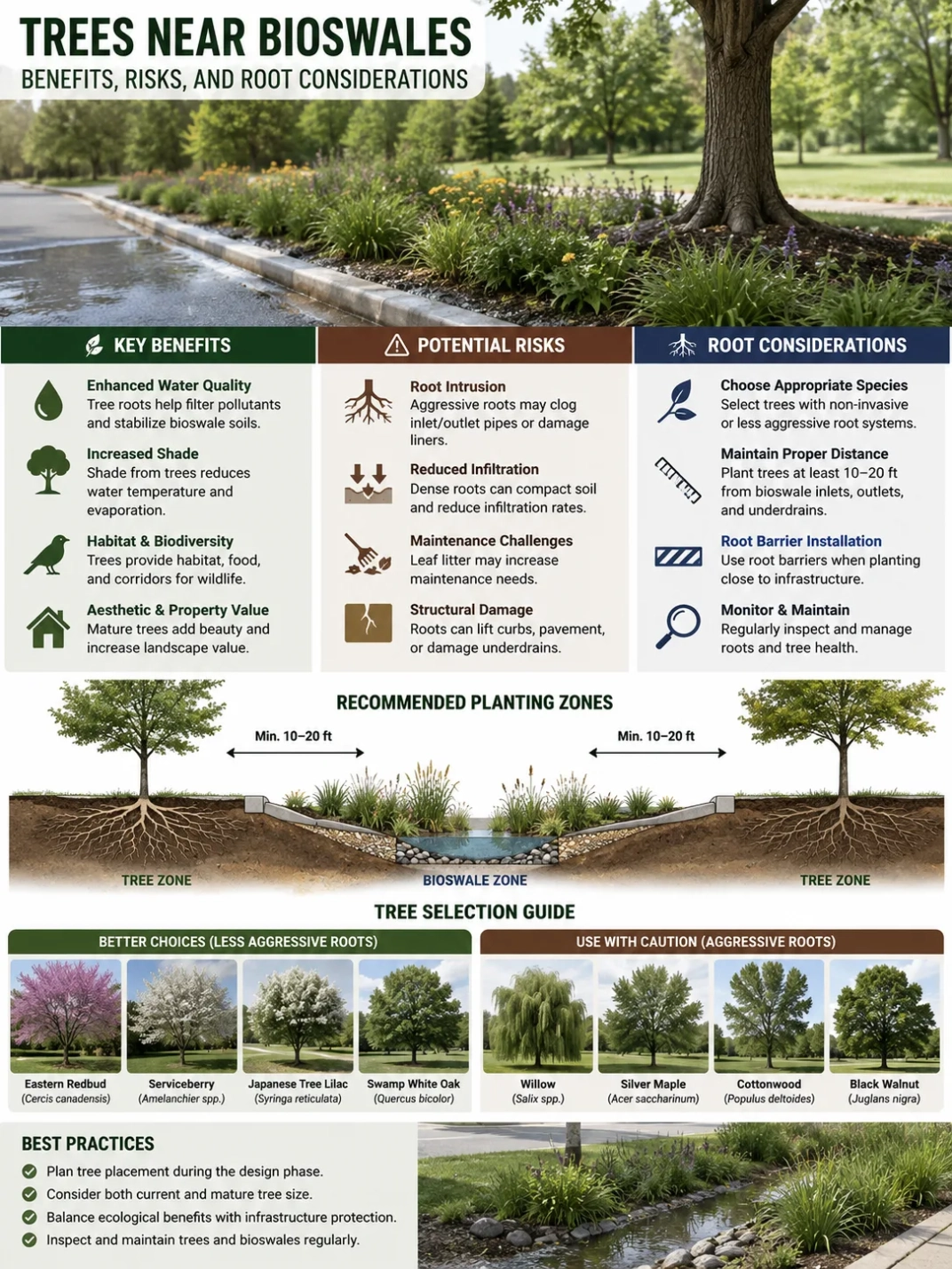
Trees can strengthen a bioswale, but only when their roots, trunks, canopy, and future size fit the way water moves through the site. A well-placed tree can intercept rainfall, draw moisture from the soil, support soil structure, shade planting areas, and help stabilize a vegetated slope. A poorly placed tree can crowd the flow path, suffer from repeated waterlogging, lift nearby pavement, obstruct maintenance, or interfere with an underdrain and overflow structure.
The main question is not simply whether trees belong near bioswales. It is where the tree sits in relation to the ponding area, inlet, outlet, soil profile, utilities, and available root space. Existing mature trees also need a different approach from newly planted trees.
How Trees Can Support a Bioswale
A tree affects stormwater before runoff reaches the ground. Leaves and branches catch part of a rain event, delaying the movement of water to the soil. Water that reaches the root zone may then move through pores, cracks, and channels shaped by roots and soil organisms. Some of that moisture returns to the atmosphere through transpiration.
These processes do not turn a tree into a complete drainage system. They can, however, support a bioswale that already has a suitable flow path, soil profile, inlet, outlet, and overflow route.
- Canopy interception: Leaves and branches temporarily hold rainfall and slow its arrival at the ground.
- Root-zone structure: Living roots can help maintain pore space and reduce the tendency of planted soil to become dense over time.
- Moisture use: Trees use water during active growth, although uptake changes with species, season, temperature, and soil conditions.
- Slope support: Roots can help hold soil on planted side slopes where erosion control is needed.
- Shade and habitat: A canopy can reduce surface heating and create a different planting environment for understory vegetation.
The benefit depends on tree health. A stressed tree with restricted roots, a buried trunk flare, compacted soil, or long periods of saturated soil will not provide the same function as a well-established tree in suitable growing conditions.
Benefits and Risks by Tree Location
| Tree Situation | Possible Benefit | Main Risk | Planning Response |
|---|---|---|---|
| Existing mature tree beside the swale | Canopy interception, shade, established roots, and slope stability | Excavation may cut structural roots or change drainage around the tree | Map the protected root area before grading and keep equipment away from uncompacted soil |
| New tree on an upper side slope | Roots can support the bank without placing the trunk in the main flow path | Limited soil volume or erosion near the root ball | Provide stable soil, a suitable moisture zone, and enough space for mature roots |
| Tree in the lowest ponding zone | Direct access to stored runoff during wet periods | Low soil oxygen, trunk-base saturation, sediment burial, and unstable establishment | Use only where the design and tree selection account for repeated wetting and drainage between events |
| Street tree beside a curb-cut bioswale | Shared green space and treatment of road or parking runoff | Salt, sediment, litter, utilities, pavement conflicts, and restricted maintenance access | Coordinate soil volume, pretreatment, utility clearance, root space, and inspection access |
| Tree near an underdrain or outlet | Can use moisture held in the surrounding soil | Roots may occupy drainage aggregate, reach pipe openings, or block access to cleanouts | Keep drainage components accessible and follow project-specific separation details |
The table shows why a single planting rule does not fit every bioswale. A tree beside a broad vegetated swale may have room to spread. The same tree in a narrow street cell may be confined by pavement, curbs, pipes, compacted subsoil, and overhead lines.
Root Space Matters More Than the Planting Hole
A planting hole is only the starting space for a young tree. Most long-term root growth must occur outside that hole. In a bioswale setting, the usable rooting area may include engineered soil, native subsoil, a side slope, or soil beneath nearby pavement designed to support roots.
Usable soil volume means more than an empty underground space. Roots need a workable balance of moisture, oxygen, pore space, nutrients, and physical support. Deep but waterlogged soil may be less useful than a broader, aerated root zone. Loose surface soil over a dense construction layer can also create a shallow perched zone where water lingers above the compacted subsoil.
Soil Note: Do not assume that bioswale soil is automatically good tree soil. Some filter media drain quickly but hold little plant-available moisture during dry weather. Other soils remain wet too long. Tree selection and soil design need to address both conditions.
Root space also needs continuity. A tree may have a large calculated soil volume that is divided by concrete footings, utility trenches, liners, or dense subgrade. Roots cannot use disconnected soil as freely as one open rooting zone.
Existing Roots Need Protection During Construction
Installing a bioswale near an established tree can change grade, soil moisture, aeration, and root support. Excavation may remove fine absorbing roots as well as larger structural roots. Stockpiled soil and construction traffic can compact the remaining root zone even when no roots are visibly cut.
The practical response is to identify the tree protection area before the layout is fixed. The protected distance should reflect tree size, species, condition, soil, slope, and local tree-preservation rules. A generic drip-line circle may not describe the full root system, especially where roots have followed open soil corridors or avoided compacted pavement.
Site Planning Note: Trenching, root cutting, major grade changes, or new ponding close to a valuable mature tree should be reviewed before work begins. An arborist can assess tree roots and condition; a drainage or landscape professional can assess the proposed water path.
Wet Soil Is Not the Same as Healthy Tree Moisture
Tree roots need water and oxygen. When soil pores remain filled with water for too long, oxygen movement slows and roots may become stressed. Tolerance for saturated soil differs widely among tree species, and even wet-tolerant trees need suitable establishment conditions.
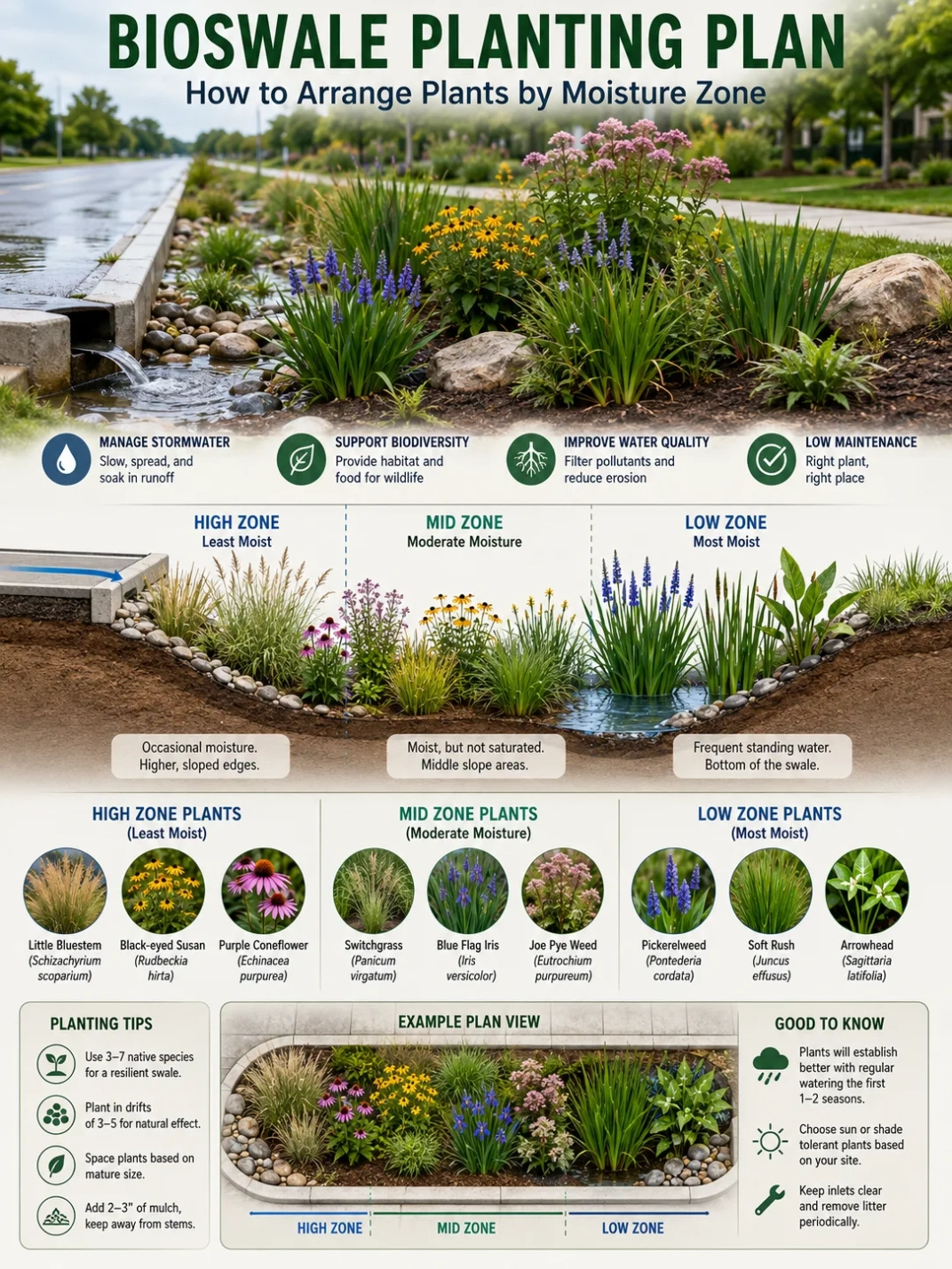
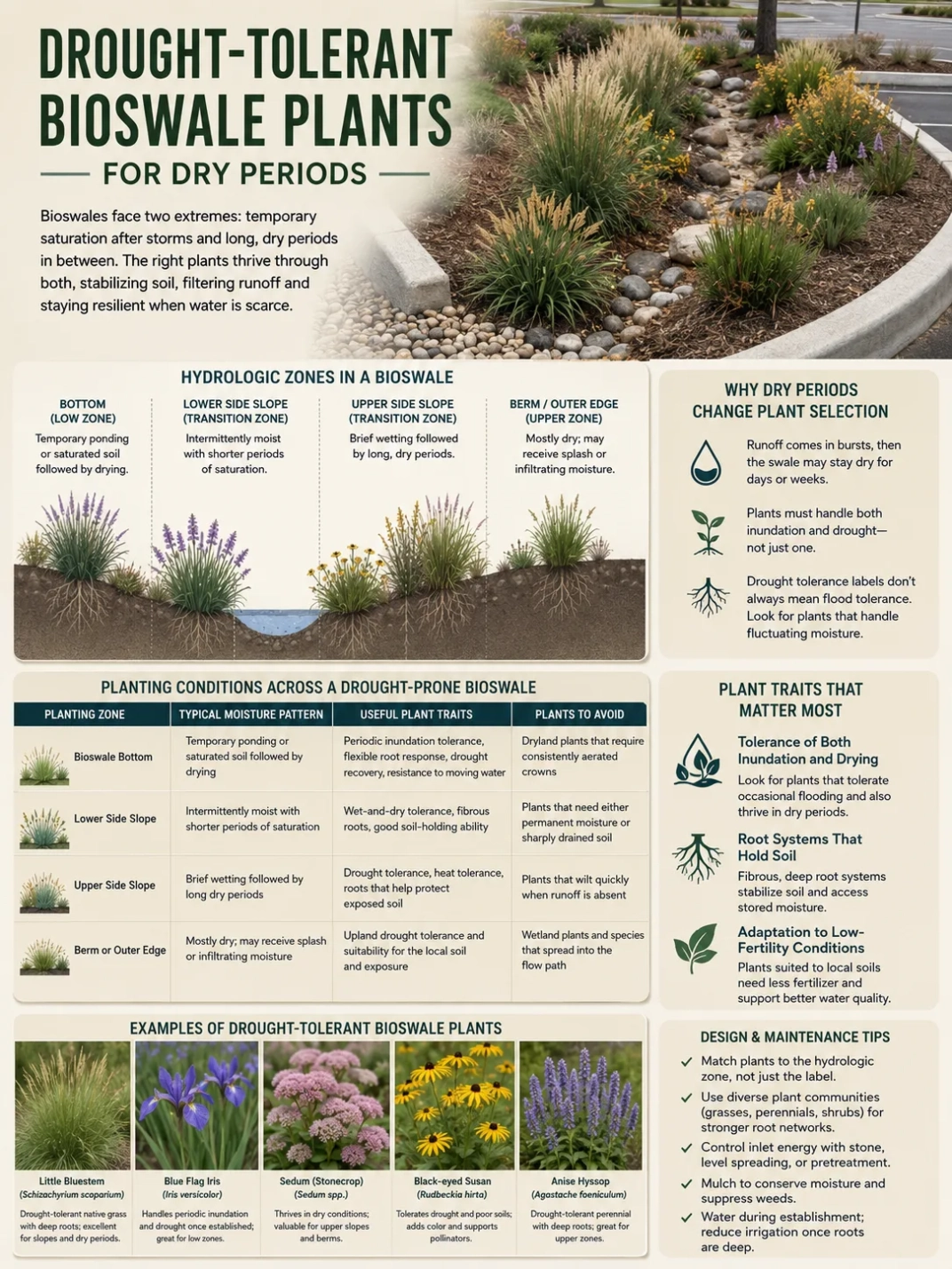
A bioswale usually receives water in pulses. The lower zone may become wet during runoff and then drain, while upper side slopes stay drier. This creates planting zones rather than one uniform condition:
- Lower flow or ponding zone: Experiences the deepest temporary water, sediment deposition, and possible scouring near inlets.
- Middle side slope: Receives moisture but may drain sooner and may face erosion if vegetation is sparse.
- Upper edge: Often stays drier, competes with surrounding landscape roots, and may be exposed to reflected heat from pavement.
A tree selected only for wet-soil tolerance may still struggle if summer soil becomes very dry, road runoff carries salt, the root area is too small, or the trunk is repeatedly buried by sediment and mulch. Alternating wet and dry conditions are often the real test.
Keep the Root Flare Clear
The root flare is the widening area where the trunk meets the main structural roots. It should remain visible rather than being buried under soil, mulch, or accumulated sediment. Planting too deep can reduce oxygen near the trunk base and encourage roots to grow in poor positions.
This detail is easy to miss in a bioswale because the soil surface may settle after construction. Mulch can also move during runoff and collect against the trunk. Inspection should include the trunk base, not only the canopy and leaves.
Roots, Underdrains, Liners, and Utilities
Many bioswales contain more than soil and plants. A system may include a perforated underdrain, drainage aggregate, observation port, cleanout, impermeable liner, overflow pipe, curb structure, or utility corridor. Trees need to be placed with the full underground layout in mind.
Underdrains Need Access
An underdrain carries water that does not infiltrate into the underlying soil or that must leave the filter media within the intended drainage period. Roots can enter open aggregate zones because those zones may offer moisture, oxygen, and low resistance. They can also make pipe repair harder even when the pipe remains functional.
Placement details vary among stormwater manuals. Some projects keep trees out of linear cell bottoms, while others allow trees where soil depth, volume, pipe offset, and maintenance access have been designed for them. This is one reason a universal tree-to-pipe distance is not reliable.
Liners Change the Rooting Pattern
A liner may be used where infiltration could affect a structure, steep slope, contaminated soil, utility, or another sensitive condition. The liner also limits downward root growth. Roots may spread laterally within the available soil layer, which can increase competition and bring them closer to curbs, pavement, and drainage components.
Utilities Compete for the Same Space
Tree roots, underdrains, water lines, sewer lines, electrical ducts, lighting bases, and irrigation pipes may all occupy a narrow corridor. Future access matters. A utility repair that excavates through the root zone can damage the tree and the bioswale at the same time.
Above ground, mature canopy spread must also fit streetlights, signs, building clearance, pedestrian routes, and overhead lines. Species size should be considered at maturity, not at installation.
When Trees Create Drainage or Maintenance Problems
Most tree-related failures begin as a mismatch between the tree, the available soil, and the hydraulic layout. The warning signs may appear slowly.
- Persistent standing water around the trunk: May point to poor drainage, blocked outlets, settled soil, or a tree placed too low.
- Exposed or undermined roots: Often indicates concentrated flow, erosion, or an unstable inlet discharge.
- Sediment piled against the trunk: Can bury the root flare and shows that pretreatment or inlet maintenance may be inadequate.
- Raised pavement or curb movement: May reflect limited rooting space, shallow soil, species growth pattern, or unsuitable pavement details.
- Declining canopy growth: Can result from root loss, waterlogging, drought, compaction, salt exposure, or several stresses acting together.
- Blocked maintenance route: Low branches, surface roots, or dense planting can prevent access to inlets, cleanouts, check dams, and overflow structures.
Removing roots without diagnosis may make the problem worse. Large root cuts can affect tree stability and health. Repeated cutting near a curb or pipe may also produce regrowth without correcting the lack of root space.
Maintenance Note: Inspect the tree and the stormwater parts together. A blocked inlet can cause erosion at the root zone, while fallen branches or leaf buildup can obstruct an overflow. Treating them as separate landscape and drainage assets can hide the cause of a problem.
Placing a New Tree Near a Bioswale
New trees are easier to coordinate because the rooting area, drainage parts, and maintenance route can be planned together. Start with site function rather than choosing a tree by appearance alone.
- Trace the runoff source. Identify whether water comes from a roof, driveway, road, parking area, lawn, or several surfaces. Sediment and salt exposure can differ.
- Mark the flow path. Show the inlet, main conveyance line, ponding zone, overflow route, and outlet. Keep the trunk out of concentrated flow unless the system was designed for that placement.
- Review the soil profile. Check filter media, native soil, compaction, drainage layer, liner, and seasonal moisture conditions.
- Reserve mature root space. Account for curbs, foundations, pavement, utilities, underdrains, walls, and other roots.
- Match the moisture zone. Select a locally suitable tree for the expected wet periods, dry periods, sun, temperature, and runoff exposure.
- Protect maintenance access. Leave a clear route to inspect and service inlets, outlets, cleanouts, check dams, and overflow structures.
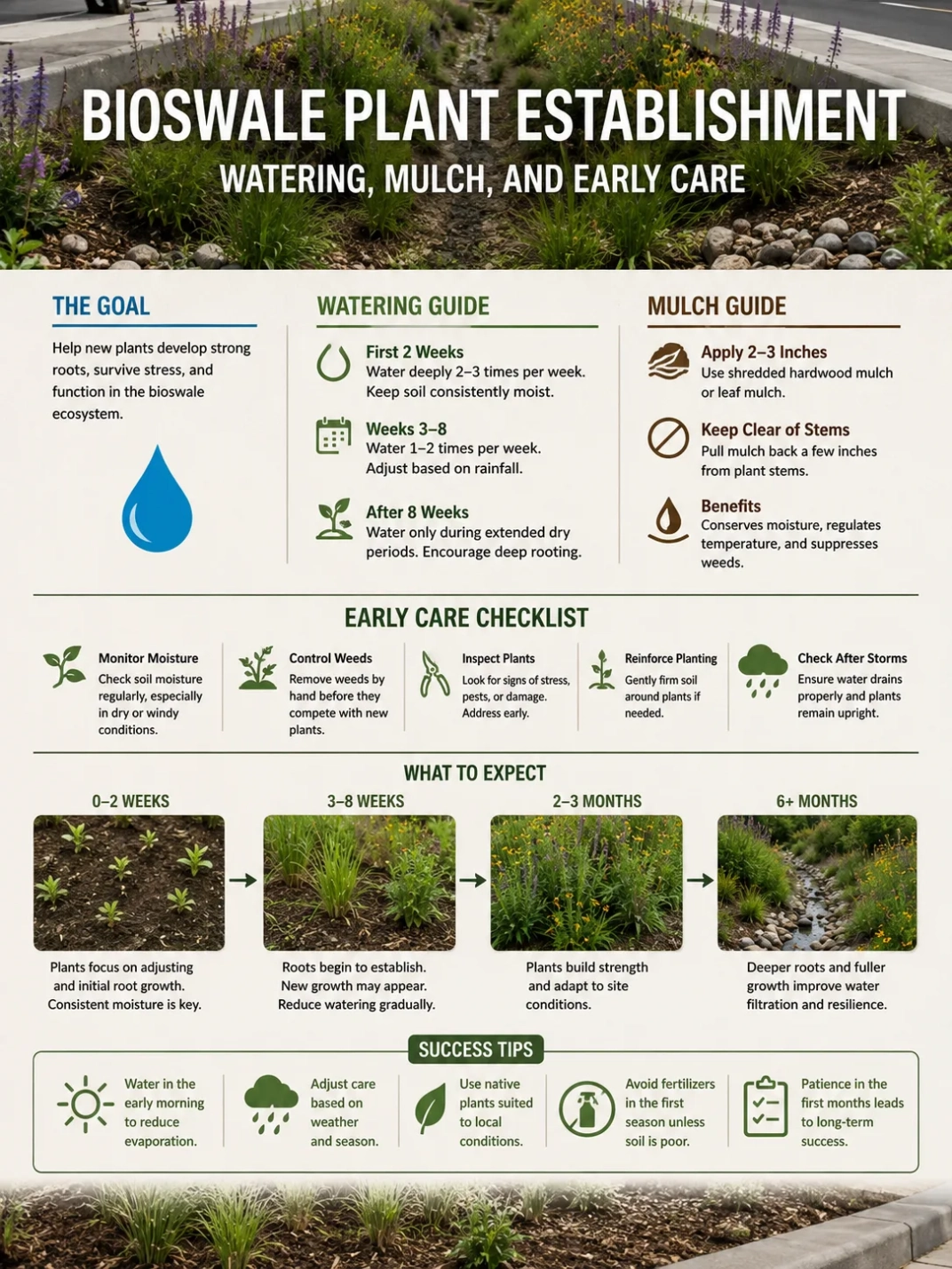
- Plan establishment care. A tree may need watering during dry periods even though it sits beside a stormwater feature. Runoff is not a dependable irrigation schedule.
Native trees may offer local ecological value and climate fit, but native status alone does not prove that a species belongs in a bioswale. The selected tree still needs the right moisture range, soil chemistry, mature size, root behavior, and site exposure.
Tree Beside the Bioswale or Inside It?
Placing a tree beside a bioswale often reduces hydraulic conflict. The canopy can still intercept rain, and roots may reach moist soil without putting the trunk in the main ponding area. This arrangement may also leave the bottom open for grasses, sedges, rushes, or other lower vegetation that tolerates sediment and moving water.
Placing a tree inside the bioswale can work where the soil depth, rooting volume, drainage pattern, and species tolerance have been planned together. It is more demanding in narrow cells, lined systems, or sites with shallow underdrains. Trees within the facility also become part of the stormwater inspection program, not only the landscape maintenance program.
Neither position is automatically better. The right choice depends on the mature tree, water depth and duration, soil oxygen, available space, and the need to keep drainage parts reachable.
What to Check Around an Existing Tree
An existing tree can be an asset, a constraint, or both. Before changing the nearby swale, check:
- The tree’s condition, lean, trunk defects, and visible root damage
- Where major roots are likely to cross the proposed excavation
- Whether the new design raises or lowers soil around the trunk
- Whether runoff will become wetter, drier, faster, or more concentrated near the roots
- Whether construction equipment can reach the site without compacting the root zone
- Whether future maintenance will require repeated digging beside the tree
- Whether roots, branches, and leaf fall could obstruct an inlet or overflow
A change that seems small on the surface can alter several conditions at once. Lowering grade may remove absorbing roots. Raising grade may reduce soil oxygen. Redirecting a downspout may create repeated saturation on one side of the root system. These effects deserve site-specific review when the tree is large, valuable, close to a structure, or already under stress.
When Professional Review Makes Sense
Professional input is useful when a bioswale is close to a foundation, retaining wall, steep slope, public drainage system, roadway, utility corridor, or mature tree. It is also appropriate when excavation may cut major roots, when an underdrain or liner is involved, or when standing water persists longer than the design intended.
A landscape architect, civil or drainage engineer, soil professional, and arborist address different parts of the same site. The needed mix depends on the problem. Tree health alone does not confirm that the drainage layout is safe, and a working outlet alone does not confirm that the root zone can support the tree over time.
Frequently Asked Questions
Can Tree Roots Damage a Bioswale?
Roots can interfere with underdrains, liners, pavement, curbs, and maintenance access when space is limited or components are poorly coordinated. Roots also help soil structure and slope stability. The outcome depends on placement, soil volume, pipe layout, tree species, and maintenance.
Should a Tree Be Planted in the Bottom of a Bioswale?
Sometimes, but not as a default rule. The lowest zone may receive repeated ponding, sediment, and concentrated flow. A tree belongs there only when the species, soil depth, drainage period, root flare elevation, and underground components suit that location.
Can an Existing Tree Remain Beside a New Bioswale?
It may remain if excavation, grade changes, compaction, and altered moisture do not place the root system or tree stability at risk. Large or valuable trees should be assessed before the bioswale footprint is finalized.
Do Tree Roots Improve Infiltration?
Living roots and soil organisms can help maintain pores and channels that support water movement. The effect is limited when soil is heavily compacted, sealed by sediment, continuously saturated, or disconnected from usable subsoil.
Does a Tree Near a Bioswale Still Need Watering?
Newly planted trees may need establishment watering during dry periods. A bioswale receives runoff only when rain falls on its drainage area, and fast-draining media may dry between events. Water needs vary by climate, season, tree size, and soil.
How Far Should a Tree Be from an Underdrain?
There is no single distance that fits every system. Local stormwater details may set horizontal and vertical offsets based on tree size, root zone, pipe depth, soil profile, and access needs. The project plan should follow the applicable design standard rather than a general spacing rule.