A plant can be drought-tolerant and still fail in a bioswale. The most useful drought-tolerant bioswale plants survive two very different conditions: temporary saturation after runoff enters the swale and extended dry soil between storms. Plants that tolerate only one side of that cycle belong in carefully chosen zones, not across the entire flow path.
Dry-period performance depends on more than the plant label. Soil texture, compaction, sun exposure, runoff frequency, sediment load and the depth of the root zone all shape how long moisture remains available. A species described as drought-tolerant in well-drained upland soil may decline when its crown is repeatedly submerged.
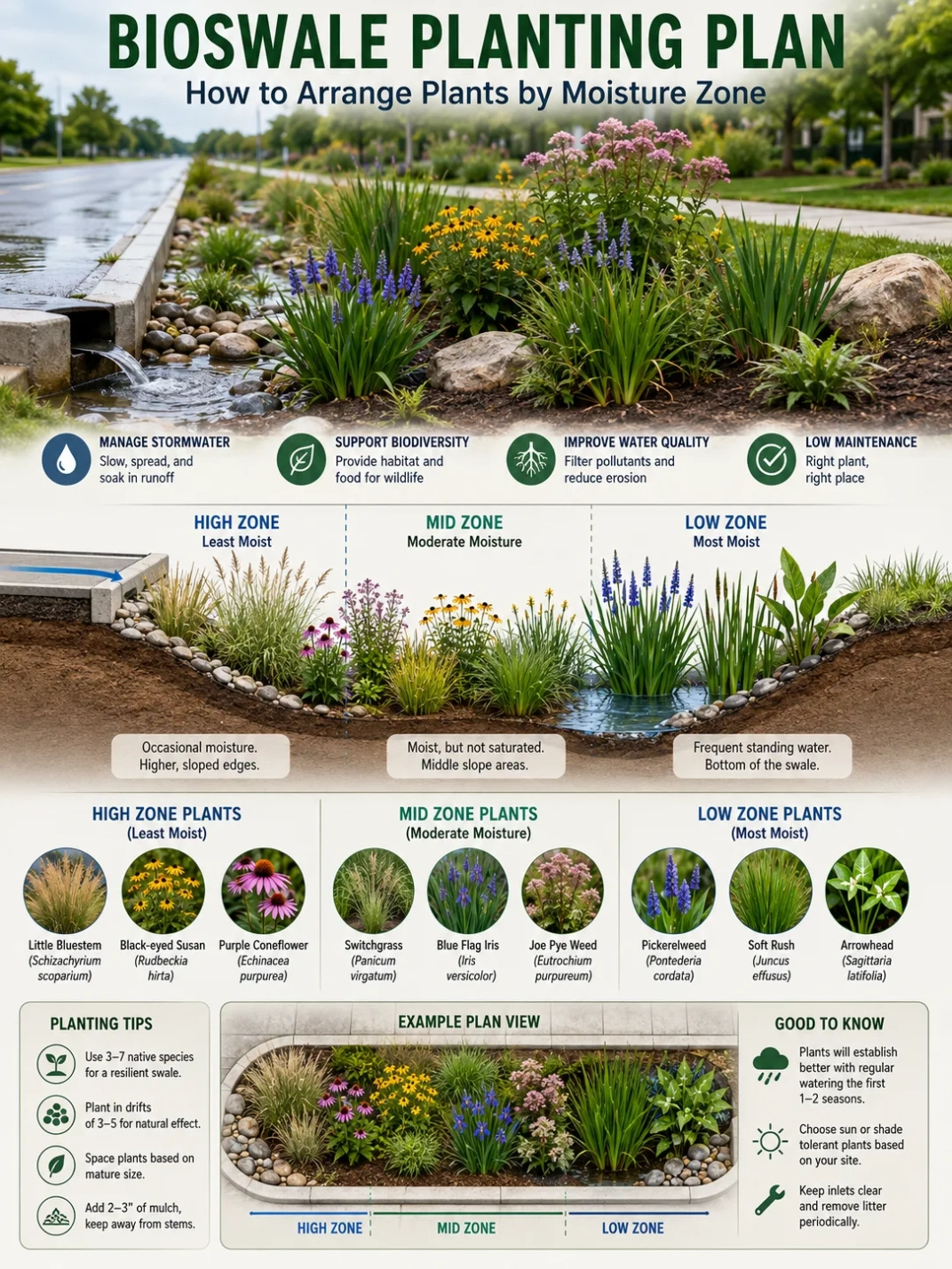
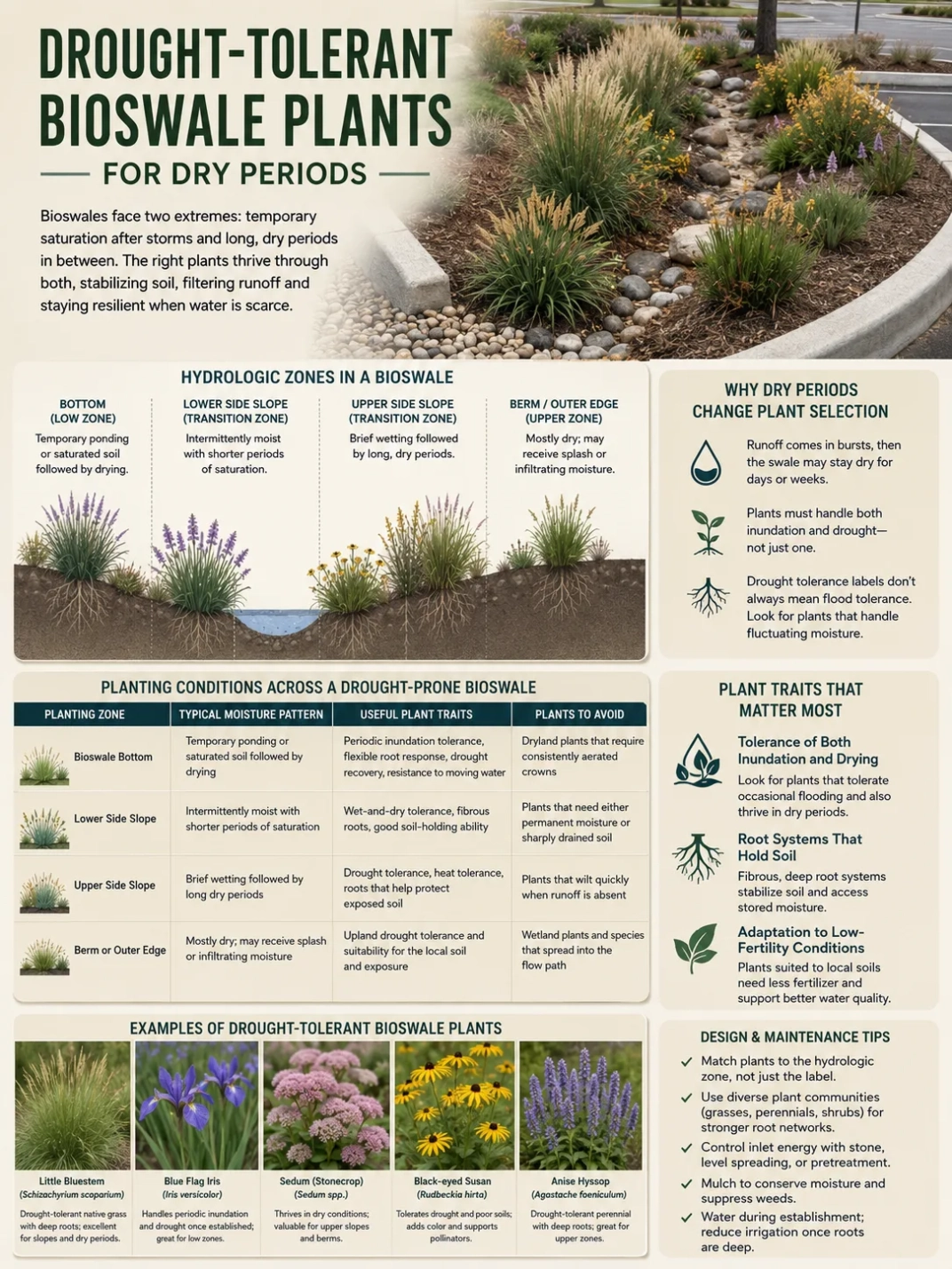
Plant selection should therefore begin with hydrologic position. The bottom, side slopes and upper edge of a bioswale do not experience the same moisture pattern. Stormwater guidance commonly separates bioretention plantings into wetter low zones, transitional middle zones and drier outer zones while still favoring drought tolerance throughout the system.
Why Dry Periods Change Plant Selection
A bioswale may receive a burst of roof, driveway, roadside or parking lot runoff and then remain dry for days or weeks. Unlike a permanently wet ditch, it usually does not provide a dependable water supply to roots.
This pattern rules out many plants commonly described as moisture-loving. Some can tolerate shallow flooding but lose vigor when the soil dries. Other plants thrive in a xeriscape yet develop crown or root problems after repeated inundation. The best choices for the main treatment area tolerate fluctuating moisture, not just drought.
Bioretention vegetation is often selected for drought tolerance because these systems are wet mainly after precipitation and may receive limited irrigation once established.
| Planting Zone | Typical Moisture Pattern | Useful Plant Traits | Plants to Avoid |
|---|---|---|---|
| Bioswale Bottom | Temporary ponding or saturated soil followed by drying | Periodic inundation tolerance, flexible root response, drought recovery and resistance to moving water | Dryland plants that require consistently aerated crowns |
| Lower Side Slope | Intermittently moist with shorter periods of saturation | Wet-and-dry tolerance, fibrous roots and good soil-holding ability | Plants that need either permanent moisture or sharply drained soil |
| Upper Side Slope | Brief wetting followed by long dry periods | Drought tolerance, heat tolerance and roots that help protect exposed soil | Plants that wilt quickly when runoff is absent |
| Berm or Outer Edge | Mostly dry; may receive splash or infiltrating moisture | Upland drought tolerance and suitability for the local soil and exposure | Wetland plants and species that spread into the flow path |
Plant Traits That Matter Most
Tolerance of Both Inundation and Drying
The bottom zone needs plants that can remain functional after short periods of saturated soil without depending on permanent wetness. This is a narrower requirement than ordinary drought tolerance.
Look for regional plant descriptions that mention combinations such as occasional flooding, seasonally wet soil, moist-to-dry conditions or fluctuating water levels. A generic “water-wise” label does not show whether the plant can handle runoff entering around its crown.
Root Systems That Hold Soil
Dense fibrous roots help bind the surface around inlets, side slopes and check dams. Deeper roots can reach moisture stored below the surface during dry periods. A mixed planting of grasses, grass-like plants, flowering perennials and selected shrubs also places roots at different depths.
Roots do not correct a poorly designed inlet. Concentrated runoff can flatten vegetation, expose soil or cut a channel before plants become established. Stone, level spreading, pretreatment or another form of flow control may be needed where water enters with force.
Adaptation to Low-Fertility Conditions
Bioswale soil media should support plant health while allowing runoff to drain and filter. Excess fertilizer can encourage soft growth, weeds or nutrient movement. Plants adapted to local soils and moderate fertility are often easier to manage than species that need frequent feeding.
Recovery After Dormancy or Stress
Some suitable plants reduce growth, lose older leaves or enter seasonal dormancy during dry weather. That response is not necessarily plant failure. The useful distinction is whether the crown and root system recover when moisture returns.
Planting Note: Drought tolerance is relative to climate. A plant rated highly drought-tolerant in a humid region may still need irrigation in an arid or Mediterranean climate. Local plant data should be checked for hardiness, summer moisture needs, soil preference, mature size and invasive status.
Useful Plant Groups for Alternating Wet and Dry Conditions
No single plant palette fits every region. The species below are selection examples, not a universal planting schedule. Native status, water needs and suitable hydrologic zone can change across a species’ range.
Switchgrass
Switchgrass (Panicum virgatum) is a useful reference species because it can tolerate drought, erosion and occasional flooding. It is generally better suited to the bottom, lower slope or transitional zone than grasses that require consistently dry crowns. Mature size and growth habit vary among local forms and cultivars, so sight lines and maintenance access need consideration.
Little Bluestem
Little bluestem (Schizachyrium scoparium) performs well in dry to moderately moist, well-drained soil and develops strong drought resistance after establishment. It fits upper side slopes and outer edges better than low points that remain saturated. Repeated ponding around the crown can place it outside its preferred conditions.
Regionally Appropriate Sedges and Rushes
Sedges and rushes are often used near the main flow path because many species tolerate wet soil and form dense root systems. Species selection matters. Some are true wetland plants that decline during long dry periods, while others tolerate seasonal drying.
In parts of California, for example, spreading rush (Juncus patens) is used where plants must handle periodic flooding and dry summers. Other regions have different native sedges or rushes suited to the same functional role. A local stormwater plant list is more reliable than selecting by plant form alone.
Deer Grass and Other Regional Muhly Grasses
Deer grass (Muhlenbergia rigens) is used in some western rain-garden and bioretention palettes because it can handle seasonal moisture followed by dry conditions. Other Muhlenbergia species have different tolerances, mature sizes and ranges. The genus name alone is not enough to confirm placement.
Yarrow
Yarrow (Achillea millefolium) can be useful on transitional or upper slopes where soil drains between storms. It is widely adapted, but local forms and cultivars differ. It should not be treated as a substitute for plants that tolerate regular ponding in the lowest part of the bioswale. California bioretention guidance includes yarrow among plants able to handle poor soils and seasonal changes in moisture.
Coneflowers, Mountain Mints and Bluestars
Flowering perennials can fill middle and upper zones when the selected species tolerates both the soil and the local dry season. Purple coneflower is drought-tolerant in suitable sunny sites, while certain mountain mints and bluestars are identified for moist-to-dry rain-garden zones. These plants add seasonal cover, but their placement should follow hydrology rather than flower color.
Drought-Tolerant Shrubs for Upper Zones
Shrubs can shade soil, add deeper roots and give a large bioswale year-round structure. They also occupy more space and can block inspection if placed close to an inlet, outlet or overflow route.
Ninebark, potentilla, buffaloberry, selected sumacs and some serviceberries may suit dry upper zones in regions where they are adapted. A shrub that tolerates drought does not automatically belong in the bioswale bottom. Root spread, suckering, mature height, salt exposure and access for sediment removal should be reviewed before planting.
Drought-Tolerant Does Not Mean Xeriscape-Only
A common planting mistake is filling the entire bioswale with plants chosen for dry gardens. Succulents, dryland shrubs and other xeric plants may perform well on a berm yet fail where runoff periodically covers the crown.
The opposite mistake is using bog or shoreline plants in a basin that dries soon after a storm. Those plants may look healthy during the rainy season and then require repeated summer irrigation. Guidance for seasonally dry rain gardens recommends plants in the flood zone that tolerate periodic inundation as well as limited summer water.
Design Note: Treat the swale as a moisture gradient. Place plants according to the wettest condition their crowns will experience, not according to the average appearance of the site during dry weather.
How Soil Conditions Affect Drought Survival
A suitable plant palette cannot compensate for severely compacted, clogged or poorly drained soil. Plant stress during a dry period may begin with how the soil handled earlier runoff.
- Fast-draining media: Water may move below shallow roots quickly, leaving the surface dry soon after a storm.
- Compacted media: Roots may remain shallow because dense soil limits air and root penetration.
- Sediment-sealed surfaces: A fine crust can reduce infiltration and redirect water around plants.
- Persistently saturated pockets: Low oxygen can weaken plants before the dry season begins.
- Thin soil over restrictive layers: Roots may have little stored moisture available between storms.
Soil testing and an infiltration assessment can help distinguish a plant-selection problem from a drainage problem. The soil also needs to support roots while allowing stored runoff to drain within the period required by the project design and local standards.
Soil Note: Avoid walking, driving equipment or stockpiling materials on wet bioswale soil. Compaction can reduce infiltration and create uneven moisture conditions that favor weeds over the intended planting.
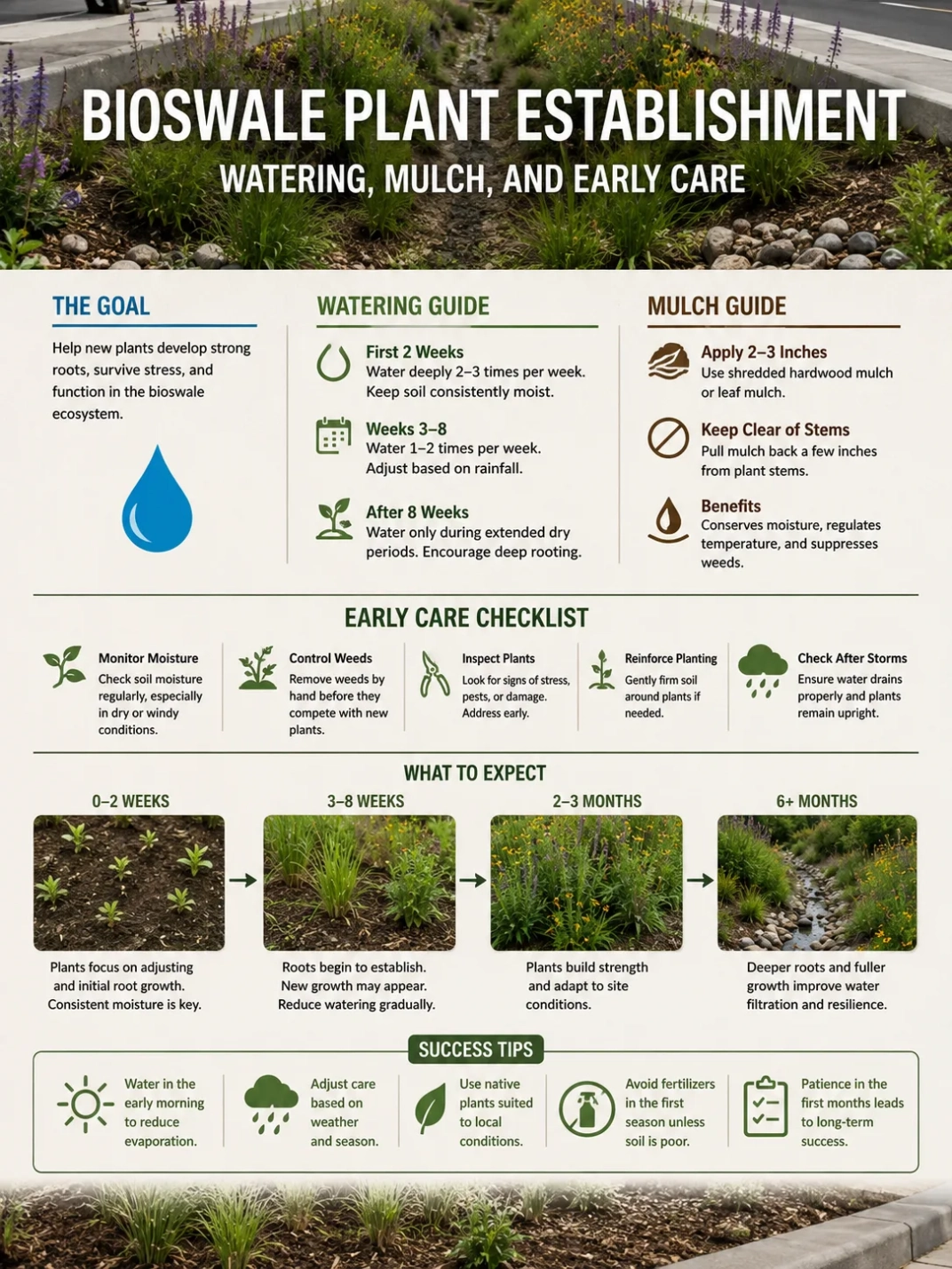
Establishment Watering Still Matters
Drought-tolerant does not mean newly planted roots can survive in dry planting media without support. Nursery-grown plants begin with root systems confined to a container or small root ball. They need moisture while roots move into the surrounding soil.
Watering needs vary with season, soil, plant size, rainfall and climate. The useful goal is to keep the active root zone from drying completely during establishment without keeping crowns continuously saturated. Irrigation can then be reduced as roots spread and plants begin responding to natural rainfall and runoff. Extension guidance likewise notes that newly planted shrubs and trees need regular watering until established.
During an extended drought, even mature bioretention vegetation may need supplemental water. Visible wilt, premature leaf drop, thinning cover and failure to recover during cooler hours can indicate stress. Irrigation should reach the root zone rather than only wetting the mulch surface.
Planting for Coverage Rather Than Decoration Alone
A bioswale planting should protect soil and leave the drainage system visible enough to inspect. Large gaps can invite erosion and weeds. Dense growth directly across an inlet or outlet can trap debris and divert flow.
A practical palette often combines:
- A dense grass, sedge or rush layer near active flow areas
- Flowering perennials in transitional and upper zones
- Low plants where clear sight lines are needed
- Selected shrubs away from inspection points and narrow flow paths
- More than one species in each moisture zone, where space allows
Plant diversity reduces dependence on one species responding perfectly to every wet and dry cycle. It also makes it easier to replace a poorly performing species without leaving the whole swale bare.
Maintenance During Dry Weather
Dry periods offer a useful time to inspect parts of the bioswale that may be hidden during runoff. Check the soil surface, plant crowns, inlet, outlet, check dams and overflow route.
- Remove litter and sediment that block water from spreading through vegetation.
- Look for narrow channels that bypass planted areas.
- Replace plants according to the moisture zone where they failed.
- Control weeds before they use limited soil moisture or obstruct the flow path.
- Maintain mulch where the design uses it, but keep loose material away from drains and curb openings.
- Check whether irrigation is reaching roots rather than running across compacted soil.
- Leave enough plant cover to protect exposed soil during heat and wind.
If several species decline in the same strip, the cause may be buried compaction, uneven grading, excess sediment or a blocked outlet rather than drought alone. Repeated replacement without correcting that condition usually produces the same result.
When the Plant List Needs Professional Review
Professional landscape, stormwater or engineering review may be appropriate when the bioswale receives runoff from a road, large parking area or other high-load impervious surface. Review is also useful where failure could redirect water toward a building, neighboring property, roadway or public drainage system.
Other reasons for site-specific review include saline runoff, steep grades, contaminated soil, a high groundwater table, an underdrain, restricted overflow space or local planting requirements. In these settings, the plant palette must work with the inlet, soil media, drainage layer and maintenance plan rather than being selected as a separate landscaping feature.
Frequently Asked Questions
What Makes a Plant Drought-Tolerant Enough for a Bioswale?
It should recover from the dry periods expected at the site after its roots are established. For lower zones, it must also tolerate temporary saturation or shallow inundation. A drought rating without wet-soil information is not enough.
Can Xeriscape Plants Grow in a Bioswale?
Some can grow on the upper slope or berm where their crowns remain well drained. Plants that are sensitive to wet roots should not be placed in the bottom or directly beside an inlet.
Are Native Plants Automatically Suitable for Dry Bioswales?
No. Native plants occupy wetlands, forests, prairies, deserts and many other habitats. Select locally native species whose natural moisture range resembles the bioswale zone where they will be planted.
Do Drought-Tolerant Bioswale Plants Need Irrigation?
They commonly need supplemental water during establishment. Mature plants may also need water during unusually long dry periods, especially in fast-draining media or hot exposed sites.
Which Plants Belong in the Bottom of a Bioswale?
Use plants documented for periodic flooding, fluctuating moisture and seasonal drying in the local climate. Depending on the region, suitable choices may include certain switchgrasses, sedges, rushes or other wet-and-dry tolerant perennials.
Why Are Plants Dying Even Though They Are Drought-Tolerant?
Possible causes include poor establishment, crown submergence, compacted soil, clogged media, sediment burial, unsuitable sun exposure, deicing salt, an incorrect hydrologic zone or roots that remain too shallow. The pattern and location of plant loss often reveal more than the drought rating on the plant label.