Standing water in a bioswale is not automatically a failure. Many bioswales are designed to hold runoff for a short period after rain so water can slow down, spread across the surface, filter through vegetation and soil, and then drain. The concern begins when ponding lasts too long, appears after light rain, collects in the wrong part of the swale, or leaves signs of clogging, soil compaction, plant stress, sediment buildup, or blocked outlets.
The difference between normal ponding and a drainage problem depends on timing, depth, soil behavior, overflow function, and the condition of the plants and inlets. A bioswale is not meant to behave like a dry lawn after every storm. It is also not meant to become a shallow pond for days at a time unless it was designed as part of a different stormwater system.
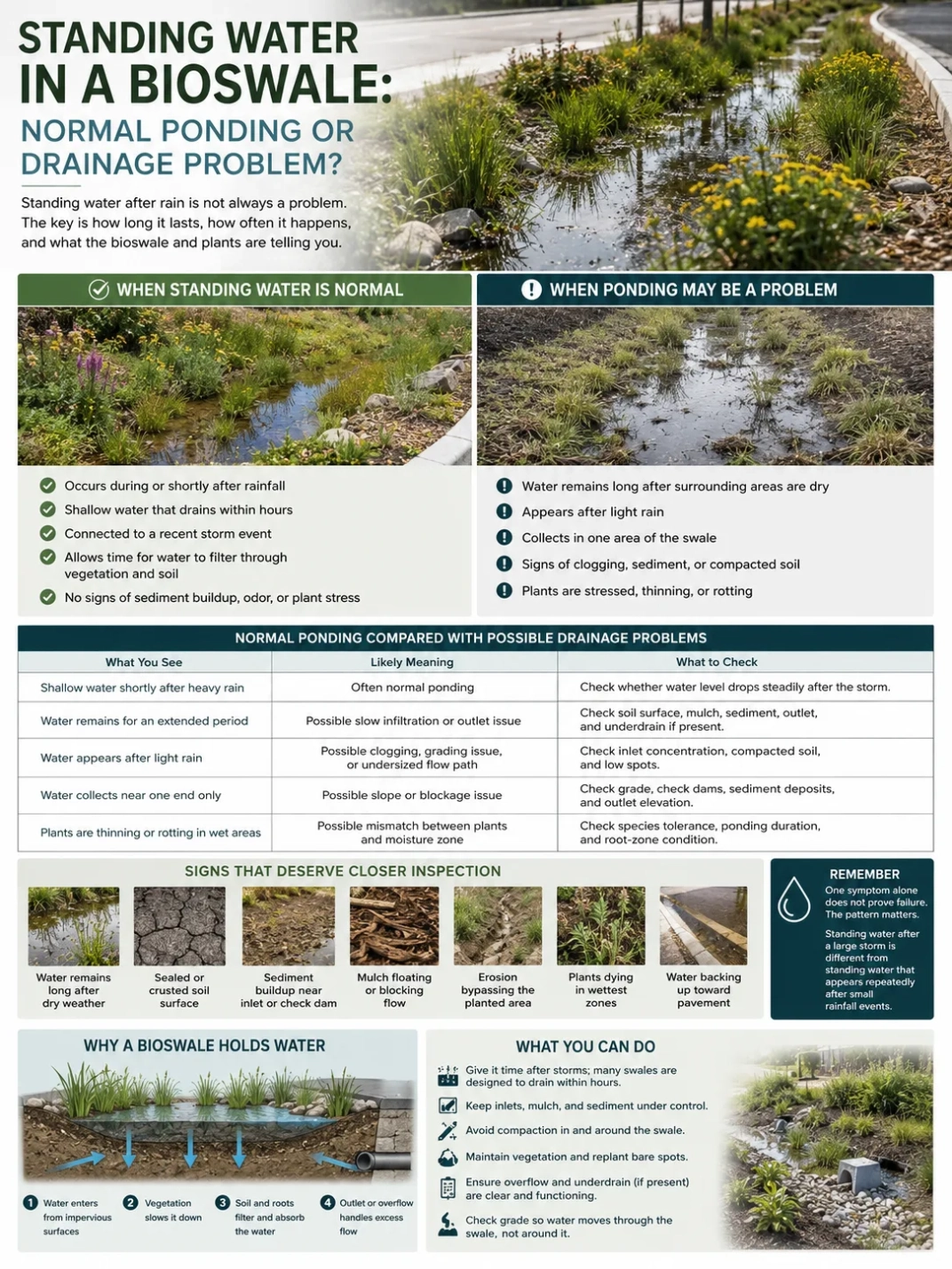
When Standing Water Is Normal
Normal ponding usually appears during or soon after rainfall, especially when runoff enters from a roof, driveway, sidewalk, parking area, road edge, or other impervious surface. The bioswale briefly stores that runoff on the surface so it can move slowly through vegetation and soil media instead of rushing straight into a drain or low point.
In many designs, shallow water may remain visible for several hours after a storm. The exact time depends on soil texture, rainfall amount, compaction, vegetation density, slope, and whether the system includes an underdrain. A bioswale in sandy or well-structured loam may drain faster than one built over clay soil or compacted urban fill.
Normal ponding is temporary, shallow, and connected to a recent storm. It should not smell stagnant, cover plants for long periods, or leave a layer of fine sediment that seals the soil surface.
| What You See | Likely Meaning | What to Check |
|---|---|---|
| Shallow water shortly after heavy rain | Often normal ponding | Check whether water level drops steadily after the storm. |
| Water remains for an extended period | Possible slow infiltration or outlet issue | Check soil surface, mulch, sediment, outlet, and underdrain if present. |
| Water appears after light rain | Possible clogging, grading issue, or undersized flow path | Check inlet concentration, compacted soil, and low spots. |
| Water collects near one end only | Possible slope or blockage issue | Check grade, check dams, sediment deposits, and outlet elevation. |
| Plants are thinning or rotting in wet areas | Possible mismatch between plants and moisture zone | Check species tolerance, ponding duration, and root-zone condition. |
When Ponding Starts to Look Like a Problem
A drainage problem is more likely when the bioswale stops draining between storms. Water that sits too long can reduce oxygen in the root zone, weaken plants that are not adapted to wet conditions, and allow fine particles to settle over the surface. Over time, that surface layer can slow infiltration even more.
The issue may not be the whole bioswale. A small clogged inlet, a compacted maintenance path, a buried outlet, or a sediment fan near a curb cut can create standing water in one section while the rest of the system works well.
Signs that deserve closer inspection include:
- Water that remains visible long after surrounding ground has dried.
- Dark, sealed, or crusted soil at the bottom of the swale.
- Fine sediment collecting near the inlet or check dam.
- Mulch floating, matting together, or blocking flow.
- Erosion channels that bypass the planted area.
- Plants dying in the wettest zone while upland plants nearby look healthy.
- Water backing up toward pavement, foundations, walkways, or neighboring property.
One symptom alone does not prove failure. The pattern matters. Standing water after a large storm is different from standing water that appears repeatedly after small rainfall events.
Why a Bioswale Holds Water in the First Place
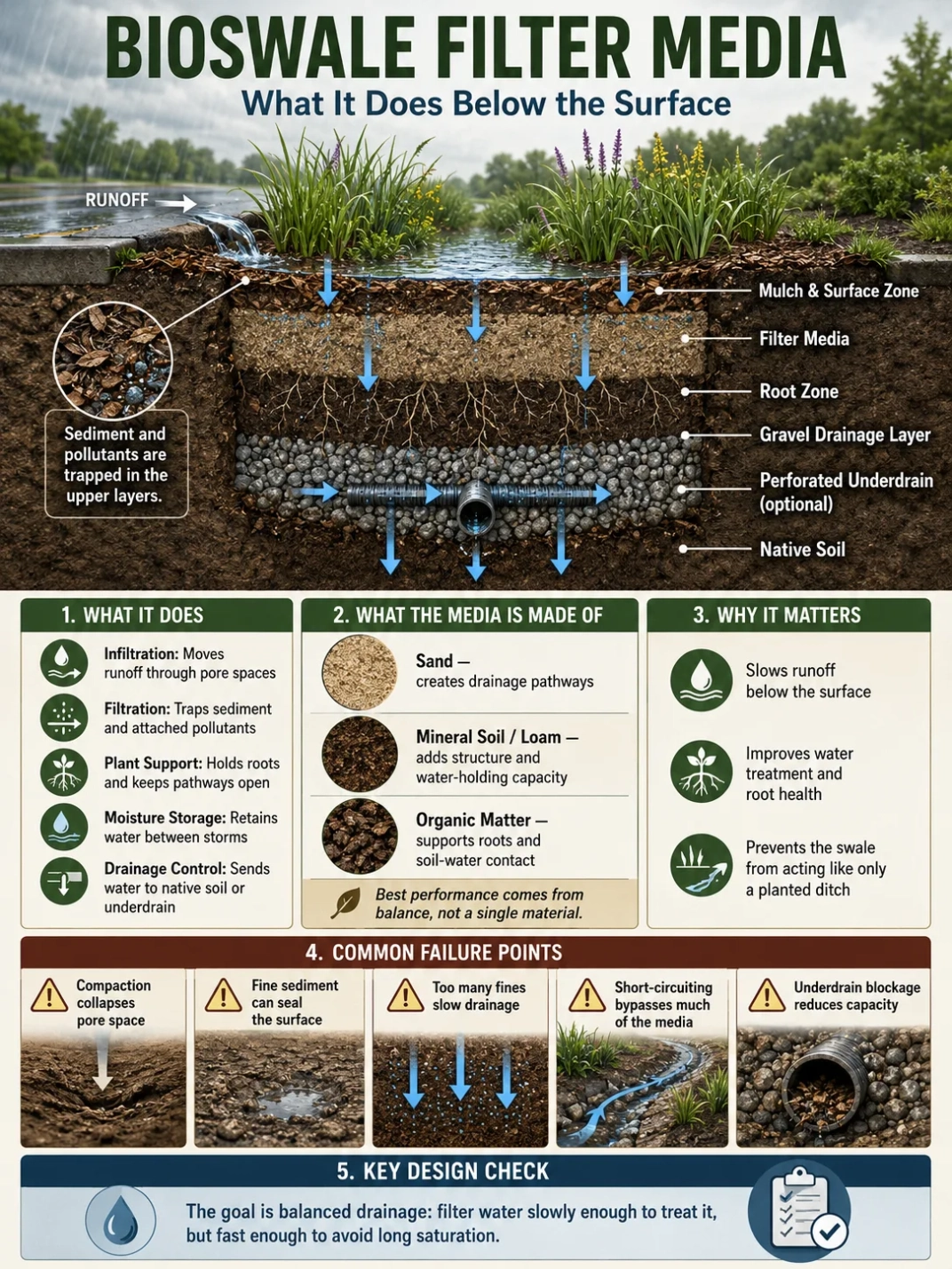
A bioswale handles runoff through a sequence of small steps. Water enters through an inlet, curb cut, pipe, sheet flow, or shallow channel. Vegetation slows it. The swale shape spreads it. Soil media and root zones allow infiltration and filtering. An outlet or overflow route manages water when the system receives more runoff than it can absorb at once.
This is why a bioswale can look “wet” by design. The surface storage area is part of the system. Without short-term ponding, runoff may move too quickly across the swale, reducing contact with plants, soil, and sediment-trapping areas.
The goal is not instant disappearance. The goal is controlled movement: slow enough to filter and settle sediment, but not so slow that the swale remains saturated beyond what its plants, soil, and drainage route can handle.
Common Causes of Drainage Problems
Clogged or Sealed Soil Surface
Fine sediment can form a thin layer over the bottom of a bioswale. This often happens near inlets where runoff first slows down. If the sediment is not removed, it can seal pores in the soil surface and reduce infiltration.
A sealed surface may look smooth, crusty, or muddy even when the rest of the landscape has drained. In planted areas, sediment can also bury crowns of grasses, sedges, rushes, and young shrubs.
Compacted Soil
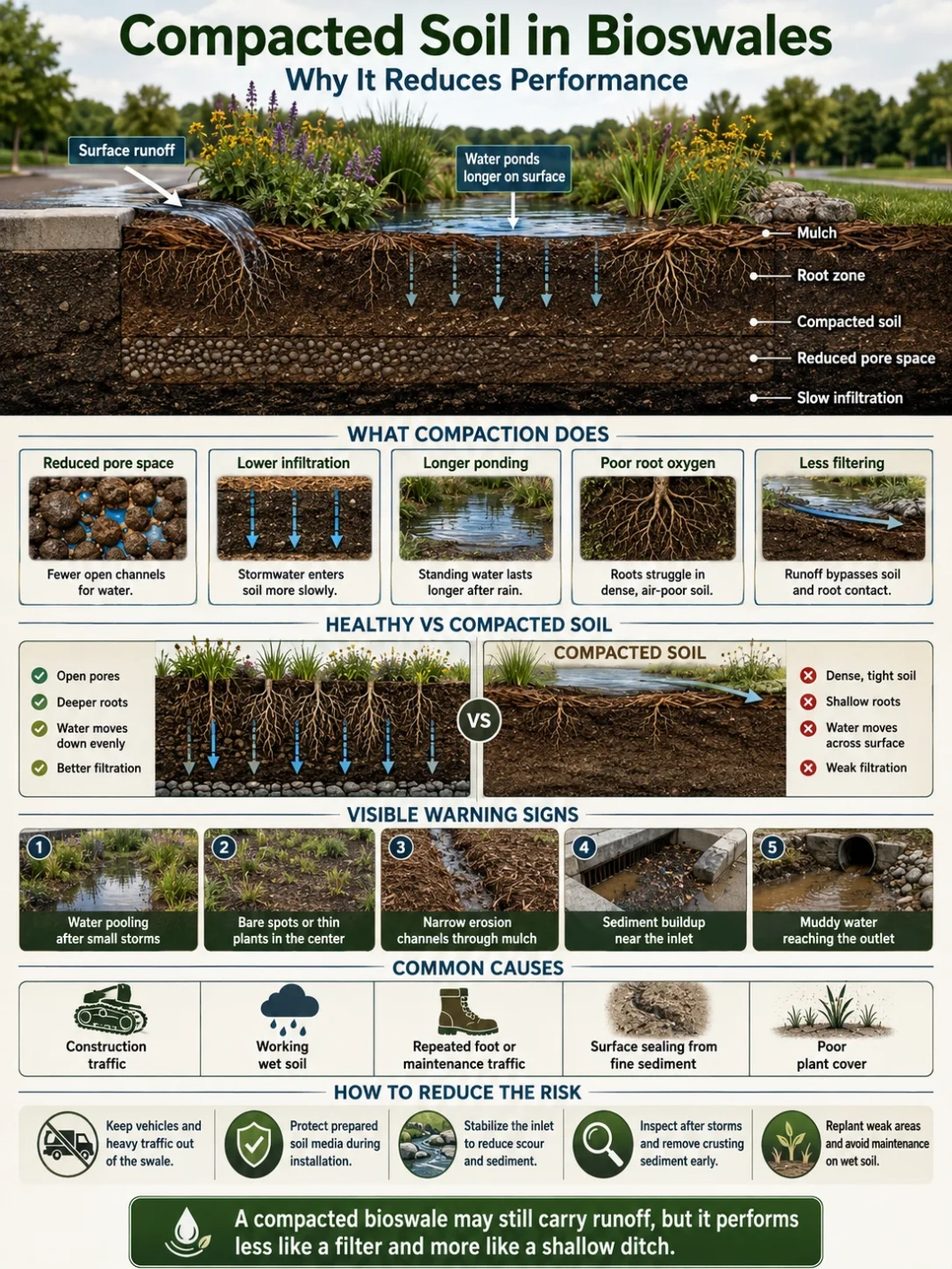
Soil compaction reduces pore space. Less pore space means less room for water and air to move. In a bioswale, compaction can come from construction traffic, foot traffic, mowing equipment, repeated sediment loading, or poor soil handling during installation.
Compacted areas often create shallow puddles because water cannot enter the soil fast enough. This can happen even when the original design was sound.
Blocked Outlet or Overflow Route
A bioswale needs a safe route for extra water. That route may be a low overflow notch, catch basin, pipe, level spreader, or a designed spillway to a drainage area. If leaves, mulch, trash, soil, or plant growth block that route, water can remain trapped.
The outlet should not be treated as an afterthought. It controls what happens when the swale receives more runoff than the soil can take in during a storm.
Poor Slope or Uneven Grade
A bioswale depends on careful grading. If the bottom is uneven, water may sit in one pocket instead of moving through the intended flow path. If the longitudinal slope is too flat for the site conditions, the system may drain slowly. If it is too steep, water may cut channels and bypass the planted surface.
Small grade changes can make a visible difference. A low spot near a check dam, outlet, or inlet can hold water even when the rest of the swale drains as expected.
Plant and Mulch Problems
Plants help keep soil open through root growth, surface roughness, and evapotranspiration. When vegetation is sparse, runoff can carry more sediment and create rills. When plants are too dense at an outlet, they can slow drainage in the wrong place.
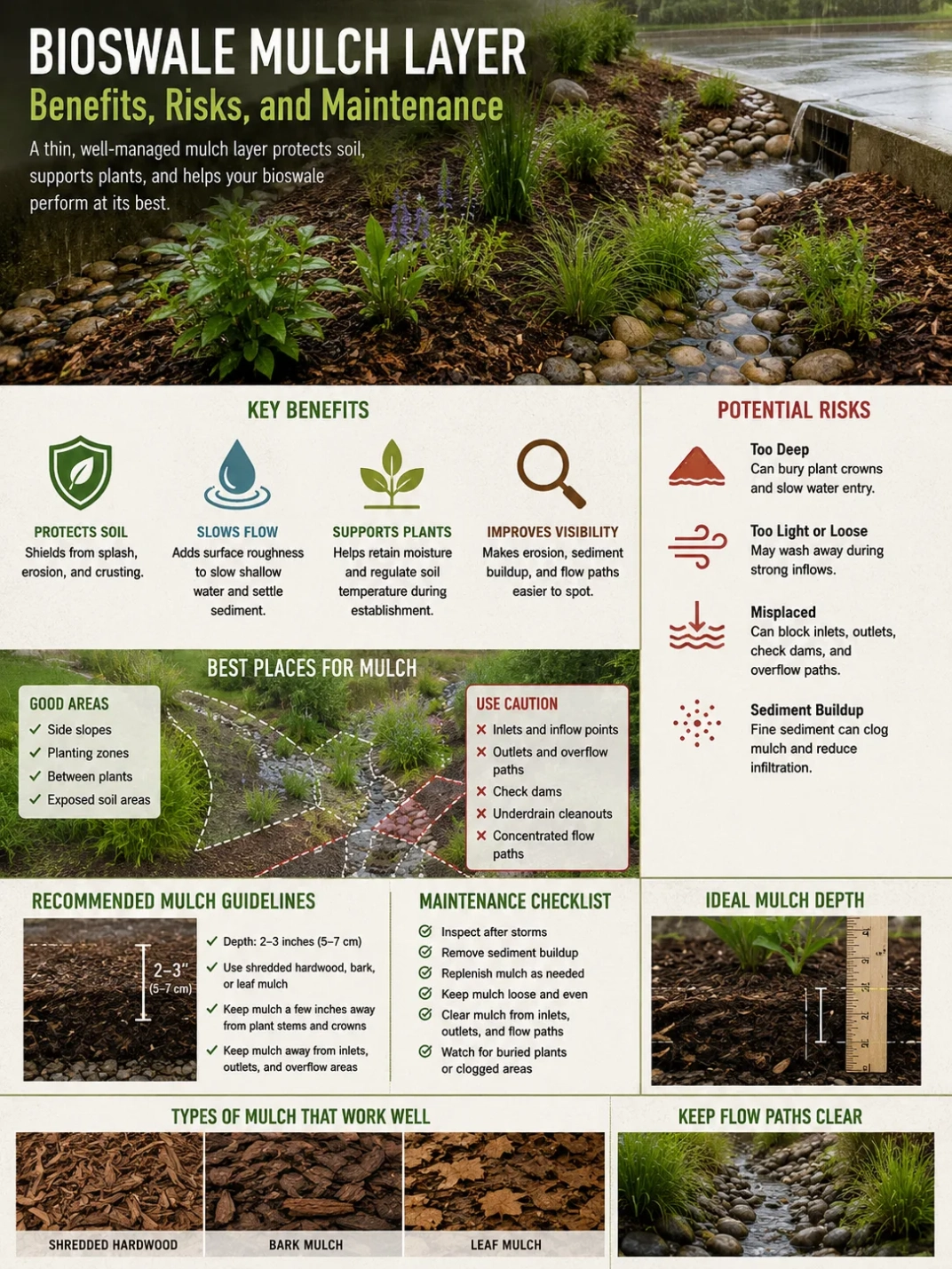
Mulch can help protect soil, but loose mulch may float during storms and collect at outlets or inlets. Matted mulch can also reduce surface infiltration. In bioswales, mulch should support the drainage function rather than form a blanket that seals the soil.
How Long Should Water Stay in a Bioswale?
There is no single ponding time that fits every site. Drainage expectations vary with local rainfall, soil profile, design depth, plant zone, groundwater conditions, and local stormwater rules. Some projects have specific drawdown requirements set by the designer or local authority.
For a real site, the best clue is the normal pattern. If a bioswale used to drain after storms but now holds water much longer, something has changed. Sediment, compaction, plant loss, outlet blockage, or grading movement may be involved.
If the bioswale is new, slower drainage during the establishment period may reflect unsettled soil, young vegetation, or construction disturbance. That does not mean the problem should be ignored. It means the inspection should focus on whether water is still moving, where it is collecting, and whether plants are adapting.
Drainage Note: A bioswale that holds water briefly after a storm may be working as intended. A bioswale that stays wet between storms, backs up toward structures, or shows repeated plant decline needs closer review.
What to Check Before Assuming Failure
A calm inspection can separate normal storm response from a real drainage issue. The best time to observe is during rainfall, shortly after rainfall, and again after the site has had time to drain.
- Start at the inlet. Look for sediment fans, erosion, blocked curb cuts, pipe discharge, or concentrated flow that hits one spot too hard.
- Follow the flow path. Check whether water spreads across vegetation or cuts a narrow channel through the swale.
- Look at the lowest areas. Standing water in one pocket may point to uneven grade or a clogged check dam area.
- Check soil texture at the surface. Crust, slime, fine sediment, or compacted spots can slow infiltration.
- Inspect the outlet and overflow route. Make sure water has a clear place to go during larger storms.
- Read the plants. Wetland-tolerant species may thrive in the bottom zone, while upland plants may decline if water stays too long.
This inspection is not a substitute for engineering review where drainage affects buildings, public infrastructure, steep slopes, roadways, or neighboring properties. It is a practical way to understand what the bioswale is showing.
Normal Ponding in Different Bioswale Zones
Standing water does not affect every part of a bioswale the same way. The bottom zone receives the most frequent moisture. Side slopes usually drain faster. The upper edges may stay much drier except during larger storms.
This zone pattern matters for planting. Grasses, sedges, rushes, and shrubs should match the moisture pattern of their part of the swale. A plant that handles short wet periods may still fail if its crown remains submerged or its roots stay saturated for too long.
Planting Note: Good bioswale planting is not just about choosing “water-loving” plants. Many bioswale plants need to handle both wet and dry periods because the same swale may be saturated after a storm and dry during a long rainless stretch.
How Maintenance Helps Drainage
Most bioswale drainage problems develop slowly. Sediment collects at the inlet. Mulch shifts. Plants thin out. Soil becomes compacted where people step or equipment turns. Leaves cover an overflow. These small changes can alter how water moves.
Maintenance does not need to make the swale look manicured. It should protect the water movement, soil surface, and plant cover.
- Remove sediment before it seals the soil surface.
- Keep inlets and outlets open.
- Replace dead plants in areas where roots are needed for soil structure.
- Repair erosion channels before they become the main flow path.
- Loosen or restore compacted areas where appropriate for the design.
- Keep mulch from piling against outlets, plant crowns, or low overflow points.
Maintenance should match the design. A public roadside bioswale with heavy sediment load needs a different inspection pattern than a small residential swale receiving roof runoff.
When Standing Water May Need Professional Review
Professional review is sensible when standing water affects buildings, sidewalks, driveways, public roads, basements, retaining walls, steep slopes, or neighboring land. It may also be needed where a bioswale connects to a storm drain, underdrain, public right-of-way, or regulated drainage system.
A designer, landscape architect, civil engineer, or qualified stormwater professional can check grade, soil infiltration, underdrain function, overflow elevation, and runoff volume. The right reviewer depends on the site and local requirements.
The main warning sign is not water itself. The warning sign is water that has no clear path, no visible drawdown, or no match with the plants and soil conditions around it.
How It Differs from a Pond, Rain Garden, or Drainage Ditch
A bioswale may look similar to other landscape drainage features, but its purpose is different. It is shaped to move runoff along a vegetated path while slowing and filtering it. A rain garden is usually more basin-like and may focus more on temporary storage and infiltration in one planted depression. A drainage ditch often moves water away with less focus on filtration, soil media, or planted treatment.
A pond or retention feature is designed to hold water longer. A bioswale usually is not. If a bioswale behaves like a permanent pond, the design intent, soil conditions, outlet, and inflow pattern should be checked.
Details That Shape Whether Ponding Is Healthy
Healthy ponding is part of a working hydrologic sequence. Runoff enters, slows, spreads, filters, infiltrates where soil allows, and leaves through a planned route when the system is full. Problem ponding breaks that sequence.
The most useful questions are practical:
- Did the water arrive from a storm or from another source?
- Is the water level dropping over time?
- Is the water spread across the swale or trapped in one low pocket?
- Are inlets and outlets clear?
- Does the soil surface look open or sealed?
- Are plants in the wettest zone suited to repeated wet and dry cycles?
- Does overflow move away safely when the swale fills?
These answers reveal more than a single snapshot. A bioswale is dynamic. Its performance shows up through repeated storm response, plant health, sediment patterns, and drainage behavior over time.
FAQ
Is standing water in a bioswale normal after rain?
Yes, shallow standing water can be normal after rain. A bioswale often holds runoff briefly so water can slow down, spread through vegetation, and filter into soil where conditions allow. It becomes a concern when water remains too long, appears after small storms, or shows signs of clogging or poor overflow.
How can I tell if ponding is caused by clogged soil?
Look for a smooth, crusted, muddy, or sediment-covered surface, especially near the inlet. If water sits on that area while other parts of the swale drain, fine sediment or compaction may be reducing infiltration.
Can a bioswale have water in only one section?
Yes. Water may collect in one section if the grade is uneven, a check dam slows flow, sediment has built up, or the outlet is partly blocked. One wet pocket does not always mean the whole bioswale has failed, but it should be inspected if it repeats after storms.
Do bioswale plants suffer from standing water?
They can, depending on the plant and how long the water remains. Many bioswale plants tolerate short wet periods, but not all can handle long saturation around their roots or crowns. Plant selection should match the wet bottom zone, drier side slopes, sun exposure, and local climate.
Does an underdrain prevent standing water?
An underdrain can help move water out of a bioswale where native soil drains slowly, but it does not fix every issue. If the surface is sealed with sediment, the outlet is blocked, or the grade is wrong, standing water may still occur. The underdrain also needs a clear discharge route.
When should standing water be checked by a professional?
Professional review is wise when water backs up toward buildings, pavement, basements, public drainage, steep slopes, or neighboring property. It is also useful when a bioswale repeatedly holds water between storms and simple maintenance checks do not explain why.