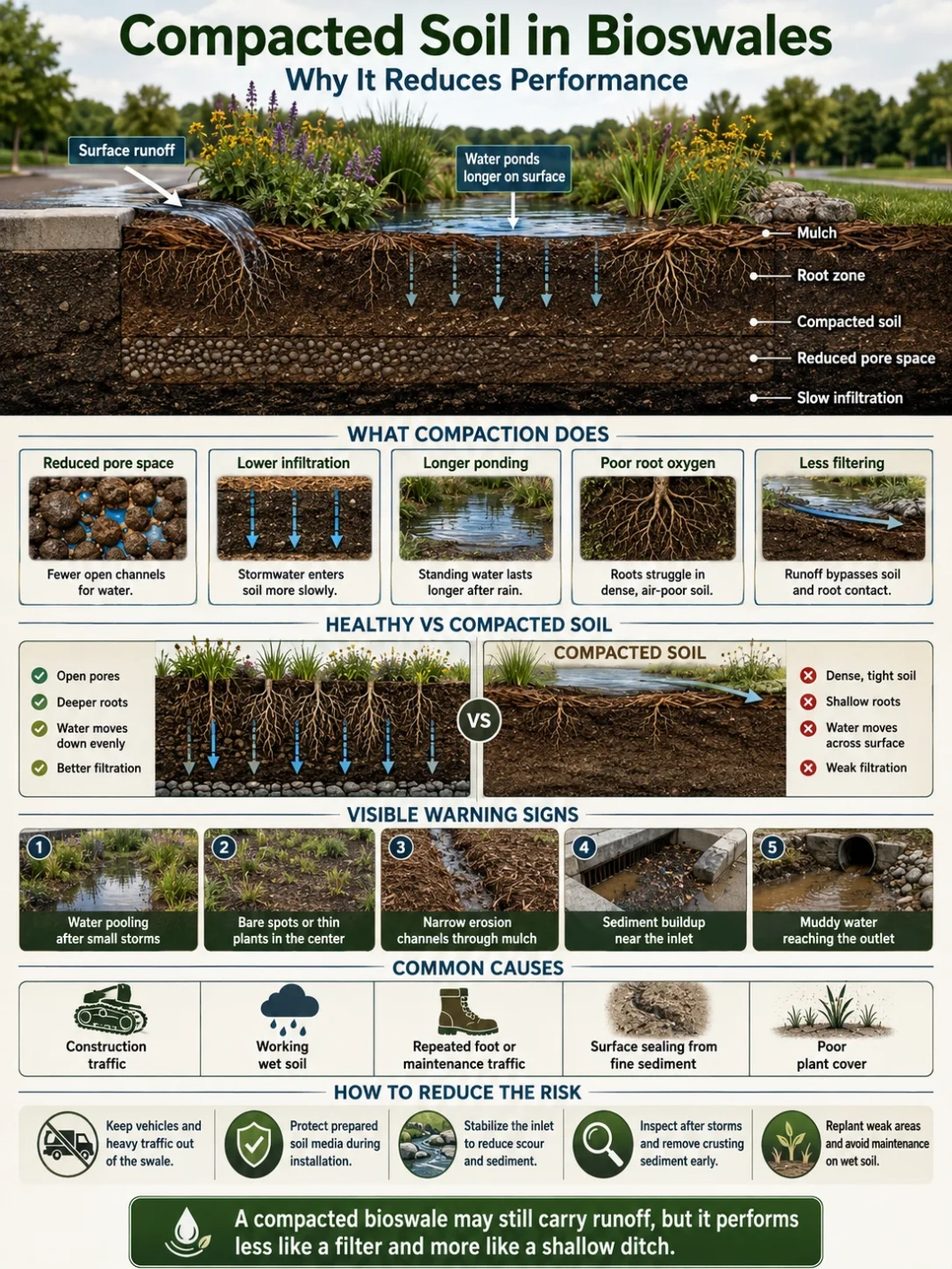
Compacted soil in bioswales reduces performance because it closes the small pore spaces that allow stormwater to soak, spread, and move through the soil. When those pores are squeezed shut, runoff stays on the surface, moves too fast, bypasses plant roots, and carries more sediment toward the outlet instead of being slowed and filtered.
A bioswale is not only a shallow planted channel. Its real work happens at the surface and below it. The soil must hold water briefly, let air reach roots, support plant growth, and allow runoff to drain at a rate that fits the site. Soil compaction weakens all of those functions at once.
Why Compaction Matters in a Bioswale
Soil looks solid, but healthy bioswale soil contains a mix of mineral particles, organic matter, water, air, roots, and open pore space. Those pores act like tiny passages. They allow water to enter the soil, move downward or sideways, and stay in contact with soil particles long enough for filtration to happen.
When soil is compacted, the larger pores collapse first. These larger pores are the ones that help stormwater enter quickly during a rain event. Smaller pores may remain, but they move water much more slowly. The result is a bioswale that may still look planted and shaped correctly, while its drainage function has already dropped.
Compaction is a hidden performance problem. It can sit below mulch, turf, sediment, or plant cover, making the bioswale appear normal until water begins to pond, bypass, or erode the flow path.
| Soil Condition | What Changes | Effect on the Bioswale |
|---|---|---|
| Reduced pore space | Water has fewer open paths into the soil. | More runoff stays on the surface or exits quickly. |
| Lower infiltration | Stormwater enters the soil more slowly. | Ponding lasts longer and drainage becomes less reliable. |
| Poor root oxygen | Air movement around roots declines. | Plants may thin, yellow, or fail to establish. |
| Surface sealing | Fine sediment and pressure form a tight crust. | Water may sheet across the swale instead of soaking in. |
| Shortened flow contact | Runoff bypasses the soil media and root zone. | Filtering of sediment and pollutants can decline. |
How Compaction Reduces Infiltration
Infiltration is the movement of water from the surface into the soil. In a bioswale, infiltration does not need to be instant. In many designs, runoff is meant to slow down, spread across the planted bed, soak into the soil media, and drain through a safe outlet or underdrain where used.
Compacted soil interrupts that sequence. Water reaches the bioswale but cannot enter the soil fast enough. During small storms, this may create shallow standing water. During larger storms, runoff may ride over the compacted layer and leave through the outlet with less filtering than intended.
This matters most near the inlet, where runoff first enters from a roof leader, curb cut, driveway, parking lot, or roadside edge. If the inlet zone is compacted, sediment drops out, water slows unevenly, and the first section of the bioswale may clog while the rest of the swale receives less flow.
Soil Note: A compacted sandy soil and a compacted clay soil can both perform poorly, but they fail in different ways. Sandy soil may lose rapid entry points when pressed tight. Clay soil may hold water for longer when its structure is smeared or compressed. Site testing helps separate soil texture from compaction.
Surface Flow Becomes Faster and Less Even
A bioswale works best when runoff spreads across a stable, vegetated flow path. Compacted soil often creates the opposite condition: hard patches, bare spots, shallow rills, and areas where water takes the fastest route downhill.
Once water begins to concentrate into narrow paths, it can cut through mulch, expose soil, and carry sediment toward the outlet. That sediment may then settle in low points, around plants, or at the entrance to an underdrain. Over time, the bioswale becomes less even and harder to maintain.
Flow path quality is part of soil performance. A bioswale with the right shape but compacted soil may still drain like a shallow ditch, moving water along the surface without enough soil contact.
Filtering Drops When Water Bypasses the Soil
Pollutant filtering in a bioswale depends on contact. Runoff needs time to interact with vegetation, mulch, soil particles, organic matter, and root zones. These parts can help trap sediment and support natural treatment processes, depending on the design and the runoff source.
Compacted soil reduces that contact. Water may remain above the soil surface, skim through a shallow channel, or move around the planted area instead of through it. The bioswale may still collect runoff, but collection is not the same as treatment.
This is why compaction can reduce performance even when the bioswale does not overflow. A swale can pass water downstream and still provide weak filtration if the water does not move through the intended soil and plant system.
Plants Struggle in Compacted Bioswale Soil
Plants are not decoration in a bioswale. Their roots help hold soil, open small channels, slow water near the surface, and support the living soil zone. Grasses, sedges, rushes, shrubs, and other suitable plants can all contribute, depending on moisture zones, sun exposure, and local conditions.
Compacted soil makes plant establishment harder. Roots may have trouble penetrating dense soil. Water may sit near the surface while deeper soil remains poorly aerated. In dry periods, compacted soil may also shed water or limit root access to stored moisture.
The visible signs may appear as thin growth, shallow roots, bare patches, weed pressure, or plants that survive near the edges but fail in the main flow path. Weak vegetation then makes the compaction problem worse because there are fewer roots to hold and open the soil.
Common Causes of Compaction
Compaction can happen before a bioswale starts working, or it can develop slowly after installation. The cause is often ordinary site activity rather than one obvious mistake.
- Construction traffic: equipment, stored materials, and repeated foot traffic can press soil before planting.
- Working wet soil: grading or walking on saturated soil can smear structure and reduce drainage paths.
- Overloaded maintenance access: mowers, carts, or vehicles can compact edges and low points.
- Sediment buildup: fine material from roofs, pavement, bare soil, or roadside runoff can seal the surface.
- Poor plant cover: bare areas receive more direct raindrop impact and are easier to compact.
- Repeated ponding: long wet periods can weaken soil structure, especially where the surface is disturbed.
Compaction is often strongest where runoff enters, where people step across the bioswale, or where equipment reaches the swale for mowing and cleanup.
Compacted Soil Is Not the Same as a Poor Soil Mix
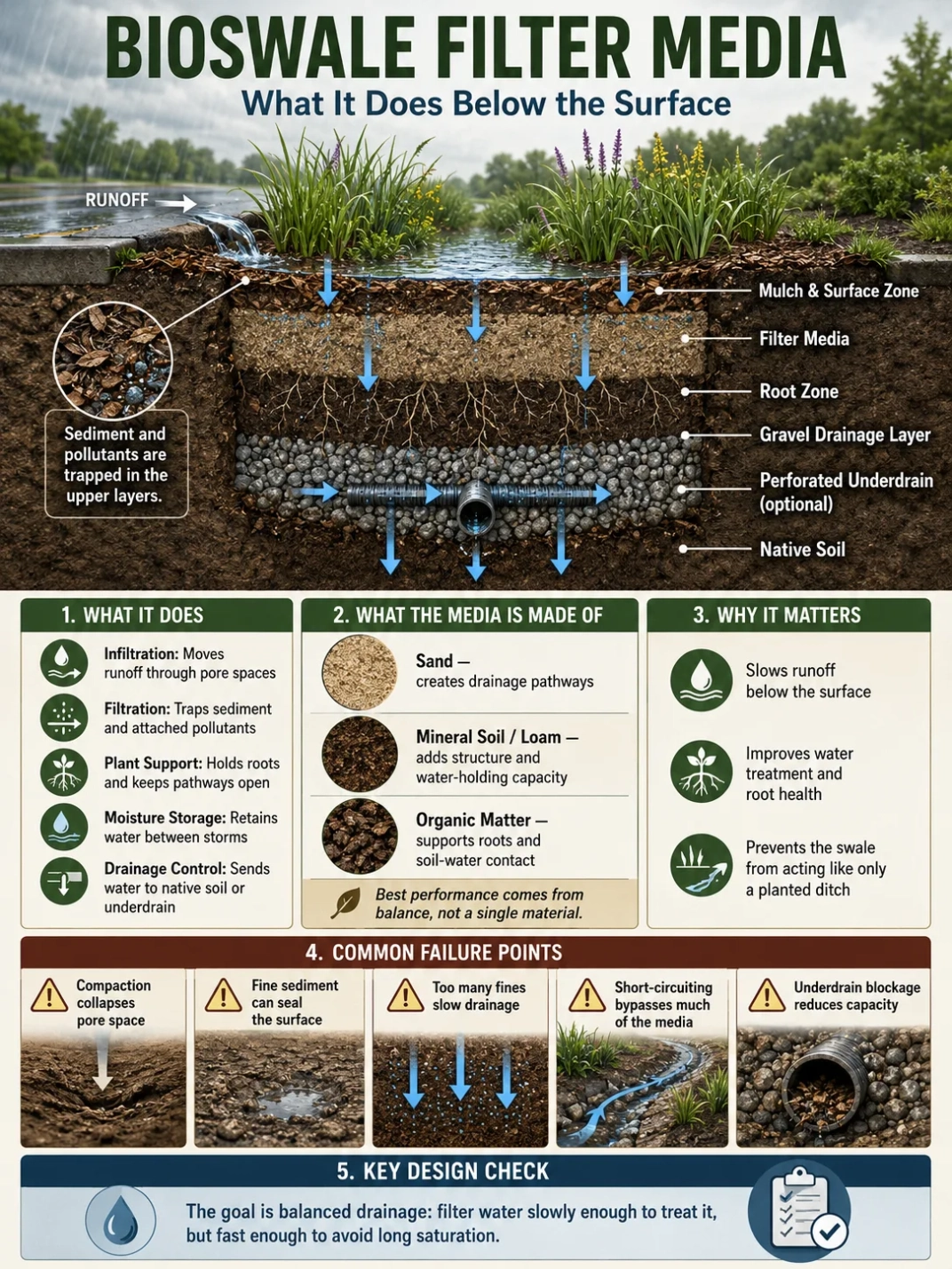
A poor soil mix and compacted soil can create similar symptoms, but they are not the same issue. A bioswale may contain a suitable filter media and still underperform if that media is compressed during installation. Another bioswale may have loose soil but still drain poorly because the soil texture or layering does not fit the site.
That difference matters because the fix is not always “add more compost” or “add sand.” Adding material without understanding the soil can create layering, unstable texture, or a surface that clogs again. In many real sites, soil evaluation, infiltration testing, and review of the drainage route give a better answer than guessing from the surface.
Design Note: Soil media should be protected after placement. If heavy equipment crosses the basin after soil preparation, the bioswale can lose much of its intended drainage capacity before the first storm.
What Compaction Looks Like on a Real Site
Compaction is not always visible as a hard, cracked surface. In a bioswale, it often appears as a pattern of small performance problems.
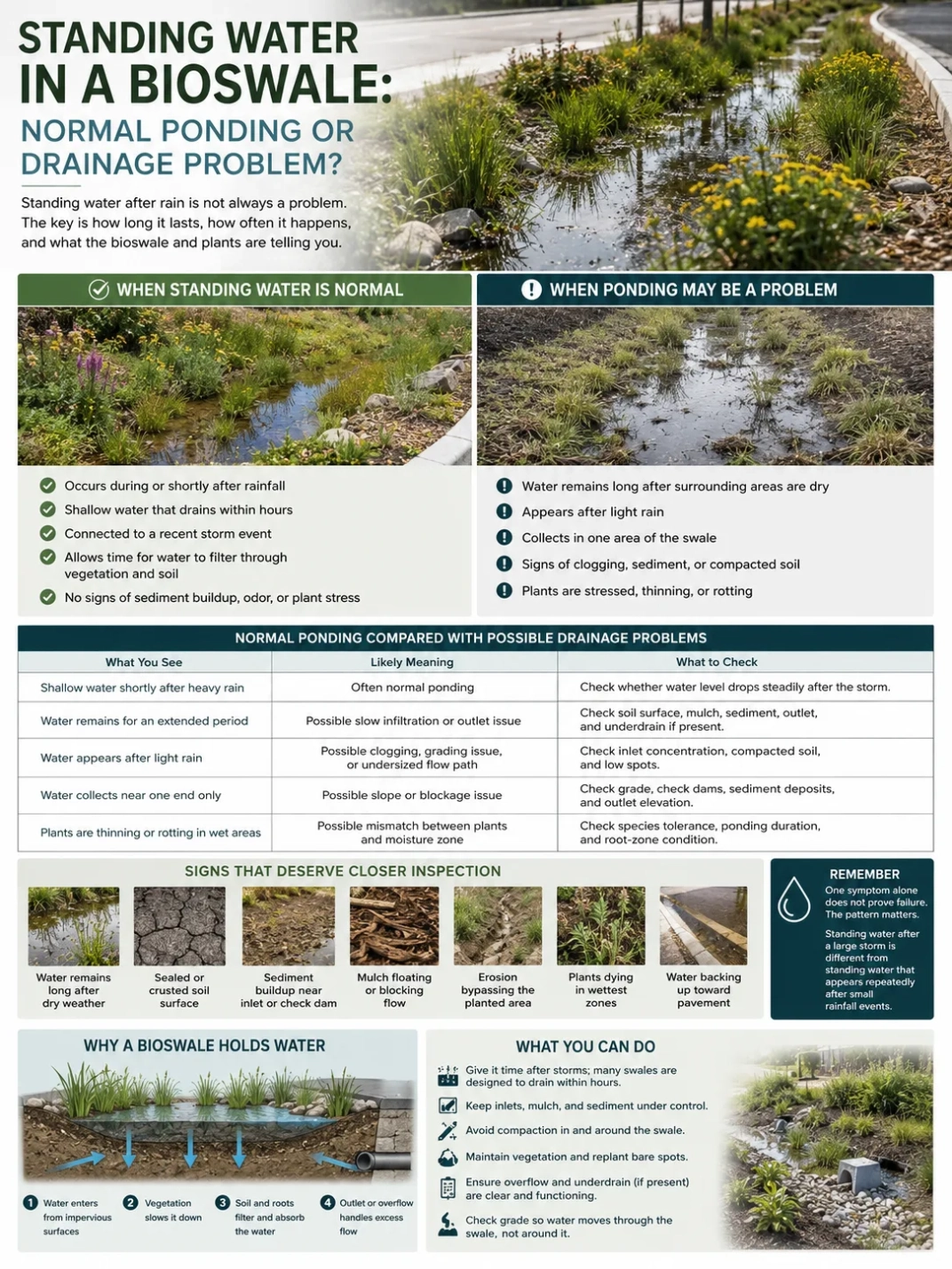
- Water remains in shallow pools after ordinary rain events.
- Runoff cuts a narrow path through mulch or exposed soil.
- The inlet area clogs with sediment faster than other areas.
- Plants fail in the center while edges look healthier.
- Mulch floats, piles up, or forms a sealed mat.
- The outlet receives muddy water during storms.
- Standing water appears in one compacted zone while nearby soil looks dry.
These signs do not prove compaction by themselves. They can also point to poor grading, undersized overflow, high groundwater, unsuitable soil media, blocked outlets, or heavy sediment loads. Still, compaction should be part of the inspection when several of these signs appear together.
How Compaction Affects Ponding and Drain Time
Temporary ponding can be normal in many bioswale and bioretention designs. The problem is not the presence of water by itself. The problem is water that remains longer than the design intent, appears after small storms, or collects in areas where the soil should accept runoff more evenly.
Compacted soil can create a perched wet layer near the surface. The top few inches may stay saturated while water struggles to move deeper. This can stress plants that need both moisture and oxygen. It can also make the surface easier to damage during maintenance.
Where local rules or project plans set a drawdown expectation, that expectation should guide inspection. Without that information, the safer approach is to look for changes over time: slower drainage, expanding bare patches, more sediment at the inlet, or more frequent bypass flow.
Design Details That Reduce Compaction Risk
Compaction control starts before planting. A bioswale should be treated as a drainage feature during construction, not as leftover landscape space. The soil bed, side slopes, inlet, outlet, and overflow route all need protection from unnecessary pressure.
- Limit traffic inside the swale: keep equipment, vehicles, and material storage out of the basin area where possible.
- Shape the flow path carefully: uneven grading can concentrate water and increase erosion on compacted spots.
- Stabilize the inlet: stone, vegetation, or other approved inlet treatment can reduce scour and sediment loading.
- Protect prepared soil media: place and finish soil when conditions are suitable, then avoid repeated disturbance.
- Plan maintenance access: access routes should allow inspection without turning the swale bed into a walking path or wheel path.
- Use plants with suitable roots: dense root systems can help maintain soil structure when matched to moisture, sun, and climate conditions.
Some sites also use underdrains, check dams, or amended soil media, depending on soil conditions, rainfall, runoff volume, and local design rules. These parts can help a bioswale function, but they do not remove the need to avoid compaction.
Maintenance Checks That Catch Compaction Early
Maintenance should look at more than weeds and trash. A bioswale can be clean and still have compacted soil. Regular inspection after storms gives the best clues because it shows how water actually moves through the system.
- Check whether water spreads evenly or forms a narrow channel.
- Look for sediment crusts near the inlet and low points.
- Watch for plant thinning in the main flow path.
- Remove sediment before it seals the surface.
- Replace dead plants where soil and moisture conditions are suitable.
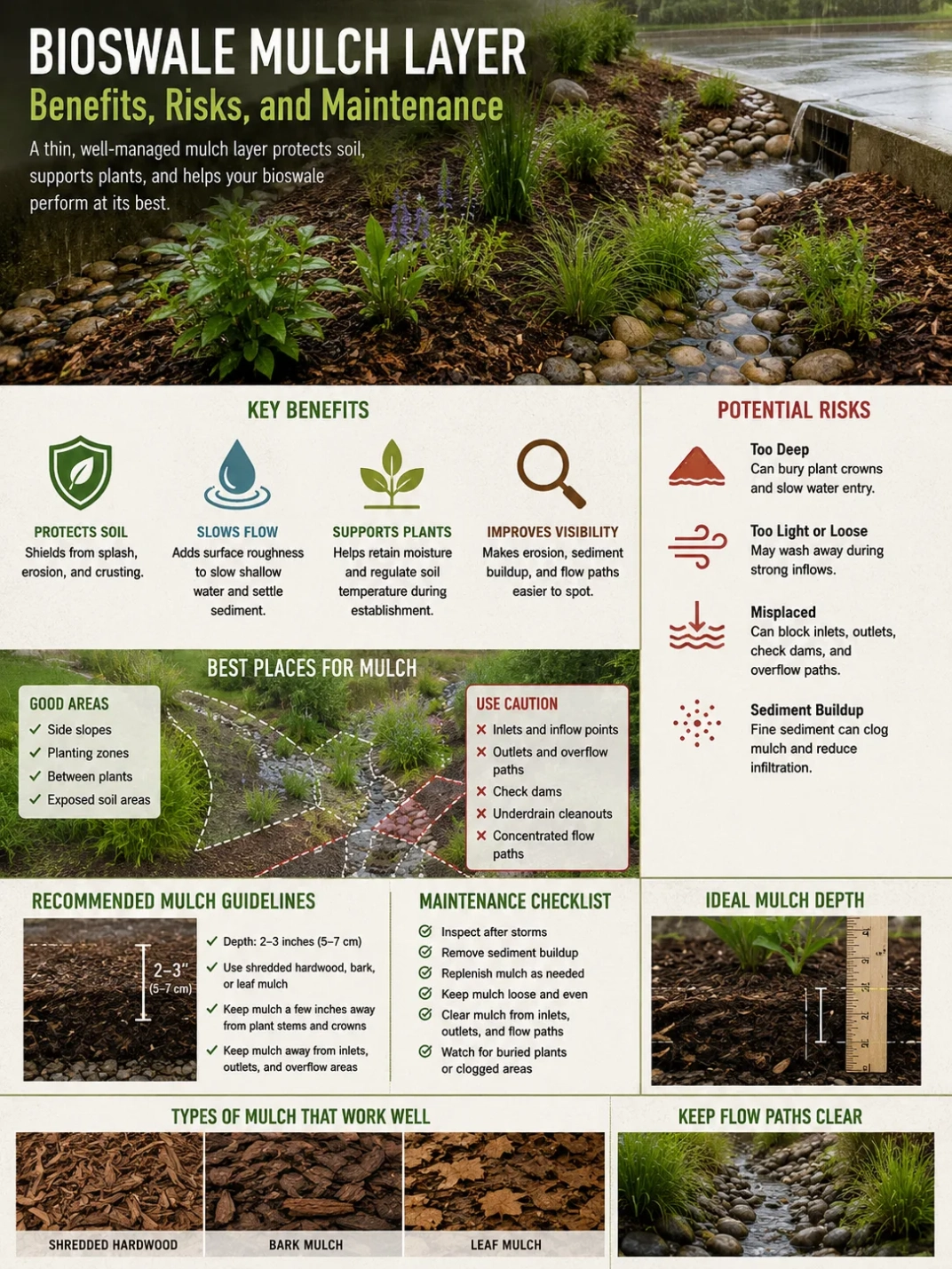
- Keep mulch from forming a thick, matted layer that blocks infiltration.
- Avoid mowing or walking through the swale when soil is wet.
Maintenance Note: Aeration, soil loosening, or media replacement may help in some cases, but the right method depends on the depth of compaction, the soil type, plant roots, and the drainage design. Deep disturbance near utilities, underdrains, liners, or tree roots should be handled with care.
Where Compaction Creates Bigger Design Problems
Compaction is more serious when the bioswale receives runoff from large impervious areas. Parking lots, roads, roofs, and long driveways can send fast runoff with sediment, grit, and fine particles. If the soil surface is already tight, that added sediment can clog the system faster.
Residential sites can also face limits. A small yard bioswale near a foundation, basement wall, neighboring property, or public drainage route needs a safe overflow path. Loosening compacted soil without planning where excess water goes can create a new drainage problem nearby.
Site conditions shape the answer. Soil texture, slope, groundwater depth, runoff source, planting plan, and local requirements all affect whether compaction can be corrected with maintenance or whether the bioswale needs design review.
When Another Drainage Feature May Be Needed
A bioswale is useful where surface flow, planting, soil contact, and safe overflow can work together. If the site has very slow-draining subsoil, heavy hardscape runoff, limited space, or repeated sediment loading, a bioswale may need support from other drainage elements.
A rain garden may hold water in a more basin-like shape. A bioretention cell may use engineered media and an underdrain. A French drain moves water underground but does not offer the same planted surface treatment. Permeable pavement manages runoff where it falls, while detention basins and retention ponds handle larger storage roles.
These systems are not interchangeable. Compacted soil in a bioswale does not automatically mean the wrong feature was chosen, but it may show that the site needs better pretreatment, soil reconstruction, overflow planning, or maintenance access.
Professional Review and Site Limits
Professional review is useful when compaction appears with repeated flooding, poor drawdown, unstable slopes, erosion, foundation concerns, public right-of-way runoff, or a blocked underdrain. It may also be needed when local codes set drainage, infiltration, or overflow requirements.
The goal is not to make the bioswale more complicated than necessary. The goal is to understand whether the problem is shallow surface compaction, deeper soil density, sediment clogging, grading, outlet restriction, groundwater, or a mismatch between runoff volume and available swale area.
That distinction leads to better repairs. A compacted surface may need sediment removal and careful loosening. A deeper problem may need soil media replacement, drainage correction, or redesign of the inlet and overflow route.
FAQ
Why is compacted soil bad for a bioswale?
Compacted soil is bad for a bioswale because it reduces pore space. With fewer open pores, water enters the soil more slowly, roots receive less air, and runoff may bypass the soil media instead of being filtered through it.
Can a bioswale still work if the soil is compacted?
A bioswale may still move some water when soil is compacted, but its performance is usually weaker. It may act more like a shallow drainage channel than a planted infiltration and filtering system.
What are the signs of compacted soil in a bioswale?
Common signs include standing water after small storms, thin plant growth, bare patches, hard surface crusting, sediment buildup near the inlet, narrow erosion paths, and runoff that reaches the outlet quickly.
Does mulch fix compacted bioswale soil?
Mulch can protect the surface and reduce erosion, but it does not fix deeper compaction by itself. If the soil below is dense, water may still fail to enter the soil at the intended rate.
Can plant roots reduce compaction over time?
Healthy roots can help improve soil structure over time, especially when plants are well matched to the site. However, roots may not solve severe compaction, construction damage, or a sealed sediment layer without added maintenance or soil repair.
Should compacted bioswale soil be replaced?
Soil replacement may be needed when compaction is deep, drainage remains poor, or the media was damaged during construction. In lighter cases, sediment removal, careful loosening, replanting, and better traffic control may be enough, depending on site conditions.