Shrubs can give a bioswale a stable woody layer, deeper root structure, winter form, and a longer season of interest, but only when their size and moisture tolerance match the flow path. A shrub placed beside an inlet may face fast runoff and sediment, while the same plant near the upper edge may face dry soil between storms. The best choice depends on where water enters, how long the soil stays wet, how quickly it drains, and how much room maintenance crews need.
Shrubs should not be treated as decorative filler between grasses. Their stems change how water moves across the surface. Their roots affect soil structure. Their mature spread can either protect bare ground or block an outlet, sight line, curb opening, or inspection path.
Why Shrubs Matter in a Bioswale
A well-placed shrub can slow shallow runoff, break up a long flow path, hold leaves and mulch in place, and reduce exposed soil around its root zone. Woody roots may also help keep side slopes intact where the soil is suitable and not heavily compacted.
Shrubs add a layer that herbaceous planting cannot fully replace. They create height, branch density, shade, shelter, and winter structure. They can also support a more varied plant community by creating small changes in light, wind, and soil moisture.
The same woody growth can cause problems when it hides erosion, crowds a check dam, traps too much sediment at a narrow inlet, or spreads into an overflow route. Placement matters as much as species choice.
| Bioswale Position | Typical Conditions | Useful Shrub Traits | What to Avoid |
|---|---|---|---|
| Inlet Zone | Fast inflow, sediment, splash, and short periods of deeper water | Flexible stems, strong recovery, and tolerance of wet and dry cycles | Dense branching that blocks flow or hides sediment buildup |
| Lower Flow Path | Frequent wetting, slower drainage, and possible temporary ponding | Roots that tolerate repeated saturation followed by drying | Shrubs that decline in oxygen-poor soil |
| Side Slope | Faster drainage, variable moisture, and erosion exposure | Fibrous or spreading roots and a moderate mature size | Top-heavy plants on unstable or very steep banks |
| Upper Edge | Drier soil, reflected heat, and less frequent wetting | Drought tolerance, heat tolerance, and controlled spread | Plants selected only for wet-soil tolerance |
| Near Outlet or Overflow | Concentrated flow during larger storms and regular inspection needs | Compact form placed outside the clear flow opening | Low branches, suckers, or roots that obstruct access |
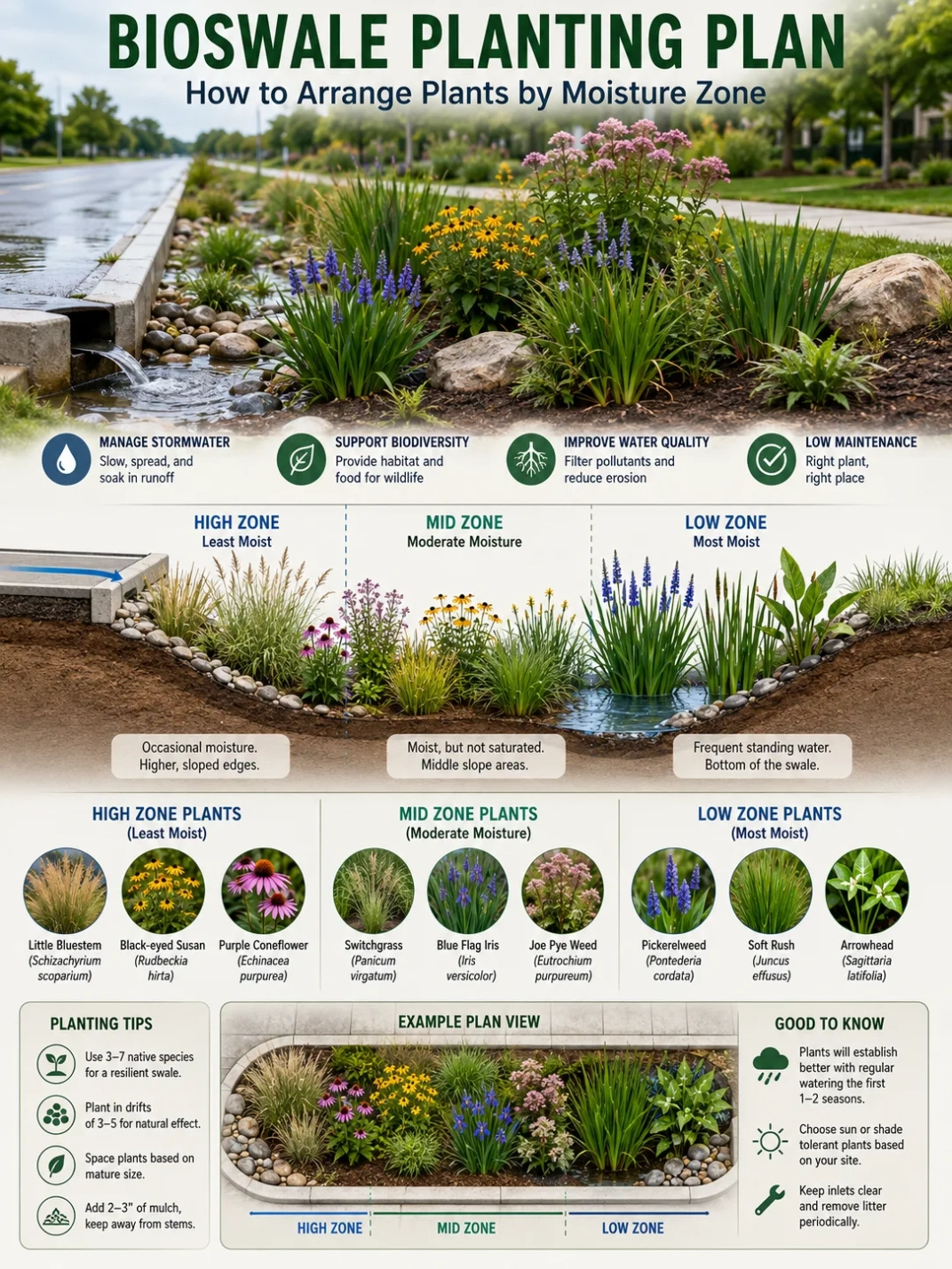
Choose by Moisture Zone, Not by the Word “Wet”
“Wet-tolerant” is too broad for bioswale planting. Some shrubs tolerate moist soil but decline when roots remain saturated. Others handle short flooding but need the soil to drain between storms. A few can live in very wet ground yet perform poorly on the dry upper bank.
The useful question is not simply whether a shrub likes water. It is whether the shrub can handle the wet-dry pattern at its exact planting position.
The Inlet Zone
Water may enter through a curb cut, pipe, downspout connection, or shallow channel. This area often receives the highest sediment load. Shrubs here need space around the stem base so accumulated material can be removed without damaging the plant.
An open branching form is often easier to inspect than a dense thicket. Flexible stems may also recover better where runoff, leaf litter, or snow loading bends young growth.
The Bottom or Lower Flow Path
The lower zone may stay moist longer after rain. Soil oxygen can drop while pores are filled with water. Shrubs used here need tolerance for temporary saturation, followed by periods when the surface dries.
Standing water that remains far longer than the design intends may point to compacted soil, a clogged surface, a blocked underdrain, or an outlet problem. Plant selection cannot correct a drainage defect by itself.
Side Slopes and Upper Edges
Side slopes usually drain faster than the bottom. The upper edge may be dry for long stretches, especially beside pavement. Shrubs in these areas often need drought tolerance, sun tolerance, and roots that can hold the soil without becoming too large for the available width.
Planting Note: A moisture zone is a field condition, not just a line on a plan. Observe where sediment settles, where mulch moves, where water lingers, and where the soil dries first.
Root Structure and Soil Behavior
Shrub roots help shape the upper soil profile, but root depth varies with species, soil texture, compaction, drainage, and oxygen. A plant described as deep-rooted may still keep most roots near the surface when lower soil layers are dense or poorly aerated.
That matters in bioswales because the planting hole is not the whole soil system. Digging a large hole in compacted ground can create a pocket that collects water without improving the flow path beyond it.
Fine Roots and Soil Contact
Fine roots explore pores, interact with soil organisms, and help bind small soil particles. Repeated root growth and decay may support pore formation over time. This process works best where the soil is not repeatedly compressed by vehicles, storage, foot traffic, or maintenance equipment.
Spreading Roots and Suckers
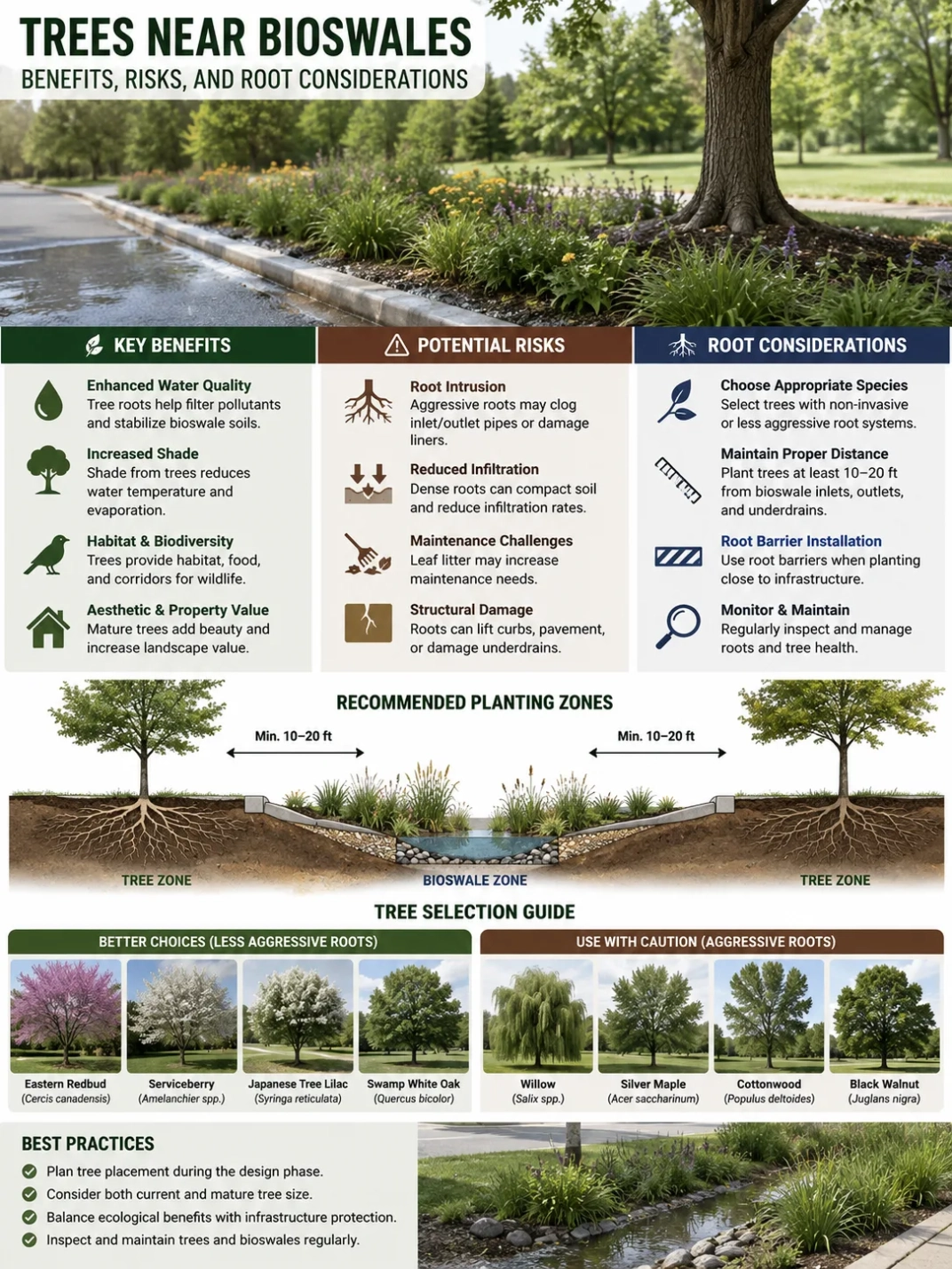
Some shrubs spread by underground stems or root suckers. This can be useful on a broad slope where a colony is wanted. It can be difficult beside a narrow sidewalk, curb opening, underdrain cleanout, fence, or utility corridor.
Before planting, decide whether the intended form is a single specimen, a loose group, or a spreading mass. The maintenance plan should match that growth habit.
Woody Roots Near Drainage Components
Roots should not be expected to damage every pipe or underdrain, but damaged joints, persistent moisture, and poorly sealed components can attract root growth. Keep shrubs clear of inspection ports, outlet structures, liners, and other parts that need access. Where a project includes subsurface drainage, follow the spacing and planting limits set for that site.
Mature Size Controls More Than Appearance
A small nursery shrub can become wider than the bioswale itself. Mature height and spread affect water movement, maintenance access, visibility, shade, and competition with nearby plants.
- Width: Branches should not close a curb cut, narrow a sidewalk, or cover an overflow opening.
- Height: Public sites may need clear sight lines near roads, paths, crossings, and parking areas.
- Branch density: Dense growth can trap leaves and litter where flow needs to remain open.
- Growth rate: Fast growth may fill space quickly but can increase pruning needs.
- Stem form: Multi-stem shrubs often fit naturalistic planting, while single-stem forms may leave more room at ground level.
Spacing should allow shrubs to reach a useful form without constant shearing. Repeated tight clipping can create dense outer growth, weak interior branching, and a shape that no longer matches the water path.
Seasonal Interest That Still Supports Drainage
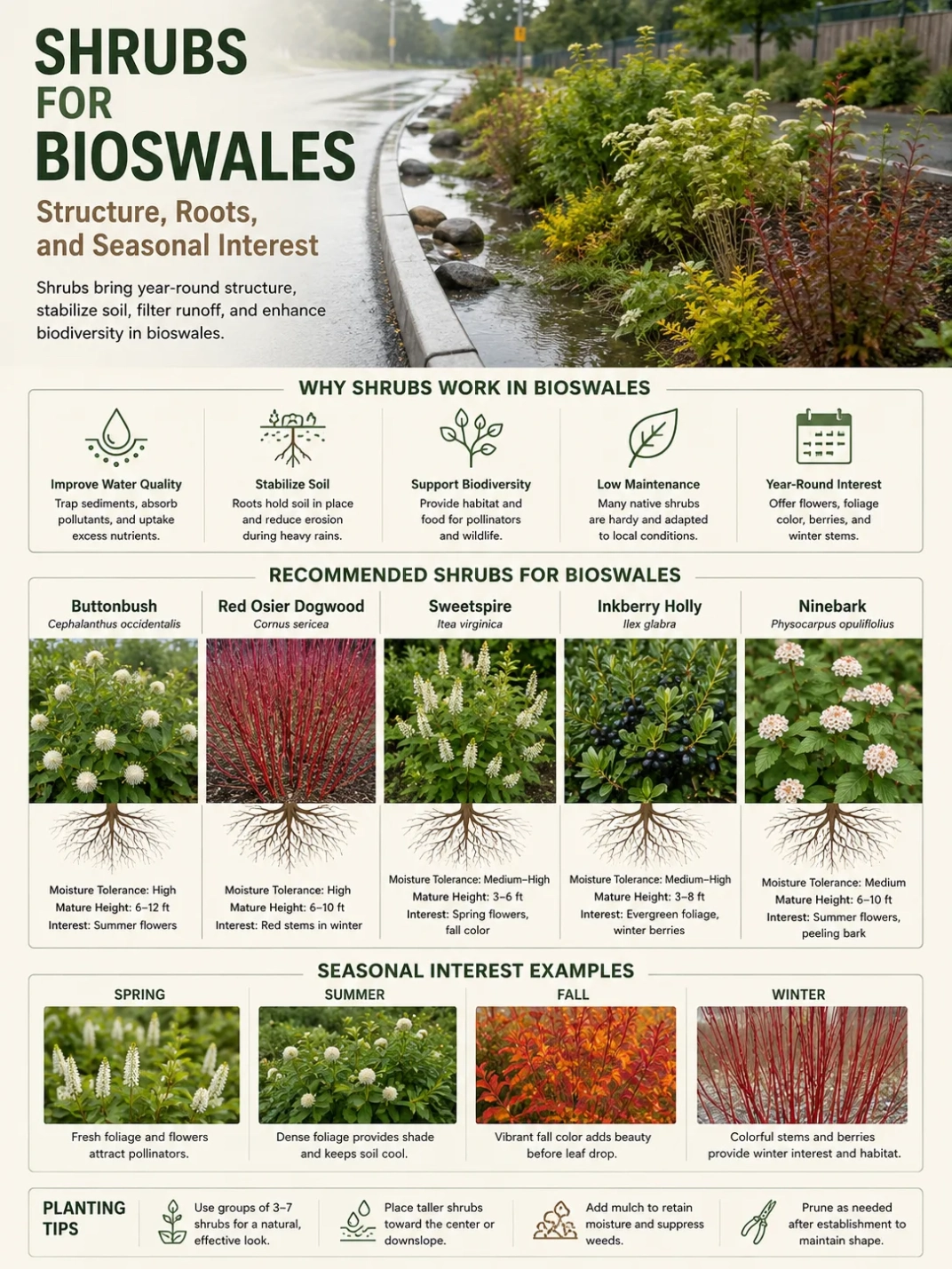
Seasonal interest can come from flowers, fruit, foliage color, bark, stem color, seed heads, or winter silhouette. A balanced planting spreads these features across the year instead of relying on one short bloom period.
Spring and Early Summer
Early flowers can add interest before grasses and sedges reach full size. In a bioswale, flower display should be balanced with stem strength and tolerance of storm flow. Heavy flower clusters are less useful if branches repeatedly fall across an inlet.
Late Summer and Fall
Fruit, seed, and foliage color can extend the visual season. Fruit may also support wildlife, although placement beside roads or busy walkways may call for plants that do not drop large, slippery, or messy fruit.
Winter Structure
Woody stems keep the bioswale visible after herbaceous plants die back. Colored bark, patterned stems, and a clear branching outline can prevent a winter planting from looking empty. This is especially useful in public landscapes where the drainage feature remains part of the streetscape all year.
Winter form should not block winter function. Snow storage, deicing residue, road grit, and plowed material may affect shrubs near streets and parking lots. Plants closest to these areas need tolerance for the actual exposure at that site.
Shrub Types Often Considered for Bioswales
Plant lists should be regional. Climate, soil chemistry, rainfall pattern, salt exposure, local pests, and invasive-plant rules can change what fits. The following groups describe functions and growth habits rather than a universal planting list.
Wet-Tolerant Multi-Stem Shrubs
These shrubs can suit lower zones when they tolerate repeated wetting and later drying. In parts of North America, locally appropriate dogwoods, buttonbush, sweetspire, and some viburnums may be considered. Each species and cultivar has its own soil, sun, cold, heat, and space needs.
Flexible Shrubs for Flow Edges
Shrubby willows and similar plants may tolerate moisture and bending in some regions. They can also spread quickly, grow large, or produce roots and shoots where space is limited. They fit better where the design can accept that behavior.
Compact Shrubs for Upper Banks
Compact, drought-tolerant shrubs can fit upper slopes and edges that drain fast. Some ninebarks, inkberry hollies, shrubby cinquefoils, and regionally native small shrubs may work where soil and climate match. Mature width still needs attention; the word “compact” on a plant label does not mean the plant will remain narrow without pruning.
Thicket-Forming Shrubs for Broad Sites
Colony-forming shrubs can cover wide banks, support erosion control, and create habitat. They are usually a poor fit in tight urban cells, narrow residential swales, or locations where crews need open access to inlets and outlets.
Site Planning Note: Confirm local native status, invasive status, expected mature size, salt tolerance, and wet-dry tolerance before selecting a shrub. A species that performs well in one region may be poorly suited to another.
Mix Shrubs with Grasses, Sedges, and Perennials
Shrubs usually work best as one layer in a mixed planting. Grasses, sedges, rushes, and flowering perennials can fill gaps close to the ground, protect soil between woody stems, and respond quickly after planting.
A shrub-only bioswale may leave open soil while young plants establish. It may also create a coarse root and canopy pattern with fewer low stems to slow shallow sheet flow. A mixed community gives the planting more ways to cover soil and recover from local damage.
Competition still needs to be managed. Dense ground-layer plants can crowd young shrub crowns, while mature shrubs may cast enough shade to reduce sun-loving species beneath them. Planting zones should reflect the light conditions expected after the shrubs grow, not only the conditions present on planting day.
Planting and Establishment Details
Good plant selection can be undone by poor installation. Container-grown shrubs may have circling or matted roots. Burlap, wire, ties, and deep planting can interfere with establishment when they are not handled correctly for the plant and root ball type.
- Place the root flare near the intended finished soil surface rather than burying the stem base.
- Spread or correct circling roots where accepted planting practice allows.
- Keep mulch away from direct contact with stems and crowns.
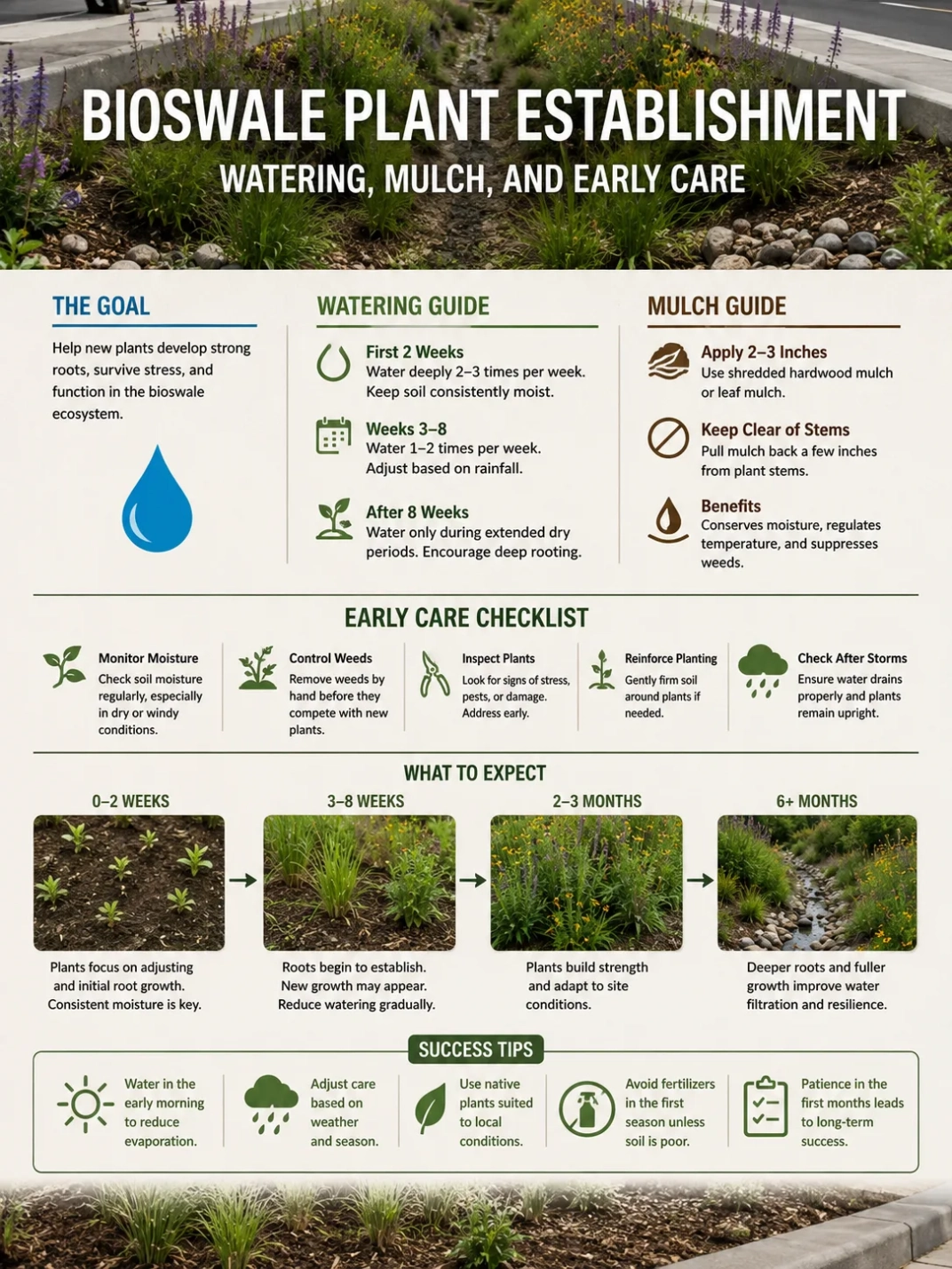
- Water during establishment based on weather, soil moisture, and plant condition rather than a fixed calendar alone.
- Protect the soil from compaction during planting and later maintenance.
- Keep inlet, outlet, overflow, and cleanout areas visible.
Temporary irrigation may be needed even for wet-tolerant shrubs. A bioswale does not stay wet all the time, and newly planted roots occupy a limited soil volume. Dry weather between storms can stress plants before roots extend into surrounding soil.
Maintenance Needs for Woody Planting
Shrubs change the maintenance pattern of a bioswale. They need less seasonal cutting than many herbaceous plants, but they require inspection for broken branches, blocked flow openings, sediment around stems, suckering, dead wood, and poor structure.
- Remove sediment before it buries stem bases or changes the intended grade.
- Prune branches that block inlets, outlets, paths, signs, or sight lines.
- Replace dead shrubs only after checking whether drainage, soil compaction, salt, or planting depth caused the loss.
- Watch for erosion channels that form beside root balls or along the outer edge of a shrub mass.
- Maintain mulch as a thin, even layer where mulch is part of the design.
- Control volunteer woody plants before they occupy drainage structures or maintenance routes.
Maintenance Note: Repeated shrub loss in the same spot often points to a site problem rather than bad luck. Check ponding, soil density, inflow force, salt exposure, and root depth before replanting.
Where Shrubs Can Work Against the Design
Shrubs are not suitable for every part of every bioswale. In very narrow systems, their mature width may leave no clear path for water or inspection. Near road intersections, tall growth may conflict with visibility. In small residential drainage areas, roots and branches may crowd foundations, fences, utilities, or neighboring property.
Dense shrubs can also make it harder to see bare soil, invasive plants, erosion, or standing water. A planting that looks full from the sidewalk may hide a blocked outlet beneath the canopy.
Avoid placing shrubs where they would obstruct:
- Curb cuts and pipe inlets
- Overflow routes
- Underdrain cleanouts
- Check dams and level spreaders
- Pedestrian access
- Road and driveway sight lines
- Utility access zones
- Inspection and sediment-removal areas
When Site Conditions Need Professional Review
Professional input may be appropriate where runoff comes from a large parking area or roadway, where slopes are unstable, where water could reach a building, where an underdrain or liner is planned, or where local drainage rules apply. The same is true when overflow could move toward neighboring property or a public right-of-way.
Landscape architects, civil engineers, soil specialists, horticulturists, and local stormwater staff may address different parts of the problem. Planting design should support the hydraulic layout, not compete with it.
Frequently Asked Questions
Are Shrubs Good for Bioswales?
Yes, when their moisture tolerance, root behavior, mature size, and location match the site. Shrubs can add woody structure, seasonal interest, soil cover, and root diversity. They should remain clear of inlets, outlets, overflow paths, and maintenance access.
Do Bioswale Shrubs Need to Be Native?
Native shrubs are often useful because they may fit local climate and ecology, but native status alone does not prove that a plant suits a wet-dry cycle, compact urban soil, road salt, shade, or limited space. Check the species, the site, and local invasive-plant guidance together.
Can Shrubs Be Planted in the Bottom of a Bioswale?
Some can, provided they tolerate the expected ponding and the soil drains within the intended design conditions. A shrub that likes moist soil may still fail in prolonged saturation. Persistent standing water should be investigated rather than treated only as a planting issue.
How Far Should Shrubs Be from an Inlet or Outlet?
There is no single distance that fits every bioswale. Spacing depends on mature width, flow velocity, sediment load, maintenance equipment, visibility, and the shape of the drainage opening. Keep the structure open and accessible at the shrub’s mature size.
Will Shrub Roots Improve Infiltration?
Roots can help create soil pores and support soil structure over time, but they cannot correct every drainage problem. Compacted subsoil, clogged filter media, poor grading, or a blocked outlet may still limit infiltration and drainage.
Do Shrubs Reduce Bioswale Maintenance?
They change the work rather than remove it. Shrubs may need less routine cutting than some herbaceous plants, but they still need pruning, sediment checks, replacement, weed control, and inspection around drainage structures.