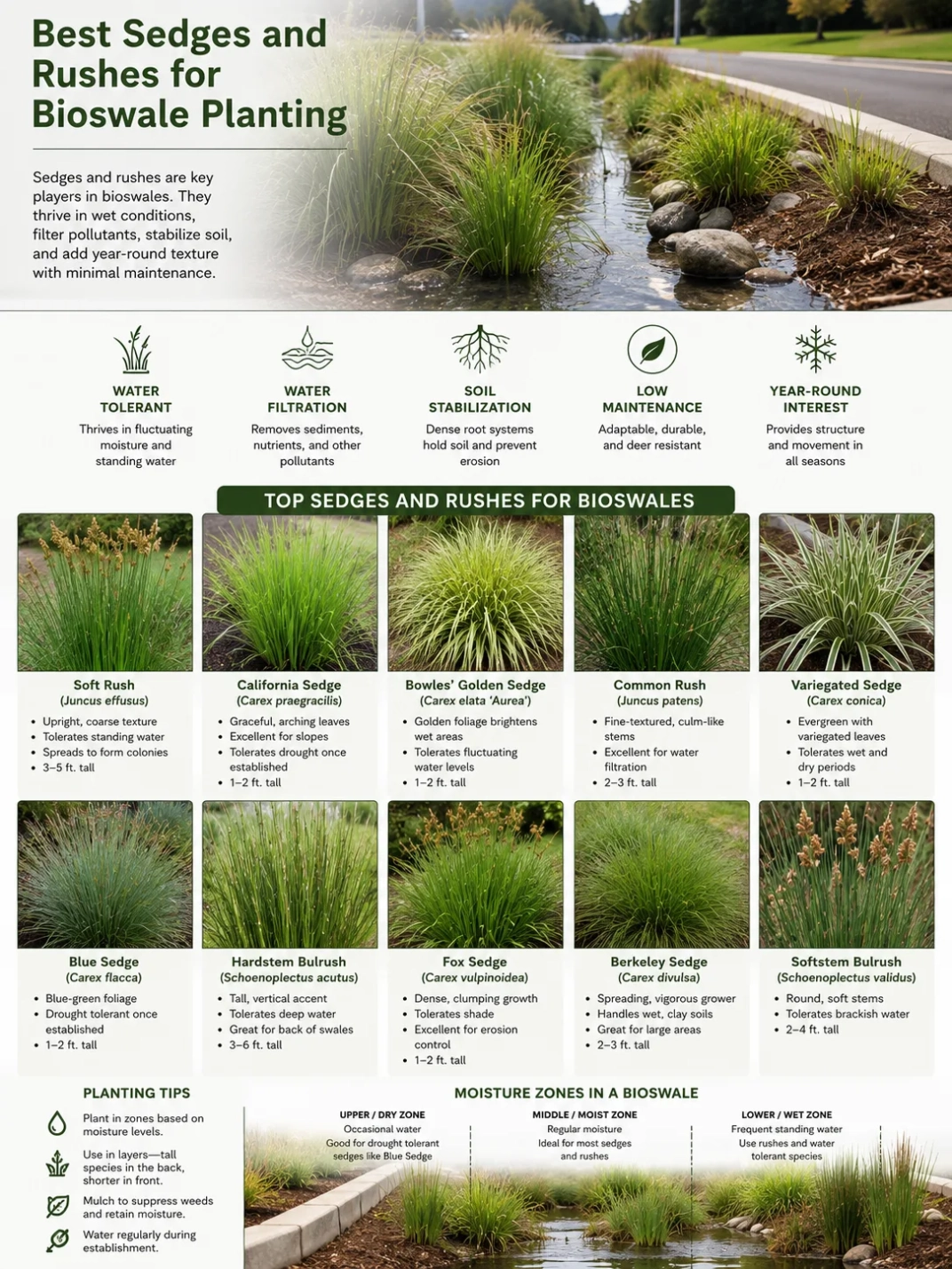
The best sedges and rushes for a bioswale are plants matched to its wettest bottom, periodically moist side slopes, and drier upper edge. Species that tolerate both saturation and dry intervals usually perform better than plants chosen only because they are labeled “moisture loving.” Mature height, root form, spreading habit, sediment exposure, winter conditions, and local ecology matter just as much as appearance.
Sedges and rushes are especially useful where stormwater runoff arrives in short pulses. Their upright stems slow shallow flow, their dense bases help hold soil, and their roots maintain pathways through the planting media. They can also trap suspended sediment near the surface, although pollutant treatment depends on the entire bioswale system—not plants alone.
Why Sedges and Rushes Fit Bioswales
A bioswale does not stay evenly wet. The inlet may receive fast runoff and sediment. The bottom may pond briefly after rainfall. Side slopes may drain sooner, while the upper edge can remain dry for long periods.
Many sedges and rushes are adapted to this shifting moisture pattern. Their foliage bends under moving water rather than forming a solid obstruction, and their fibrous or rhizomatous roots can help protect exposed soil. Dense growth also reduces open patches where weeds and surface erosion may begin.
The two groups are related in landscape function but botanically different. Sedges belong mainly to the Cyperaceae family and often have angled stems. True rushes belong to the Juncaceae family and commonly have rounded stems. Plant form varies, so identification should not rely on stem shape alone.
Match Plants to Bioswale Moisture Zones
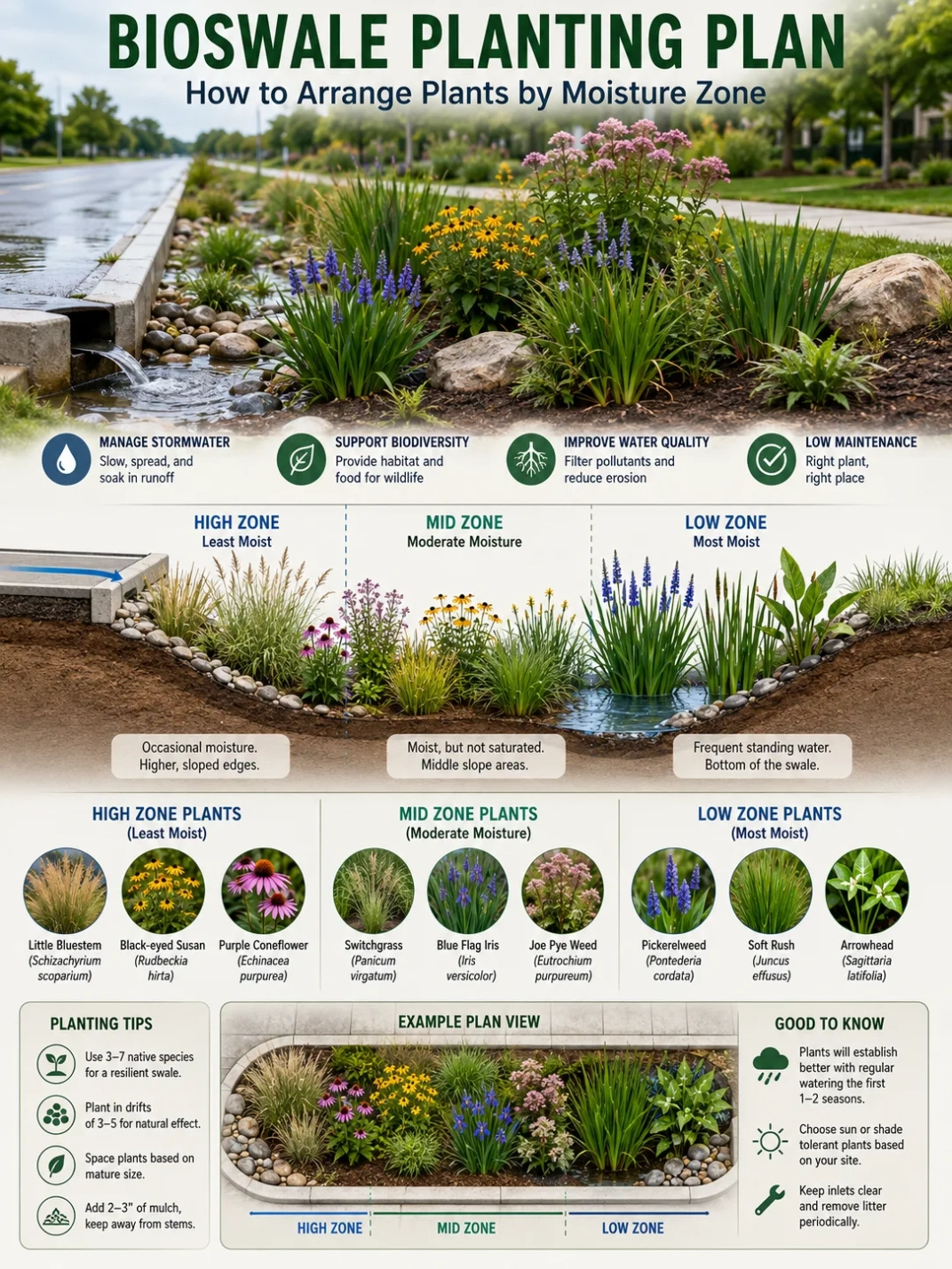
Plant selection is more reliable when the bioswale is divided into hydrologic zones. These zones describe how often an area becomes wet and how quickly it dries.
| Planting Zone | Typical Conditions | Useful Plant Traits | Examples to Consider |
|---|---|---|---|
| Bioswale bottom | Receives the most runoff and may hold shallow water after storms | Tolerance of periodic ponding, wet soil, sediment, and later drying | Fox sedge, sallow sedge, soft rush, common spike-rush |
| Lower side slope | Frequently moist but usually drains before the bottom | Dense roots, flexible stems, and tolerance of alternating wet and dry soil | Fox sedge, awl-fruited sedge, fringed sedge, soft rush |
| Upper side slope | Receives splash and occasional saturation but can remain dry between storms | Seasonal moisture tolerance, soil-holding roots, and moderate drought tolerance | Path rush, clustered field sedge, locally adapted dry-mesic sedges |
| Inlet area | May receive concentrated flow, coarse sediment, and debris | Firm root crowns, dense stems, and recovery after burial or flattening | Fox sedge, soft rush, other locally proven wet-meadow species |
| Outlet and overflow edge | May experience short periods of faster flow | Strong soil cover without blocking the intended overflow route | Low or medium-height sedges chosen for the local moisture range |
These examples describe common tendencies rather than universal placement rules. Soil texture, rainfall pattern, sun exposure, drainage layers, and irrigation during establishment can change where a species performs well.
Planting Note: A plant suited to a natural marsh may not fit a bioswale that drains within a short period. Look for species adapted to seasonal wetness, not only permanently saturated ground.
Sedges Worth Considering
The genus Carex contains many species used in stormwater landscapes. Their needs differ widely. Some form tight clumps, some spread through rhizomes, and others prefer woodland moisture rather than exposed runoff channels.
Fox Sedge
Fox sedge (Carex vulpinoidea) is a common choice for sunny, seasonally wet bioswales in much of North America. It forms dense clumps and tolerates wet soil, shallow temporary ponding, and periods of drier ground after establishment.
Its fibrous roots and dense stems can help stabilize the bioswale bottom and lower side slopes. It may self-seed where conditions suit it, which can be useful in naturalistic plantings but may require editing where a formal appearance is expected.
Tussock Sedge
Tussock sedge (Carex stricta) forms raised clumps that create texture and small variations in surface flow. It is best suited to sites that remain moist or wet for much of the growing season.
This species may be less suitable for hot, exposed bioswales that dry hard between storms. Its raised tussocks also affect how water moves across the soil surface, so placement should support the intended flow path rather than redirect it toward an edge.
Sallow Sedge
Sallow sedge (Carex lurida) grows in wet meadows, marsh margins, and other damp ground across parts of eastern North America. Its clumping growth can suit bioswale bottoms and lower slopes that receive regular moisture.
It is often a better fit where the soil remains moist between rainfall events. Extended dry periods, especially during establishment, can reduce plant vigor.
Fringed Sedge
Fringed sedge (Carex crinita) prefers moist to wet soil and can grow in sun or partial shade, depending on local climate. Its arching seed heads give it a softer form than many upright sedges.
It can fit shaded or partly shaded bioswales near woodland edges, provided the soil does not become excessively dry. It is less suited to narrow sites where mature foliage would lean into a path or cover a small inlet.
Awl-Fruited Sedge
Awl-fruited sedge (Carex stipata) occurs in wet ground and disturbed moist areas. That background can make it useful where runoff brings periodic sediment and changing moisture conditions.
Its appearance is informal, and plantings may shift as individual plants spread or reseed. It often fits naturalistic swales better than highly ordered ornamental beds.
Slough Sedge
Slough sedge (Carex obnupta) is associated with wet habitats in western North America, especially the Pacific Northwest. It spreads through rhizomes and can form broad, dense stands.
That spreading habit can stabilize larger wet swales, but it may overwhelm a narrow residential planting or mix poorly with slower-growing species. It is best reserved for regions where it is locally appropriate and where its mature spread can be managed.
Clustered Field Sedge
Clustered field sedge (Carex praegracilis) is a spreading western North American sedge that can tolerate seasonal moisture followed by drier conditions. It is often more useful along upper slopes and edges than in a deeply ponded bottom.
Its lower profile can preserve visibility near sidewalks, driveways, and curb openings. Regional origin and local suitability still need to be checked before planting.
Rushes Worth Considering
Rushes in the genus Juncus bring upright structure and dense root systems to wet and seasonally wet landscapes. Their vertical stems can remain visible after many broad-leaved plants flatten under runoff.
Soft Rush
Soft rush (Juncus effusus) is widely used in rain gardens, bioretention areas, and vegetated swales. It tolerates saturated soil and temporary shallow water, yet established plants can also handle periods when the surface dries.
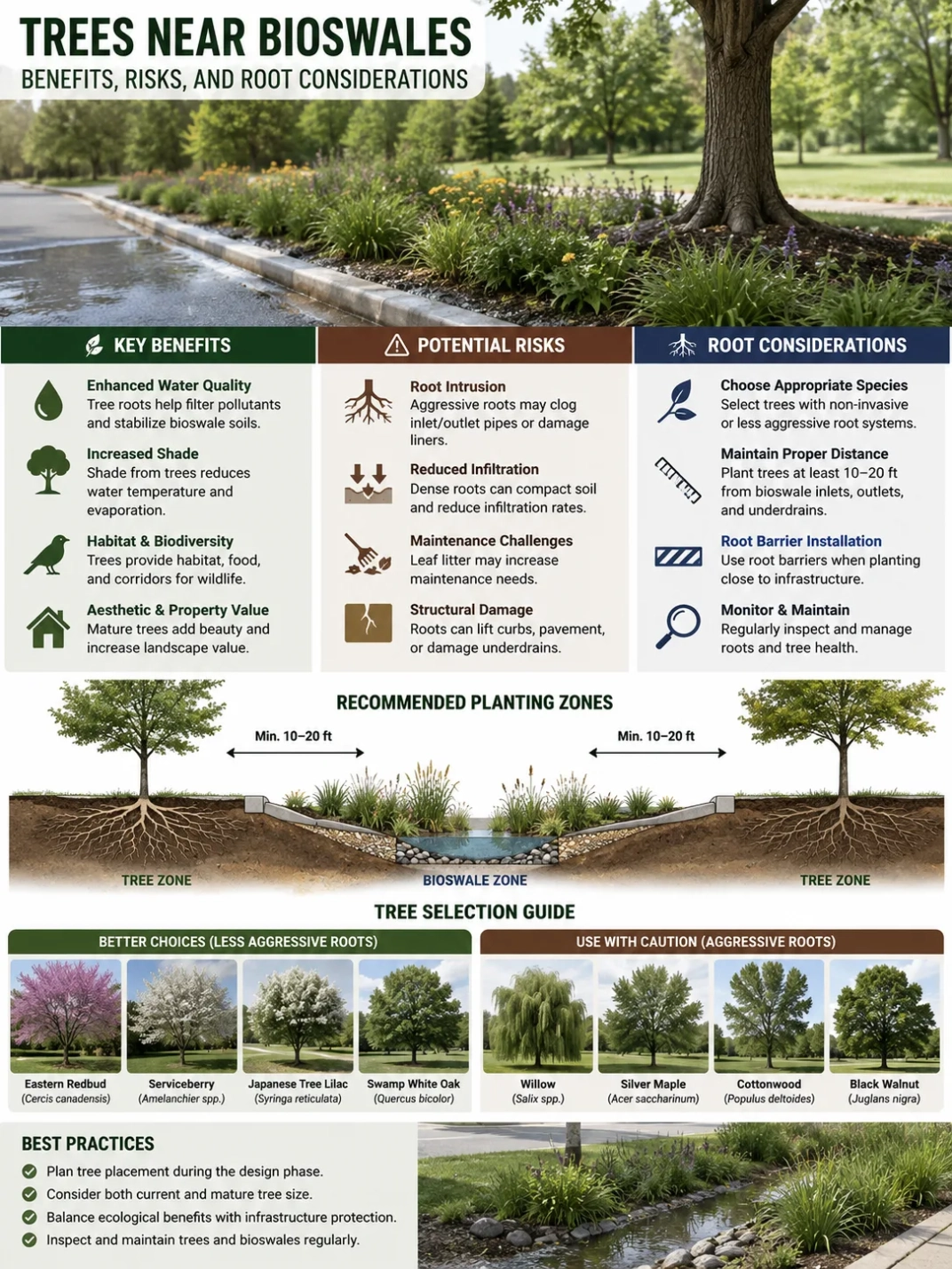
Its dense clumps work well in bioswale bottoms, near inlets, and along lower side slopes. Mature plants can become tall and visually dominant. They should not block road sightlines, building entrances, inspection access, or the visible condition of an inlet.
Path Rush
Path rush (Juncus tenuis) is a smaller rush associated with compacted paths and disturbed ground. It tolerates foot traffic and drier soil better than many wetland rushes.
Its best bioswale role is often near the upper edge, between stepping areas, or in transition zones that receive occasional moisture. It is generally too small and sparse to serve as the main erosion-control plant at a high-flow inlet.
California Gray Rush
California gray rush (Juncus patens) has blue-green to gray-green stems and is used in seasonally wet landscapes in parts of the western United States. Once established, it can handle a wider dry period than many rushes associated with permanently wet soil.
It can fit bioswale side slopes, upper zones, and basins that receive winter rain but dry during summer. It should be selected only within regions and site conditions that match its ecological range.
Common Spike-Rush
Common spike-rush (Eleocharis palustris) belongs to the sedge family despite its common name. It forms low, upright stems and often spreads through underground rhizomes.
It may suit wet bioswale bottoms where a shorter plant is preferred. Spreading behavior varies with soil and moisture, so it can form a useful cover in one site and become too mobile in another.
Bulrushes for Larger Wet Systems
Plants called bulrushes, including species in Schoenoplectus, also belong to the sedge family. They can tolerate wet soil and shallow water, but many grow taller and spread farther than typical Carex species.
They are more suitable for larger stormwater basins, broad public landscapes, or permanently moist sections than for small residential swales. Their height may interfere with sightlines, litter removal, or inspection access.
Design Note: Plant height should be judged at maturity, not at installation. Small nursery plugs can become dense clumps that cover curb cuts, overflow notches, drain grates, or maintenance paths.
How to Choose among Similar Species
A plant list becomes useful only after it is filtered through the actual site. The following traits help separate a good candidate from a plant that merely looks appropriate in a catalog.
- Hydroperiod: Check how often the planting zone becomes saturated and how long it remains wet.
- Dry-period tolerance: Bioswales may go through weeks without rain, especially in climates with seasonal rainfall.
- Root habit: Clumping plants stay more contained, while rhizomatous plants can cover soil faster but may spread outside their intended area.
- Mature height: Lower plants may be needed near streets, driveways, paths, windows, and curb openings.
- Sediment tolerance: Plants near the inlet may be partly buried by incoming soil and grit.
- Sun exposure: Species suited to open wet meadows may thin out beside buildings or under trees.
- Salt exposure: Roadside runoff may contain deicing salt in cold regions. Salt tolerance should be checked through locally relevant plant information.
- Maintenance appearance: Some species remain upright, while others arch, reseed, or form an uneven meadow-like pattern.
Plant source also matters. A species may occur across a broad geographic range while local populations differ in climate response, growth timing, or moisture tolerance. Where available, regionally appropriate native material can provide a closer ecological fit.
Use a Plant Community, Not a Single Species
A bioswale planted with one sedge or rush can develop bare areas if disease, drought, prolonged wetness, or sediment affects that species. A mixed planting spreads those pressures across plants with different root depths, heights, and moisture preferences.
Sedges and rushes often work best as the structural layer of the planting. Flowering perennials, low grasses, and selected shrubs can add seasonal cover and habitat value where the site has enough space. The mix should still leave inlets, outlets, and overflow routes visible.
A Simple Zonal Planting Pattern
- Place wet-tolerant clumping sedges or rushes in the bottom and near low-flow sections.
- Use species that handle repeated wetting and drying along the lower side slopes.
- Add lower, more drought-tolerant sedges or small rushes near the upper edge.
- Keep spreading species away from drains, inspection points, and narrow paved edges unless their growth can be controlled.
- Leave enough open access to remove sediment and check the soil surface.
This pattern needs adjustment where water enters with high velocity. Plants should not be expected to correct an unstable inlet, eroding channel, or poorly directed overflow route.
Root Form and Water Movement
Roots influence more than plant survival. Dense fibrous roots bind the upper soil layer, while older root channels can allow water and air to move through the media. Root activity also supports soil organisms involved in nutrient cycling.
Rhizomatous sedges and spike-rushes can create broad soil cover. Clump-forming plants leave more open space between crowns during early establishment. That space can be filled with smaller companion plants or protected with an appropriate surface treatment while roots develop.
Plants cannot restore infiltration where construction traffic has heavily compacted the subsoil. They may gradually improve the upper root zone, but a sealed or poorly prepared soil layer can continue to restrict drainage.
Soil Note: Repeated standing water may come from slow native soil, compacted subsoil, a clogged surface, a blocked outlet, or a high seasonal water table. Replacing plants without identifying the cause may repeat the same problem.
Common Planting Mistakes
Using Only Wetland Plants
A bioswale may be wet for only a short period after rainfall. Plants that depend on constant saturation can decline during normal dry intervals, especially on upper slopes.
Ignoring Mature Spread
Rhizomatous species can fill open ground efficiently, but they may also enter adjacent beds, surround drain structures, or crowd out slower plants. Their spread should match the available maintenance area.
Planting Tall Rushes beside Traffic Areas
Tall stems can hide pedestrians, vehicles, curbs, or debris at the inlet. Public-space and roadside plantings often need lower vegetation near visibility zones.
Treating the Inlet Like the Rest of the Swale
The inlet receives a different stress pattern. Sediment burial, debris, concentrated flow, and occasional flattening can remove plants that perform well elsewhere in the bioswale.
Choosing by Flower or Foliage Alone
Appearance matters in visible landscapes, but moisture tolerance and growth habit determine whether the planting remains useful. A visually attractive sedge placed in the wrong hydrologic zone may leave bare soil within a season.
What Maintenance Usually Involves
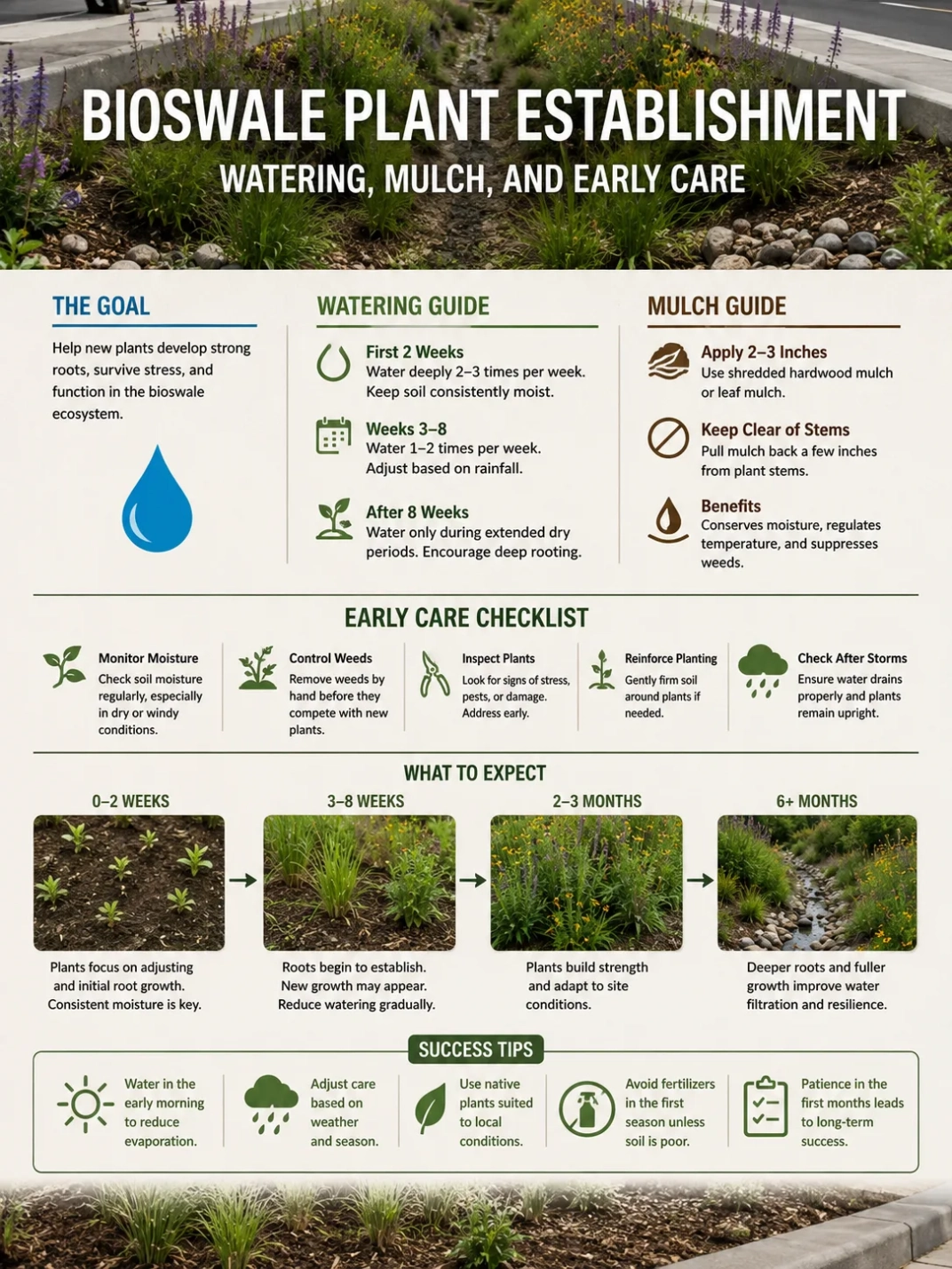
Established sedges and rushes are often lower-maintenance than frequently mown turf, but they still need inspection. Young plantings need closer attention while roots fill the soil and runoff patterns become visible.
- Remove sediment that buries plant crowns or blocks the inlet.
- Check for bare channels forming between clumps.
- Replace plants that repeatedly fail in the same moisture zone.
- Remove unwanted seedlings before they dominate the planting.
- Cut back dead stems when needed for appearance, access, or local maintenance practice.
- Keep outlets, overflow points, and drain structures visible.
- Look for soil compaction caused by foot traffic or maintenance equipment.
- Check whether mulch has floated, collected in a low point, or covered plant crowns.
Dead stems can protect crowns and provide winter structure, so routine cutting is not required in every setting. Public visibility, fire-management practices, snow storage, and local planting standards may shape the maintenance schedule.
Maintenance Note: Repeated plant loss near one location often points to a flow, soil, or grading issue. Replanting the same species may not solve it.
When Site Conditions Matter Most
A small residential bioswale receiving roof or driveway runoff may need compact plants that preserve access and remain manageable by hand. A parking lot or roadside bioswale may face more sediment, trash, road salt, heat, and concentrated flow.
Public and commercial systems also need clear inspection routes. Plants should not conceal curb cuts, underdrain cleanouts, observation wells, overflow structures, or eroded soil.
Professional review may be appropriate where runoff could affect a building foundation, basement, retaining wall, neighboring property, steep slope, public drainage system, or high-traffic area. Local planting restrictions and drainage requirements can also affect which species and layouts are acceptable.
Sedges and Rushes Compared with Other Bioswale Plants
Sedges and rushes provide dependable structure, but they do not replace every plant type. Grasses can add fine roots and movement on drier slopes. Flowering perennials can cover seasonal gaps and support a more varied planting. Shrubs may help in broad swales where their roots, mature size, and maintenance access have been planned.
Compared with many broad-leaved perennials, sedges and rushes often hold their form longer under shallow flowing water. Compared with turf, they usually provide taller stems and deeper, less frequently disturbed root systems. The most suitable mix depends on the bioswale’s runoff source, soil, appearance goals, and available maintenance.
Frequently Asked Questions
What is the best sedge for a bioswale?
No single sedge fits every bioswale. Fox sedge is often considered for sunny, seasonally wet sites in parts of North America, while tussock sedge and sallow sedge are better suited to areas that remain moist for longer periods. Regional suitability and the planting zone should guide the choice.
Are rushes good for standing water?
Some rushes, including soft rush, tolerate saturated soil and temporary shallow ponding. That does not mean they should remain under deep water for long periods. The selected species must match the expected water depth and drying pattern.
Can sedges grow on the dry edge of a bioswale?
Some sedges tolerate seasonal dryness and are better suited to upper slopes or edges. Wetland sedges that need consistently moist soil may decline in the same position. Upper-zone plants should be chosen for both occasional runoff and dry weather.
Should a bioswale use only native sedges and rushes?
Locally native plants can offer a close fit with regional climate and ecology, but the species still needs to match the bioswale’s soil and water pattern. A plant can be native to the wider region yet unsuitable for a dry upper slope, compacted urban soil, or highly exposed roadside location.
How close should sedges and rushes be planted?
Spacing depends on mature width, whether the plant forms clumps or spreads by rhizomes, erosion risk, installation size, and how quickly soil cover is needed. Nursery size alone is not a reliable spacing measure. The mature plant habit should guide the layout.
Why are rushes dying in the bioswale?
Possible causes include prolonged dry soil, deep or extended ponding, compacted media, sediment covering the crowns, poor establishment watering, shade, road salt, or a species that does not fit the local climate. The water pattern and soil condition should be checked before replacement plants are selected.