Salt-tolerant plants for roadside bioswales must handle more than salty soil. They may face chloride-rich runoff, salt spray from traffic, sediment deposits, compacted edges, short periods of ponding, summer drought, reflected heat, and snow storage. A plant that tolerates one of these stresses may still fail when several occur together.
The strongest roadside planting plans match each species to a moisture zone, salt exposure route, soil condition, mature height, and maintenance role. Salt tolerance is only the first filter.
Plant names also need regional review. A species may be native in one part of North America, unsuitable or invasive in another, and unavailable elsewhere. The examples below are starting points for local plant schedules, not a universal planting list.
Why Salt Tolerance Means More Than One Trait
Road salt reaches vegetation in different ways. Dissolved salts move with runoff into the soil and root zone. Fine droplets can land on leaves, buds, stems, and evergreen needles. Salted snow may also be pushed directly onto the planting area, where concentrated meltwater enters the bioswale later.
Soil-salt tolerance and salt-spray tolerance are not identical. A plant may survive saline soil yet show severe damage on road-facing foliage. Another may resist spray but decline where salty water ponds around its roots. Plant schedules should distinguish these exposure paths whenever reliable regional data are available.
Planting Note: Native status does not automatically mean road-salt tolerance. Choose locally appropriate native plants where possible, but screen them for salinity, wet-and-dry cycling, snow loading, sediment, and roadside visibility.
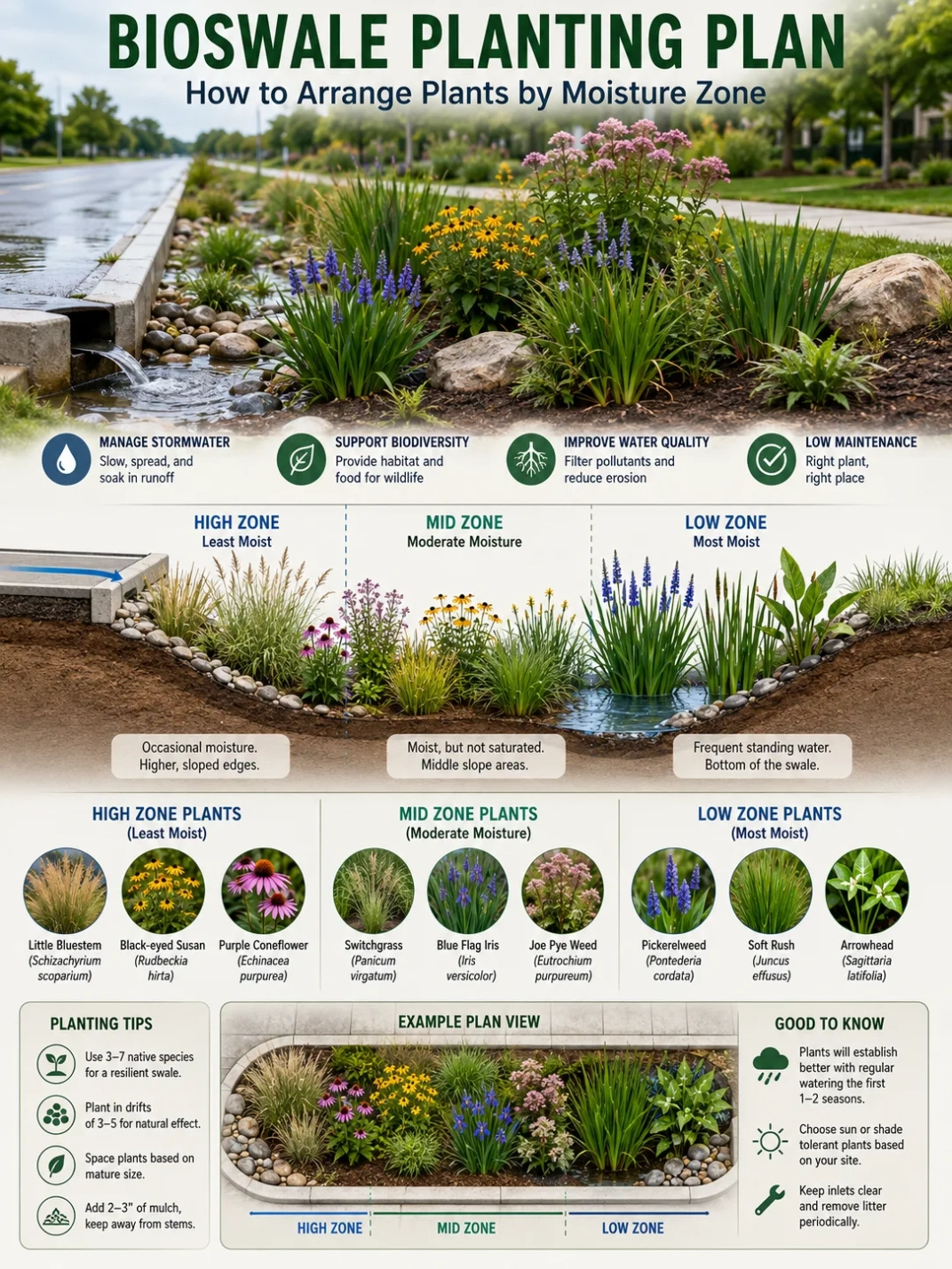
Plant Zones in a Roadside Bioswale
A roadside bioswale rarely has one uniform growing condition. The bottom may receive short periods of ponding, the side slopes may drain more quickly, and the curb edge may receive the heaviest salt spray and sediment. Dividing the planting area into zones helps avoid putting dry-site plants in the wettest area or tall plants where they block sight lines.
| Bioswale Zone | Typical Stress | Useful Plant Traits | Placement Caution |
|---|---|---|---|
| Curb and inlet edge | Salt spray, brine, sediment, splash, snow piles | Low growth, strong crowns, salt tolerance, easy replacement | Keep inlets visible and accessible |
| Swale bottom | Periodic ponding, saturated soil, deposited fines | Wet-and-dry tolerance, dense roots, flexible stems | Salt tolerance must be paired with wet-soil tolerance |
| Lower side slope | Moving water, erosion, changing moisture | Fibrous roots, spreading cover, stem density | Avoid plants that expose bare soil as they mature |
| Upper side slope | Drought, heat, thinner soil, occasional spray | Drought tolerance, salt tolerance, stable root mass | Do not use dry-site plants in frequent ponding areas |
| Back edge | Lower salt load, maintenance traffic, utilities | Broader plant choice, seasonal structure | Protect sight triangles, signs, sidewalks, and access |
Plant Examples by Function and Zone
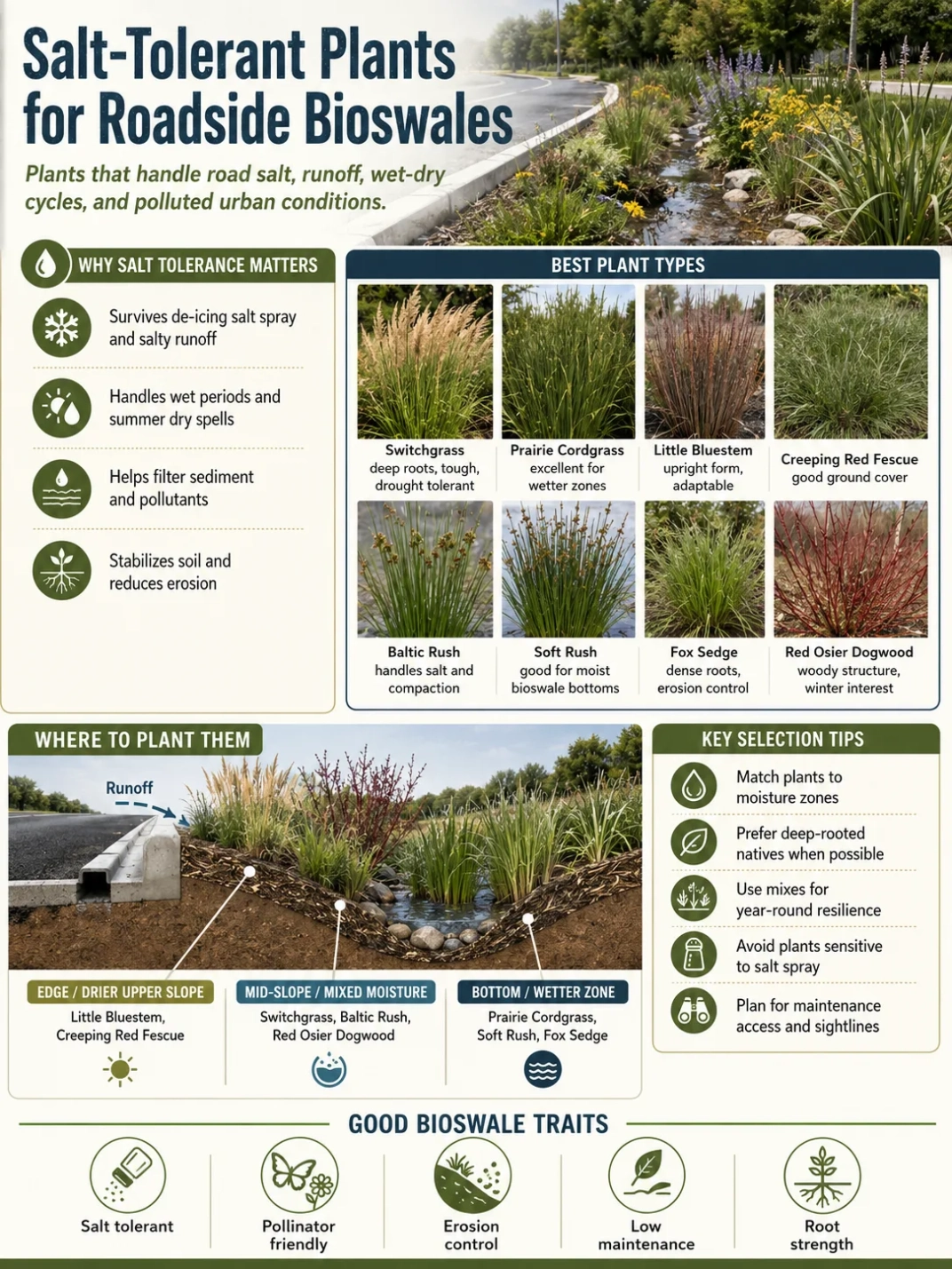
The following plants are commonly considered for salty or demanding roadside landscapes in parts of North America. Suitability depends on climate, local ecology, soil chemistry, drainage, and the actual amount of deicing salt. Scientific names help avoid confusion among regional common names.
| Plant or Plant Group | Possible Zone | Why It May Fit | What to Check |
|---|---|---|---|
| Switchgrass (Panicum virgatum) | Bottom, lower slope, or back edge | Fibrous roots; handles alternating wet and dry periods; documented roadside and salt tolerance in some regional references | Mature height, cultivar behavior, winter visibility, and local native range |
| Little bluestem (Schizachyrium scoparium) | Upper slope | Useful in dry, sunny areas; dense clumps help protect soil; moderate salt exposure may be acceptable | Not suited to a bottom that remains wet |
| Fine fescues (Festuca species and cultivars) | Curb edge or mostly drained strip | Low growth and good performance in some salty roadside turf conditions | Species and cultivar matter; avoid frequent ponding |
| Prairie dropseed (Sporobolus heterolepis) | Upper slope or dry back edge | Dense fibrous root mass; tolerates drought and occasional wet periods | Confirm its salt rating for the expected exposure; establishment can be slow |
| Bush cinquefoil (Dasiphora fruticosa) | Upper slope or back edge | Compact shrub form; useful in dry, exposed landscapes; listed as salt tolerant in some cold-region references | Keep outside direct flow paths and driver sight lines |
| Northern bayberry (Morella pensylvanica) | Upper slope or back edge | Can tolerate salt exposure and lean soils in parts of its range | Regional suitability, mature spread, drainage, and plant sex where fruit is desired |
| Bearberry (Arctostaphylos uva-ursi) | Dry upper edge | Low evergreen groundcover with salt tolerance in some northern landscape lists | Needs suitable drainage and soil chemistry; avoid wet bottoms |
| Sea thrift (Armeria maritima) | Dry curb edge or small urban cell | Compact form and tolerance of exposed, salty settings | Not a plant for prolonged ponding or heavy sediment burial |
Grasses for Root Density and Surface Cover
Grasses are often useful because their fibrous roots hold the upper soil layer and their stems slow shallow flow. Switchgrass can fit wetter portions where local specifications support its use. Little bluestem and prairie dropseed usually fit drier side slopes better than the swale bottom.
Low turf or fine-fescue mixes may be practical near the roadway where clear visibility, mowing, and easy sediment cleanup matter. A turf strip is not automatically inferior to a taller native planting. In a narrow, heavily salted cell, a low and replaceable cover may be the more workable choice.
Sedges and Rushes for Wet-and-Dry Cycling
Sedges and rushes can fit the lower zone because many species tolerate fluctuating water levels and form dense root systems. Yet salt tolerance varies widely within these groups. A regional plant list should identify species that tolerate both the expected salinity and the swale’s drawdown pattern.
Do not treat “wetland plant” as a synonym for “roadside bioswale plant.” A wetland species may dislike chloride, compacted soil, summer drying, or repeated sediment burial.
Perennials and Groundcovers for the Upper Edge
Low perennials can add cover at the curb edge without blocking visibility. Sea thrift, selected sedums, and other compact salt-tolerant plants may fit dry upper zones in suitable climates. They should not be placed where runoff routinely ponds or deposits a thick layer of grit.
Groundcovers can reduce bare soil, but spreading behavior needs review. Some plants sold for difficult sites can escape cultivation or become hard to remove from an inlet. Check local invasive-species guidance before specifying any fast-spreading groundcover.
Shrubs for Setback Areas
Shrubs are usually better on the back edge or upper slope than beside a curb cut. Bush cinquefoil and northern bayberry are examples that may suit salty, exposed conditions within parts of their range. Their mature size must remain compatible with visibility, snow storage, utilities, pedestrian movement, and maintenance equipment.
Woody plants can be harder to replace after repeated salt injury. In the highest-exposure strip, herbaceous plants that die back and renew from protected crowns may recover more readily than evergreen foliage exposed through winter.
How Road Salt Changes the Root Zone
Deicing salt can create both chemical and physical stress. Sodium and chloride may interfere with water uptake, so plants can show drought-like symptoms even when the soil is moist. Sodium can also worsen soil structure in susceptible soils, reducing pore space, aeration, and infiltration.
This matters in a bioswale because plant health and water movement depend on the same root-zone conditions. A plant list cannot correct a compacted, clogged, or poorly drained profile. If salty water remains in the soil for too long, even tolerant plants may decline.
Soil Note: Browning, weak growth, and plant loss do not prove salt injury. Similar symptoms can come from drought, waterlogging, root damage, poor planting depth, compaction, nutrient imbalance, or clogged drainage. Soil and plant-tissue testing may be useful when decline repeats after winter.
How to Build a More Reliable Planting Palette
A resilient roadside bioswale usually relies on several compatible species rather than one plant used from curb to back edge. Diversity helps the planting retain cover when one species struggles with a harsh winter, unusual ponding, or a heavy sediment load.
- Map salt exposure. Mark brine entry points, spray zones, snow-storage areas, and places where meltwater collects.
- Map moisture zones. Separate the ponding bottom from lower slopes, upper slopes, and dry setback areas.
- Check soil texture and compaction. Plant selection cannot substitute for a functioning soil profile.
- Match mature height to safety needs. Keep vegetation low near intersections, driveways, crossings, signs, and curb openings.
- Use functional diversity. Combine dense-rooted grasses, locally suitable sedges or rushes, and limited perennials or shrubs where conditions allow.
- Plan for replacement. The highest-salt strip may need more frequent replanting than the protected back edge.
- Verify regional status. Confirm native range, winter hardiness, invasive risk, and approved plant lists before installation.
Planting density matters as much as species choice. Wide gaps expose soil to erosion and make it easier for weeds to establish. Crowding large plants can hide inlets, trap litter, and make inspection difficult. The layout should protect soil while keeping the hydraulic parts visible.
Roadside Bioswale Plants Are Not Just Rain Garden Plants
A rain garden and a roadside bioswale may both receive stormwater, but their plant stresses can differ. Roadside bioswales often receive runoff from pavement along a longer flow path. They may also receive road grit, tire-wear particles, deicing salts, snow piles, litter, and repeated splash.
For that reason, a plant that performs well in a roof-runoff rain garden may not suit a curbside bioswale. Roadside selection needs a pollutant and maintenance screen in addition to the usual sun, soil, and moisture review.
Common Plant Selection Mistakes
- Using one moisture rating for the whole swale: The bottom and upper edge can behave like different planting sites.
- Confusing salt spray with soil salinity: The same species may respond differently to each exposure.
- Choosing tall plants at curb openings: Vegetation can hide sediment buildup, damage, or blocked flow.
- Placing dry-prairie plants in the bottom: Drought tolerance does not imply tolerance of repeated ponding.
- Using wetland plants without a salt check: Wet-soil tolerance alone is not enough for salted runoff.
- Ignoring sediment: Road grit can bury crowns and alter the designed ponding depth.
- Relying on a single species: One failure can leave a large bare area exposed to erosion.
- Skipping local ecological review: A hardy roadside plant may be invasive outside its intended region.
Maintenance After Winter and Storms
Salt-tolerant planting still needs inspection. The period after snowmelt often reveals salt burn, broken stems, buried crowns, clogged curb cuts, and concentrated sediment. Major storms can expose erosion, flattened vegetation, bypass flow, or standing water that lasts longer than expected.
- Clear litter and sediment from inlets without damaging plant crowns.
- Check whether water can spread across the intended flow path.
- Look for bare soil, rills, undercut plants, and displaced mulch or stone.
- Replace failed plants with species matched to the actual zone, not merely the original plan.
- Record repeated winter injury on the road-facing side of plants.
- Test soil when plant decline repeats and the cause is unclear.
- Keep outlets, check dams, observation points, and underdrain access visible.
Maintenance Note: Plant failure can reveal a flow problem. Replacing vegetation without checking ponding, sediment, compaction, inlet behavior, and overflow may lead to the same loss again.
When Site Conditions Need Professional Review
Plant selection should be coordinated with drainage design when the bioswale receives runoff from a large road area, sits near buried utilities, has steep grades, includes an underdrain, or must meet public-road standards. The overflow route also needs review so water does not bypass the facility, damage adjacent areas, or enter traffic and pedestrian routes in an unintended way.
Road agencies and local authorities may set limits for plant height, clear zones, sight distance, soil media, ponding, approved species, and maintenance access. These requirements vary by place. A landscape architect, civil engineer, soil specialist, or qualified stormwater professional can align the plant palette with the hydraulic design and local review process.
Frequently Asked Questions
What Is the Best Salt-Tolerant Plant for a Roadside Bioswale?
There is no single best plant. The right choice depends on whether the location is the wet bottom, a moving-water slope, a dry upper edge, or a curbside spray zone. Switchgrass may fit some wet-and-dry zones, while little bluestem or prairie dropseed may fit drier slopes. Local salt-tolerance and invasive-species guidance should confirm the choice.
Are Native Plants Automatically Salt Tolerant?
No. Native plants are adapted to regional ecological conditions, but many did not evolve beside salted pavement. Select native species that also match the expected soil salinity, spray exposure, moisture cycle, sun, and maintenance conditions.
Are Grasses Better Than Flowers in a Roadside Bioswale?
Grasses often provide dense roots, flexible stems, and broad soil cover. Perennials can add seasonal diversity and fill smaller niches. A mixed palette may work better than either group alone, provided every species matches its zone and does not block inspection or visibility.
Can Shrubs Be Planted in a Roadside Bioswale?
Shrubs may fit the upper slope or back edge where they remain outside direct flow, heavy brine, sight triangles, and maintenance paths. Their mature height and spread should be checked before planting. In narrow curbside cells, low herbaceous vegetation is often easier to inspect and replace.
What Should Be Done When Plants Die After Winter?
Check more than the plant label. Look for salt-spray patterns, buried crowns, sediment, clogged inlets, long ponding, dry soil, compaction, and snow-storage damage. Repeated or unexplained decline may justify soil testing before the area is replanted.