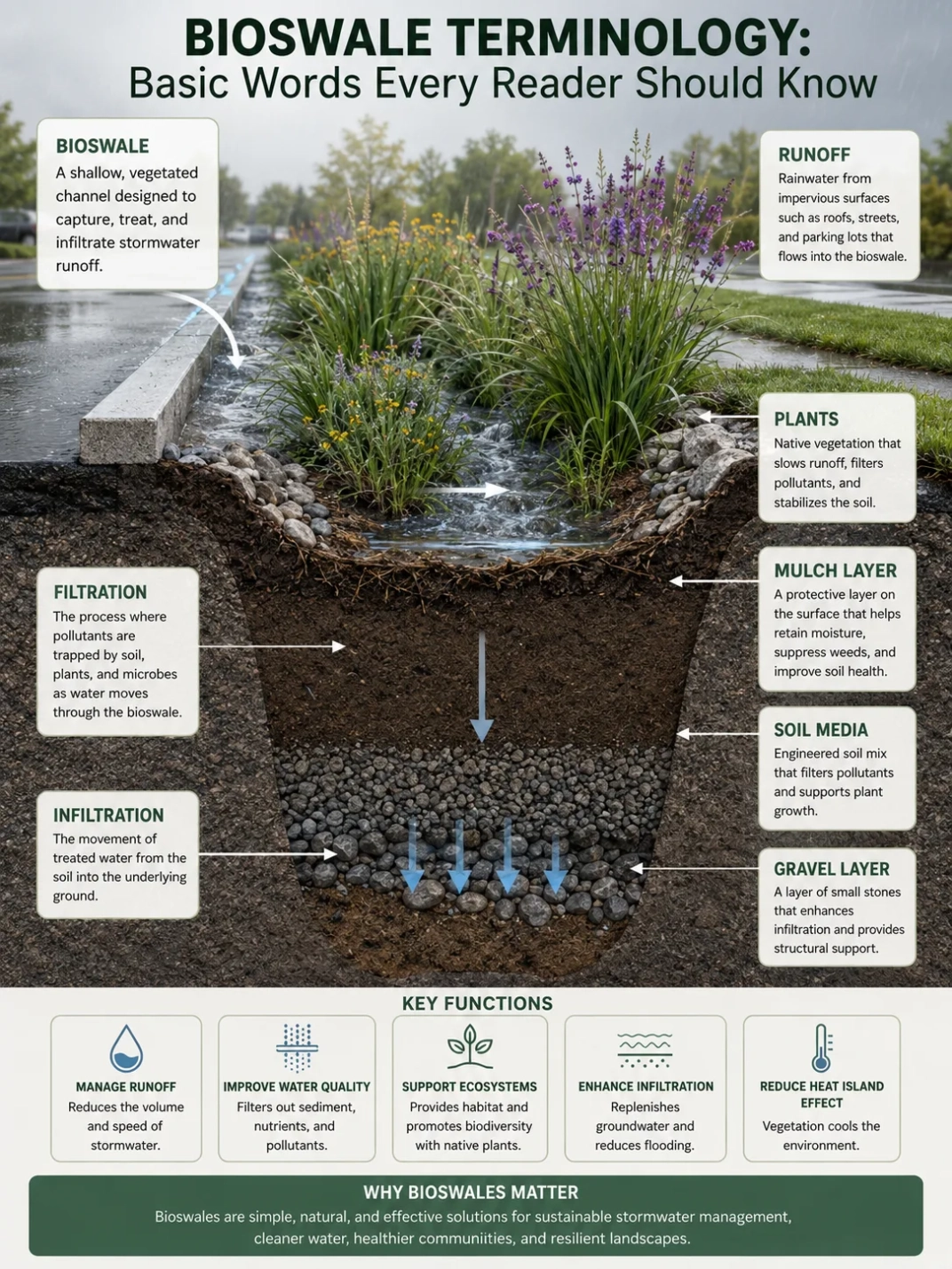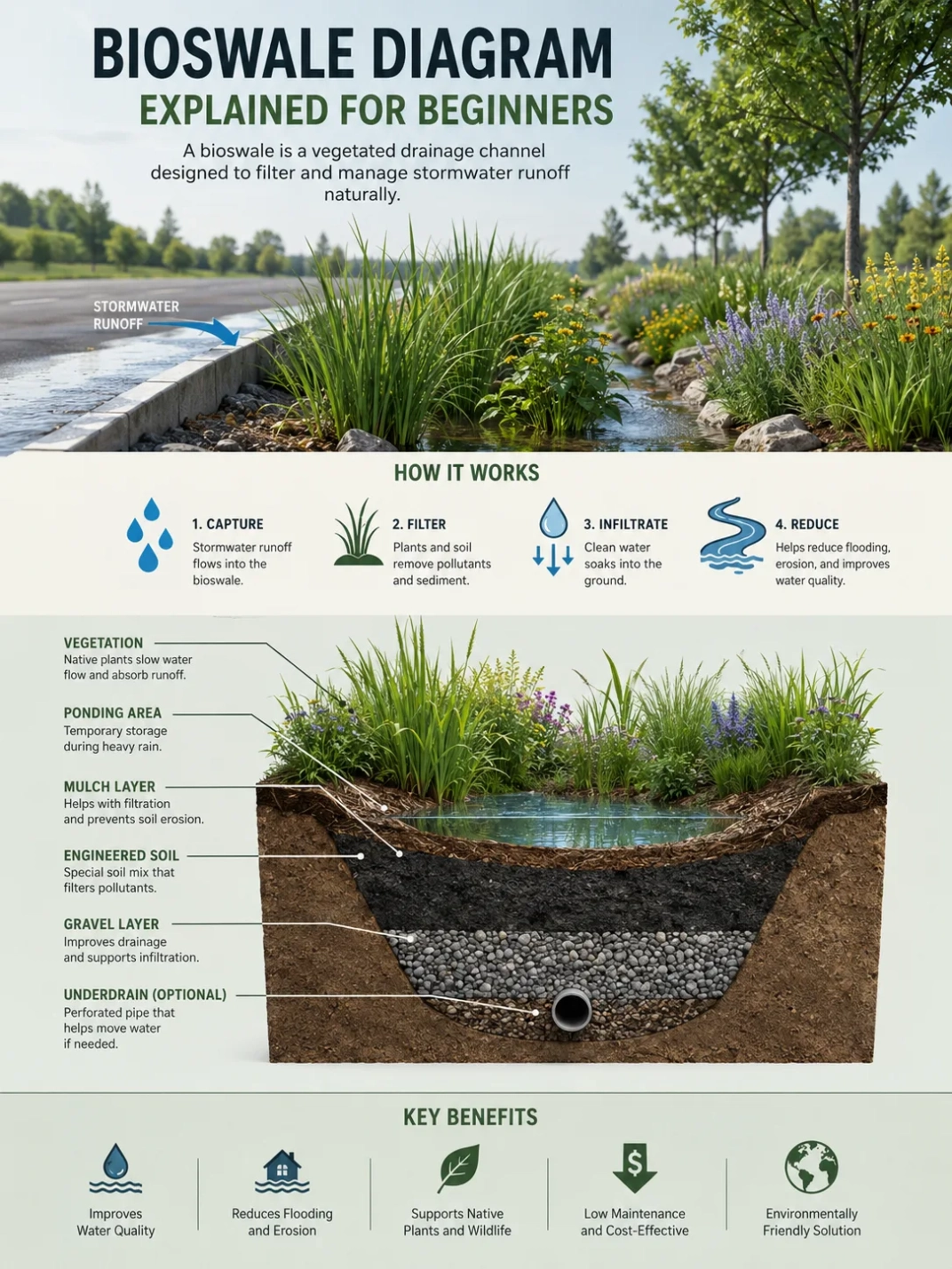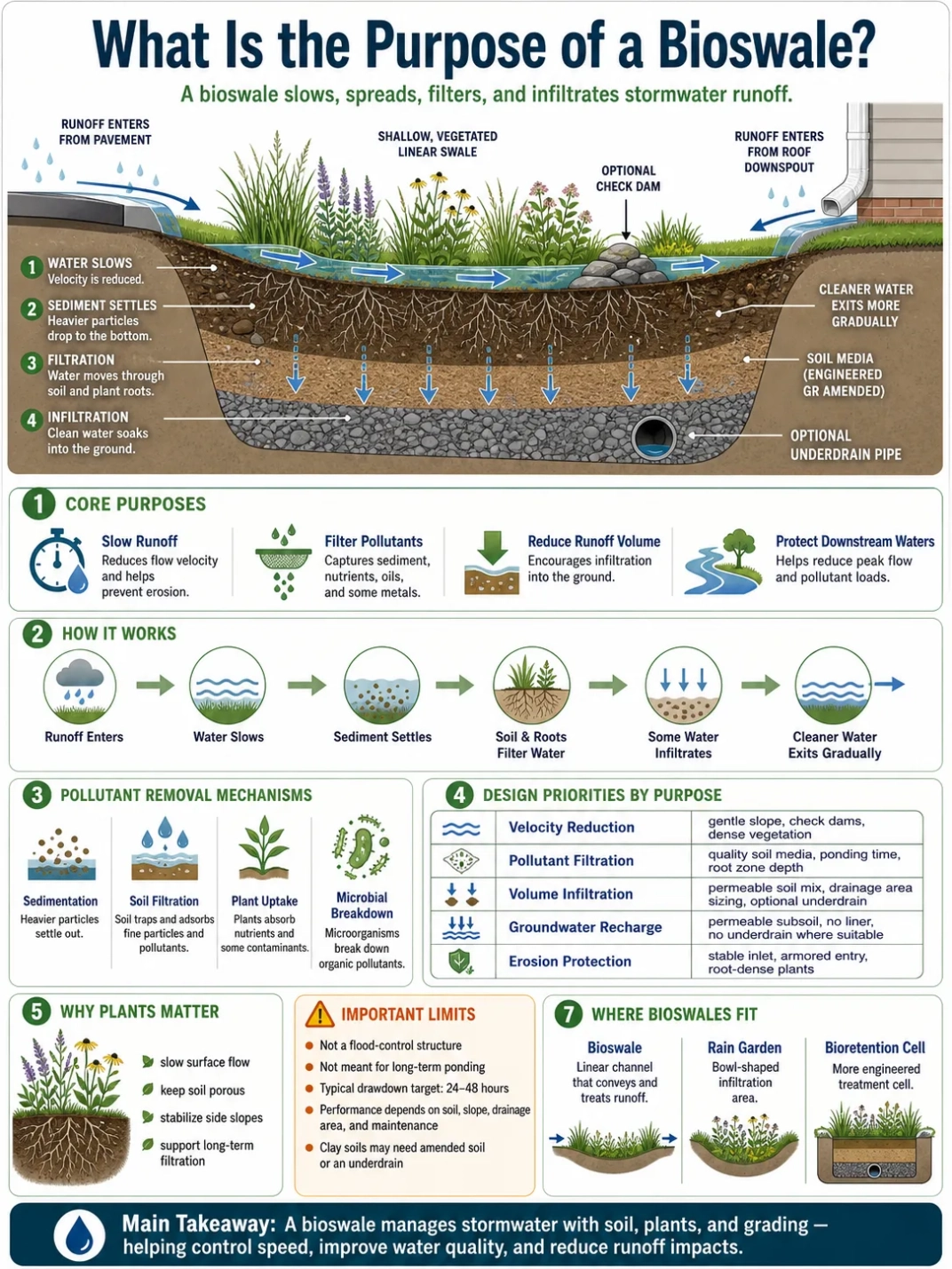
A bioswale is built around a single operational need: managing stormwater runoff in a way that conventional drainage cannot. Where a pipe or concrete channel moves water away as fast as possible, a bioswale slows it, spreads it, filters it, and allows it to infiltrate into the ground — or at least releases it more gradually into the downstream drainage system. That difference in approach explains most of what bioswales are designed to accomplish.
The purpose is not simply aesthetic, and it is not just one thing. A well-designed bioswale addresses runoff volume, flow velocity, water quality, and sometimes groundwater replenishment — all at once, using soil, plants, and careful grading rather than engineered mechanical systems.
Slowing Runoff Before It Becomes a Problem
When rain falls on a roof, parking lot, road, or compacted lawn, it moves quickly across the surface and picks up speed as it concentrates. That velocity carries sediment, debris, and dissolved pollutants with it. It also puts pressure on downstream systems — storm drains, culverts, streams, and receiving water bodies — all at the same time.
A bioswale intercepts that flow early. Its gently sloped, vegetated channel creates friction. Water spreads out laterally, contacts plant stems and root zones, and moves more slowly through the system. That reduction in velocity is not just a detail — it is one of the primary reasons bioswales can reduce erosion and sediment transport downstream.
Check dams, where used, reinforce this effect by creating brief ponding intervals along the swale’s length, giving water more time to slow and infiltrate between each small weir.
Filtering Pollutants Through Soil and Vegetation
Stormwater runoff from roads, driveways, and parking lots carries a predictable mix of contaminants: oil, heavy metals, suspended sediment, nutrients from fertilizers, and fine particulate matter. These do not disappear when rain stops — they travel with the flow until they reach a receiving water body or a system designed to capture them.
Bioswales intercept this load through several overlapping mechanisms:
- Sedimentation — As water slows, heavier particles drop out of suspension and settle onto the swale floor or become trapped in vegetation.
- Filtration through soil — Water that infiltrates passes through soil layers, where fine particles and some chemical pollutants bind to soil particles or are taken up by microbial activity in the root zone.
- Plant uptake — Nutrient pollutants, particularly nitrogen and phosphorus, can be absorbed by plant roots over time, though the degree of uptake depends on plant species, growth stage, and pollutant concentration.
- Biological breakdown — Soil microorganisms in active root zones help break down certain organic compounds present in runoff.
The effectiveness of pollutant removal varies by contaminant type, soil composition, plant density, and how well the swale is maintained. Bioswales tend to perform well for sediment and some heavy metals. Performance for dissolved nutrients and hydrocarbons is more variable and depends heavily on soil media quality and detention time.
Soil Note: Filter performance is closely tied to soil structure. A compacted or clay-heavy native soil may limit infiltration and reduce contact time between water and the root zone. In many bioswale designs, the native soil is amended or replaced with a specified soil mix to support both plant growth and drainage. What works in one location may need adjustment in another based on local soil texture and permeability.
Reducing Runoff Volume Through Infiltration
One of the most direct purposes of a bioswale is volume reduction. When runoff infiltrates into the ground rather than flowing into a storm drain, that volume is removed from the drainage system entirely — at least temporarily.
This matters for two reasons. First, it reduces the total volume of water that reaches downstream channels, streams, or combined sewer systems. Second, water that infiltrates gradually recharges the soil moisture and, in permeable soils, contributes to groundwater over time.
How much infiltration a bioswale can achieve depends on the native soil permeability, the depth and composition of the soil media used, and the size of the drainage area it serves. In dense clay soils, infiltration may be slow or limited, which is why some bioswale designs include an underdrain — a perforated pipe at the base that collects water that cannot infiltrate and routes it to the storm drain system. This maintains water quality benefits and velocity control even when full infiltration is not possible.
In sandy or well-drained soils, a bioswale can infiltrate a meaningful portion of the design storm volume, reducing the burden on downstream infrastructure.
Protecting Downstream Water Bodies
Streams, ponds, wetlands, and coastal areas that receive urban stormwater are affected not just by pollutant loads, but by the altered hydrology that comes with development. Impervious surfaces cause faster, larger, and more frequent peak flows — which erode stream banks, destabilize stream channels, and introduce fine sediment that degrades aquatic habitat.
Bioswales, as part of a low-impact development approach, help moderate that hydrologic impact. By slowing and retaining runoff closer to its source, they reduce peak discharge rates and extend the time over which runoff reaches receiving waters. This does not mean a single bioswale resolves all downstream impacts — it depends on the scale of the drainage area, the intensity of development, and how many such features are present. But even modest reductions in peak flow and sediment load can benefit water quality over time.
What a Bioswale Is Not Designed to Do
Understanding purpose includes understanding limits. A bioswale is not a detention basin. It is not designed to hold large volumes of water for extended periods. Most designs target ponding depths that drain within 24 to 48 hours — both to protect plant health and to ensure the system is ready for the next storm event.
A bioswale also does not function as a flood control structure in the engineering sense. It can reduce peak flows from smaller, more frequent storms, but it is not a substitute for proper sizing of downstream conveyance infrastructure. For larger drainage areas or sites with specific flood management requirements, a bioswale is typically one component within a broader stormwater management system, not the sole solution.
It is also not a treatment system for highly concentrated or industrial-strength contamination. Bioswales handle the diffuse, non-point source pollution typical of urban and suburban runoff. Sites with known contamination or high-concentration discharge may require engineered treatment systems that go beyond what a vegetated swale can offer.
How Purpose Shapes the Design
The intended purpose directly influences how a bioswale is configured. A swale designed primarily for water quality — where filtration and sediment removal are the main goals — may use a denser, finer-textured soil mix, a longer flow path, and tighter vegetation spacing to maximize contact time and filtration surface.
A swale designed for volume reduction in a permeable soil may prioritize depth, open soil media, and species with deep root systems that keep soil porous over time.
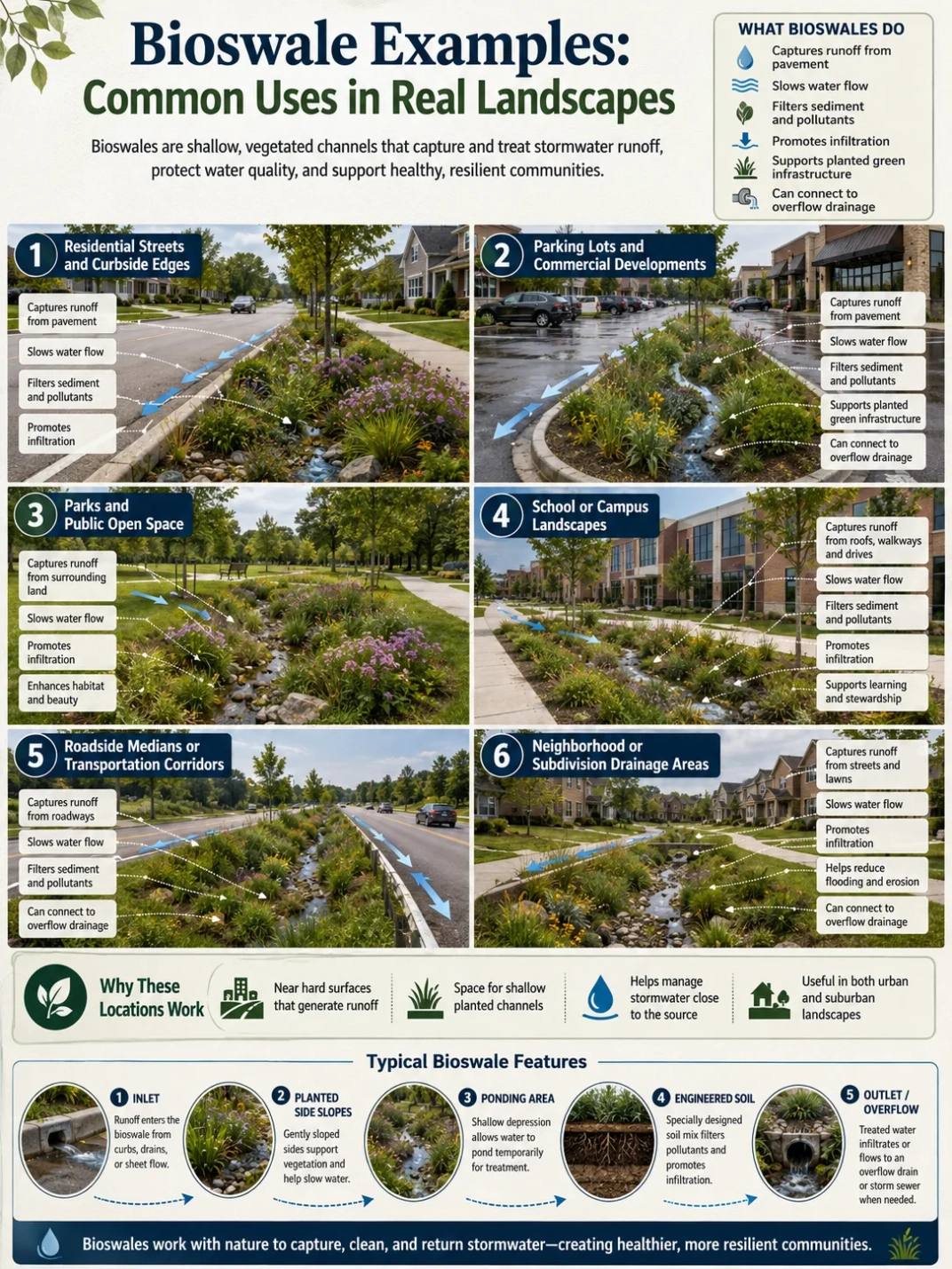
A swale in a roadside application, receiving concentrated curb-cut flow from a street, will need to handle sediment loads and velocity in ways that a smaller residential yard swale may not. Inlet protection, erosion-resistant materials at the entry point, and robust plant selection become more critical in that context.
| Primary Purpose | Key Design Focus | Important Considerations |
|---|---|---|
| Velocity reduction | Gentle longitudinal slope, check dams, dense vegetation | Slope must allow flow without channeling or erosion |
| Pollutant filtration | Soil media quality, ponding time, plant root zone depth | Detention time affects removal effectiveness |
| Volume infiltration | Permeable soil mix, underdrain optional, drainage area sizing | Native soil permeability limits what is achievable |
| Groundwater recharge | No underdrain, permeable subsoil, no liner | Only viable in appropriate soil and groundwater conditions |
| Erosion protection | Stable inlet, armored entry zone, root-dense plant species | Vegetation establishment period is a vulnerable phase |
The Role of Plants in Serving These Purposes
Vegetation is not incidental to a bioswale’s purpose — it is structural. Plants slow surface flow directly by adding physical resistance. Their root systems keep soil porous, which supports infiltration and resists compaction over time. Root channels also create pathways for water to move deeper into the soil profile.
Beyond hydrology, plants stabilize the swale’s side slopes and floor against erosion during storm events. Species with fibrous, deep root systems tend to perform better than shallow-rooted ornamentals in this context. Native species are often preferred not because of a general principle, but because they tend to be adapted to local wet-dry cycles, require less supplemental irrigation once established, and support soil biology that contributes to long-term function.
During the establishment period — typically the first one to two growing seasons — plants have not yet developed the root density needed to fully stabilize the swale or resist erosion. This is when a bioswale is most vulnerable, and why establishment-phase maintenance and temporary erosion controls matter.
Planting Note: Plant selection should reflect the actual moisture conditions within the swale — not just the general climate. The swale floor may experience frequent inundation, while the upper side slopes may stay relatively dry between events. Species chosen for one zone may struggle in another. Matching plants to micro-zones within the swale tends to produce better long-term coverage and function.
Where Bioswales Fit within Green Infrastructure
Bioswales are one tool in a broader set of approaches sometimes grouped under low-impact development or green infrastructure. They share certain principles with rain gardens, bioretention cells, and vegetated filter strips — all of which use soil and plants to manage runoff — but each has a distinct form and application.
A rain garden is typically a shallow, bowl-shaped depression designed to receive and infiltrate runoff from a defined area, such as a roof downspout or driveway. It does not have a defined flow channel.
A bioretention cell is a more engineered version — often with a specified soil mix, an underdrain, and precise sizing — used in larger commercial or municipal applications where performance standards must be met.
A bioswale is specifically a linear system. Its channel shape is designed to convey water while also treating it. This makes it well-suited to roadside corridors, parking lot edges, and sites where runoff needs to travel some distance before reaching an outlet.
In many projects, these systems work together. A parking lot bioswale may drain to a bioretention cell. A residential bioswale may feed a rain garden at a low point in the yard. The purpose of the bioswale in that chain is to slow, pre-filter, and distribute flow before it reaches the next treatment or infiltration point.
When Site Conditions Affect What a Bioswale Can Accomplish
The purpose a bioswale can realistically serve is constrained by site conditions. A bioswale on a steeply sloped site may struggle to control velocity without closely spaced check dams. A swale in a high water table area may not be able to infiltrate much at all, limiting its usefulness for volume reduction. A bioswale receiving runoff from a very large impervious area relative to its size may become overwhelmed during significant rainfall events.
These are not reasons to avoid bioswales — they are reasons to match the design to what the site can support. On sites where conditions are uncertain, or where the bioswale is expected to meet specific regulatory performance targets, professional review of the drainage area, soil conditions, slope, and overflow routing is appropriate before finalizing the design.
Site Planning Note: A bioswale’s overflow route deserves attention during planning. When a storm exceeds the swale’s capacity, water needs a safe path — away from building foundations, neighboring properties, and unstabilized areas. This is especially relevant for residential applications where the overflow route may not be obvious until it is too late to address.
Frequently Asked Questions
What is the main purpose of a bioswale?
A bioswale is designed to slow stormwater runoff, filter pollutants, and allow water to infiltrate into the soil rather than flowing rapidly into storm drains or receiving water bodies. It addresses runoff velocity, volume, and water quality at the same time, using a vegetated channel and appropriate soil to do so.
Does a bioswale actually remove pollutants?
Yes, though the degree varies. Bioswales perform well for sediment and some heavy metals. Dissolved nutrients and hydrocarbons are more variable. Filtration depends on soil media quality, ponding time, plant root zone activity, and how regularly the swale is maintained. No bioswale removes all pollutants under all conditions.
Can a bioswale reduce flooding?
A bioswale can reduce peak flow rates from smaller, more frequent storm events by slowing runoff and allowing some infiltration. It is not a flood control structure and is not a substitute for properly sized drainage infrastructure. On sites with significant flood management requirements, a bioswale is typically part of a larger system.
How long should water stay in a bioswale after a storm?
Most designs target a drawdown time of 24 to 48 hours. Extended ponding beyond this range can stress or kill plants not suited to prolonged saturation, and it reduces the swale’s capacity for the next storm event. If a bioswale consistently holds water for days after rain, this usually signals a drainage or soil infiltration issue worth investigating.
Is a bioswale the same as a rain garden?
No. A rain garden is a bowl-shaped depression designed to receive and infiltrate runoff from a specific source, such as a downspout. It does not have a defined flow channel. A bioswale is a linear channel designed to both convey and treat runoff as it moves through the landscape. They share similar principles but serve different spatial functions.
Can a bioswale work in clay soil?
Clay soil limits infiltration, which reduces a bioswale’s ability to absorb runoff volume. In clay conditions, the native soil is often amended or replaced with a more permeable soil mix. Some designs in clay soils include an underdrain to collect water that cannot infiltrate, preserving water quality and velocity control benefits even when full infiltration is not achievable.