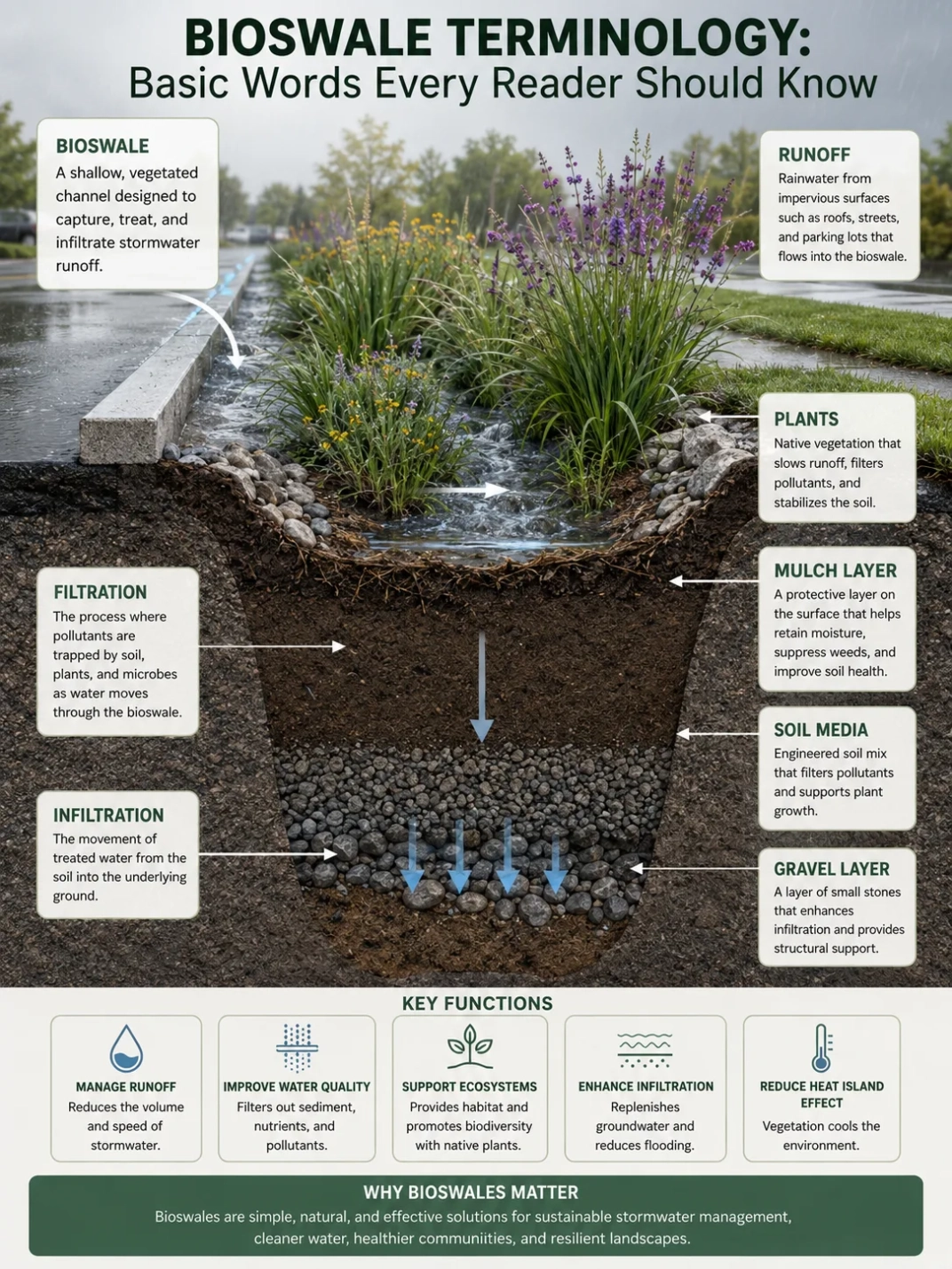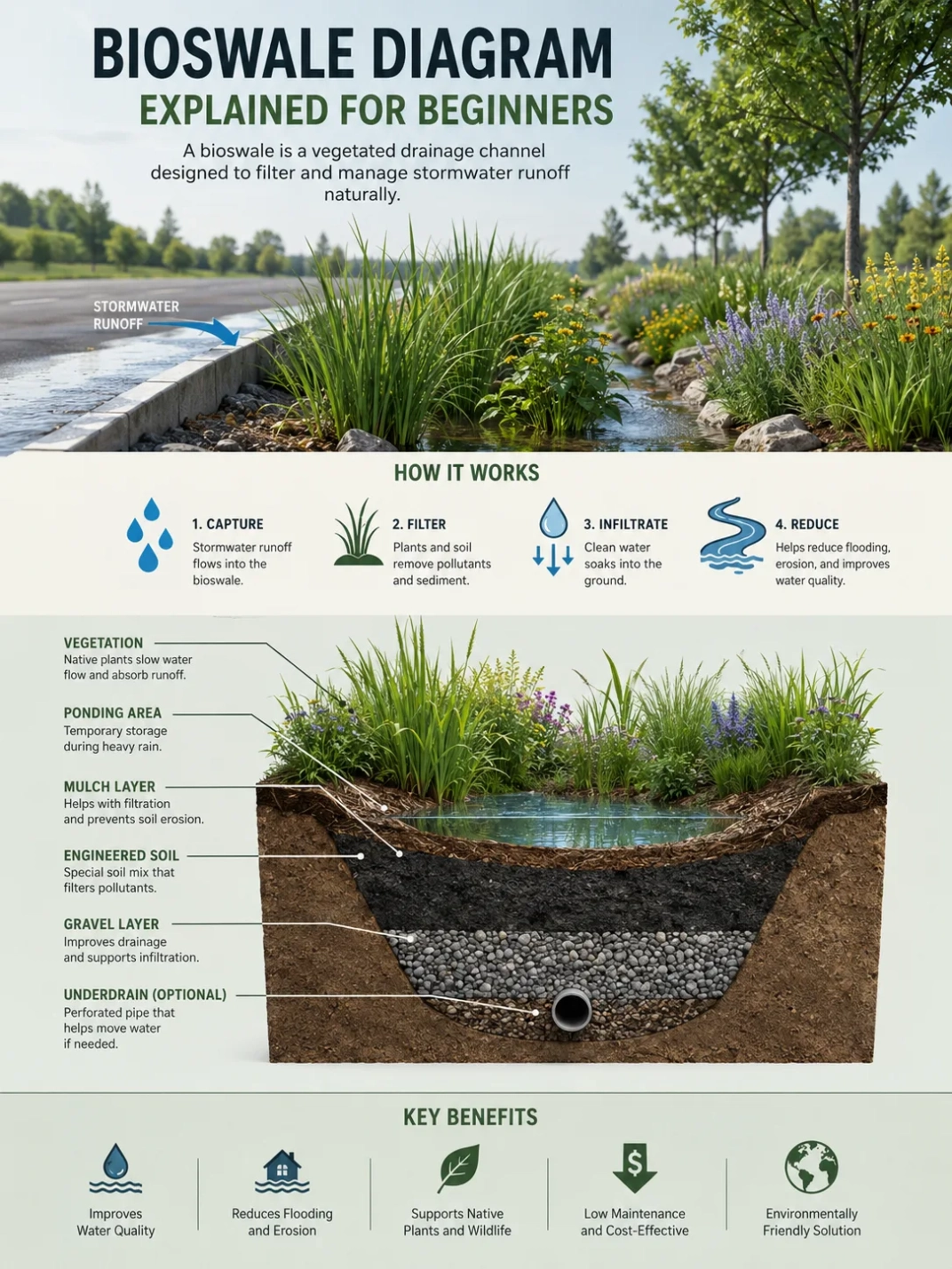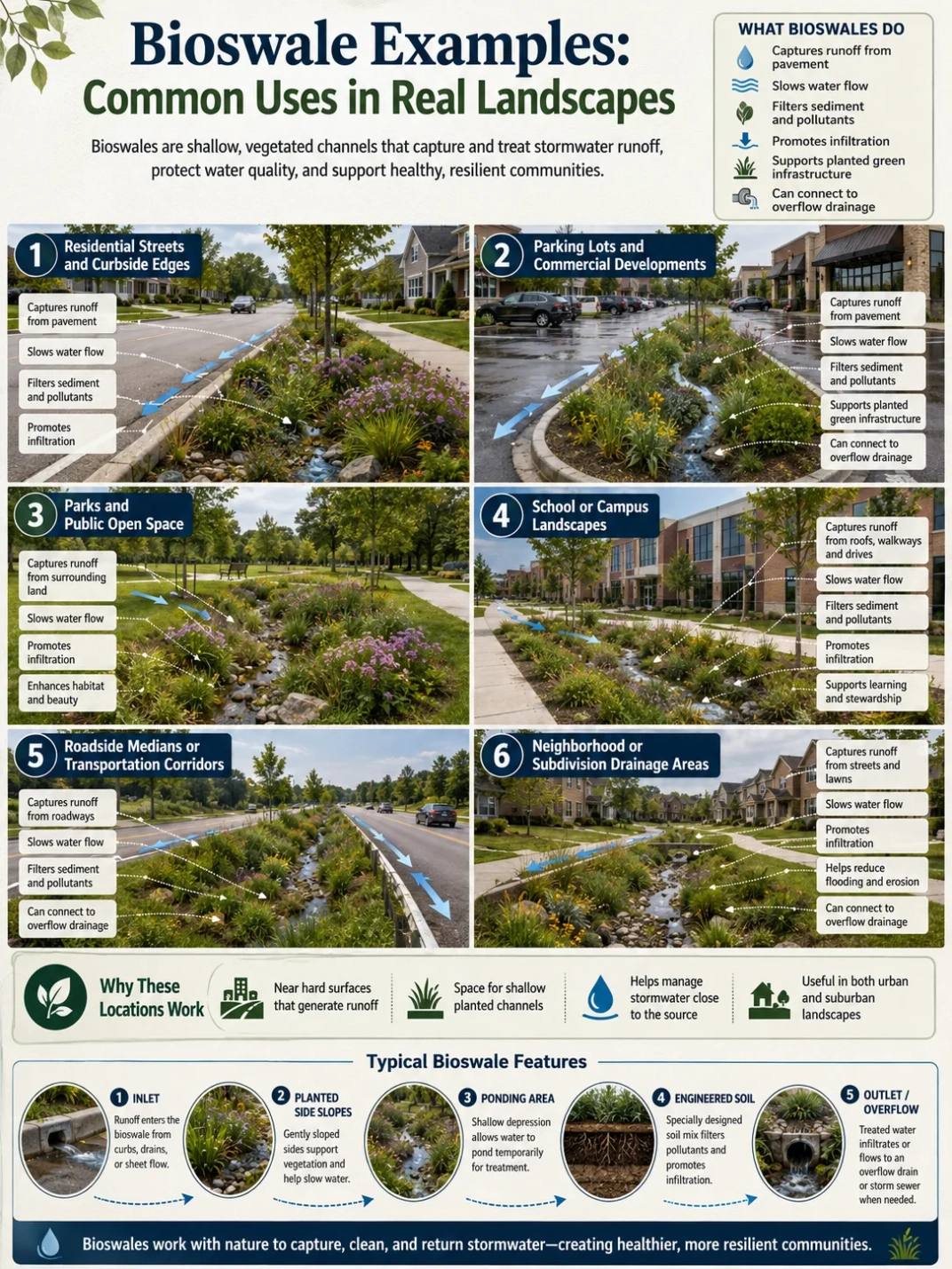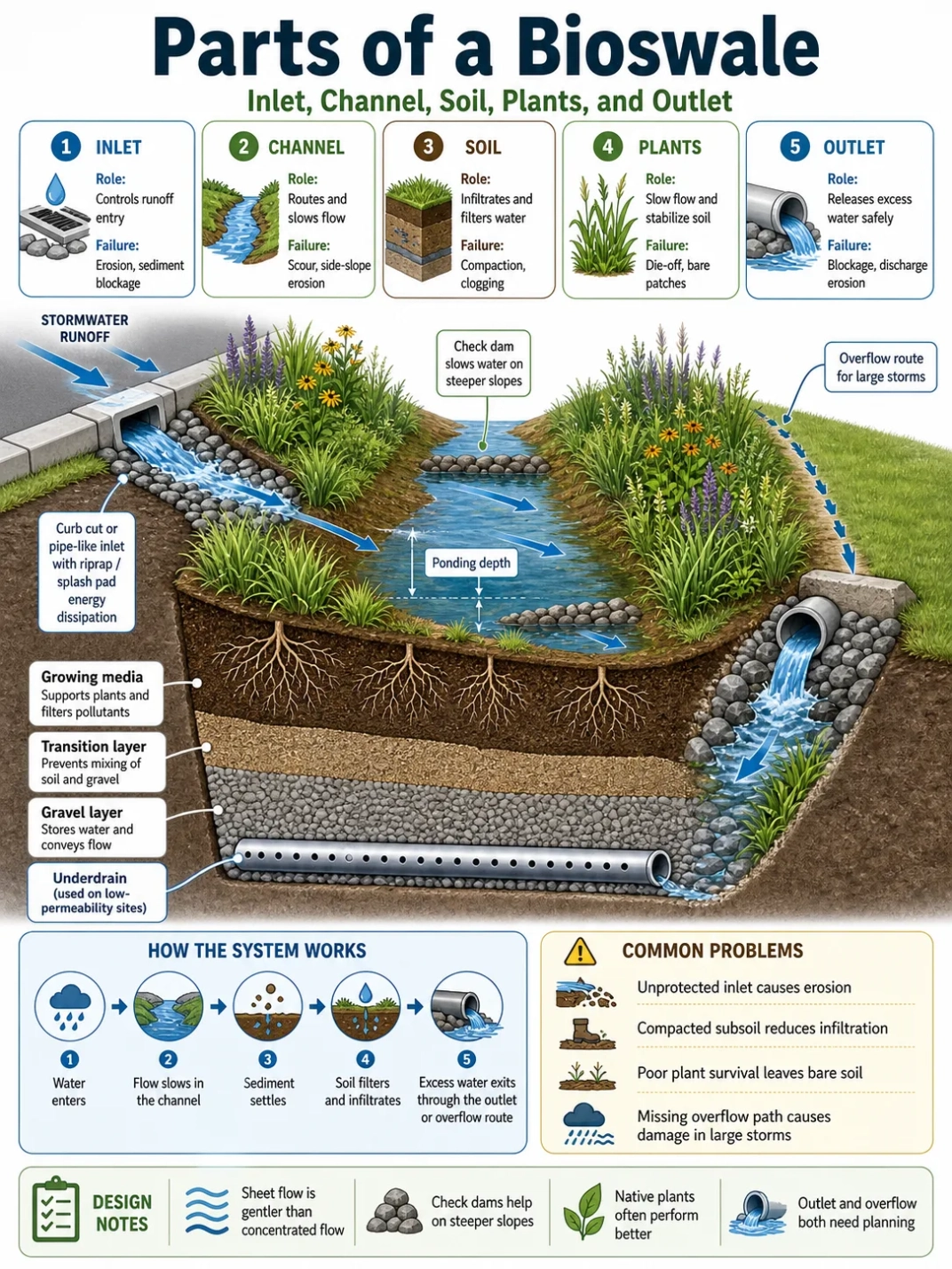
A bioswale is not a single object — it is a sequence of connected parts, each doing a specific job. The inlet controls how water enters. The channel shapes the flow path. The soil handles infiltration and filtering. The plants slow the water and stabilize the structure. The outlet manages whatever cannot be absorbed. When each part is designed to work with the others, the system functions. When one part is missing or poorly matched to site conditions, the rest of the system absorbs the gap — or fails.
| Component | Primary Role | Common Failure |
|---|---|---|
| Inlet | Directs runoff into the channel at a controlled velocity | Erosion, sediment blockage at entry |
| Channel | Routes and slows water through the system | Channelization, erosion on side slopes |
| Soil | Absorbs, stores, and filters water below the surface | Compaction, poor infiltration, clogging |
| Plants | Slow flow, filter pollutants, stabilize soil | Die-off, bare patches, invasive growth |
| Outlet | Releases excess water safely at the downstream end | Erosion at discharge, blockage, no overflow path |
The Inlet: Controlling How Water Enters
The inlet is where stormwater runoff first enters the bioswale. Its form depends on the runoff source — a curb cut along a roadside, a pipe from a roof downspout, a concrete apron at the edge of a parking lot, or a low point in a lawn where sheet flow collects naturally. What all inlets have in common is this: fast-moving water arriving at an unprotected soil surface will erode it.
Energy dissipation at the inlet is not optional. Riprap (loose stone), concrete splash pads, or level spreaders — shallow devices that distribute concentrated flow across a wider area before it hits the channel — are common solutions. The goal is to reduce the velocity of incoming water before it contacts soil or vegetation.
Sediment concentrates near the inlet by design. As water slows at entry, coarse particles drop out of suspension. This means the inlet zone accumulates debris faster than the rest of the channel — and needs to be the most accessible part of the bioswale for periodic cleanout. Leaving sediment to build up here can eventually narrow the entry point and redirect flow around the system instead of through it.
Sheet Flow versus Concentrated Flow
Bioswales perform better when water enters as dispersed sheet flow across the full width of the channel rather than as a concentrated stream at a single point. Sheet flow reduces the erosive impact at entry, distributes the sediment load more evenly, and allows vegetation to intercept runoff before it reaches the channel base. Where runoff arrives as a concentrated pipe discharge, an energy dissipation structure at the outlet of the pipe becomes especially important.
The Channel: Shape, Slope, and Flow Path
The channel is the shaped depression that holds and routes water as it moves through the bioswale. Its cross-section is usually trapezoidal or parabolic — wider at the top, narrower at the base — with gently sloping sides. Side slopes are typically expressed as a ratio of horizontal distance to vertical rise. Shallower slopes (3:1 or flatter) are easier to vegetate and maintain; steeper slopes are harder to stabilize and more prone to erosion under flow.
The longitudinal slope — the grade along the length of the channel — determines how fast water travels from inlet to outlet. Steeper grades increase velocity, reduce the time water spends in the system, and raise the risk of scour along the channel bed. Very flat grades can allow water to pond longer than intended or to pool unevenly. Many bioswale designs target a longitudinal slope somewhere between 1% and 5%, though local conditions — topography, soil type, runoff volume — often dictate what is realistic on a given site.
Check Dams
On sites where the natural slope is steeper than ideal, check dams offer a practical solution. These are low barriers installed at intervals across the channel — constructed from stone, timber, compacted earth, or other durable materials — that interrupt the flow path and create shallow ponding zones behind them. Each zone temporarily holds water, slows its velocity, and allows more time for infiltration before the water moves to the next section of the channel.
Check dams also reduce the risk of progressive channel erosion on steeper grades. Without them, a bioswale on a 6% or 8% slope can function more like an accelerating drainage ditch than a filtering system.
Ponding Depth
Temporary ponding in a bioswale channel is intentional. It gives water time to spread, slow, settle sediment, and infiltrate. The acceptable ponding depth varies by design standard and local guidance, but many designs allow somewhere between a few inches and roughly a foot of standing water during and immediately after a storm event.
Water that drains through a bioswale too quickly may not filter effectively. Water that lingers too long stresses plants adapted to wet-dry cycles, and can create conditions favorable to mosquito breeding. The channel geometry, soil infiltration rate, and plant selection all influence how long water remains after a storm.
The Soil: Where Infiltration and Filtering Happen
Soil is the part of a bioswale that performs most of its invisible work. As water moves downward through the soil profile, physical filtration traps suspended particles, biological processes break down organic pollutants, and chemical interactions bind certain metals and nutrients to soil particles. The effectiveness of all three depends on the soil’s texture, structure, and depth — not just its surface appearance.
Native in-place soil is sometimes adequate, but many bioswale installations replace or amend the existing material with an engineered soil mix. This mix is designed to balance two competing needs: draining fast enough to prevent chronic waterlogging, while holding water long enough to allow meaningful filtration. A mix biased too far toward drainage moves water through before pollutants can be removed. One that holds too much water causes root stress, anaerobic conditions, and eventually plant loss.
Soil Layers and Filter Media
Many bioswale designs use a layered soil profile. The upper zone holds the growing media — a mixture tuned for plant establishment and moderate drainage. Below that, a transition layer of coarser material (often sand or fine gravel) helps water move toward the base of the profile more freely. In designs that include an underdrain, a perforated pipe sits in the lowest gravel layer and carries excess water that cannot infiltrate into the native soil below.
An underdrain is not a standard feature in every bioswale. On sites with well-draining native soils, water infiltrates naturally through the full profile, and no underdrain is required. Where native soil permeability is low — particularly in areas with dense clay — an underdrain allows the system to drain between storms without relying on infiltration through the native layer. The underdrain then routes this water to a storm drain, a detention area, or another safe discharge point.
Clay Soil and Low-Permeability Sites
Clay soil creates a specific design challenge. Its naturally low permeability means water moves through it slowly, or stays near the surface. Installing a bioswale over clay without modifying the soil profile or adding drainage infrastructure can result in persistent standing water, chronic plant stress, and eventually a system that functions only as a detention area rather than an infiltrating one.
On clay-heavy sites, the engineered soil layer carries more of the design burden. Geotextile fabric is sometimes used to separate the engineered media from the native clay below, which prevents intermixing of the two materials over time. Whether any infiltration into the native clay is credited in the design depends on local stormwater standards and the results of soil testing on that specific site.
The Plants: Structure, Not Just Appearance
Plants in a bioswale are sometimes treated as the aesthetic layer — what separates the system from a plain earthen channel. Their actual role is structural. Dense, upright vegetation slows surface flow. Root systems hold soil in place and create pathways for water to move downward. The organic matter that plants produce over time supports microbial communities that break down pollutants in the soil.
A bioswale with sparse or failing vegetation loses much of this function. Without plant cover, water moves faster across the channel, sediment migrates more easily through the system, and bare soil near the inlet and along side slopes becomes vulnerable to erosion. Replanting is part of routine maintenance — not because it improves the look of the system, but because vegetation is doing physical work that nothing else replaces.
Moisture Zones Within the Channel
Moisture conditions vary within a single bioswale. The channel base — the zone that ponds temporarily during and after rain — stays wettest. It needs plants that tolerate periodic inundation and then dry out between events. The side slopes drain faster and experience a wider range of moisture conditions. The buffer zone at the channel edge may rarely receive standing water at all.
This moisture gradient means effective planting usually involves more than one plant type. Sedges, rushes, and moisture-tolerant native grasses often anchor the channel base. Deeper-rooted shrubs and taller grasses work well on the side slopes, where their root structure also helps stabilize the soil against erosion. Drought-tolerant plants fill the upper buffer zone where dry conditions are more frequent.
Root Structure and Long-Term Infiltration
Root systems do something the engineered soil mix cannot do on its own — they actively maintain the permeability of the growing media. As roots grow, they create microscopic channels through compaction-prone soil. When roots die and decompose, those channels remain open, allowing water to move downward more freely over time. This is one reason why an established bioswale often infiltrates faster than a newly installed one.
Plants with shallow, fibrous root systems provide less of this long-term benefit. In designs without an underdrain, selecting species with deep root structures helps sustain infiltration rates as the system ages and sediment accumulates in the upper soil layer.
The Outlet and Overflow Route
Every bioswale needs a controlled exit point for water that cannot be absorbed. Even a well-designed system with good soil and established vegetation will reach its capacity in large storm events. The outlet manages normal discharge. The overflow route handles everything beyond that.
A typical outlet might be a stabilized low point at the downstream end of the channel, a pipe connecting to a storm drain, or a level spreader that disperses outflow across a vegetated area before it reaches any concentrated drainage feature. Whatever form it takes, the outlet needs energy dissipation just like the inlet. Water leaving a bioswale can carry enough velocity to scour soil and undercut vegetation at the discharge point — a failure mode that is easy to miss during design and frustrating to repair after the fact.
The Overflow Route
The overflow route is separate from the normal outlet. It is the path water takes during a storm that exceeds the bioswale’s capacity — a condition that will occur eventually, regardless of how well the system is designed. Overflow infrastructure might include a notched weir at the top of a check dam, an elevated inlet pipe sized for large events, or a graded spillway that directs excess flow toward a stable surface.
Without a clearly designed overflow route, large rain events allow water to find its own path. This uncontrolled overflow can erode channel sides, scour adjacent plantings, or direct water toward structures or neighboring properties. The overflow route is not a sign that the bioswale is undersized — it is a safety feature that every well-designed system includes.
How the Parts Work as a System
Each component passes responsibility to the next. Runoff enters at the inlet, where velocity drops and coarse sediment settles. It spreads across the vegetated channel surface, where plants intercept suspended particles and slow the flow further. Water infiltrates through the soil profile, where filtration — physical, biological, and chemical — removes additional pollutants. Whatever cannot infiltrate reaches the outlet in a lower-energy, cleaner discharge than it arrived with.
This sequence only functions when each part is matched to the others. An oversized inlet sends concentrated flow into a channel whose vegetation cannot absorb the impact. A soil layer engineered for infiltration sitting over impermeable compacted subsoil behaves as though the lower layer does not exist. Plants selected for the wrong moisture zone die out and leave bare soil exposed during the next rain event.
Where the Design Can Fall Short
Some failure patterns appear consistently across different bioswale installations:
- An undersized or unprotected inlet causes erosion at the entry point and deposits sediment in the wrong places.
- Compacted subsoil prevents infiltration even when the engineered soil layer is well-designed and correctly installed.
- Plants that cannot tolerate wet-dry cycles decline over time, leaving the channel surface bare and unstable.
- A missing or undersized overflow route allows large storm events to find an unplanned path out of the system.
- A longitudinal slope that is too steep moves water through the channel so quickly that infiltration and filtering have little time to occur.
- A blocked outlet causes water to back up beyond the ponding zone, stressing plant roots and potentially undermining the channel sides.
Most of these problems are less expensive to prevent during design than to correct after construction. Soil testing, careful slope analysis, and plant selection matched to actual site moisture conditions resolve the majority of them before the first shovel goes in the ground.
Frequently Asked Questions
Do all bioswales include an underdrain?
No. An underdrain is included when native soil cannot absorb water at a sufficient rate — most often on sites with dense clay or very low permeability. Where native soil drains adequately, water infiltrates naturally through the full soil profile and no underdrain is needed. Whether one is required depends on site-specific soil conditions, local stormwater standards, and how the bioswale connects to the broader drainage system.
What happens to a bioswale when the plants die?
Bare soil in a bioswale loses several functions at once. Without vegetation, surface flow accelerates, sediment moves through the system instead of settling, and side slopes become vulnerable to erosion — especially near the inlet. The channel may still convey water, but its filtering and flow-slowing functions are diminished. Plant replacement is part of standard maintenance, particularly during the first two years after installation when establishment is incomplete.
Do bioswales always need check dams?
Not always. On sites with gentle longitudinal slopes — generally below 2% to 4%, depending on the design standard and expected flow volume — check dams are often unnecessary. On steeper sites, they slow water, create temporary ponding, and reduce the risk of channel erosion. Whether they are needed depends on the site grade, the expected flow rate, and how long water needs to remain in the system for adequate infiltration and filtering.
Why does sediment collect near the inlet?
As fast-moving runoff enters the bioswale and its velocity drops, coarse sediment suspended in the water settles out of suspension. This happens most quickly near the inlet, where the velocity change is sharpest. Sediment accumulation in this zone is predictable and expected — which is why the inlet area should be accessible for cleanout. Allowing sediment to build up here over time can restrict flow or cause runoff to bypass the system.
Is the outlet the same thing as the overflow route?
They serve different conditions. The outlet is the normal discharge point for water that moves through the system during a typical storm — whether through a pipe, an underdrain, or a stabilized exit at the downstream end. The overflow route is a separate path for large events when the bioswale reaches its capacity. Both need to be planned deliberately. A system with a functional outlet but no overflow route may perform well in small storms and cause problems in large ones.
Can the soil in a bioswale lose effectiveness over time?
Yes. Sediment accumulation in the upper soil layer gradually reduces infiltration rates. Foot traffic or vehicle access on the channel can compact the growing media. The rate at which this happens depends on the sediment load in the runoff, maintenance frequency, and how well the inlet is protecting the channel from high-velocity inflow. Periodic inspection, sediment removal near the inlet, and protecting the channel from unnecessary compaction are the primary ways to extend soil performance.