Native plants often work best in bioswales because they are already shaped by local rainfall patterns, seasonal dry spells, soil conditions, heat, cold, and the insects and microbes around them. A bioswale is not a normal garden bed. It is a planted drainage feature that must slow stormwater runoff, tolerate short wet periods, recover after drying, hold soil in place, and stay manageable over time.
The best plant choice is not simply “something that likes water.” In many bioswales, the planting area shifts between wet, damp, and dry conditions within the same week. Local native species often handle that pattern better than plants selected only for color, height, or nursery availability.
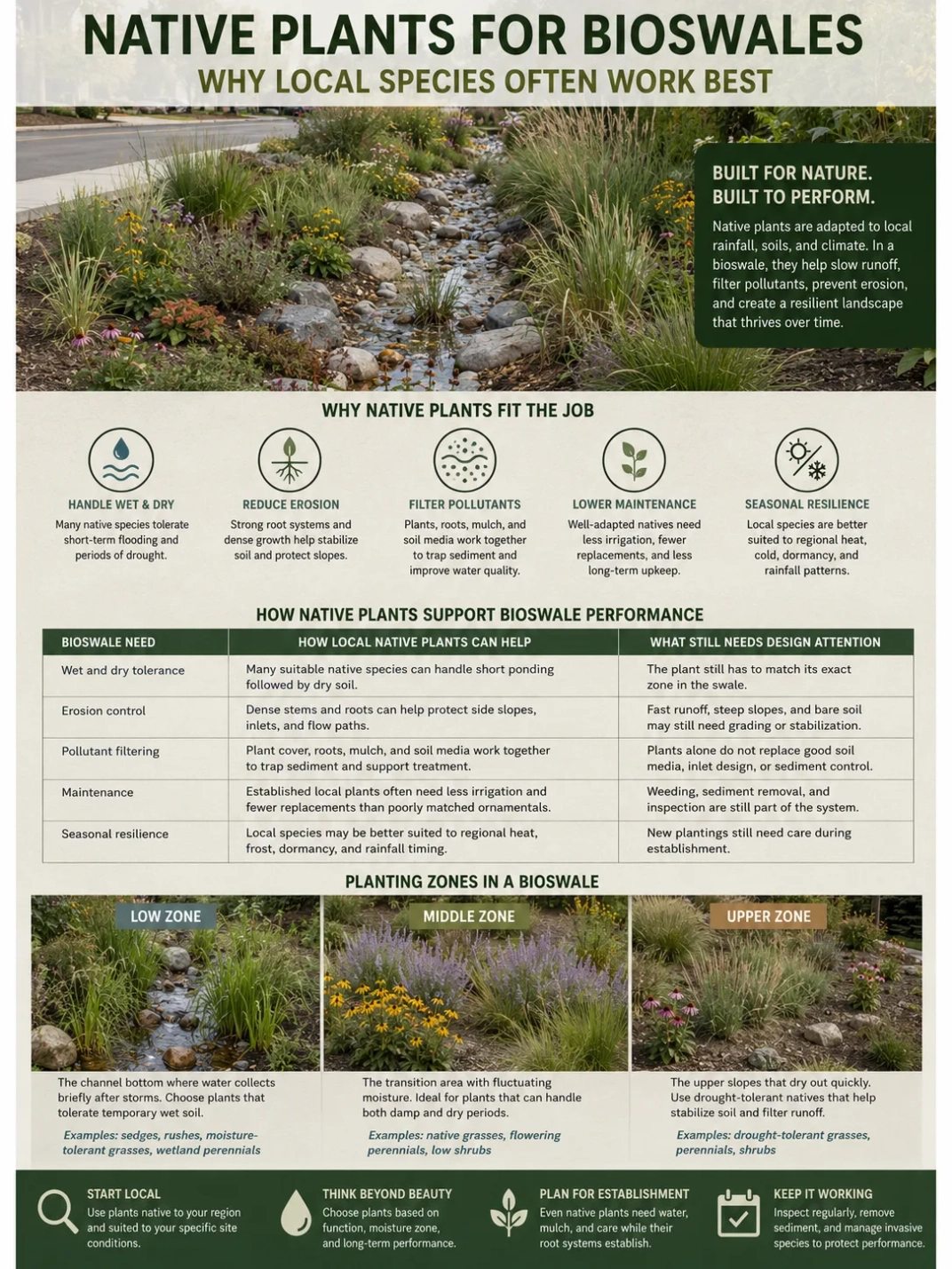
Why Native Plants Fit the Job
Native plants are useful in bioswales because they can support both stormwater function and long-term landscape stability. When chosen well, they help cover the soil, slow shallow flow, reduce erosion, and create a living root zone around the swale’s filter media or existing soil.
The advantage is local fit. A plant that evolved in a region with dry summers, cold winters, clay subsoil, sandy coastal soils, or seasonal flooding may be better prepared for those same stresses inside a bioswale. That does not mean every native plant belongs in every swale. It means the starting point should be the local plant community, then the final choice should match the exact moisture zone, sun exposure, soil texture, runoff source, and maintenance plan.
| Bioswale Need | How Local Native Plants Can Help | What Still Needs Design Attention |
|---|---|---|
| Wet and dry tolerance | Many suitable native species can handle short ponding followed by dry soil. | The plant still has to match its exact zone in the swale. |
| Erosion control | Dense stems and roots can help protect side slopes, inlets, and flow paths. | Fast runoff, steep slopes, and bare soil may still need grading or stabilization. |
| Pollutant filtering | Plant cover, roots, mulch, and soil media work together to trap sediment and support treatment. | Plants alone do not replace good soil media, inlet design, or sediment control. |
| Maintenance | Established local plants often need less irrigation and fewer replacements than poorly matched ornamentals. | Weeding, sediment removal, and inspection are still part of the system. |
| Seasonal resilience | Local species may be better suited to regional heat, frost, dormancy, and rainfall timing. | New plantings still need care during establishment. |
The Wet-Dry Cycle Matters More Than Garden Preference
A bioswale receives runoff from hard surfaces such as roofs, driveways, roads, sidewalks, or parking lots. During a storm, water may enter quickly through an inlet, curb cut, downspout, or sheet flow. After the storm, the water should move, spread, soak in where conditions allow, or leave through a safe overflow route.
This creates a difficult plant environment. The bottom may be wet for a short period, the upper slope may dry quickly, and the inlet area may receive sediment, mulch movement, or stronger flow. Native bioswale plants work best when they are chosen for this shifting moisture pattern, not just for their mature height or flower season.
Plants that need steady moisture may fail on upper slopes. Plants that only like dry soil may thin out in the lower channel. Plants with shallow roots may look acceptable at first but leave soil exposed after heavy runoff or summer stress.
Planting Zones in a Bioswale
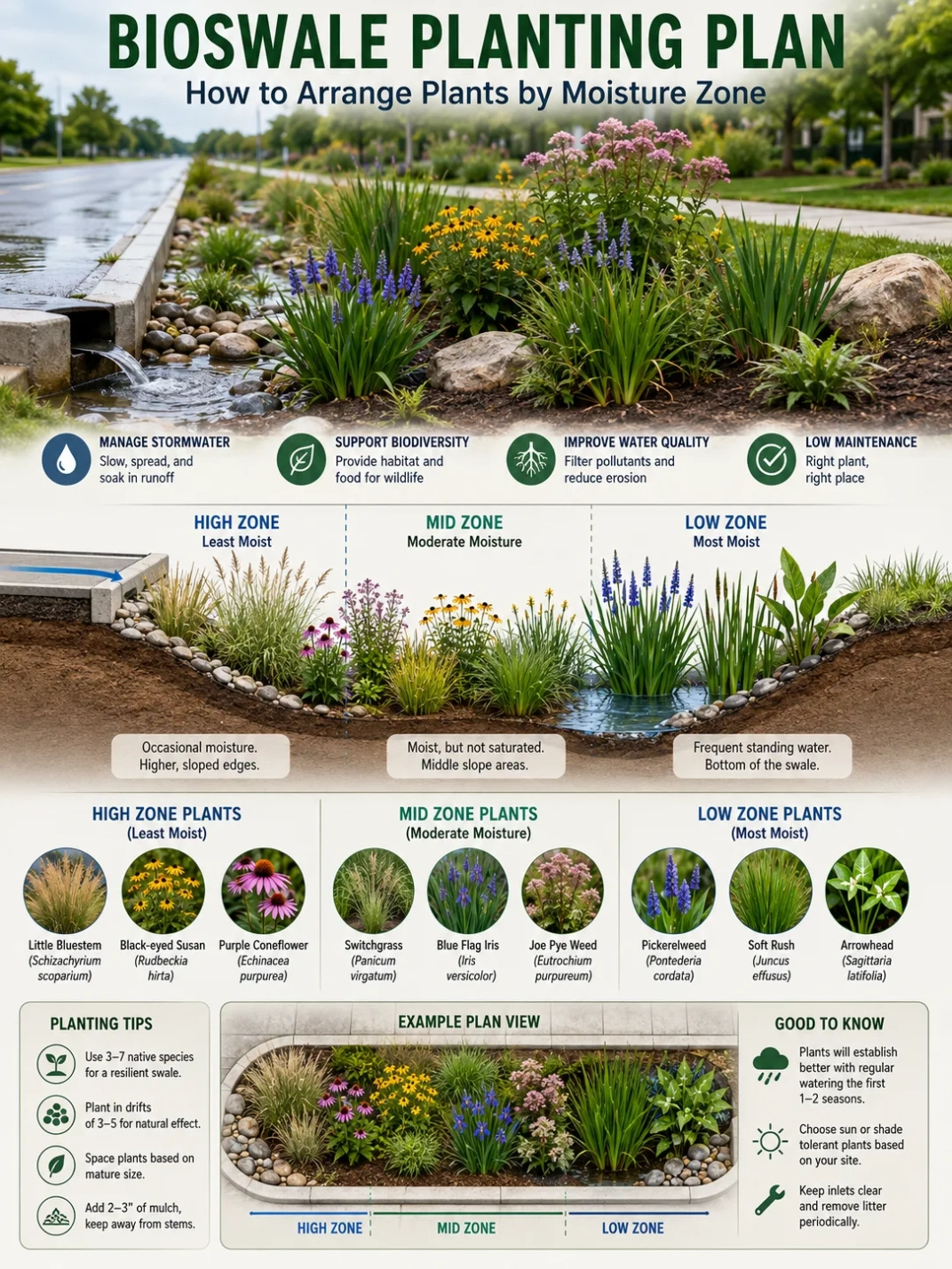
Most bioswales are not uniform from edge to edge. A simple way to think about planting is by moisture zone. This helps avoid one of the most common mistakes: placing the same plant mix everywhere.
Low Zone
The low zone is the channel bottom or basin area where water may collect briefly after rain. Plants here should tolerate temporary wet soil and then recover when the soil dries. In many regions, native sedges, rushes, moisture-tolerant grasses, and certain perennials may fit this role.
This zone should not be treated as a pond unless the design is meant to hold water. A bioswale usually needs drainage behavior, not permanent standing water.
Middle Zone
The middle zone receives fluctuating moisture. It may be damp after storms but drier between events. This is often a good place for native grasses, flowering perennials, and low shrubs that can tolerate both short wet periods and ordinary dry periods.
Upper Edge and Side Slopes
The upper edge may stay much drier than the bottom. Plants here need to hold soil on the slope and tolerate splash, heat, and dry spells. A plant that thrives at the bottom of a swale may not perform well along the upper shoulder.
Planting Note: A native plant is only a good bioswale plant when it fits the swale’s moisture zone. Local origin helps, but placement controls whether the plant can handle runoff, drying, sediment, shade, and maintenance conditions.
Roots Do More Than Hold the Plant Upright
In a bioswale, roots help connect vegetation to drainage performance. Dense root systems can help bind soil, protect against shallow erosion, and create small pathways in the soil around them. This can support infiltration where soil conditions allow.
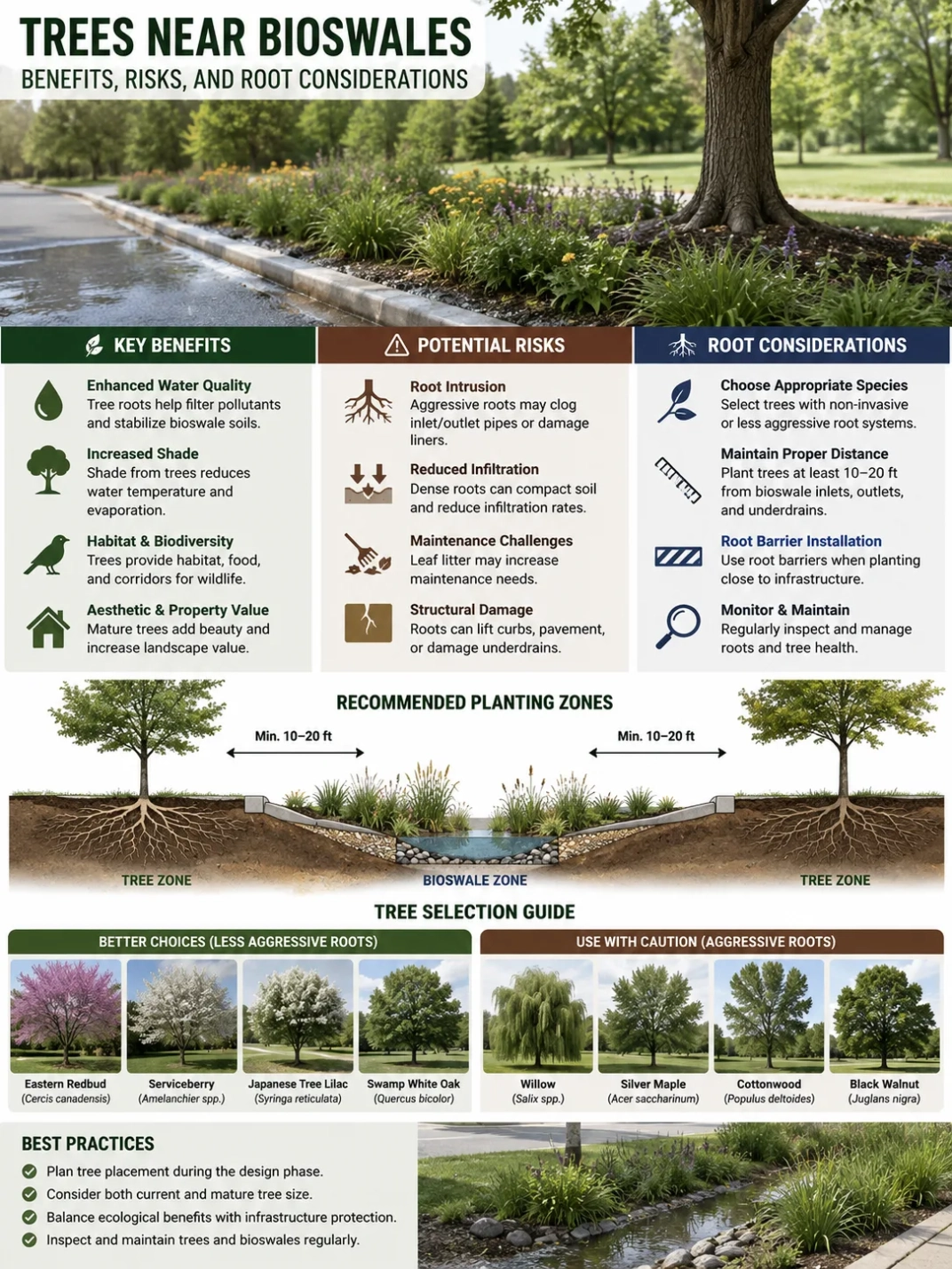
Different plants bring different root forms. Fine fibrous roots can knit the upper soil layer. Deeper roots can help plants survive dry periods and support soil structure over time. Shrubs may add woody structure, but they should be placed where they will not block the flow path, crowd an inlet, or make sediment removal difficult.
Roots are not magic. They cannot correct a swale that has the wrong slope, badly compacted soil, no safe overflow, or a clogged inlet. They work as part of the system, along with grading, soil media, mulch, flow length, and maintenance.
Native Does Not Mean Untended
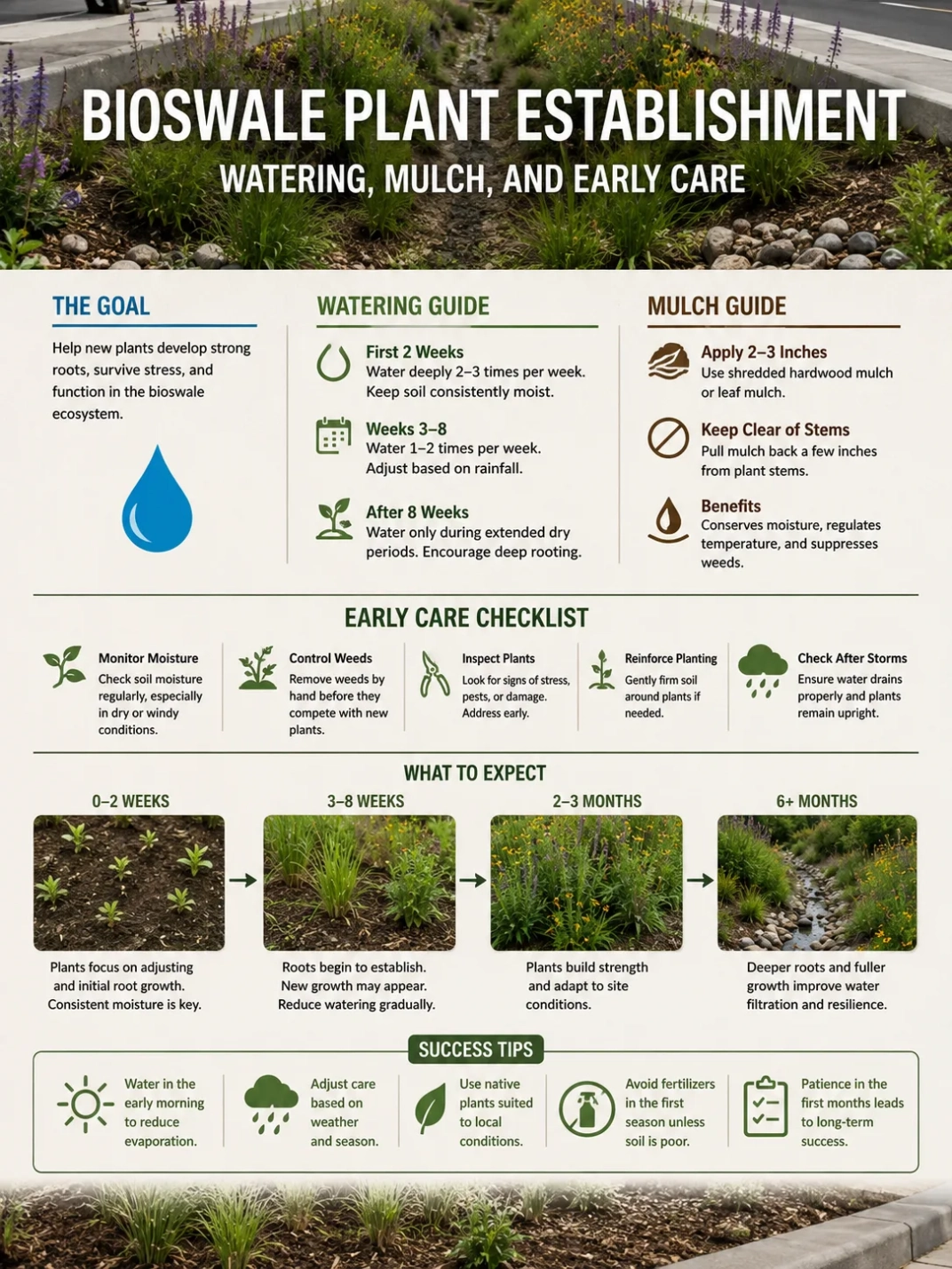
A well-planted bioswale still needs care, especially during establishment. Young native plants often need watering, weed control, and protection from being buried by sediment or mulch movement. Once established, they may need less input than poorly matched non-native ornamentals, but they are not maintenance-free.
Routine care usually focuses on keeping the drainage path open and the vegetation healthy. That includes checking the inlet, removing trash or sediment, replacing dead plants, controlling invasive plants, and making sure water is not standing longer than intended for the design.
Maintenance Note: Plant failure is often a symptom, not the whole problem. Repeated dieback near an inlet may point to sediment buildup, fast flow, road salt exposure, poor soil contact, shade change, or soil compaction.
Local Species Can Reduce Replacement Problems
Plants that are not adapted to the site may look good when installed but decline after the first difficult season. In bioswales, that decline can leave bare soil, create erosion points, and reduce the roughness that helps slow water.
Local native species often have a better chance of settling into the site after the establishment period. They may be more familiar with the region’s rainfall timing, dormancy cycle, temperature range, and soil biology. This matters because a bioswale should remain functional in ordinary weather, not only on the day it is planted.
For public or roadside bioswales, local fit can also help reduce the need for repeated replanting. These sites may face reflected heat, compacted edges, deicing salt where used, sediment from pavement, and irregular maintenance access. Plant choice should reflect those pressures.
Native Plants and Pollutant Filtering
Bioswales can help manage runoff pollution by slowing water and allowing sediment to settle before water moves farther downstream. Vegetation supports this process by covering soil, reducing flow speed near the surface, and adding root activity to the planted soil zone.
Plants are only one part of pollutant filtering. Soil texture, filter media, mulch, inlet design, ponding behavior, sediment load, and maintenance all affect performance. A dense native planting can support treatment, but it should not be used as a substitute for proper sizing, safe overflow, or site-specific drainage design.
Why Region-Specific Plant Lists Matter
A plant can be native to one region and unsuitable in another. Even within the same country, rainfall, heat, winter cold, soil pH, salt exposure, elevation, and growing season length can change plant performance. That is why broad plant lists should be treated carefully.
For a real bioswale, the better question is not “What is the best native plant?” It is: Which local plants fit this runoff source, soil, sun exposure, moisture zone, and maintenance level?
A balanced native plant palette may include grasses, sedges, rushes, flowering perennials, shrubs, and sometimes small trees where space allows. The mix should avoid plants known to spread aggressively in the local area. A plant that behaves well in one region may become a maintenance problem somewhere else.
Where Native Plants Can Fail in a Bioswale
Native planting improves the odds of success, but it does not remove design limits. Problems usually appear when plant selection is expected to fix drainage or soil issues that need separate attention.
- Wrong moisture match: dry-site plants placed in the lowest zone may thin out after repeated wet periods.
- Compacted soil: roots may struggle if the planting bed is dense, smeared, or poorly prepared.
- Fast inlet flow: young plants can be flattened or buried if runoff enters too forcefully.
- Too much sediment: repeated sediment deposits can smother crowns and reduce infiltration.
- Poor establishment care: even drought-tolerant native plants need support while roots develop.
- Invasive pressure: open soil and disturbed edges can invite aggressive weeds if not managed.
These failures do not mean native plants are a poor choice. They show that the plant layer must be matched with the physical design of the bioswale.
Native Plants Compared with Standard Ornamental Planting
Ornamental plants can be useful in some landscapes, but many are selected for appearance under garden conditions rather than for runoff stress. Bioswale planting asks for a different kind of performance.
| Planting Approach | Possible Strength | Possible Limit |
|---|---|---|
| Local native plant mix | Often better matched to local climate, seasonal stress, and habitat conditions. | Needs correct zone placement and may look less formal during dormancy. |
| Standard ornamental planting | May provide predictable color, form, or availability in nurseries. | May need more irrigation, replacement, or care if not suited to wet-dry cycles. |
| Single-species planting | Simple to install and maintain in some formal settings. | Can leave the swale vulnerable if that one species fails. |
| Mixed plant community | Can spread risk across species with different root forms and seasonal habits. | Needs a clear maintenance plan so desirable plants are not removed by mistake. |
What to Check Before Choosing Native Plants
Plant selection should happen after the basic site behavior is understood. A plant list chosen before checking drainage can lead to avoidable replacement work.
Runoff Source
Roof runoff, driveway runoff, parking lot runoff, and roadside runoff do not place the same stress on plants. Pavement runoff may bring more sediment, heat, and pollutants than roof runoff. Roadside runoff may add salt exposure in regions where deicing materials are used.
Sun and Shade
Many bioswale plant failures are simple light mismatches. A full-sun native grass may decline under tree shade. A shade-tolerant plant may struggle in a hot curbside swale.
Soil Texture and Drainage
Sandy soils, loamy soils, clay soils, and engineered filter media all behave differently. Some bioswales include an underdrain where infiltration is limited or where the design needs controlled drainage. Plant roots must be able to establish in the actual soil or media used.
Maintenance Access
Plants should not block inspection points, overflow routes, inlets, outlets, or sediment forebays where present. A large shrub in the wrong spot can make a small bioswale harder to inspect and maintain.
Site Planning Note: For bioswales near buildings, public sidewalks, roads, property lines, or existing drainage systems, plant choice should follow the drainage design. Local rules or professional review may apply depending on the project size and location.
Plant Diversity Helps the Swale Stay Covered
A bioswale planted with several suitable native species is often more stable than one planted with a single species. Different plants grow at different times, root at different depths, and respond differently to wet or dry periods. This helps keep the soil covered across seasons.
Diversity should still be practical. A small residential swale may need a simple palette that can be maintained easily. A public or commercial swale may need a tougher mix that can handle sediment, foot traffic near edges, heat from pavement, and periodic disturbance.
How Native Plants Affect Appearance
Native bioswale planting can look natural, meadow-like, formal, or restrained depending on the species and layout. The design does not have to look messy. Clear edges, repeated plant groups, careful height placement, and seasonal maintenance can make a bioswale read as intentional.
Appearance matters because bioswales are often placed where people see them: front yards, streetscapes, parking lots, campus paths, and public spaces. A plant palette that looks cared for is more likely to be protected, inspected, and maintained.
Native Plants in Residential Bioswales
In residential settings, native plants can help a small bioswale handle roof or driveway runoff while fitting into the surrounding landscape. The planting should stay clear of building foundations, protect the overflow route, and avoid sending water toward neighboring property.
Home-scale bioswales also need simple maintenance. A mix that requires expert plant identification every month may not be realistic. Durable local grasses, sedges, and perennials often work better than delicate plants that need constant trimming, staking, or watering.
Native Plants in Public and Roadside Bioswales
Public bioswales and roadside bioswales face harder conditions than many home landscapes. They may receive runoff from larger impervious surfaces, more sediment, stronger flows, heat from pavement, litter, and irregular maintenance. Native plants can help, but the design needs to protect them during high-flow events.
In these locations, plant height, sight lines, maintenance equipment, pedestrian movement, and winter conditions may shape the final plant palette. Low-growing native plants may fit near visibility zones, while taller grasses or shrubs may belong farther from paths, driveways, or intersections.
Common Misunderstandings About Native Bioswale Plants
One misunderstanding is that native plants can simply be planted and ignored. Another is that any wetland plant belongs in a bioswale. Both ideas can lead to weak performance.
- Native does not mean aquatic. Many bioswales dry between storms, so plants must tolerate both wet and dry periods.
- Native does not mean local enough. A species native to a broad region may still be a poor fit for a specific climate, soil, or elevation.
- Native does not mean tidy without care. Seasonal cutting, weeding, and sediment removal may still be needed.
- Native does not mean suitable beside pavement. Heat, salt, reflected light, and compacted edges can narrow the plant choices.
FAQ
Do bioswales need native plants?
A bioswale does not strictly need native plants in every case, but local native species are often a strong choice because they may be better suited to regional climate, seasonal wet-dry cycles, local soils, and lower-input maintenance after establishment.
Are wetland plants best for bioswales?
Not always. A bioswale may be wet for a short time after rain and dry for long periods between storms. The best plants usually tolerate both temporary wet soil and drying, especially in the middle and upper zones.
Can native grasses work in a bioswale?
Many native grasses can work well when they match the site. Their stems and roots can help slow shallow flow, cover soil, and stabilize slopes. Some wetter zones may be better suited to sedges or rushes, depending on the region.
Why do some native plants fail after planting?
Failure can come from poor moisture-zone placement, compacted soil, fast inlet flow, sediment buildup, shade mismatch, lack of establishment watering, or weed competition. The problem is often a site or design mismatch rather than the native plant label itself.
Should a bioswale use one native species or a mix?
A mix is often better because different plants handle stress in different ways. A simple, well-chosen mix can keep soil covered across seasons and reduce the chance that one plant failure leaves the swale bare.
Can native plants fix poor drainage?
Native plants can support drainage performance, but they cannot fix a bioswale with poor grading, clogged soil, unsafe overflow, or the wrong soil media. Drainage behavior should be checked before relying on plants to solve the problem.