Sizing a bioswale starts before any formula is used. The useful first step is to understand how much runoff will enter the swale, how fast it will arrive, where it can safely go, and whether the soil can accept or release water at the needed pace. Without those answers, a calculated width, depth, or length may look precise on paper but perform poorly on the ground.
A bioswale is not sized only by making a landscaped trench bigger. Its size comes from a chain of site decisions: the drainage area, the amount of impervious surface, the design storm, the flow path, the soil profile, available grade, plant zone, inlet behavior, outlet control, and maintenance access. Each one changes the final footprint.
The goal is to create a stable vegetated channel that can slow, filter, convey, and sometimes infiltrate stormwater runoff. A small residential swale receiving roof runoff has very different sizing limits than a roadside or parking lot bioswale receiving sediment-heavy flow from pavement.
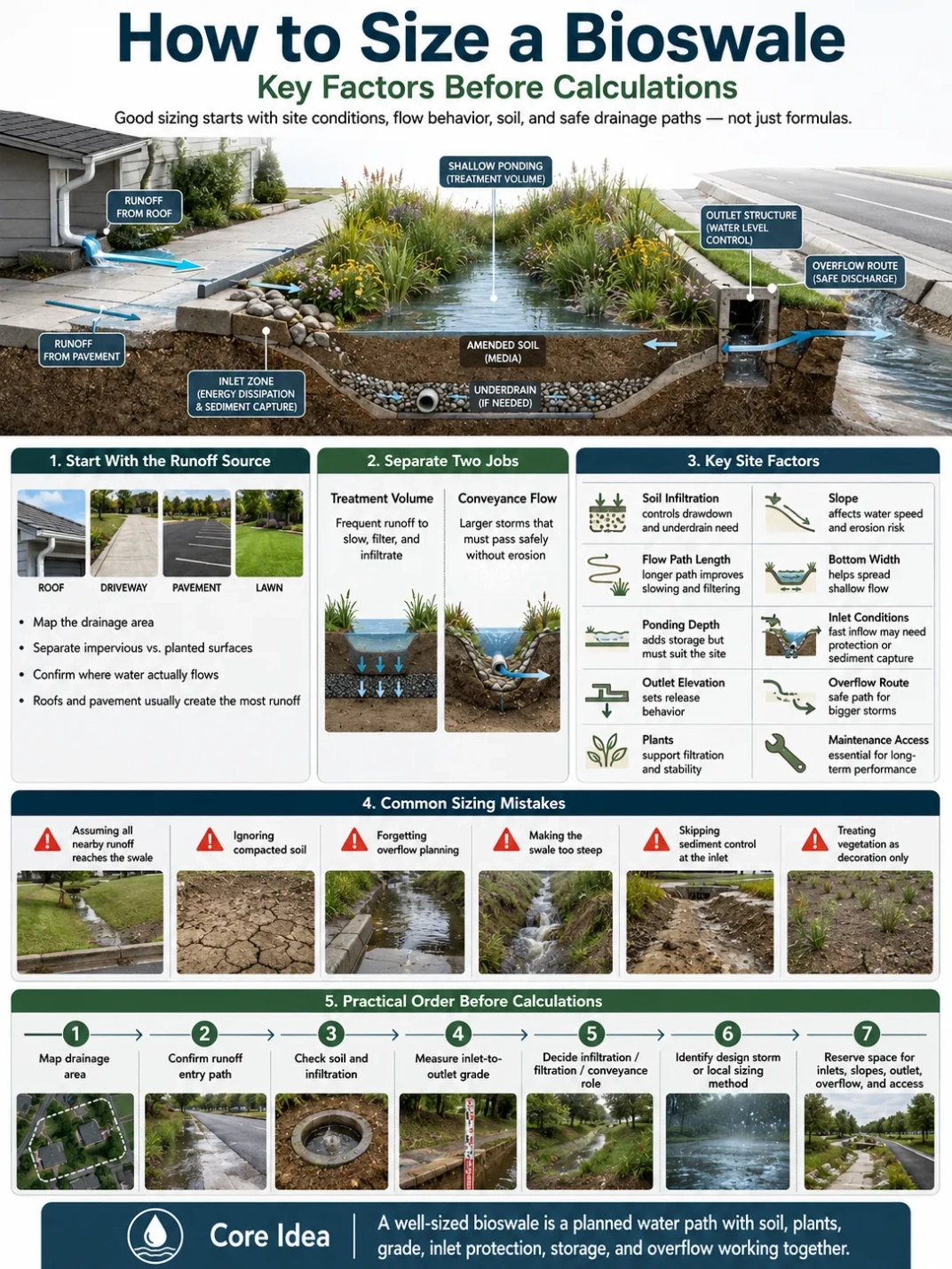
Sizing Begins With the Runoff Source
The drainage area is the land surface that sends water into the bioswale. It may include a roof, driveway, patio, sidewalk, parking lot, street edge, lawn, or mixed landscape area. The same square footage can produce very different runoff depending on surface type.
Impervious surfaces matter most because they shed water quickly. Roofs, asphalt, concrete, compacted gravel, and paved driveways usually send more runoff to the swale than planted soil. Turf or garden areas may absorb part of the rainfall before it reaches the bioswale, depending on soil condition and slope.
Before calculations, the drainage area should be drawn clearly. Guessing from property lines can be misleading. Water follows grade, roof leaders, curb openings, surface depressions, and compacted paths.
| Sizing Input | Why It Matters | What to Check on Site |
|---|---|---|
| Drainage area | Sets the amount of runoff entering the swale. | Roof sections, pavement, lawn slope, curb flow, and downspout direction. |
| Surface type | Changes how much rainfall becomes stormwater runoff. | Impervious pavement, compacted soil, turf, mulch, planting beds, and gravel. |
| Soil infiltration | Controls whether water can soak into native soil or needs an underdrain. | Soil texture, compaction, seasonal wetness, groundwater, and field test results. |
| Available slope | Shapes water speed, erosion risk, and ponding behavior. | Longitudinal grade, side slope, low points, and outlet elevation. |
| Overflow route | Provides a safe path when storms exceed the treatment volume. | Street inlet, storm drain, yard low point, spillway, or approved discharge path. |
| Maintenance access | Affects long-term function after sediment, mulch movement, or plant growth. | Reach to inlets, outlets, check dams, underdrain cleanouts, and planted areas. |
Separate Treatment Volume from Conveyance Flow
A bioswale often has two jobs. One job is to treat a smaller, more frequent storm by slowing runoff and allowing sediment, filtration, plant contact, and soil processes to work. The other job is to move larger flows through or past the system without erosion or unwanted ponding.
Those two jobs should not be mixed into one vague “make it big enough” decision. The treatment volume relates to the amount of runoff the bioswale is expected to hold, filter, or infiltrate. The conveyance flow relates to how the swale handles water that keeps moving during heavier rain.
Many local stormwater manuals define a water quality event, design storm, drawdown time, or runoff depth for sizing. These values vary by climate, soil, watershed rules, and project type. A residential landscape may use a simpler approach, but public or commercial projects usually need project-specific design review.
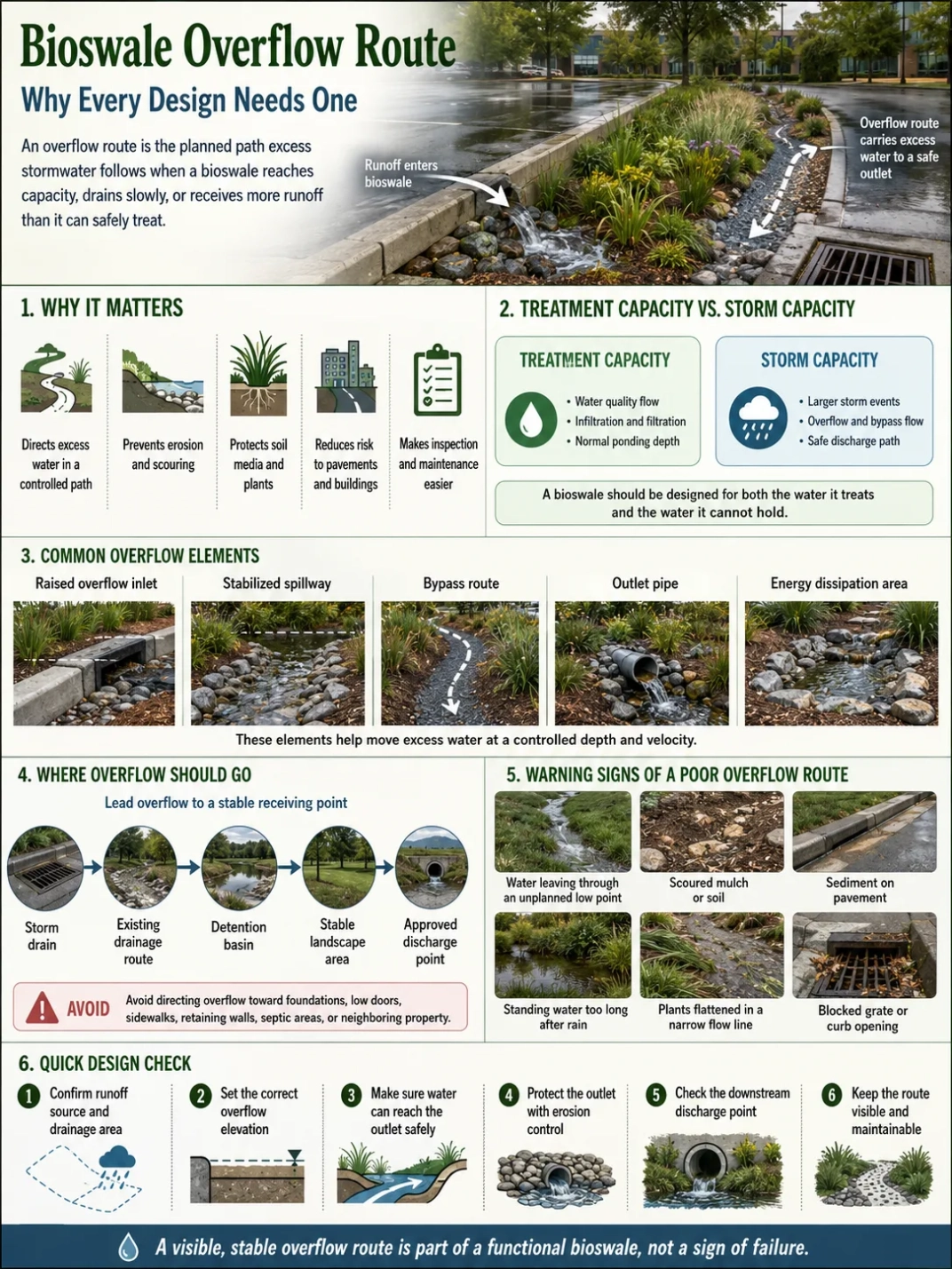
Design Note: A bioswale should have a planned overflow path. The overflow route is not a failure feature. It is part of the design because no surface stormwater system is meant to store every possible storm.
Measure the Flow Path, Not Just the Footprint
The length and shape of the flow path affect performance. Water needs enough travel distance to slow down, spread out, contact vegetation, drop sediment, and enter the soil or filter media. A short, steep swale can act more like a fast drainage ditch than a bioswale.
The flow path includes the inlet, bottom width, side slopes, bends, check dams if used, outlet, and any overflow route. It also includes how water enters the swale. Sheet flow from a pavement edge behaves differently from concentrated water coming from a pipe, downspout, curb cut, or driveway channel.
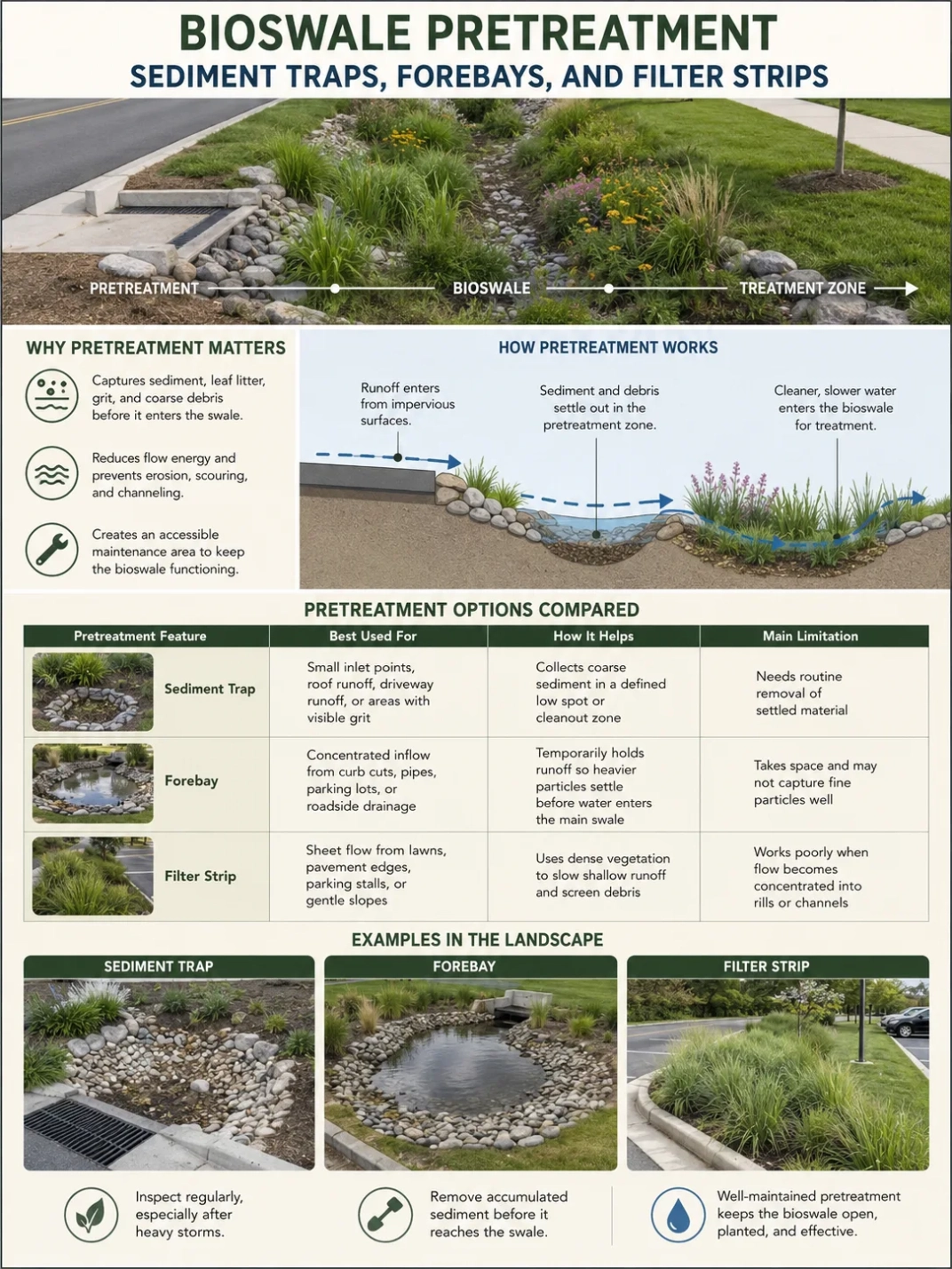
Concentrated inflow can scour mulch, expose soil, flatten plants, or carve a channel through the swale bottom. Sizing should leave room for inlet protection, energy dissipation, and sediment capture near the entry point. These details may not change the drainage area, but they can change the needed length and shape.
Why Bottom Width Matters
The bottom of a bioswale should support shallow, distributed flow when possible. A very narrow bottom can concentrate water and increase erosion risk. A wider bottom can spread water, improve contact with vegetation, and provide more surface area for infiltration or filtration.
Wider is not automatically better. If the site is nearly flat and the outlet is poorly set, a wide swale can hold water longer than intended. If the site is steep, a wider bottom still needs grade control to prevent fast flow.
Soil Infiltration Controls More Than Storage
Soil is one of the main limits in bioswale sizing. Native soil affects drawdown time, standing water, plant health, underdrain need, and whether infiltration is a realistic part of the design. A bioswale on sandy soil may drain quickly. A bioswale on compacted clay may need amended media, an underdrain, or a different drainage approach.
Soil texture alone is not enough. Compaction can make a soil behave much tighter than its texture suggests. Construction traffic, old driveways, fill material, buried debris, and repeated mowing can reduce infiltration near the surface. Field testing is often more useful than a visual guess.
Soil Note: A design infiltration rate is usually more conservative than a raw field test result. Designers may apply safety factors because soils vary across a site and can clog or compact over time.
Where infiltration is limited, the bioswale may still provide value as a vegetated filtration and conveyance system. In that case, sizing must account for controlled drainage through engineered media, an underdrain, or an approved outlet rather than assuming that all runoff will soak into the ground.
Ponding Depth Should Fit the Site and the Use
Ponding depth is the temporary water depth held above the swale surface during a storm. It helps provide storage, but it also affects safety, plant stress, drawdown time, side slope design, and available freeboard.
Deeper ponding can reduce the surface area needed for a target runoff volume, but only where the site can support it. In public spaces, near walkways, beside roads, or in small residential yards, shallow and visible storage may be more practical. Local standards may also limit surface ponding depth or require a maximum drain-down period.
The ponding depth should be paired with the outlet elevation. If the outlet is too low, water may pass through before treatment. If it is too high, water may remain longer than intended. The swale needs enough storage for frequent runoff, but it also needs a release path.
Slope Shapes Water Speed and Stability
Slope affects almost every part of sizing. The longitudinal slope moves water along the swale. The side slopes affect safety, maintenance, vegetation, and how sheet flow enters from nearby surfaces.
On a steep site, stormwater can move too fast for good filtering and may erode the swale bottom. Check dams, grade breaks, level spreaders, stone at inlets, or a different alignment may be needed. On a very flat site, water may sit too long unless the outlet, underdrain, or soil infiltration can keep up.
Because slope is tied to available elevations, it should be checked early. A swale cannot be sized well from a plan view alone. The vertical profile matters.
The Inlet Can Decide How Large the First Section Needs to Be
The inlet is where runoff enters the bioswale. It may be a curb cut, downspout extension, pipe, driveway edge, sheet-flow strip, or pavement opening. The inlet often receives the fastest water and the most sediment.
If the inlet is undersized or poorly protected, the first section of the swale can clog, erode, or bypass the planting zone. That can make a correctly sized swale perform poorly. The entry area may need extra width, stone protection, a forebay, a grass filter strip, or a small sediment zone that can be cleaned without disturbing the whole swale.
Sediment control is part of sizing because sediment slowly steals storage, blocks pores, and changes the swale bottom. Parking lots, roads, construction areas, and gravel drives can send more sediment than roofs or clean patio surfaces.
Outlet and Overflow Choices Change the Required Shape
The outlet controls where water goes after the bioswale has done its work. It may connect to a storm drain, discharge to another green infrastructure feature, release to a lower landscape area, or move through an approved overflow route.
Outlet elevation helps set the storage depth. Overflow elevation helps protect the site during larger storms. These elevations should be planned before final sizing because they affect how much water can be held and how quickly it leaves.
Drainage Note: A bioswale should not redirect runoff toward building foundations, neighboring property, public sidewalks, or areas where standing water would create a maintenance or access problem. Local drainage rules may apply.
Underdrains Are a Sizing Decision, Not an Afterthought
An underdrain is a perforated pipe placed below the soil media or aggregate layer to collect and move water out of the bioswale. It is often considered when native soil drains slowly, groundwater separation is limited, or the project must meet a drain-down requirement.
Adding an underdrain changes the sizing logic. The swale may rely less on native soil infiltration and more on storage, filtration through media, and controlled discharge. The underdrain elevation can also create an internal water storage zone below the pipe, where local standards and soil conditions allow.
An underdrain does not remove the need for good soil media, inlet protection, overflow planning, and maintenance access. It simply changes how water leaves the system.
Plants Influence Both Flow and Long-Term Capacity
Plants are not decoration added after sizing. Dense vegetation helps slow water, hold soil, support filtration, and keep the swale surface more stable. Roots can improve soil structure over time, although they do not solve every compaction or drainage problem.
Plant selection should match the moisture zones inside the swale. The bottom may experience short wet periods followed by dry conditions. Side slopes may be drier. Inlets may receive sediment and higher flow. Plants near outlets may need to tolerate occasional movement of water and debris.
Planting Note: Native grasses, sedges, rushes, and shrubs can be good candidates when they match the region, sun exposure, soil moisture, and maintenance plan. Plant lists should be chosen locally, not copied from a different climate.
The mature plant size also affects the usable channel. A swale that looks open at installation may become dense after establishment. That can be useful for filtration, but maintenance crews still need access to remove sediment, inspect inlets, and clear outlets.
Available Space Must Include Edges and Access
The visible swale footprint is only part of the space needed. A practical bioswale also needs stable side slopes, inlet protection, outlet structures, overflow space, plant growth area, and access for inspection.
In residential settings, space is often limited by foundations, fences, trees, utilities, sidewalks, driveways, property lines, and the direction of yard slope. In public or commercial settings, space may be shaped by curbs, parking stalls, pedestrian routes, sight lines, utility corridors, snow storage, and maintenance equipment.
Trying to force a bioswale into a narrow leftover strip can create a system that is hard to plant, hard to clean, and easy to bypass. The available footprint should be judged by function, not just by whether the swale physically fits.
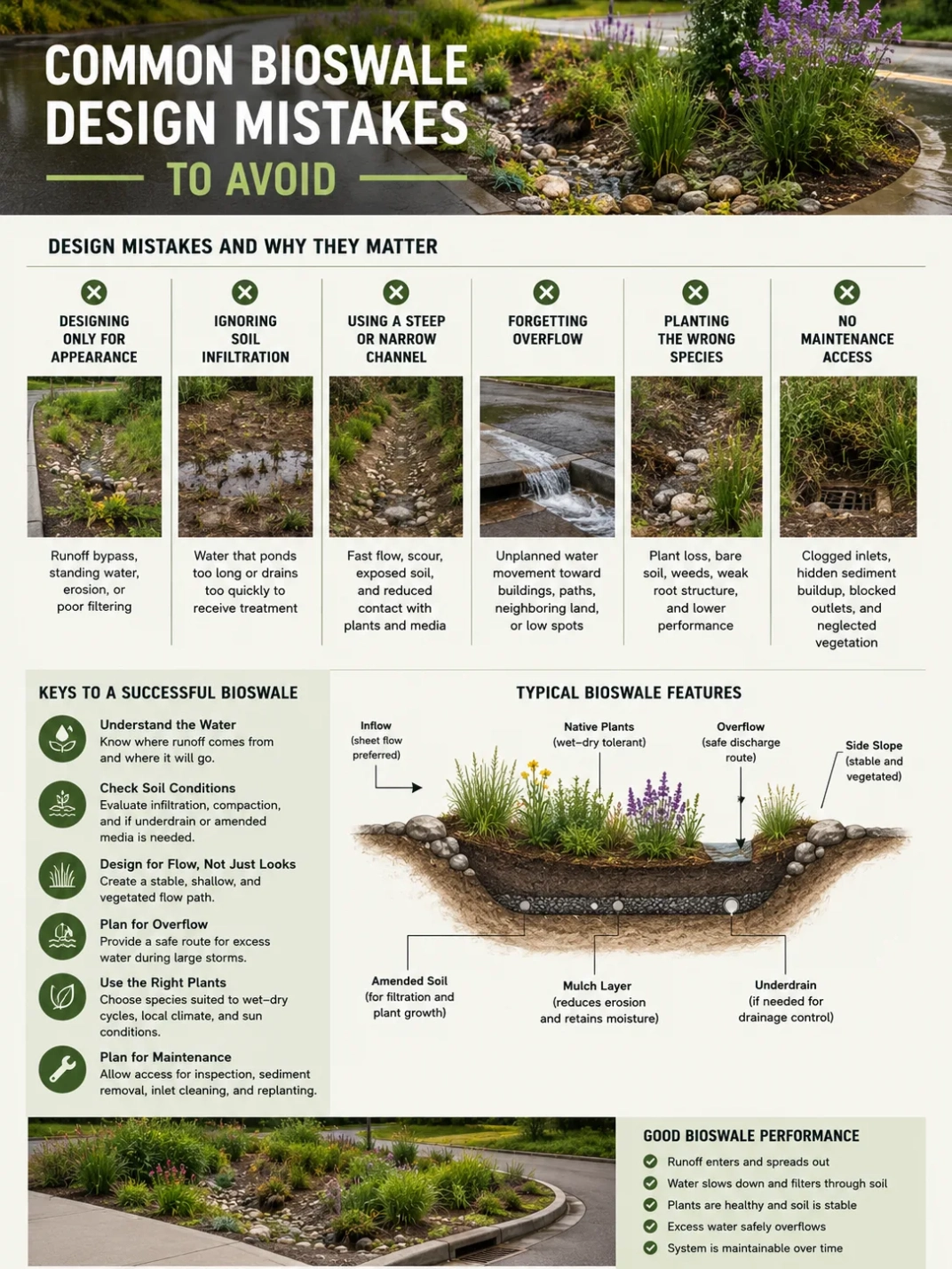
Common Sizing Mistakes
Most sizing errors come from missing site information rather than from a math mistake. The calculation can only be as good as the assumptions behind it.
- Using roof or pavement area without checking flow direction. Runoff may not enter the swale unless grading or piping sends it there.
- Ignoring compacted soil. A swale on compacted subgrade may drain much more slowly than expected.
- Forgetting overflow. Larger storms need a planned path that does not damage the swale or nearby areas.
- Making the swale too steep. Fast water can reduce filtering time and increase erosion.
- Skipping sediment planning. Inlets that receive dirty runoff need space and access for cleaning.
- Treating plants as a finish layer. Vegetation affects roughness, erosion control, root structure, and maintenance.
A Practical Order Before Calculations
A good sizing process follows the path of water from source to outlet. This keeps the design grounded in the real site instead of starting with a target dimension too early.
- Map the drainage area and separate roof, pavement, turf, and planted surfaces.
- Confirm how runoff will reach the bioswale: sheet flow, pipe, curb cut, downspout, or surface channel.
- Check soil texture, compaction, seasonal wetness, and infiltration potential.
- Measure available grade from inlet to outlet, including low points and overflow elevation.
- Decide whether the bioswale is mainly for infiltration, filtration, conveyance, or a mix of these functions.
- Identify the design storm, water quality volume, or local sizing method required for the site.
- Reserve space for inlet protection, side slopes, planting zones, outlet control, and maintenance access.
After those steps, calculations can be used to test the swale footprint, ponding depth, media depth, storage volume, drain-down time, and flow capacity. If the numbers do not fit the site, the answer may be a longer swale, wider bottom, reduced drainage area, underdrain, pretreatment zone, or a different stormwater practice.
When Another Drainage System May Fit Better
A bioswale is a strong fit where runoff can move along a planted channel and where the site has enough length, grade control, and safe overflow. It may not be the best fit for every drainage problem.
A rain garden may fit better where water can collect in a basin rather than move along a channel. A bioretention cell may fit better where engineered media and controlled drainage are the main treatment method. A French drain may fit subsurface drainage needs, but it does not provide the same surface vegetation and sediment capture. Permeable pavement may reduce runoff at the source rather than sending it to a separate swale.
The right choice depends on space, soil, slope, runoff source, maintenance capacity, and local rules. In some sites, a bioswale works best as one part of a larger drainage system.
When Professional Review Is Sensible
Professional review is sensible when the bioswale receives runoff from a large impervious area, sits near a building foundation, connects to a public drainage system, affects a neighboring property, lies near utilities, or must meet a local stormwater standard.
It is also helpful where slopes are steep, soils drain slowly, groundwater is shallow, erosion is already present, or standing water has been a repeated issue. These conditions do not rule out a bioswale, but they call for careful grading, outlet planning, and soil evaluation.
A well-sized bioswale is not just a calculated storage volume. It is a planned water path with soil, plants, grade, inlet protection, and overflow working together.
FAQ
What is the first thing to know before sizing a bioswale?
The first thing to know is the drainage area that will send runoff into the bioswale. That area should be separated by surface type, such as roof, driveway, pavement, turf, or planting bed, because each surface produces runoff differently.
Can a bioswale be sized with a simple rule of thumb?
A rule of thumb can help with early planning, but it should not replace site-based sizing. Soil infiltration, slope, design storm, inlet conditions, outlet elevation, and overflow route can all change the required size.
Does soil type change bioswale size?
Yes. Soil affects how quickly water can soak in, how long water may remain, whether an underdrain is needed, and how much surface area or storage the bioswale may need. Compacted soil can limit drainage even when the surface looks suitable.
Should a bioswale be sized for the biggest possible storm?
Most bioswales are planned to treat frequent runoff events and safely convey or bypass larger storms. The exact design storm or water quality volume depends on local standards, site conditions, and project goals.
How does slope affect bioswale sizing?
Slope affects water speed, erosion risk, ponding, outlet elevation, and the need for grade control. A steep swale may need check dams or a different alignment, while a very flat swale may need careful outlet or underdrain planning.
When does a bioswale need an underdrain?
An underdrain may be needed when native soil drains too slowly, when local rules require a set drain-down time, or when the design relies on filtration and controlled discharge rather than full infiltration into the ground.