Bioswale pretreatment is the small upstream layer of protection that keeps sediment, leaf litter, grit, and coarse debris from entering the main planted swale too quickly. Sediment traps, forebays, and filter strips do not replace the bioswale itself. They help the bioswale stay open, planted, and able to move stormwater through soil and vegetation without clogging early.
A well-designed bioswale slows runoff, spreads flow, supports infiltration, and filters pollutants through vegetation, mulch, soil media, and root zones. Pretreatment works before that process begins. It captures the rough material first, especially from driveways, parking lots, roadsides, rooftops, construction edges, and other hard surfaces where runoff can carry sediment at the first point of entry.
Bioswale pretreatment matters most where runoff enters as concentrated flow. A curb cut, pipe outlet, roof downspout, trench drain, or paved channel can send water into one small point with enough energy to scour mulch, bury plants, compact soil, and shorten the life of the swale. Pretreatment turns that sharp inflow into a more manageable pattern.
What Pretreatment Does in a Bioswale
Pretreatment sits between the runoff source and the main treatment zone. Its job is simple: slow the water before the bioswale has to treat it.
That small pause changes how the system behaves. Heavier particles can settle. Floating debris can collect near an accessible edge. Water can enter the planted channel at a lower velocity. Maintenance crews or homeowners can remove buildup from one defined area instead of digging sediment out of the whole bioswale.
Pretreatment usually supports three functions:
- Sediment capture: It holds coarse sediment, grit, sand, and organic debris before they reach the soil surface.
- Energy reduction: It slows concentrated inflow so water does not cut channels through mulch, plants, or soil media.
- Maintenance control: It creates a place where sediment can be seen, measured, and removed.
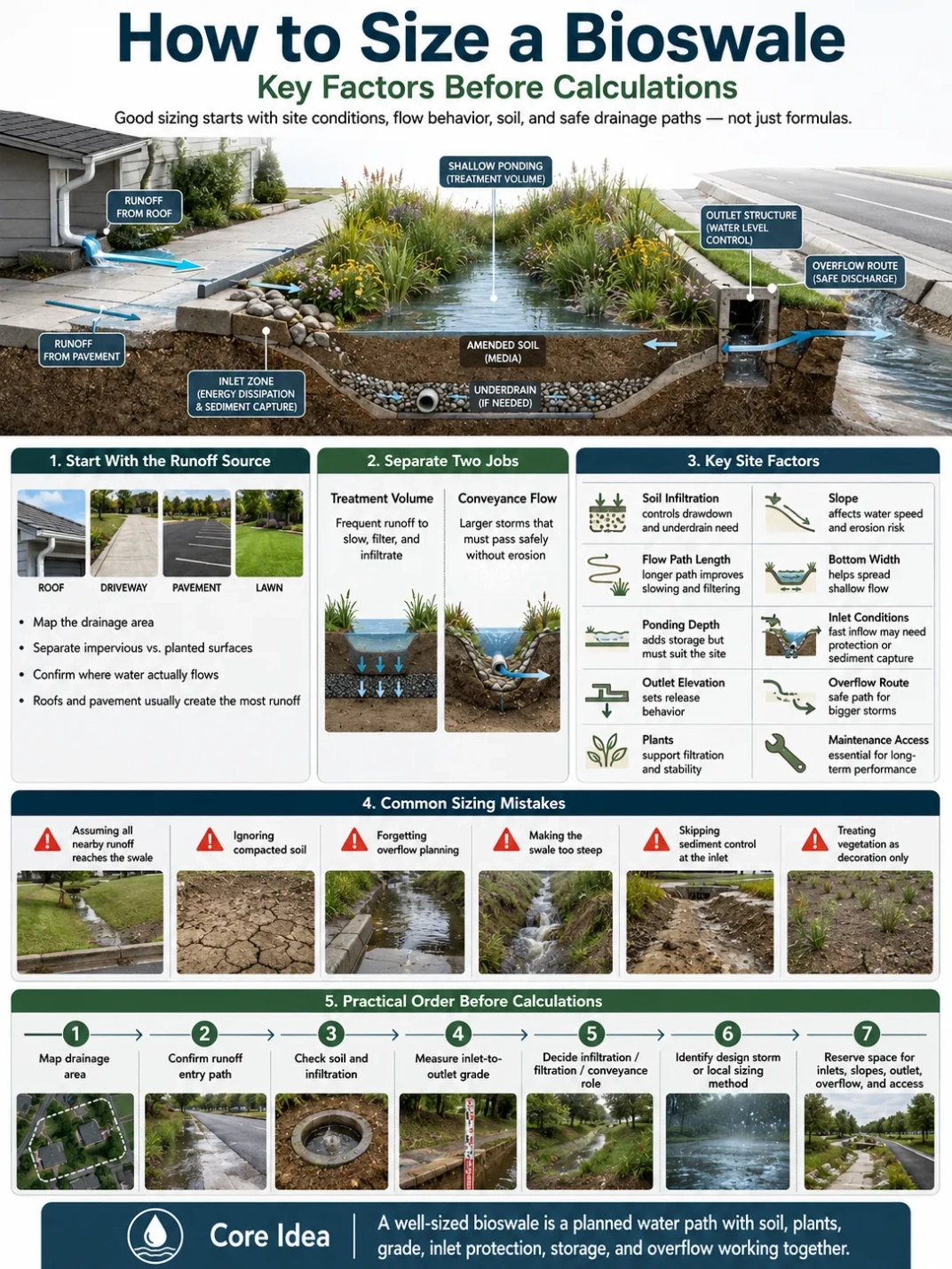
Pretreatment is not a cure for poor grading or undersized drainage. If the swale receives more water than it can safely convey, pond, infiltrate, or overflow, a sediment trap or filter strip will not solve that core design issue.
Design Note: Pretreatment should be easy to reach. A forebay or trap that collects sediment but cannot be cleaned will eventually become part of the clogging problem.
Sediment Traps, Forebays, and Filter Strips Compared
These three pretreatment methods often work together, but they are not the same. The right choice depends on how runoff arrives, how much space is available, and whether the flow is sheet flow or concentrated flow.
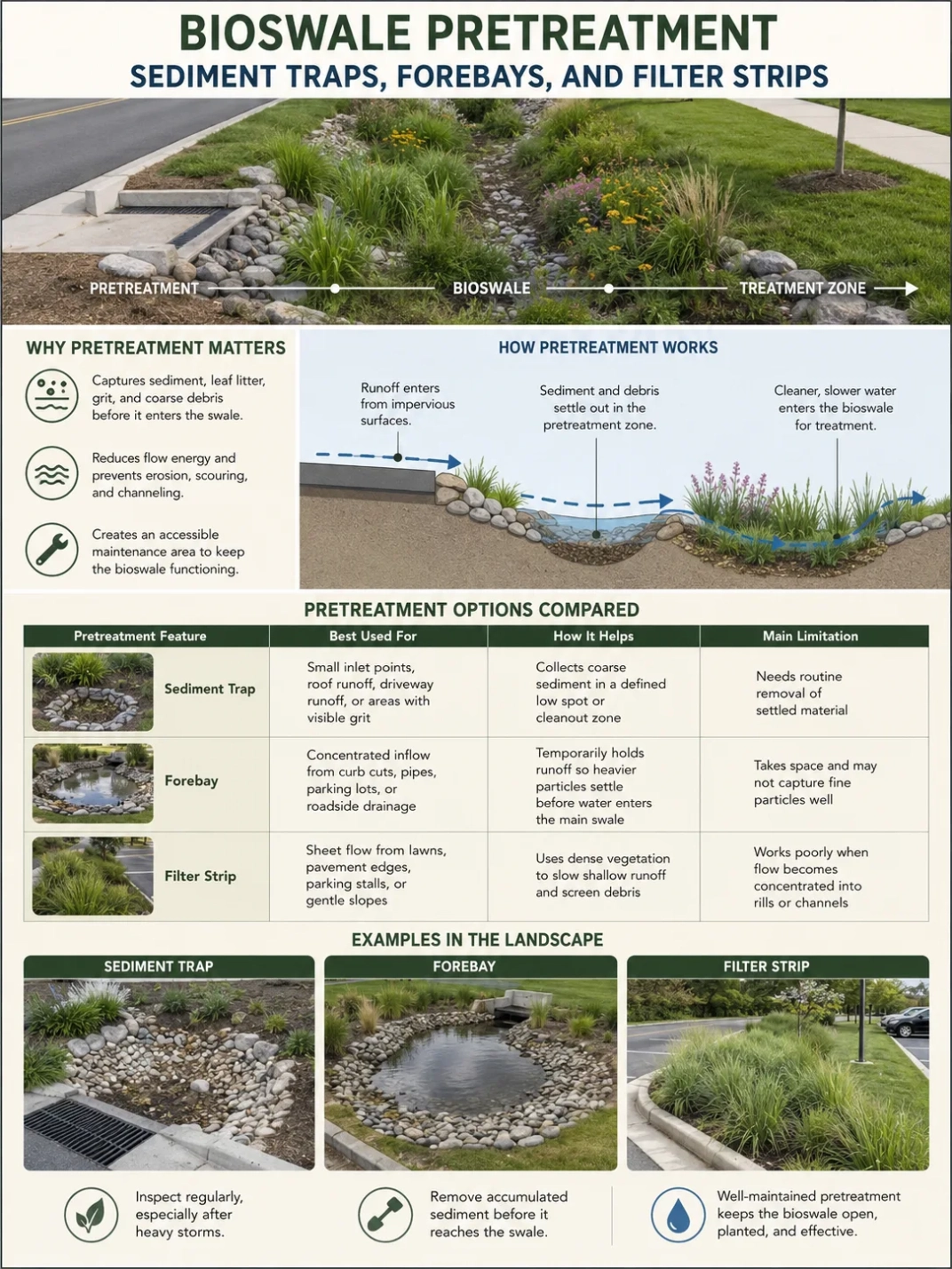
| Pretreatment Feature | Best Used For | How It Helps | Main Limitation |
|---|---|---|---|
| Sediment Trap | Small inlet points, roof runoff, driveway runoff, or areas with visible grit | Collects coarse sediment in a defined low spot or cleanout zone | Needs routine removal of settled material |
| Forebay | Concentrated inflow from curb cuts, pipes, parking lots, or roadside drainage | Temporarily holds runoff so heavier particles settle before water enters the main swale | Takes space and may not capture fine particles well |
| Filter Strip | Sheet flow from lawns, pavement edges, parking stalls, or gentle slopes | Uses dense vegetation to slow shallow runoff and screen debris | Works poorly when flow becomes concentrated into rills or channels |
A sediment trap is usually the simplest feature. A forebay is more defined and often more suitable for concentrated runoff. A filter strip is broad and shallow, so it depends on runoff spreading evenly across vegetation.
Sediment Traps: Small Capture Zones at the Inlet
A sediment trap in a bioswale is a small settling or cleanout area placed where runoff first enters the system. It may be a shallow stone-lined pocket, a depressed inlet pad, a small basin, or another accessible point designed to catch coarse material before it spreads downstream.
The main purpose is not deep storage. It is early capture. When stormwater washes over pavement, bare soil, gravel edges, or landscaped slopes, the first flush can carry sand, soil particles, leaves, mulch pieces, and small debris. If that material lands directly on the bioswale bed, it can form a thin seal over soil media and reduce infiltration.
Where Sediment Traps Fit Best
Sediment traps are useful where the inflow point is easy to identify. They fit well near:
- Downspout outlets that discharge toward a small bioswale
- Driveway edges where runoff brings fine gravel or sand
- Curb openings that collect street-side debris
- Pipe outlets that need a simple cleanout area before flow spreads
- Sloped planting beds above the swale where loose soil may wash downslope
In larger public or commercial sites, a sediment trap may be too small on its own. It may need to be paired with a forebay, check dam, energy dissipater, or other inlet control depending on local design rules and the amount of hard surface draining to the bioswale.
What Makes a Sediment Trap Work
A good sediment trap has a visible bottom, a stable edge, and a clear path for water to leave without cutting into the swale bed. If the trap is just a random low spot, sediment may collect in a place that is hard to clean or may wash out during the next storm.
The trap should also avoid sending water into the bioswale as a narrow jet. Stone, a level edge, a shallow apron, or a short spreader section can help reduce erosive force where site conditions allow.
Maintenance Note: A sediment trap should be checked after large storms and during leaf drop. If sediment reaches the outlet level, the trap is no longer protecting the bioswale.
Forebays: Pretreatment Cells for Concentrated Flow
A forebay is a small upstream cell or first ponding area that receives runoff before the main bioswale or bioretention zone. It is often separated from the planted treatment area by a berm, stone edge, curb, weir, or other stable barrier. Water enters the forebay, slows down, drops heavier sediment, and then exits into the bioswale through a non-erosive outlet.
Forebays are common where water arrives from curb cuts, storm drain pipes, parking lot sheet flow that has become concentrated, road edges, or larger paved drainage areas. These inflows tend to carry more sediment and arrive with more energy than runoff from a small lawn or roof edge.
How a Forebay Protects the Main Swale
A forebay gives runoff a place to pause. That pause allows coarse particles to settle in a small zone instead of spreading through the planted channel. It also helps protect mulch and soil media from being displaced at the inlet.
In many designs, the forebay outlet is set so water leaves at a controlled elevation or over a stable edge. This outlet may be a weir, notch, pipe, curb opening, or spillway shape. The exact form depends on the site, local standards, expected flow, and the downstream bioswale design.
Forebays can be dry between storms or may hold water for a limited time depending on the design. They should not create long, unwanted standing water unless the system has been designed for that condition.
Forebay Materials and Layout
A forebay may be formed with stone, concrete, curbing, earth, or planted edges. The material is less important than the behavior of the water. The forebay should receive inflow without erosion, hold sediment where it can be removed, and release water without damaging the main bioswale.
Common forebay details include:
- A stable inlet surface where water first lands
- A shallow settling area that can be inspected
- A defined outlet into the planted swale
- An overflow route for larger storms
- Access for sediment removal by hand tools or maintenance equipment
Some stormwater manuals size forebays as a portion of the water quality storage volume, while others use impervious drainage area or local sizing tables. Because methods vary by location, forebay sizing should follow the applicable design standard for the site rather than a single universal rule.
Site Planning Note: A forebay is often a practical choice when water enters at one point. A filter strip is usually better when water can be kept shallow and spread out across a wide vegetated edge.
Filter Strips: Vegetated Pretreatment for Sheet Flow
A filter strip is a uniformly graded vegetated area placed upslope of a bioswale. Its purpose is to slow shallow runoff, filter coarse sediment, and help water enter the bioswale more evenly. A filter strip works best when runoff arrives as sheet flow, not as a narrow stream.
The vegetation may be turf, meadow grasses, sedges, rushes, or close-growing native plants depending on the site and local planting goals. Dense cover is the working part of the system. Bare soil, sparse plants, wheel ruts, and footpaths can turn a filter strip into a small drainage channel, which reduces its value as pretreatment.
Why Sheet Flow Matters
Filter strips are shallow-flow tools. They need water to spread across the full width of the strip. If runoff enters in one concentrated path, it can cut through the vegetation and bypass most of the filter surface.
A level spreader, gravel edge, or other flow-spreading feature may be needed where runoff leaves pavement and begins to concentrate. Without that transition, the filter strip may look green but do little pretreatment during real storms.
Where Filter Strips Fit Well
Filter strips are often useful along parking stall edges, lawn-to-swale transitions, roof dripline areas, and gentle slopes above a bioswale. They can also soften the visual edge of a drainage feature because the pretreatment area looks like part of the landscape.
They are less suitable where space is tight, slopes are steep, water enters through pipes, or the contributing area sends runoff into one narrow path. In those cases, a forebay or inlet stabilization feature may be a better first step.
Planting Note: A filter strip should be planted for dense ground coverage, not only appearance. Roots, stems, and surface roughness all help slow runoff and hold sediment near the surface.
How Pretreatment Affects Flow Path
The flow path is the route runoff takes from the source to the outlet. Pretreatment improves that route by reducing sudden changes in speed and direction. Water should not leap from a pipe, strike bare soil, and race down the center of the swale. It should enter, slow, spread, and then move through the planted treatment area.
This is where many bioswale problems begin. The soil media may be suitable. The plants may be well chosen. The swale may even have enough storage. But if the inlet delivers water too fast, sediment and erosion can damage the system before those other parts can perform.
A stable flow path usually includes:
- A controlled entry point where runoff can enter without scouring soil or mulch.
- A pretreatment zone where coarse material can settle or be filtered.
- A spread or transition area that avoids a narrow erosive channel.
- A planted treatment zone where vegetation, soil, and roots support filtration and infiltration.
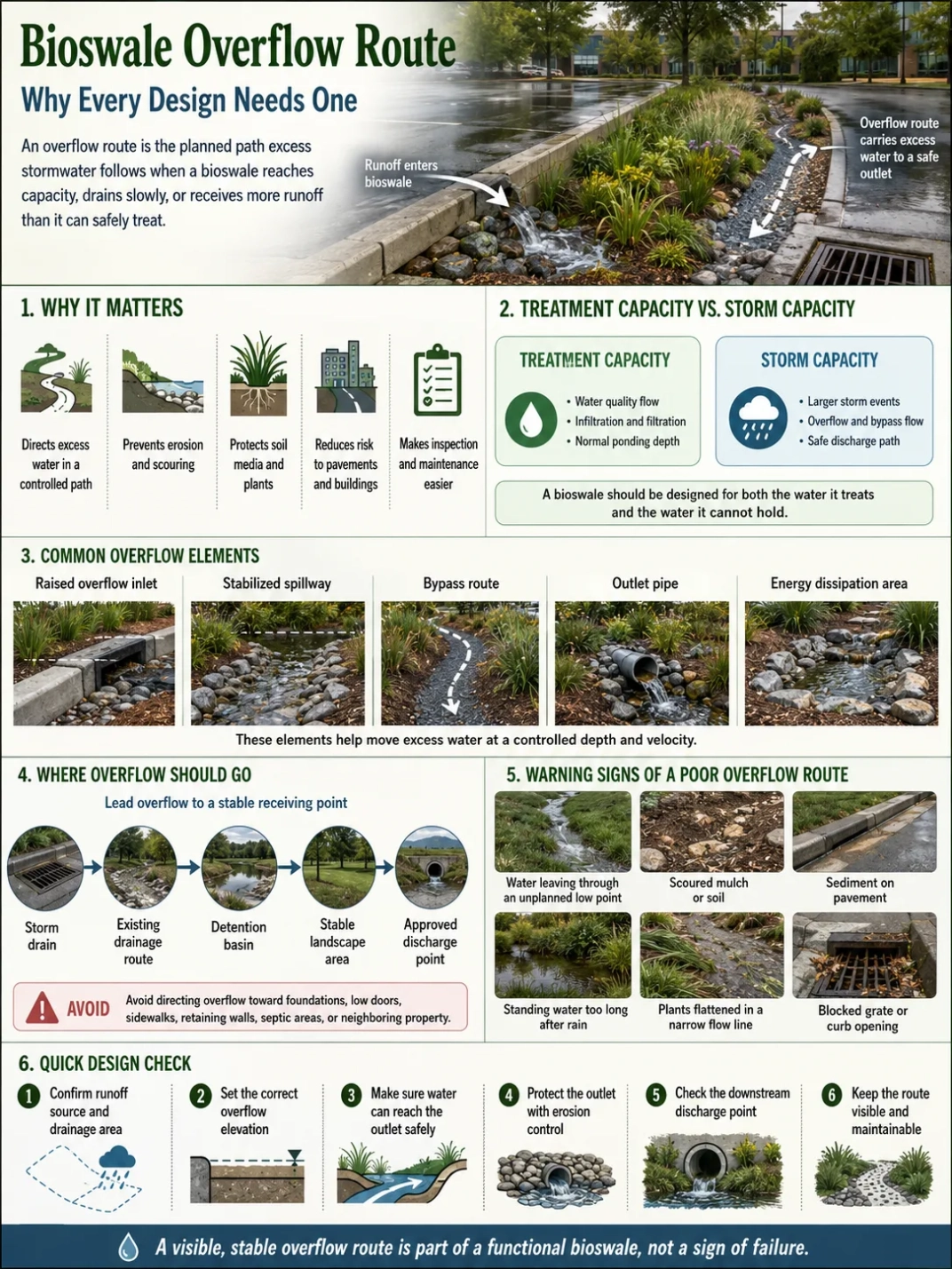
- A safe overflow route for storms that exceed normal treatment capacity.
The overflow route deserves attention. Pretreatment features should not trap water in a way that sends overflow toward foundations, neighboring properties, sidewalks, roadways, or other sensitive areas. Local drainage rules may also affect how overflow must be handled.
Pretreatment and Soil Clogging
Soil clogging is one of the main reasons pretreatment is added to a bioswale. Fine sediment, organic debris, and compacted surface layers can reduce the rate at which water moves into the soil. Once the surface seals, water may pond longer than expected or bypass the treatment area.
Pretreatment helps by catching larger material first. It does not remove every fine particle, and it should not be treated as a substitute for erosion control upstream. If bare soil continues to wash into the swale, a forebay may fill quickly and the main bed may still clog.
Soil texture and compaction also matter. A bioswale over compacted subgrade, heavy clay, or poorly draining fill may need amended soil, underdrain review, or a different drainage approach. Pretreatment protects the surface, but the underlying soil still controls much of the system’s behavior.
Soil Note: If water remains in the swale longer than expected after routine storms, do not assume the plants are the problem. Check sediment buildup, inlet blockage, soil compaction, and outlet conditions before replacing vegetation.
Maintenance Needs for Pretreatment Areas
Pretreatment features are designed to collect material, so they need inspection. That is not a design failure. It is part of how the system protects the main bioswale.
Maintenance usually involves removing accumulated sediment, clearing trash or leaf mats, checking for erosion, repairing displaced stone, restoring vegetation, and making sure water can leave the pretreatment zone at the intended point.
Useful inspection moments include:
- After large storms
- During spring cleanup
- After leaf fall
- After nearby construction or soil disturbance
- When water begins ponding longer than usual
- When sediment is visible at the inlet or outlet
For residential sites, maintenance may be as simple as hand removal of leaves and sediment from a small inlet trap. For public, roadside, or commercial systems, maintenance access should be part of the original layout because sediment volume and debris load can be much higher.
Common Pretreatment Mistakes
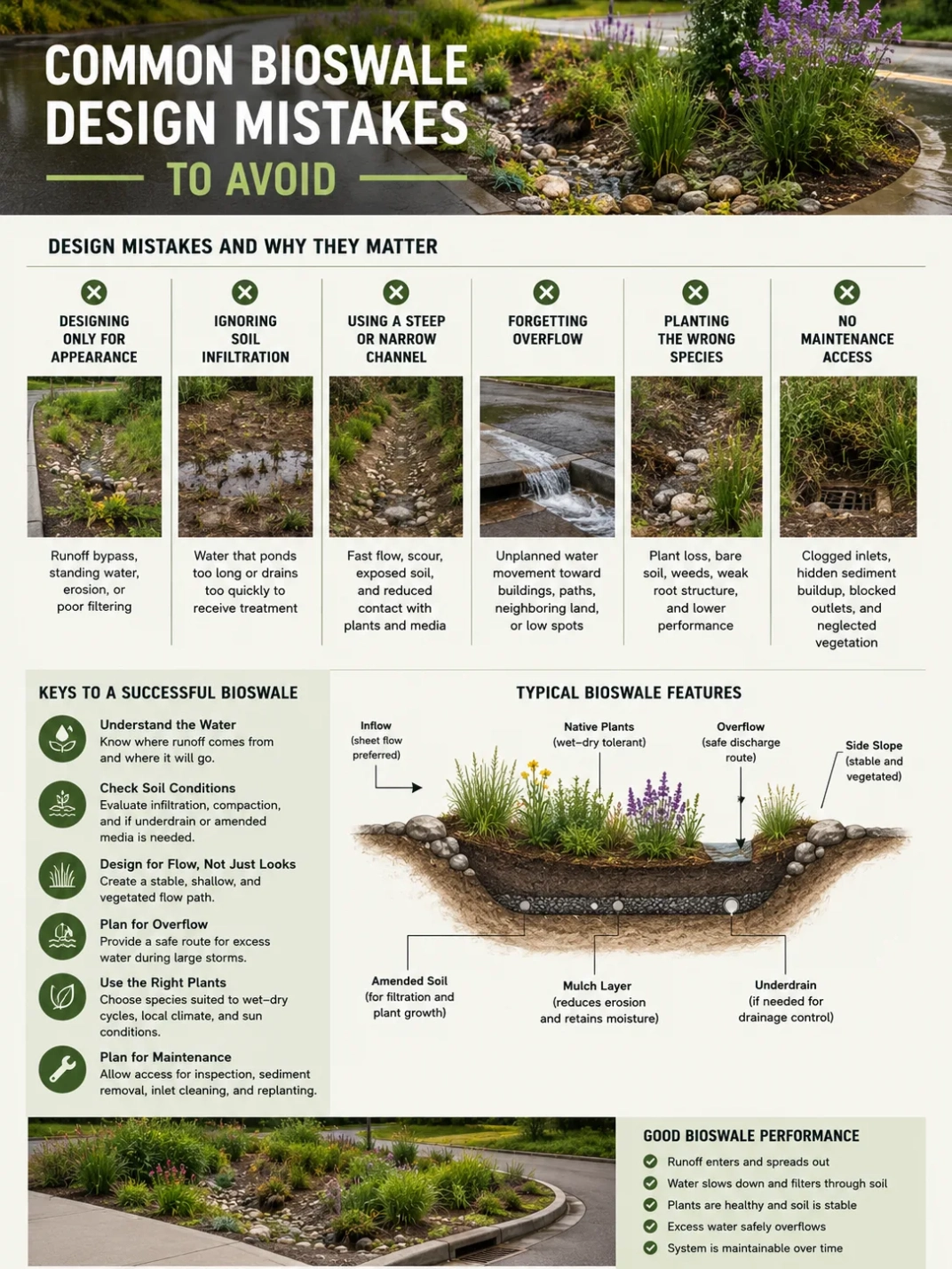
The most common mistake is treating pretreatment as decoration. A strip of grass, a patch of stone, or a small basin only helps if it changes how water enters the bioswale.
Problems often come from these conditions:
- Concentrated flow through a filter strip: The water forms a narrow channel and bypasses most vegetation.
- No cleanout access: Sediment collects where it cannot be removed without damaging plants.
- Unstable inlet edges: Flow undercuts soil, mulch, or turf at the entry point.
- Forebay outlet set poorly: Water either ponds too long or exits with too much force.
- Too much upstream sediment: Bare soil or construction runoff overwhelms the pretreatment area.
- No overflow planning: Larger storms leave the system in an unintended direction.
These issues are easier to prevent than repair. Once sediment spreads through the main bioswale bed, maintenance becomes slower and more disruptive.
Choosing the Right Pretreatment Approach
The best pretreatment choice begins with the shape of incoming water. A broad, shallow sheet of runoff behaves very differently from a pipe outlet or curb cut. The design should match the inflow pattern before plant selection or surface finish is considered.
For small residential runoff, a simple sediment trap or vegetated strip may be enough where local rules allow and the overflow route is safe. For parking lots, streets, public spaces, and larger hardscape drainage, a forebay or engineered inlet layout is often more appropriate.
Use these questions before selecting a pretreatment feature:
- Does runoff enter as sheet flow or concentrated flow?
- Where will sediment settle, and how will it be removed?
- Can water leave the pretreatment zone without erosion?
- Will the feature remain visible and accessible after plants mature?
- Is there a safe overflow route for larger storms?
- Do local codes or stormwater standards require a specific pretreatment method?
Where a bioswale receives runoff near buildings, basements, property lines, sidewalks, streets, steep slopes, or public drainage systems, professional review is a careful step. Pretreatment is only one part of the drainage system.
How Pretreatment Connects to Long-Term Bioswale Performance
A bioswale that receives clean, slowed, well-distributed runoff is easier to maintain. Plants establish better. Mulch stays in place. Soil pores remain more open. The inlet does not become a repeated repair point.
Pretreatment also makes performance easier to read. If the forebay or sediment trap fills often, the site may be sending too much sediment into the system. If a filter strip develops rills, the runoff is no longer behaving as sheet flow. If water cuts around the pretreatment area, grading or inlet control may need adjustment.
Those clues are valuable. They show how the drainage area is behaving before the main bioswale fails.
FAQ
What is bioswale pretreatment?
Bioswale pretreatment is the use of an upstream feature, such as a sediment trap, forebay, or filter strip, to slow runoff and capture coarse sediment before water enters the main planted swale.
Does every bioswale need a forebay?
No. A forebay is most useful where runoff enters as concentrated flow from a pipe, curb cut, parking lot, or similar source. Smaller systems with shallow sheet flow may use a filter strip or simple sediment trap instead, depending on site conditions.
Is a filter strip the same as a bioswale?
No. A filter strip is usually an upstream vegetated area that treats shallow sheet flow before it reaches another stormwater feature. A bioswale is the main vegetated drainage and treatment channel.
Why does sediment buildup matter in a bioswale?
Sediment can cover soil media, reduce infiltration, bury small plants, block inlets, and create shallow channels that move water around the intended treatment area.
Can pretreatment fix a poorly draining bioswale?
Pretreatment can reduce clogging and inlet erosion, but it cannot fix all drainage problems. Poor soil infiltration, compacted subgrade, undersized storage, blocked outlets, or unsafe overflow routes may need design changes.
How often should bioswale pretreatment areas be cleaned?
Cleaning depends on sediment load, leaves, nearby pavement, slope, and storm patterns. Pretreatment areas should be inspected after large storms and seasonal debris periods, then cleaned when sediment or debris begins to reduce flow or storage.