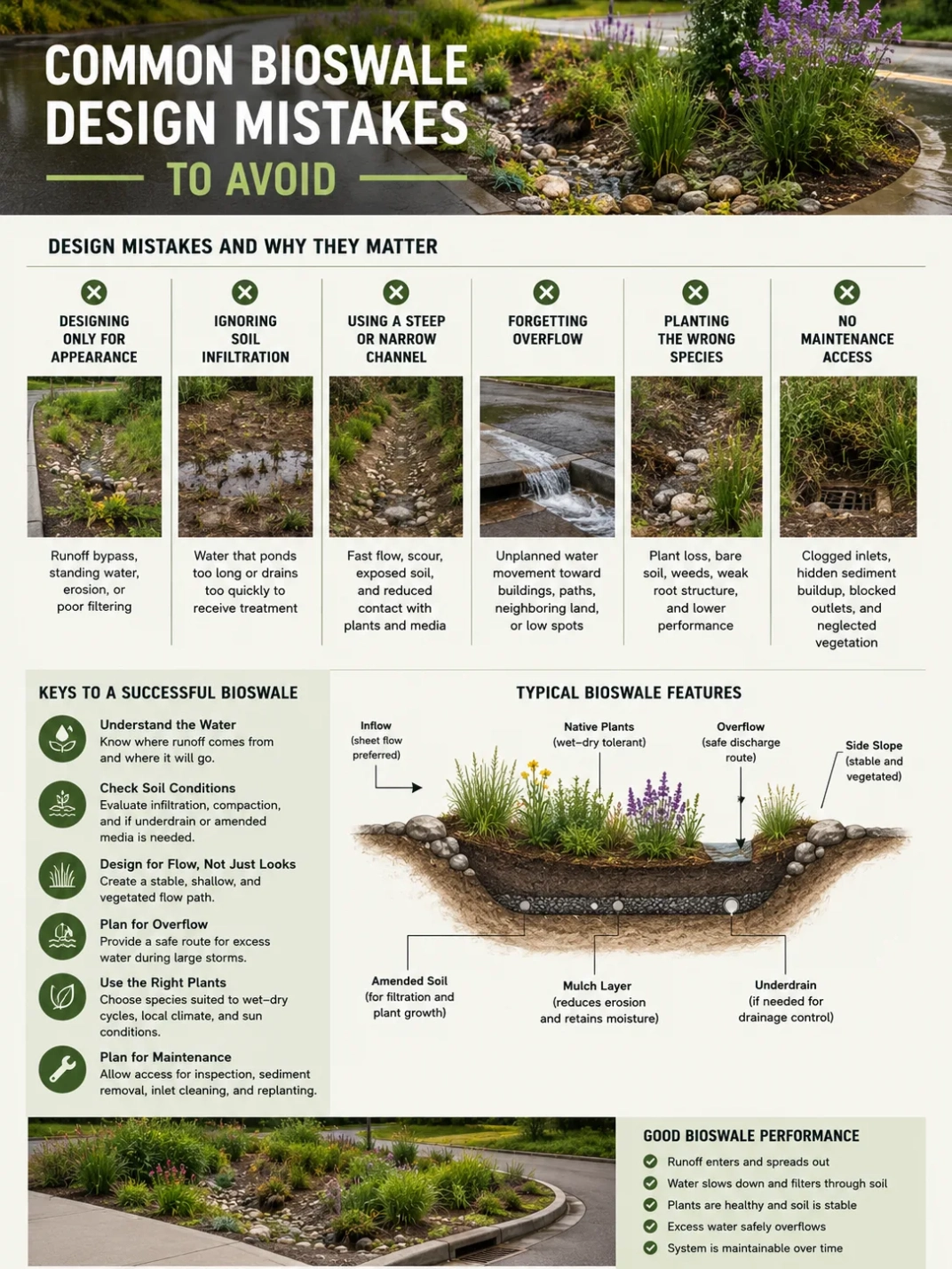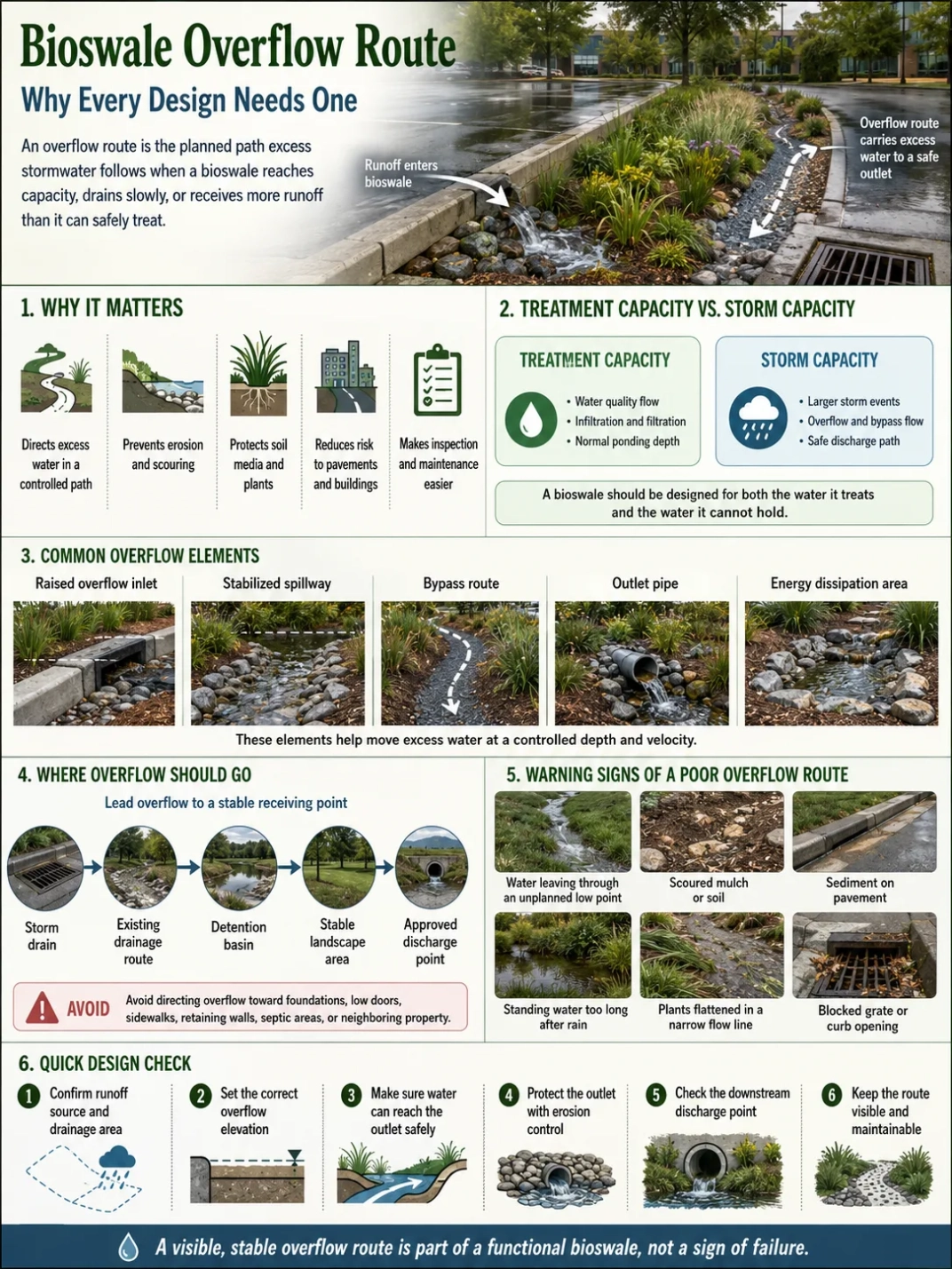
A bioswale overflow route is the planned path excess stormwater follows when the swale is full, the soil is draining slowly, or a storm sends more runoff than the planted channel can treat. Without that path, water chooses its own route. It may jump a curb cut, scour mulch, move toward a building, spill onto a walkway, or bypass the swale in a way the design did not intend.
A good bioswale is not designed only for the water it can absorb and filter. It is also designed for the water it cannot hold. That is where the overflow route becomes part of the drainage system rather than an afterthought.
Design Note: An overflow route does not mean the bioswale has failed. It means the system has a controlled way to pass larger flows while protecting soil, plants, pavement edges, buildings, and downstream drainage points.
What an Overflow Route Does in a Bioswale
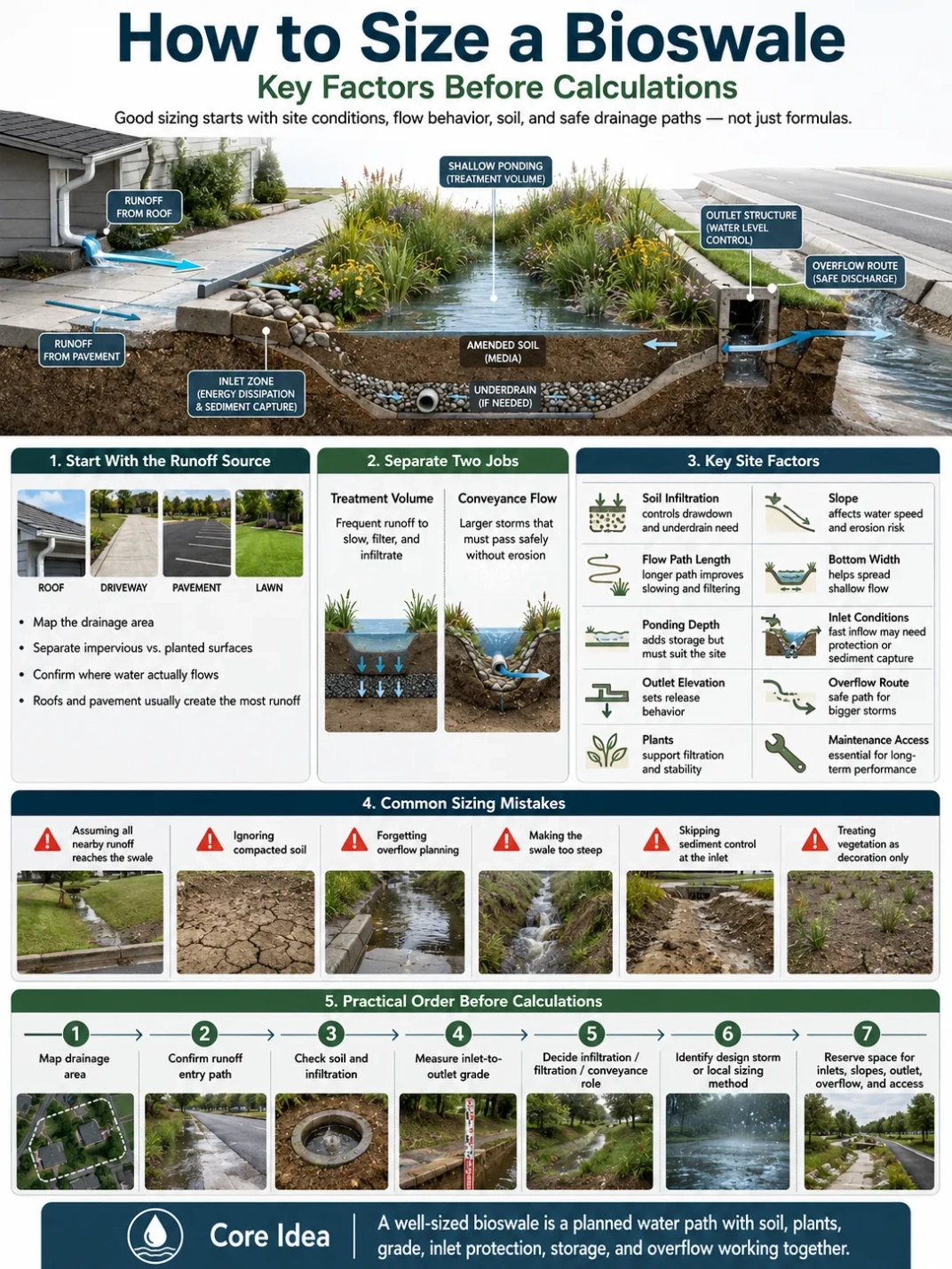
A bioswale is usually shaped to slow, spread, filter, and convey stormwater runoff. During small and moderate rain events, water may enter through a curb cut, sheet flow edge, roof leader, driveway edge, trench drain, or another inlet. It then moves along a shallow planted channel, through vegetation, mulch, soil media, and sometimes an underdrain.
The overflow route handles the part of the storm that exceeds the useful treatment and storage capacity of that system. It may be a high point in a curb opening, a raised overflow structure, a stabilized spillway, a bypass swale, an outlet pipe, a surface path to a storm drain, or a graded overland route to an approved discharge point.
The exact form varies by site. The purpose stays the same: move excess water in a known direction at a controlled depth and velocity.
| Design Issue | What Can Happen Without a Planned Route | How the Overflow Route Helps |
|---|---|---|
| High inflow | Water may overtop the lowest edge and leave the swale unpredictably. | Excess flow moves toward a chosen outlet, bypass, or safe overland path. |
| Slow infiltration | Ponding may rise above the intended level, especially in compacted or fine-textured soils. | The route limits water depth and reduces stress on plants and soil media. |
| Erosion | Fast water may cut channels through mulch, soil, or side slopes. | Stabilized outlets, level spreaders, rock aprons, or planted spillways can reduce scouring. |
| Blocked inlet or outlet | Leaves, sediment, snow, or trash may force water around the intended flow path. | A visible secondary path makes inspection and maintenance easier. |
| Nearby structures | Water may move toward foundations, low doors, basements, retaining walls, or paved edges. | Grading directs overflow away from sensitive areas where local rules allow. |
Why Treatment Capacity Is Not the Same as Storm Capacity
A bioswale is often sized around a water quality goal: the runoff volume that should slow down, spread out, infiltrate, settle sediment, or pass through filter media. That does not mean the same swale can safely hold every larger storm on the surface.
Stormwater design usually separates two related questions:
- How much water should the bioswale treat? This is tied to soil media, vegetation, ponding depth, infiltration, and water quality goals.
- Where does extra water go? This is tied to grading, outlets, bypasses, overland flow, erosion control, and downstream drainage capacity.
Confusing those questions can lead to a common mistake: making the swale deeper, longer, or more heavily planted without giving excess runoff a safe exit. More storage may help in some cases, but storage alone does not replace a clear overflow route.
A planted channel can only perform well when the water level, flow velocity, and drainage time stay within the range the soil and plants can tolerate. Once that range is exceeded, the design needs a release point.
The Difference Between an Outlet and an Overflow Route
An outlet is a component. An overflow route is the whole path water follows after the swale reaches its intended surface water level.
For example, a raised overflow grate may act as the outlet structure. But the route includes the water surface slope leading to that grate, the area around the grate, the pipe or channel after it, the receiving storm drain or landscape area, and the way water behaves if the grate becomes partly blocked.
That wider view matters because many bioswale problems do not start inside the soil media. They start at the transition points: curb cut to swale, swale to outlet, outlet to downstream drainage, or planted edge to pavement.
Common Overflow Elements
- Raised overflow inlet: A grate, catch basin, or standpipe set above the soil surface to control ponding depth.
- Surface spillway: A shallow stabilized notch or low edge that allows excess water to leave without cutting into the side slope.
- Bypass route: A graded surface path or curb flow path that sends larger flows past the treatment area.
- Outlet pipe: A pipe that connects overflow to a storm drain, detention area, or approved discharge location.
- Energy dissipation area: Stone, dense vegetation, turf reinforcement, or another stable surface used to slow water at discharge points.
Drainage Note: The most useful overflow route is visible enough to inspect. A hidden pipe may be needed, but the surface grading around it still matters. Water should be able to reach the overflow point before it damages the swale edge.
How Overflow Protects the Soil Media
Bioswale soil is not ordinary fill. In many designs, the filter media is selected or blended to support plant growth while allowing water to pass through at a controlled rate. If high flows run across the surface too fast, the soil can erode, seal, or collect sediment unevenly.
A planned overflow route helps protect the media in three ways.
- It limits ponding depth. When water rises to the overflow elevation, excess flow can leave before it drowns plants or pushes water into unintended areas.
- It reduces surface cutting. Water exits through a stable path instead of carving a low point through mulch or side slopes.
- It supports maintenance. Sediment, leaf litter, and debris often collect near inlets and outlets. A clear overflow point tells maintenance crews where to look first.
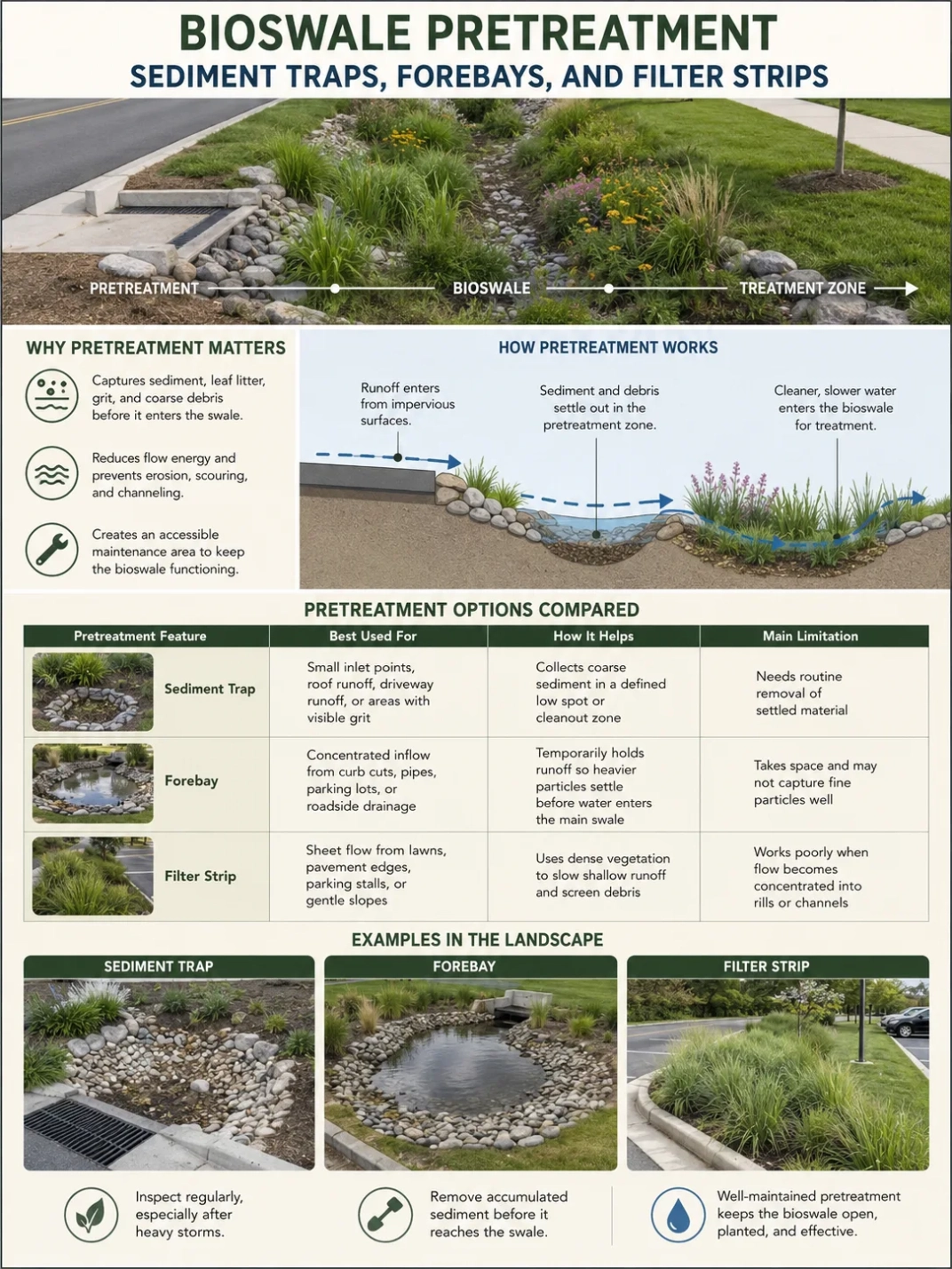
This does not remove the need for sediment control. If runoff from a road, parking lot, bare soil area, or steep driveway carries heavy sediment loads, pretreatment may be needed before water enters the bioswale. The overflow route protects the system during high flow, but it should not become the main sediment trap.
How Overflow Protects Plants
Bioswale plants are chosen for more than appearance. Grasses, sedges, rushes, shrubs, and other suitable plants help slow water, hold soil, support infiltration, and tolerate shifting moisture. The lowest parts of the swale may stay wet longer than the upper side slopes. Planting zones should reflect that difference.
Overflow affects plant health because it controls how long and how deep water can stand in the swale after a storm. If the outlet elevation is too high, plants that tolerate brief wet periods may sit under water for longer than intended. If the overflow path concentrates water through one narrow point, plants may wash out or lean away from repeated high-velocity flow.
Plant roots can help stabilize the swale, but vegetation should not be expected to solve a grading problem. A strong root system supports the design. It does not replace the need for a stable outlet.
Planting Details That Matter Near Overflow Points
- Use plants that can tolerate brief wet conditions near the low flow path.
- Avoid placing delicate plants directly where high-velocity overflow will pass.
- Keep outlet structures, grates, and spillways accessible for inspection.
- Expect some sediment and debris near inlet and overflow areas, especially after storms.
- Use erosion-resistant ground cover or stabilization where repeated overflow is likely.
What a Poor Overflow Route Looks Like
A weak overflow design is often easy to miss on paper. The swale may look planted, graded, and connected to a runoff source. The problem appears during a larger storm, after mulch floats, sediment shifts, or water reaches a low edge.
Common signs include:
- Water leaving through an unplanned gap in the berm or side slope
- Scoured mulch around the outlet or at the downstream end
- Sediment fans on pavement after rain
- Standing water that remains longer than expected
- Plants flattened in a narrow flow line
- Water marks above the intended ponding level
- Runoff moving toward a building, sidewalk, road edge, or neighboring property
- Overflow inlet blocked by leaves, trash, sediment, or floating mulch
These signs do not always mean the whole bioswale needs to be rebuilt. Sometimes the correction is a cleaner inlet, a better trash screen, a stabilized spillway, a lower overflow elevation, a wider outlet, or improved grading near the discharge point. In other cases, the drainage area, soil condition, or downstream system needs professional review.
Where the Overflow Route Should Lead
Overflow should lead to a place that can accept the water. That may be a storm drain, public drainage system, detention basin, existing swale, stable landscape area, curb flow path, or another approved drainage feature. The correct choice depends on local rules, site grading, soil conditions, and downstream capacity.
The route should generally move water away from sensitive areas such as building foundations, basement openings, low door thresholds, retaining wall backs, unstable slopes, septic areas, and heavily used pedestrian surfaces. On residential sites, this point deserves extra care because small grading changes can shift runoff toward neighboring property or public right-of-way.
Site Planning Note: When overflow could affect a building, public sidewalk, roadway, property line, utility corridor, or regulated drainage system, the design should be checked against local requirements. A bioswale is a landscape drainage feature, but it still interacts with real stormwater infrastructure.
Online and Offline Bioswale Routing
Overflow behavior changes depending on whether the bioswale is online or offline.
In an online bioswale, runoff enters the swale and larger flows continue through the same general system. This can work where the channel, outlet, and downstream route are sized and stabilized for the expected flows. The overflow route is especially important here because large storms pass through the practice rather than around it.
In an offline bioswale, a flow splitter, curb opening, bypass path, or raised inlet may send smaller water quality flows into the swale while larger flows bypass it. This can protect the soil media and plants from frequent high-velocity water. It may also be useful where the swale is meant mainly for treatment rather than full conveyance.
Neither layout is automatically better. The better choice depends on the drainage area, available space, surface grades, receiving system, maintenance access, and local design expectations.
Overflow Elevation and Ponding Depth
The elevation of the overflow point controls how deep water can pond before it leaves the bioswale. If the overflow point is set too low, water may leave before the swale has time to slow and filter runoff. If it is set too high, ponding may stress plants, saturate soil for too long, or move water into areas that were not designed to hold it.
Good design balances treatment and safety. The overflow elevation should reflect the intended ponding depth, the soil’s ability to drain, the plant palette, available freeboard, and the downstream path. It should also account for practical issues such as mulch movement, sediment buildup, winter debris, and access for cleaning.
Freeboard is the vertical space between the planned high water level and the top of the swale edge or adjacent surface. It gives the system a small margin before water spills somewhere else. The needed amount varies by site and local standard, so it should not be guessed from a generic diagram.
Why Erosion Control Belongs at the Overflow
Water leaving a bioswale may be faster and more concentrated than water moving through the planted bed. That is why the outlet area often needs erosion control or energy dissipation.
Useful approaches may include a rock apron, turf reinforcement, dense low vegetation, a level spreader, a stabilized spillway, or a drop that prevents water from cutting into the soil. The right choice depends on expected flow, slope, soil erodibility, maintenance access, and whether the area is residential, roadside, or public space.
One small detail is often overlooked: erosion control needs to work after the landscape matures, not just on installation day. Plants grow, mulch shifts, sediment collects, and debris moves. The overflow route should stay visible and serviceable.
Maintenance Checks for the Overflow Route
Overflow routes need regular inspection because they are where water, sediment, plants, and debris meet. The check does not need to be complicated, but it should be consistent.
After Heavy Rain
- Look for fresh erosion at the overflow point.
- Check whether mulch, leaves, or sediment blocked the outlet.
- Notice whether water left the swale through the intended path.
- Look for sediment fans or soil deposits downstream.
- Check whether plants were flattened by concentrated flow.
During Routine Landscape Care
- Keep overflow grates, curb cuts, spillways, and surface paths clear.
- Remove sediment before it raises the ponding area or blocks flow.
- Replace washed-out mulch with material suited to the flow conditions.
- Trim vegetation only enough to preserve function and visibility.
- Repair bare soil before small rills become larger channels.
A blocked overflow can make even a well-built bioswale act like an undersized basin. Maintenance is part of the drainage design, not a separate cosmetic task.
Residential Sites Need Special Care
On a home site, overflow planning often matters more than the size of the bioswale suggests. A small swale receiving roof runoff, driveway runoff, or yard flow can still send water toward a foundation, patio, garage, sidewalk, or neighboring lot if the overflow path is not clear.
Before placing a residential bioswale, the site should be read as a connected drainage surface. Where does roof water enter? Where does driveway runoff go now? Is the yard sloping toward the house or away from it? Where would water go if the swale filled to the top during a larger storm?
For simple yard drainage, a shallow planted route may be enough where local rules allow. For sites with basements, retaining walls, steep slopes, clay soil, compacted fill, shared drainage, or public right-of-way connections, a qualified professional may need to review the plan.
Public and Commercial Sites Have Different Pressures
Parking lots, road edges, campus landscapes, and public spaces often send more sediment, trash, salt, and concentrated runoff into bioswales than a typical yard. The overflow route must account for higher flows, pedestrian safety, curb geometry, maintenance vehicles, traffic areas, utilities, and the receiving drainage system.
In these settings, overflow is not only a landscape detail. It is part of public stormwater conveyance. It may need hydraulic checks, inlet and outlet sizing, erosion protection, inspection access, and coordination with local drainage standards.
That does not make bioswales unsuitable for public or commercial hardscape. It means the overflow route should be planned with the same care as the planting plan and soil section.
How It Differs from a Rain Garden Overflow
A rain garden and a bioswale can both use plants, soil media, and shallow ponding to manage runoff. The overflow issue is similar, but the flow pattern is different.
A rain garden is often a basin-like depression. Overflow usually leaves from a high point, spillway, raised drain, or surface notch. A bioswale is linear. It receives and moves water along a flow path, so the overflow route may need to handle both ponding depth and downstream conveyance.
Put simply, a rain garden overflow asks, “Where does extra water leave the basin?” A bioswale overflow also asks, “How does moving water stay stable as it travels through and out of the channel?”
What to Check Before Finalizing the Route
A practical overflow review should happen before plants are installed and before the swale is treated as finished. The review should look at both the drawing and the actual grade on site.
- Runoff source: Confirm what area drains to the bioswale, including roofs, pavement, lawns, roads, and compacted surfaces.
- Low points: Identify where water will go if the swale reaches its highest intended ponding level.
- Outlet elevation: Check whether the overflow point matches the intended water depth.
- Flow path: Make sure water can reach the overflow without cutting across weak soil or mulch.
- Discharge point: Confirm that overflow leads to a stable and allowed receiving area.
- Blockage risk: Consider leaves, sediment, floating mulch, snow, trash, and plant growth.
- Maintenance access: Ensure the outlet can be seen and cleaned without damaging planting zones.
- Adjacent risk: Review nearby buildings, walkways, roads, utilities, and property boundaries.
The best overflow route is not the most complicated one. It is the one that can be understood, inspected, maintained, and trusted during a storm that exceeds the bioswale’s treatment capacity.
FAQ
What is a bioswale overflow route?
A bioswale overflow route is the planned path excess stormwater follows when the swale reaches its intended ponding level or receives more runoff than it can treat. It may include a surface spillway, raised outlet, bypass path, curb route, pipe, or approved discharge point.
Does every bioswale need an overflow route?
A bioswale should have a planned way to handle excess water. Even small systems can receive more runoff than expected during larger storms, blocked outlet conditions, slow soil drainage, or frozen and saturated ground conditions.
Is an overflow route the same as an underdrain?
No. An underdrain helps move water from the soil or drainage layer below the surface. An overflow route handles excess surface water when ponding reaches a set level or when runoff exceeds the swale’s storage and infiltration capacity.
Where should bioswale overflow go?
Overflow should move to a stable and allowed receiving point, such as a storm drain, existing drainage route, detention area, curb flow path, or another approved landscape drainage feature. It should be directed away from buildings and sensitive areas where site conditions and local rules allow.
Can plants handle bioswale overflow by themselves?
Plants help slow water and hold soil, but they should not be the only overflow control. Fast or concentrated water can flatten plants, move mulch, and erode soil. A stable route, proper grading, and maintenance access are still needed.
How do you know if a bioswale overflow route is failing?
Warning signs include erosion near the outlet, sediment on nearby pavement, water leaving through an unplanned low point, blocked grates or curb cuts, long-standing water, washed mulch, or repeated plant damage along a narrow flow line.