Most bioswale design mistakes come from treating the feature as a planted drainage ditch instead of a stormwater system with soil, slope, flow, overflow, vegetation, and maintenance needs working together. A bioswale can help slow, filter, convey, and sometimes infiltrate runoff, but only when the site layout supports how water actually moves.
A good bioswale is not judged by how green it looks on day one. It is judged by whether runoff enters it safely, spreads out instead of cutting a channel, drains within a reasonable time for the design, and stays maintainable after sediment, leaves, plant growth, and seasonal weather begin to change the system.
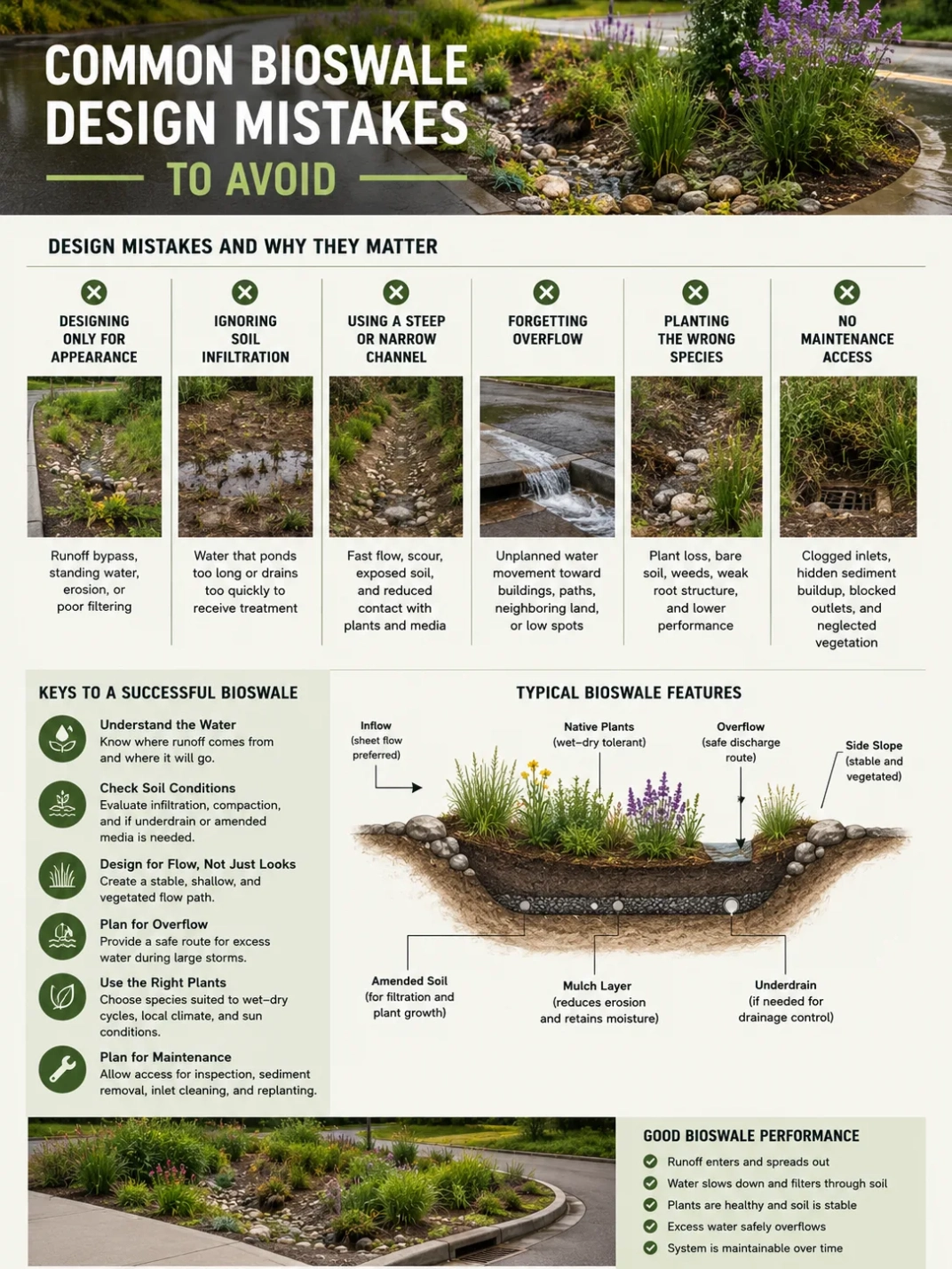
Common Bioswale Design Mistakes and Why They Matter
The same mistakes appear in residential yards, parking lot edges, roadside swales, and public landscape projects. The scale changes, but the pattern is similar: water is either moving too fast, entering in the wrong place, sitting too long, bypassing the soil, or carrying more sediment than the swale can handle.
| Mistake | What It Can Cause | Better Design Approach |
|---|---|---|
| Designing only for appearance | Runoff bypass, standing water, erosion, or poor filtering | Start with drainage area, flow path, soil conditions, inlet, outlet, and overflow route |
| Ignoring soil infiltration | Water that ponds too long or drains too quickly to receive treatment | Check native soil, compaction, groundwater, and whether engineered media or an underdrain is needed |
| Using a steep or narrow channel | Fast flow, scour, exposed soil, and reduced contact with plants and media | Shape a stable, shallow, vegetated flow path suited to the runoff source and local rainfall |
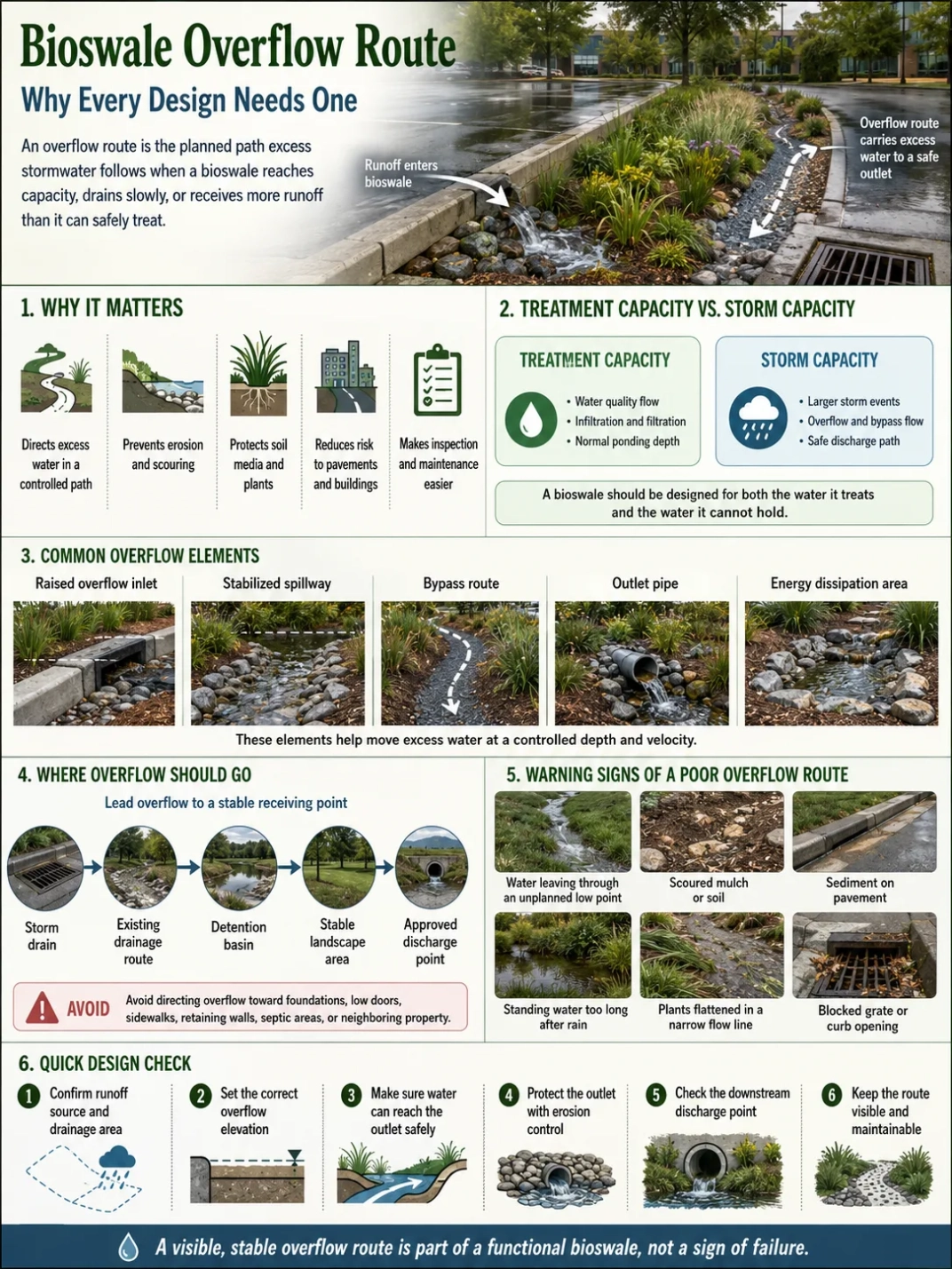
| Forgetting overflow | Unplanned water movement toward buildings, paths, neighboring land, or low spots | Provide a safe overflow route before large storms test the system |
| Planting the wrong species | Plant loss, bare soil, weeds, weak root structure, and lower performance | Use plants suited to wet-dry cycles, sun exposure, local climate, and maintenance capacity |
| No maintenance access | Clogged inlets, hidden sediment buildup, blocked outlets, and neglected vegetation | Design for inspection, sediment removal, trimming, replanting, and inlet cleaning |
Design Note: A bioswale should have a clear job. Some designs focus more on conveyance, some on filtration, some on infiltration, and many combine all three. Confusing those roles is where many early design errors begin.
Mistake 1: Treating the Bioswale Like a Simple Drainage Ditch
A drainage ditch mainly moves water away. A bioswale is usually expected to do more: slow runoff, spread flow, support vegetation, filter sediment, and guide excess water safely. When the design only creates a narrow channel, runoff may rush through the bottom before soil and plants can do much work.
This mistake is common when the swale is placed wherever space is left over instead of where runoff can enter along a planned route. A bioswale beside a driveway, road, roof downspout, or parking lot edge needs to receive water in a controlled way. If water enters as a fast jet from one pipe or curb opening, the inlet area may erode before the rest of the swale gets used.
How to Avoid It
- Identify the runoff source before shaping the swale.
- Allow water to enter as sheet flow where possible.
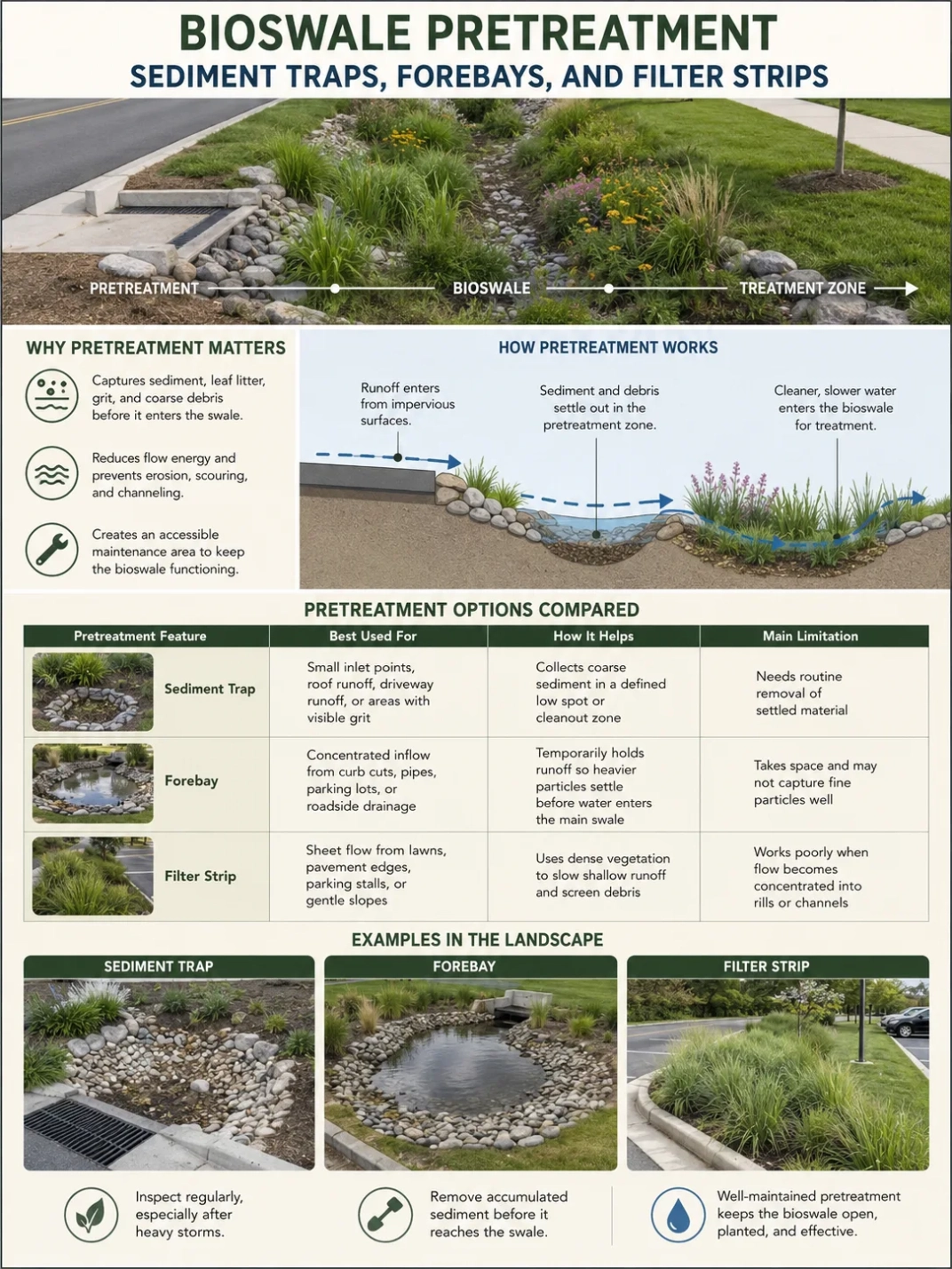
- Stabilize concentrated inflow points with suitable stone, vegetation, forebays, or other site-appropriate measures.
- Make sure the flow path is long enough to slow and treat runoff, not just pass it through.
Mistake 2: Choosing the Location Before Understanding the Water
A bioswale placed in the wrong location can look correct on a drawing and still fail on site. The low point may not receive the intended runoff. The upstream area may send more water than expected. A nearby foundation, retaining wall, sidewalk, septic area, utility corridor, or neighboring property may limit where water can safely go.
Good siting starts with a simple question: Where does runoff come from, and where will it go when the swale is full?
That second part matters. A bioswale is not a closed container. During larger storms, excess water needs an outlet, overflow structure, or safe surface route. Without one, the water may choose its own path.
Site Planning Note: Projects near buildings, basements, public drainage systems, steep slopes, roadways, contaminated soils, or utility lines may need professional review and local approval. Site conditions and local rules can change what is suitable.
Mistake 3: Ignoring Soil Compaction and Infiltration
Soil can make or break a bioswale. A surface may look open and natural, but construction traffic, grading, stockpiled materials, or repeated foot traffic can compact the soil. Compacted soil reduces infiltration and can leave water standing longer than intended.
Native soil also varies. Sandy soils may drain quickly. Clay-heavy or compacted soils may drain slowly. Some sites need amended soil media, filter media, an underdrain, or a design that conveys water rather than relying mainly on infiltration. There is no single soil recipe that fits every site.
What to Check
- Soil texture and drainage behavior after rainfall
- Compaction from construction equipment or past land use
- Groundwater or seasonal high-water conditions
- Whether infiltration is suitable under local rules
- Whether an underdrain is needed to protect function
Soil Note: A bioswale that stays wet for too long can stress plants and create maintenance issues. A bioswale that drains too quickly may provide less contact time between runoff, vegetation, and soil media. The design should match the soil, not fight it.
Mistake 4: Making the Slope Too Steep or the Flow Path Too Short
Water needs time and space. If the longitudinal slope is too steep, runoff may cut a small channel through the swale bottom. Once that happens, water often follows the eroded path and bypasses much of the vegetation and filter media.
A short, steep bioswale can behave more like a chute than a treatment feature. That does not mean every site must be flat. It means slope, check dams, surface roughness, plant density, and outlet control need to work together.
Signs the Grade May Be a Problem
- Exposed soil or rills after storms
- Mulch washed to the outlet
- Plants flattened in one narrow line
- Sediment collected only at one end
- Water skipping over the planted area
Where grades are challenging, check dams, step-down sections, wider bottoms, erosion-resistant vegetation, or another stormwater practice may be better than forcing a bioswale into a poor shape.
Mistake 5: Designing Poor Inlets and Outlets
The inlet is where the bioswale first meets real runoff. If the inlet is too narrow, too high, too low, blocked by curbing, or aimed directly at bare soil, the rest of the swale may not perform well.
Outlet design matters just as much. An outlet that is too low may drain the system before water has time to spread through the swale. An outlet that is too high or easily blocked may cause prolonged ponding. An overflow route that is not visible during design may become very visible during a storm.
Drainage Note: Inlets, outlets, and overflow routes should be easy to inspect. A hidden outlet may look clean on the surface while leaves, sediment, or mulch block the actual flow point.
Mistake 6: Forgetting Sediment Before It Reaches the Swale
Bioswales can trap sediment, but they should not be treated as a dumping zone for all loose soil from a site. Heavy sediment loads can clog surface pores, bury plants, reduce storage depth, and shorten the life of the system.
This is especially relevant near construction areas, gravel drives, eroding slopes, road shoulders, and parking lot edges. If runoff carries grit, sand, leaves, or trash into the same inlet every storm, the design should include a place where that material can settle and be removed.
Better Sediment Control Choices
- Stabilize exposed soil before the swale receives regular runoff.
- Use a small forebay or inlet area where sediment can collect visibly.
- Keep mulch from floating into outlets.
- Design curb cuts and entry points so they can be cleaned without damaging plants.
Maintenance access is part of sediment control. If the inlet cannot be reached with simple tools, it is less likely to be cleaned at the right time.
Mistake 7: Selecting Plants Only for Looks
Plants in a bioswale are not decoration alone. Their roots help hold soil, slow shallow flow, support soil structure, and create roughness that helps runoff spread. Plants also need to tolerate the actual moisture pattern of the swale.
One zone may be wet after storms and dry between rain events. Another may stay drier near the upper side slope. A low spot near an inlet may receive sediment and more frequent water. A plant list that ignores those zones may leave bare patches exactly where cover is needed most.
Plant Selection Mistakes to Avoid
- Using turf grass where deeper-rooted plants are needed for stability
- Choosing plants that dislike periodic wet soil
- Planting species that cannot handle dry periods between storms
- Ignoring shade, salt exposure, heat, or local climate
- Using aggressive species that may crowd out the intended planting
Planting Note: Native grasses, sedges, rushes, shrubs, and other locally suitable plants may support a stronger bioswale, but plant choice should be regional. A plant that works well in one climate may be a poor fit somewhere else.
Mistake 8: Relying on Mulch in the Wrong Place
Mulch can help protect soil and support planting areas, but loose mulch in a fast-flowing swale can float, move, block outlets, or pile up near check dams. In some bioswale designs, stone, dense vegetation, erosion-control fabric, or a different surface treatment may be better in high-flow areas.
The problem is not mulch itself. The problem is using it where flowing water will carry it away.
Areas near inlets, curb cuts, steep sections, and overflow points need closer attention. If mulch is used, the design should consider how it will behave during a real storm, not only during installation.
Mistake 9: Undersizing or Oversizing Without a Clear Reason
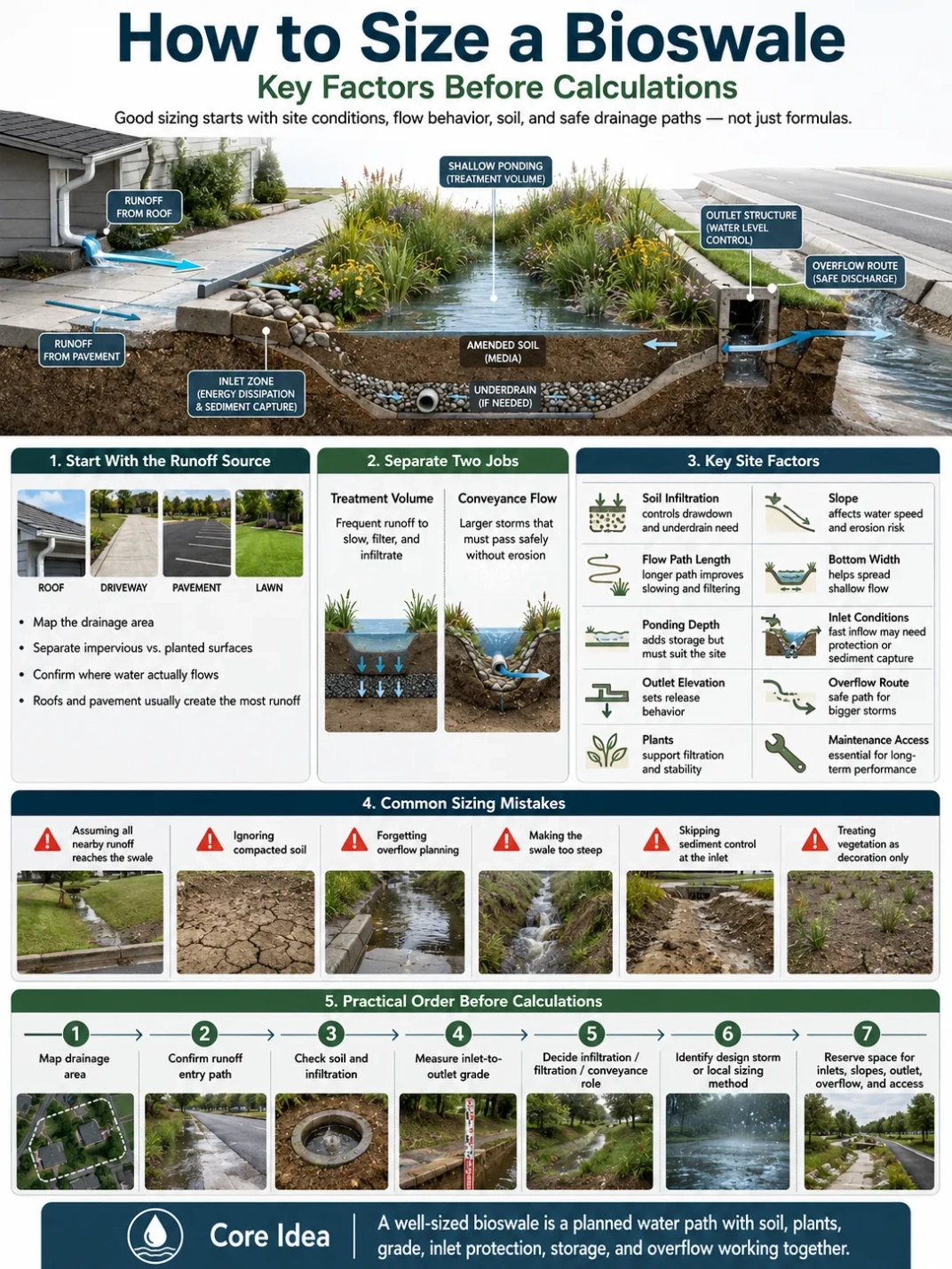
An undersized bioswale may overflow too often, erode, or fail to provide enough treatment area. An oversized bioswale may take up unnecessary space, hold water unevenly, or create planting and maintenance problems. Size should relate to the drainage area, runoff source, soil, rainfall pattern, slope, and design goal.
For small residential projects, this may mean careful site observation and conservative placement. For public, commercial, roadside, or large hardscape runoff, sizing usually needs hydrologic and hydraulic review. Parking lots and roads can send more sediment and faster runoff than a roof leader or small patio.
Design Note: A bioswale should not be sized by copying a detail from another site. Drainage area, soil, slope, rainfall, and allowed overflow path all change the design.
Mistake 10: Leaving No Safe Overflow Route
A bioswale can be designed for a target storm or water quality volume, but larger storms can exceed that design. When overflow is not planned, water may move toward places that were not meant to receive it.
A safe overflow route may be a stabilized surface path, an outlet structure, a connection to another approved stormwater feature, or a discharge point allowed by local rules. The right option depends on the site. What matters is that overflow is expected, visible, and managed.
Overflow Planning Should Consider
- Nearby buildings and foundations
- Walkways, driveways, and accessible routes
- Neighboring property boundaries
- Public drainage systems
- Downstream erosion risk
- How the outlet will be inspected and kept clear
Mistake 11: Skipping Maintenance in the Design Stage
Maintenance is often discussed after construction, but it should shape the design from the beginning. A bioswale needs inspection points, reachable inlets, visible outlets, plant access, and enough space to remove sediment without tearing up the whole system.
Common maintenance tasks include removing trash and debris, clearing inlets and outlets, checking erosion, replacing failed plants, managing weeds, refreshing surface cover where appropriate, and removing accumulated sediment. The exact schedule depends on runoff load, plant establishment, season, and site use.
Maintenance Note: A bioswale that receives parking lot or roadside runoff may need more frequent checks than one receiving cleaner roof runoff. Sediment and debris usually show where attention is needed.
Mistake 12: Confusing a Bioswale With Other Drainage Features
A bioswale can resemble a vegetated swale, rain garden, bioretention area, dry creek bed, or drainage ditch. The terms overlap in casual use, but the design intent is not the same.
A rain garden is often a shallow planted basin that collects runoff in one area. A bioswale is more linear and usually conveys water along a path while providing treatment. A French drain moves water below the surface through gravel and pipe. A dry creek bed may guide water and prevent erosion, but it may not provide the same soil and vegetation treatment as a bioswale.
This distinction matters because each system handles water differently. Choosing the wrong form can lead to poor drainage, weak treatment, or maintenance trouble.
What to Check Before Finalizing a Bioswale Design
Before moving from concept to construction, the design should answer practical questions, not just show a planted shape on a plan.
- Runoff source: Is the water coming from a roof, driveway, sidewalk, road, parking lot, lawn, or mixed area?
- Entry point: Will runoff enter as sheet flow or concentrated flow?
- Flow path: Is the swale long and stable enough to slow water?
- Soil: Can the native soil infiltrate, or does the design need amended media or an underdrain?
- Overflow: Where does excess water go during larger storms?
- Planting zones: Are plants matched to wet, dry, sunny, shaded, and high-flow areas?
- Sediment: Is there a visible place to collect and remove sediment?
- Maintenance: Can people inspect, clean, trim, and replant without damaging the swale?
- Local limits: Are permits, drainage rules, setbacks, or professional review needed?
When Professional Review Is Worth Considering
Small landscape bioswales can be simple in concept, but some sites carry more risk. Professional review is worth considering when the bioswale receives runoff from a large impervious area, sits near a building foundation, affects public drainage, crosses utilities, lies on steep ground, handles roadway runoff, or depends on infiltration near sensitive subsurface conditions.
Professional input can also help when standing water is already a problem. A bioswale may be part of the solution, but it may not be the whole solution. Poor grading, blocked drains, compacted soil, high groundwater, or an undersized downstream outlet can all create symptoms that look like a bioswale issue.
FAQ
What is the most common bioswale design mistake?
The most common mistake is designing the bioswale as a planted ditch instead of a stormwater feature with planned inlet, flow path, soil, plants, outlet, overflow, and maintenance access. The shape may look right, but runoff may move too fast or bypass the treatment area.
Can a bioswale fail if the soil is wrong?
Yes. Compacted soil, slow-draining soil, contaminated soil, or soil that drains too quickly can affect performance. Depending on the site, the design may need amended media, an underdrain, different planting, or a different drainage approach.
Why is overflow planning so important in bioswale design?
Overflow planning gives excess water a safe route during larger storms. Without it, water may move toward buildings, paved areas, neighboring property, or erosion-prone low spots. The overflow route should be clear, stable, and allowed by local rules.
Are native plants required for every bioswale?
Native plants are often a good choice because they can support local ecology and may adapt well to local conditions, but plant selection should be site-specific. The plants need to match wet-dry cycles, sunlight, soil, maintenance level, and local climate.
Is standing water in a bioswale always a design problem?
Short-term ponding after rain may be part of the design. Water that remains much longer than intended can point to compacted soil, poor infiltration, blocked outlets, undersized drainage, or grading problems. The expected drain-down time depends on the local design and site conditions.
Can homeowners design a small bioswale themselves?
Some small residential bioswales are planned by homeowners, especially for simple yard or driveway runoff. Professional help is wise when water is near a foundation, basement, steep slope, public drainage system, utility area, property boundary, or any place where overflow could create problems.