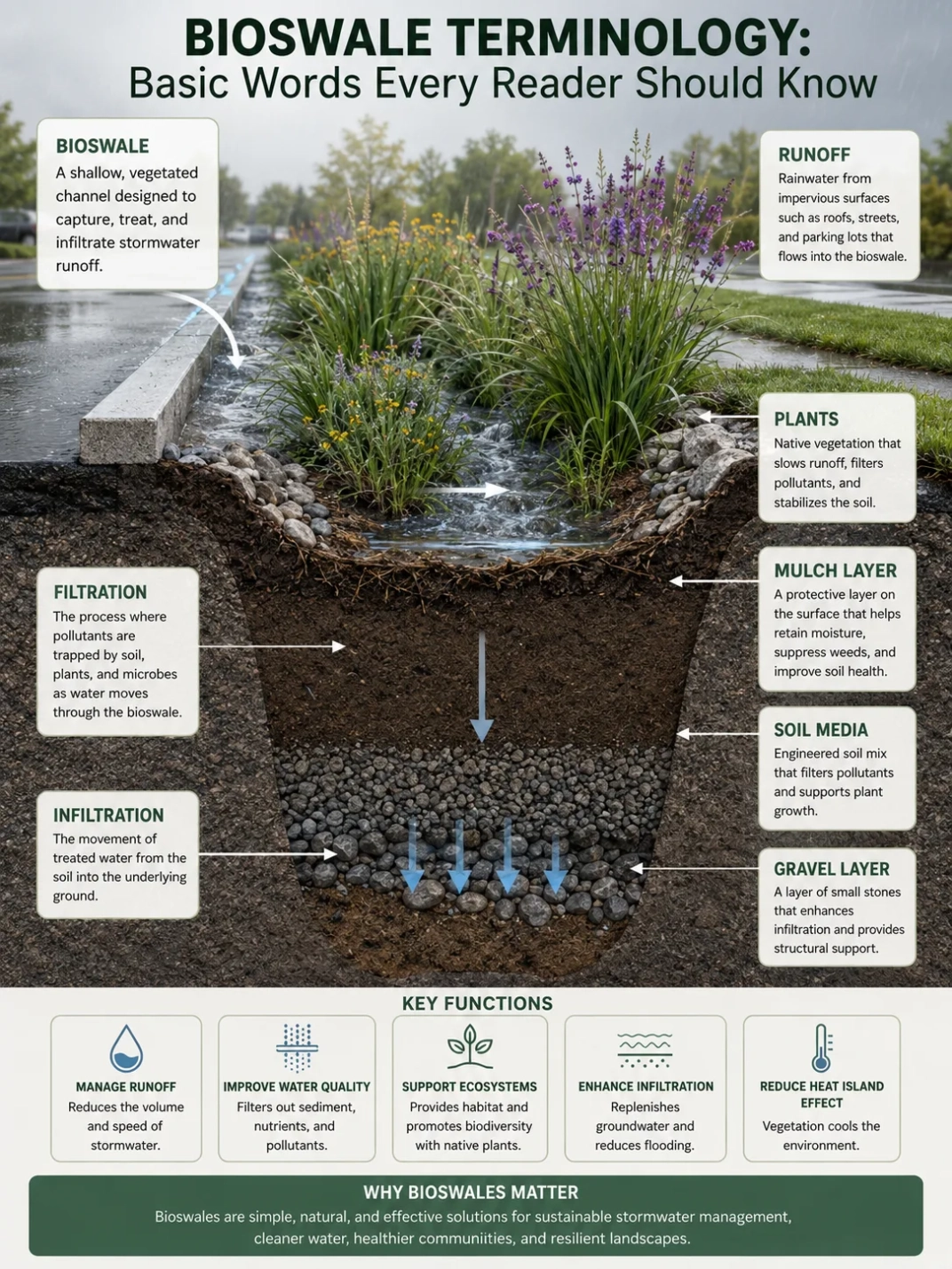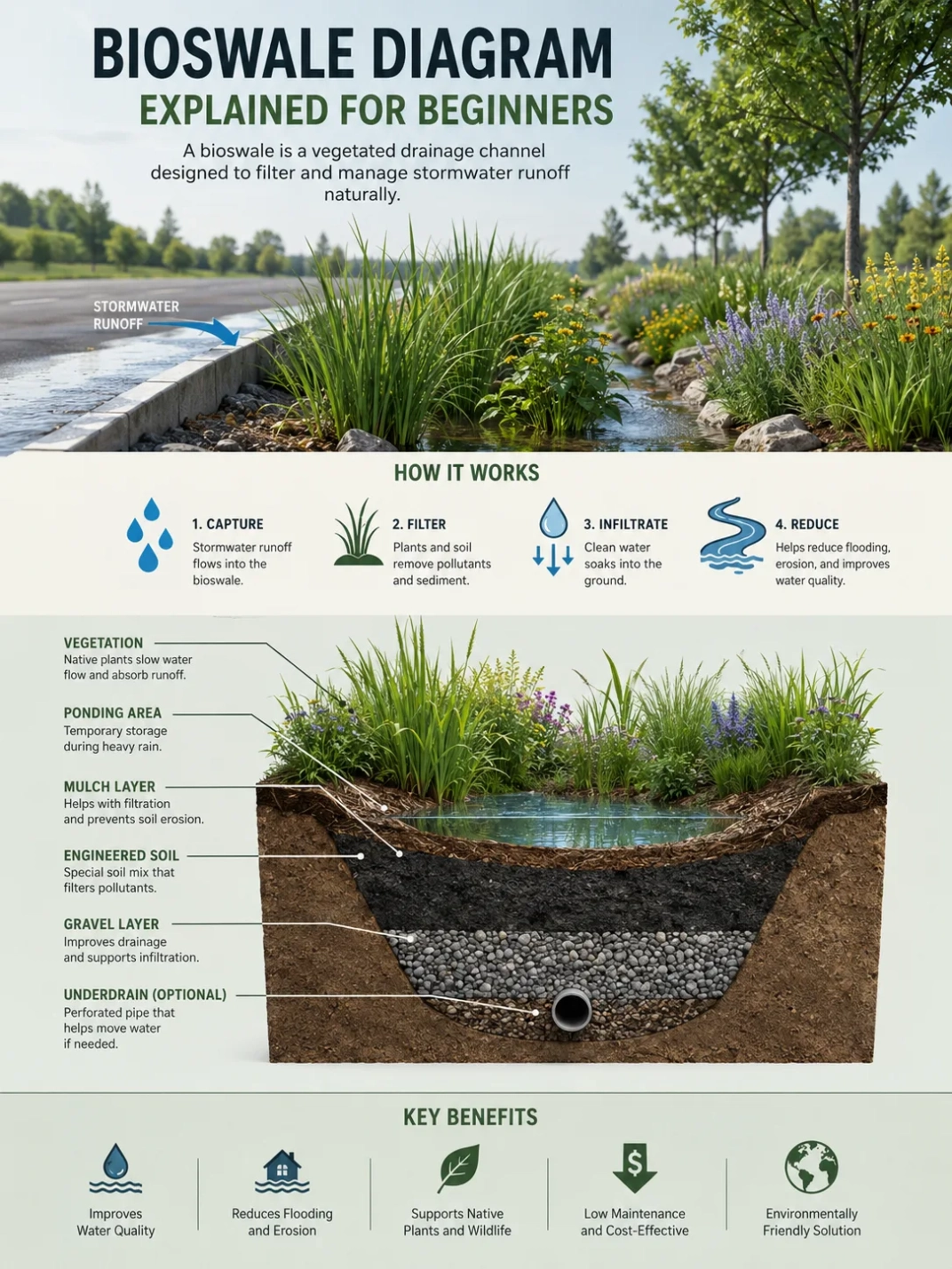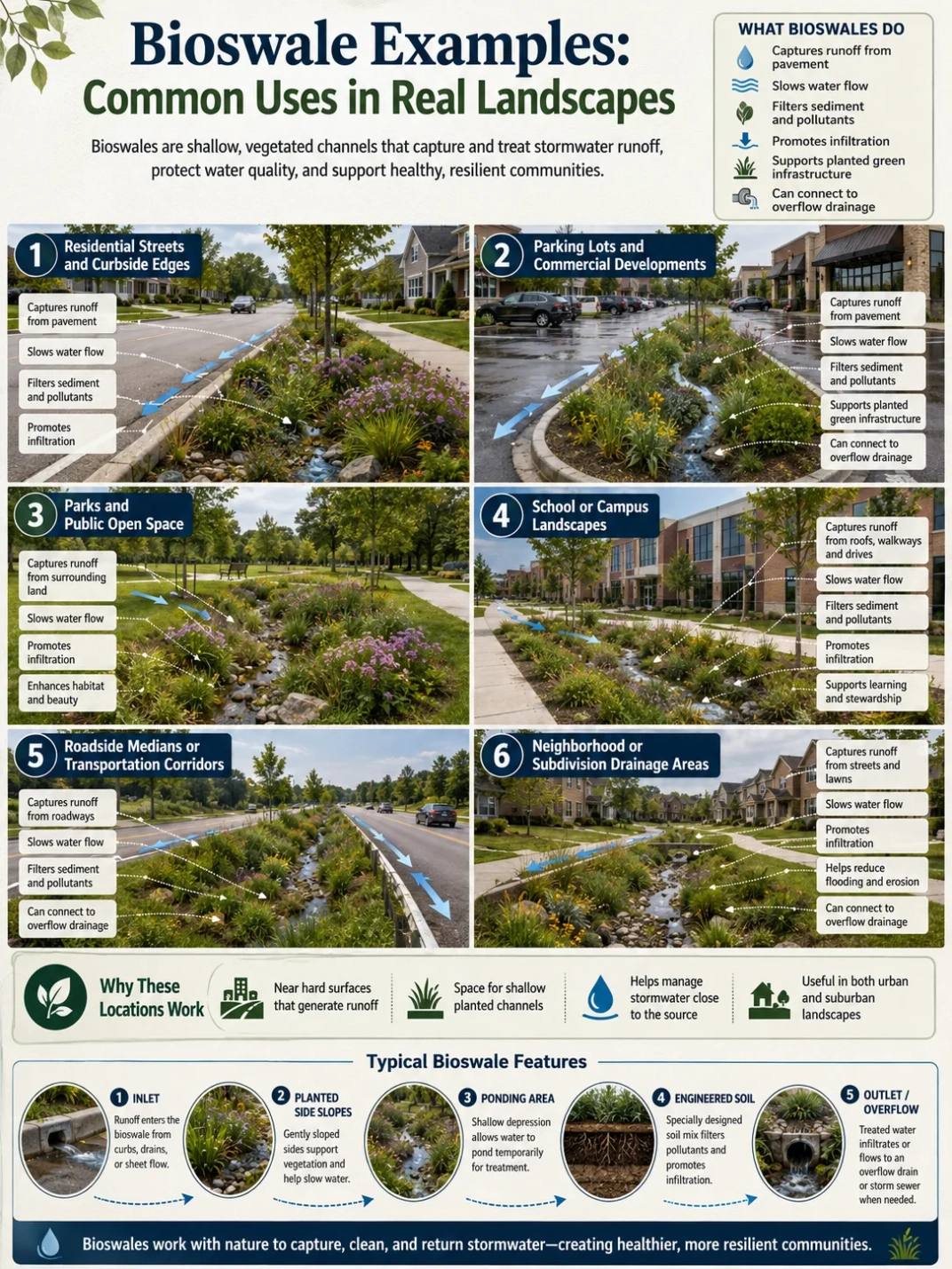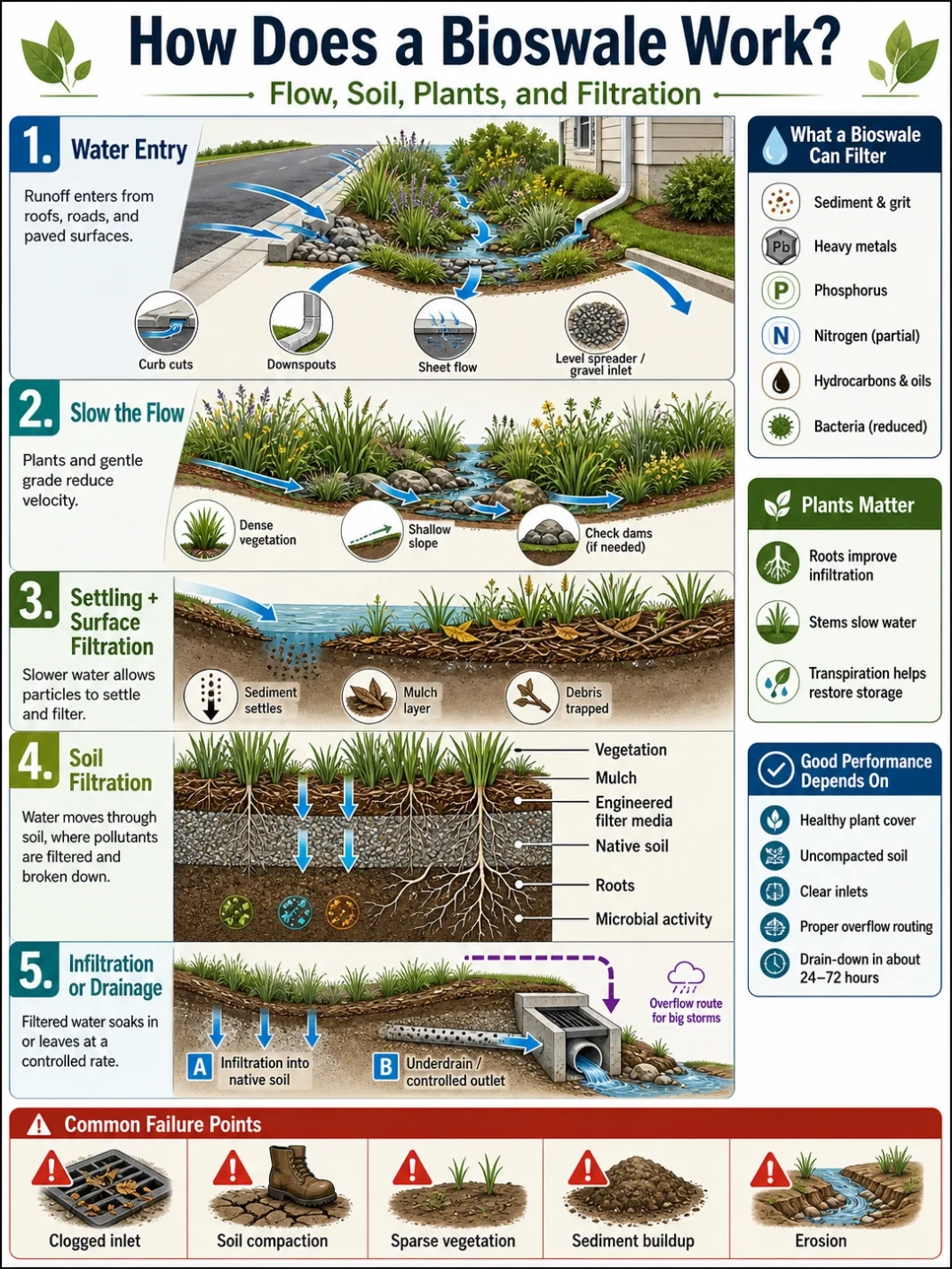
A bioswale moves water through a deliberate sequence: slow it, spread it, filter it, and release it at a controlled rate. Each stage depends on the one before it. When the system is properly designed and reasonably maintained, that sequence handles runoff from roofs, driveways, roads, and paved surfaces in a way that a pipe or concrete channel cannot replicate. Understanding how a bioswale works means following the water — from the moment it enters the channel to the point it either infiltrates into the ground or exits through a controlled outlet.
How Water Enters the System
Runoff reaches a bioswale through several possible entry points. In roadside installations, water typically enters through curb cuts or depressed inlets along the pavement edge. In residential settings, a downspout extension, a shallow swale connection, or sheet flow from a sloped lawn may direct water into the channel.
The inlet design matters more than it might appear. A poorly designed or absent inlet can concentrate flow into a single point, which erodes the channel bottom and bypasses the gradual spreading that makes filtration effective. Well-designed inlets often include a stabilized entry area — gravel, rip-rap, or a level spreader — to disperse incoming flow before it reaches the vegetated channel.
Slowing the Flow
Speed determines how much settling and filtration can occur. Fast-moving water carries sediment and pollutants past the vegetation and through the channel before the soil has a chance to act on it. A bioswale is designed to slow that flow down.
Vegetation is the primary mechanism. Dense plantings of grasses, sedges, and other low-growing plants create friction along the channel bottom and sides. Water pushes through stems and root mats rather than flowing freely. This friction drops flow velocity, which allows suspended particles to begin settling out of the water column.
Longitudinal slope plays a direct role here as well. A channel that falls too steeply accelerates flow and can scour the channel bottom. A shallow, consistent slope keeps water moving slowly enough to be useful. Where a steeper grade is unavoidable, check dams placed across the channel at intervals create small ponding zones that temporarily hold water and promote settling.
| Stage | What Happens | Primary Mechanism |
|---|---|---|
| Entry | Runoff enters from pavement, downspouts, or adjacent surfaces | Curb cuts, depressed inlets, level spreaders |
| Velocity Reduction | Flow slows as it contacts dense vegetation and a shallow slope | Plant stems, root mats, check dams |
| Sediment Settling | Heavier particles drop out of the water column | Reduced velocity, ponding zones |
| Surface Filtration | Water passes through mulch or ground cover layer | Mulch bed, thatch, decomposing plant litter |
| Soil Filtration | Water moves through engineered or amended soil media | Filter media, organic matter, microbial activity |
| Infiltration or Drainage | Water enters native soil or exits through a controlled outlet | Soil permeability, underdrain pipe, outlet structure |
Sediment Settling and Surface Filtration
Once flow slows, sediment begins to drop. Heavier particles — sand, grit, debris from pavement — settle near the inlet zone or in low-velocity areas along the channel. This is why the upper portion of a bioswale tends to accumulate sediment faster than the rest of the system and typically needs more frequent attention during routine maintenance.
After settling, water still carries finer particles and dissolved pollutants. These move into the surface layer of the channel — often a mulch bed or a dense mat of decomposing plant material. This layer provides a first round of physical filtration and supports microbial communities that can process certain organic pollutants before water reaches the soil below.
What Happens Inside the Soil
Below the surface layer, water moves into the soil profile. This is where much of the actual pollutant removal happens — and where performance depends heavily on what the soil is made of and whether it has been maintained over time.
Engineered Filter Media
Many bioswales — particularly those designed for urban or commercial sites — are built with an engineered soil mix rather than relying on existing native soil. This filter media is typically a blend of sand, compost, and sometimes other amendments, designed to balance drainage rate with pollutant capture.
The goal is a mix that allows water to pass through at a rate useful to the system — neither so fast that filtration is minimal nor so slow that the channel stays waterlogged for extended periods. Getting this balance right depends on local soil conditions, the volume of runoff the system needs to handle, and available space. Soil mixes vary by project and region; what performs well on one site may not translate directly to another.
Native Soil and Infiltration
Beneath the filter media, water ideally infiltrates into the native soil below the channel. This is where a bioswale can reduce runoff volume, not just quality. Water that enters the ground doesn’t leave as runoff at all.
How well this works depends on the permeability of the native soil. Sandy or loamy soils with good structure allow relatively fast infiltration. Compacted or clay-heavy soils slow infiltration considerably. In some cases, subsoil compaction from prior construction activity limits infiltration even where the surface appears healthy.
Where native soil infiltration is limited or unreliable, an underdrain — a perforated pipe installed at the base of the filter media — provides an alternative exit path for filtered water. An underdrain prevents the channel from remaining saturated and protects plant roots from prolonged flooding. It also allows the system to function during periods when native soil is already full from previous rainfall.
How Plants Contribute to the Process
Plants in a bioswale do more than add vegetation. Their roots physically shape the soil profile over time in ways that sustain the system’s function.
Deep-rooted native plants create pores and channels through the soil as they grow and as older roots decompose. These pathways improve infiltration rates and help resist the compaction that would otherwise reduce the channel’s ability to absorb water. In an established bioswale with healthy native plants, the root zone is often measurably more permeable than surrounding compacted soil.
At the surface, plant stems and leaf litter slow water velocity and filter physical debris before it reaches the soil layer. Dense plantings of sedges or fine-stemmed grasses are particularly effective at this — they create a barrier that coarser particles can’t easily pass through.
Plants also draw water from the soil through transpiration, which can partially restore soil storage capacity between rain events. This varies by climate and species, and it’s not a process to rely on in isolation — but it contributes to the overall water balance in vegetated channels.
Pollutant Removal: What the System Actually Filters
A bioswale can reduce several categories of pollutants, though the degree of removal varies by design, soil type, plant cover, and how long water remains in the channel.
Sediment-bound pollutants — heavy metals, phosphorus, and some hydrocarbons attached to particles — are captured primarily through settling and physical filtration. These are the pollutants that a well-functioning bioswale handles most reliably.
Dissolved pollutants are more variable. Nitrogen compounds, for example, are partially taken up by plants and processed by soil microbes, but this depends on plant health, microbial activity, and the residence time of water in the channel. A bioswale that drains very quickly may not retain water long enough for biological processes to act on dissolved pollutants effectively.
Hydrocarbons from pavement runoff are broken down in the soil through microbial activity, though this takes time and works best when soil organic matter is maintained and when the channel has a dry-out period between rain events — conditions that support the aerobic microbial communities most useful for decomposition.
- Sediment and grit: Settled during velocity reduction and ponding phases
- Heavy metals: Filtered through soil media and bound to organic matter
- Phosphorus: Captured with sediment particles; some uptake by plants
- Nitrogen: Partial removal through plant uptake and microbial activity
- Hydrocarbons and oils: Broken down by aerobic soil microbes over time
- Bacteria: Reduced through UV exposure, soil filtration, and natural die-off
Outlet Behavior and Overflow
Water that doesn’t infiltrate needs a controlled exit. Most bioswales include an outlet structure — a rock pad, a pipe connection to a downstream drainage system, or a level spreader that releases water gradually across a vegetated area beyond the channel.
The outlet controls two things: the rate at which water leaves the channel and the maximum depth the channel holds before overflow occurs. A channel that holds too much water too quickly can overwhelm plants and cause erosion at the channel base. One that drains too fast doesn’t allow enough filtration time to be effective.
Overflow design is not optional in most applications. When a bioswale receives more runoff than it was sized for — during large storms or sustained rainfall — water needs somewhere to go without causing damage. A proper overflow route directs excess flow away from structures, foundations, and adjacent properties without concentrating it in ways that cause erosion.
Where a Bioswale Differs from a Drainage Ditch
A conventional drainage ditch moves water from one point to another as efficiently as possible. Concrete or compacted soil lines the channel, velocity stays high, and any sediment or pollutant in the water stays in the water until it reaches the outlet.
A bioswale is designed to do the opposite — slow water down, spread it across a vegetated channel, hold it briefly in contact with soil, and let filtration and infiltration work on it before it exits. The difference isn’t cosmetic. Planted soil, engineered filter media, controlled ponding depth, and flow-slowing vegetation are the features that separate a bioswale from a simple ditch.
A drainage ditch moves water faster, costs less to install, and needs less design input. But it offers no filtration, minimal infiltration, and can accelerate erosion at its outlet. A bioswale that is properly designed and reasonably maintained handles a comparable volume of water while improving what leaves the site.
Where the Process Can Break Down
The functional sequence described above only holds when each component is working. Several common failure points can interrupt it.
Soil compaction reduces infiltration over time, especially in areas with foot traffic or where heavy equipment has crossed the channel. Compacted soil forces water to remain at the surface longer, which can cause prolonged ponding and plant stress.
Clogged inlets — blocked by leaf debris, sediment, or other material — prevent water from entering the channel evenly. In some cases, water bypasses the system entirely or concentrates at a single point and erodes the channel edge.
Sparse or failing plant cover removes the friction that slows flow. Bare soil also erodes faster, sending sediment downstream and reducing the channel’s effective depth over time.
Sediment buildup near the inlet — if not cleared periodically — can redirect flow, raise the effective channel bed, or cause water to pond in the wrong location.
Most of these problems develop gradually. Regular inspections after significant rain events, and light maintenance through the growing season, typically catch them early before they affect performance across the whole channel.
Frequently Asked Questions
Does a bioswale actually filter water, or does it just slow it down?
Both — and the two are connected. Slowing the water is what makes filtration possible. When velocity drops, sediment settles and water has time to move through the soil profile, where physical filtration and microbial activity remove or break down pollutants. A channel that only slows flow without allowing meaningful soil contact does far less filtration work than one designed to pond briefly and infiltrate.
How long should water stay in a bioswale after a rain event?
Most designs aim for water to drain within 24 to 72 hours after a storm. Longer ponding can stress plants not suited to extended saturation and may indicate that the soil media is draining too slowly or that an underdrain needs attention. Short ponding of a few hours is generally acceptable and expected after larger rain events.
Can a bioswale work in clay soil?
Clay soil limits native infiltration, which is a real constraint. In clay-heavy sites, many designs place an engineered filter media layer over the native clay, paired with an underdrain to carry filtered water out of the channel. The system can still reduce runoff velocity and remove pollutants effectively, though volume reduction through infiltration will be lower than in more permeable soils.
What role do plants play in how a bioswale filters water?
Plants contribute in several ways. Their stems slow flow and trap debris at the surface. Their roots improve soil permeability over time as they grow and decompose. Their root zones also support microbial communities that break down certain pollutants. Native species adapted to both wet and dry conditions tend to maintain these functions more consistently than non-native ornamentals.
Is a bioswale the same as a rain garden?
They share some principles but function differently. A rain garden is typically a shallow depression designed to hold and infiltrate water in place — it doesn’t have a defined flow path. A bioswale is a linear channel that moves water from one point to another while filtering it along the way. Some sites use both: a bioswale to convey and pre-filter runoff, and a rain garden at the outlet to handle final infiltration.
Does a bioswale always need an underdrain?
Not always. In well-draining soils, water infiltrates into native soil below the channel without a pipe. An underdrain is more common in sites with low native soil permeability, high water tables, or where the system needs to drain within a specific time window to protect plants or prevent overflow. When an underdrain is included, it typically connects to a downstream stormwater outlet or an approved discharge point.