Bioswales can be effective when they are matched to the site, sized for the runoff they receive, planted for both wet and dry conditions, and maintained so water can move through the system. They can slow, spread, filter, and sometimes infiltrate stormwater runoff, but they cannot solve every drainage problem or replace engineering review where water volume, steep slopes, foundations, streets, or public drainage systems are involved.
What “Effective” Means for a Bioswale
A bioswale is not effective simply because it has plants and a shallow channel. It works when runoff enters in a controlled way, follows a stable flow path, slows down, contacts vegetation and soil, and leaves through infiltration, an underdrain, or a safe overflow route.
That makes effectiveness a site-specific question. A bioswale beside a parking lot has a different job than one receiving roof runoff from a house. A shallow roadside swale with compacted soil may not perform like a planted bioretention swale with engineered soil media and an underdrain.
Drainage Note: A bioswale should be judged by what it is designed to do: reduce runoff speed, capture sediment, support infiltration where soils allow, improve water quality, or move excess water safely. It may do several of these, but not always all of them.
Where Bioswales Usually Perform Well
Bioswales tend to work best where runoff comes from a clear source, such as a roof edge, driveway, sidewalk, street shoulder, courtyard, parking bay, or small paved area. These surfaces send water across the ground faster than planted soil does. A bioswale gives that water a shaped place to slow down.
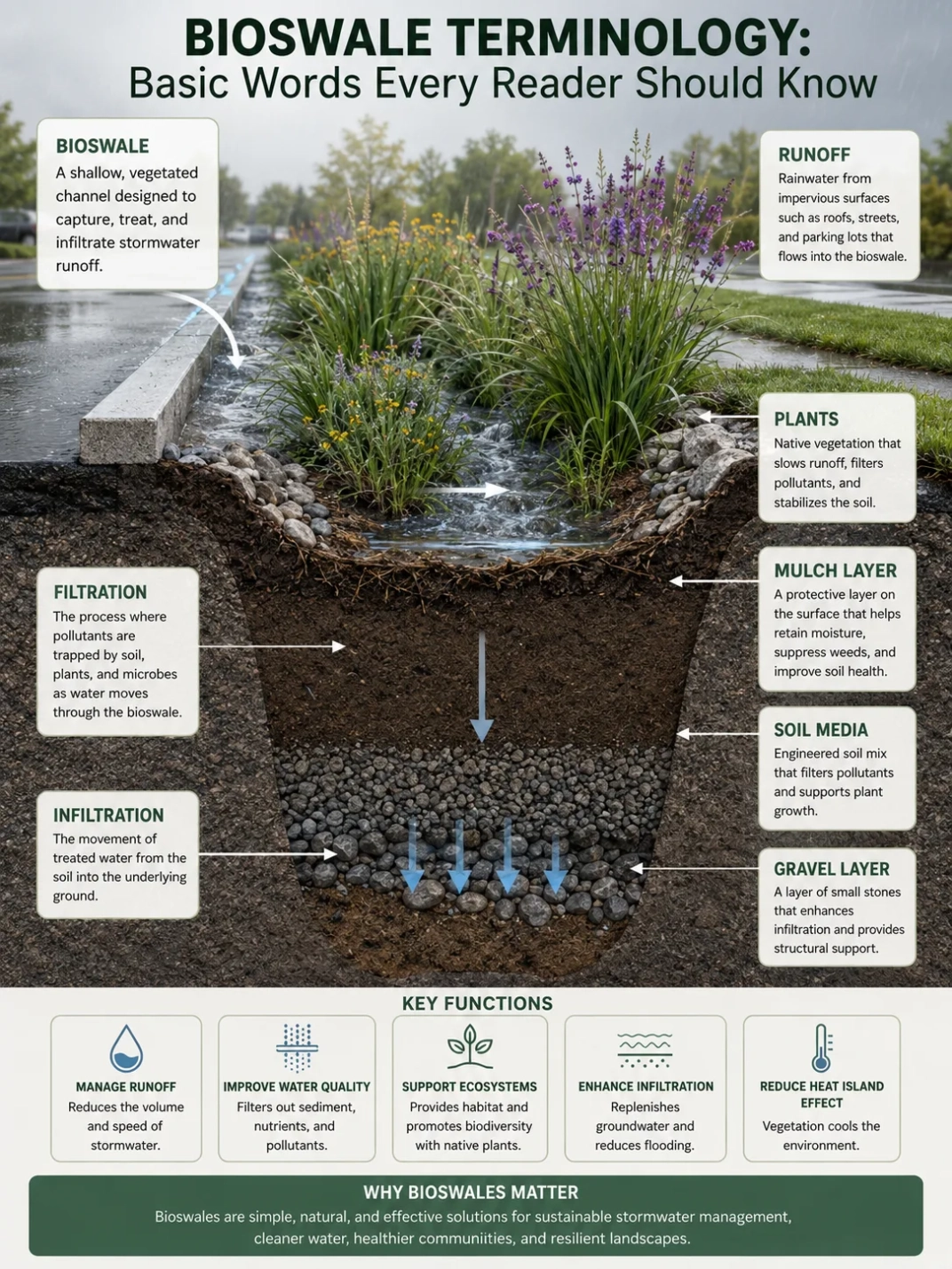
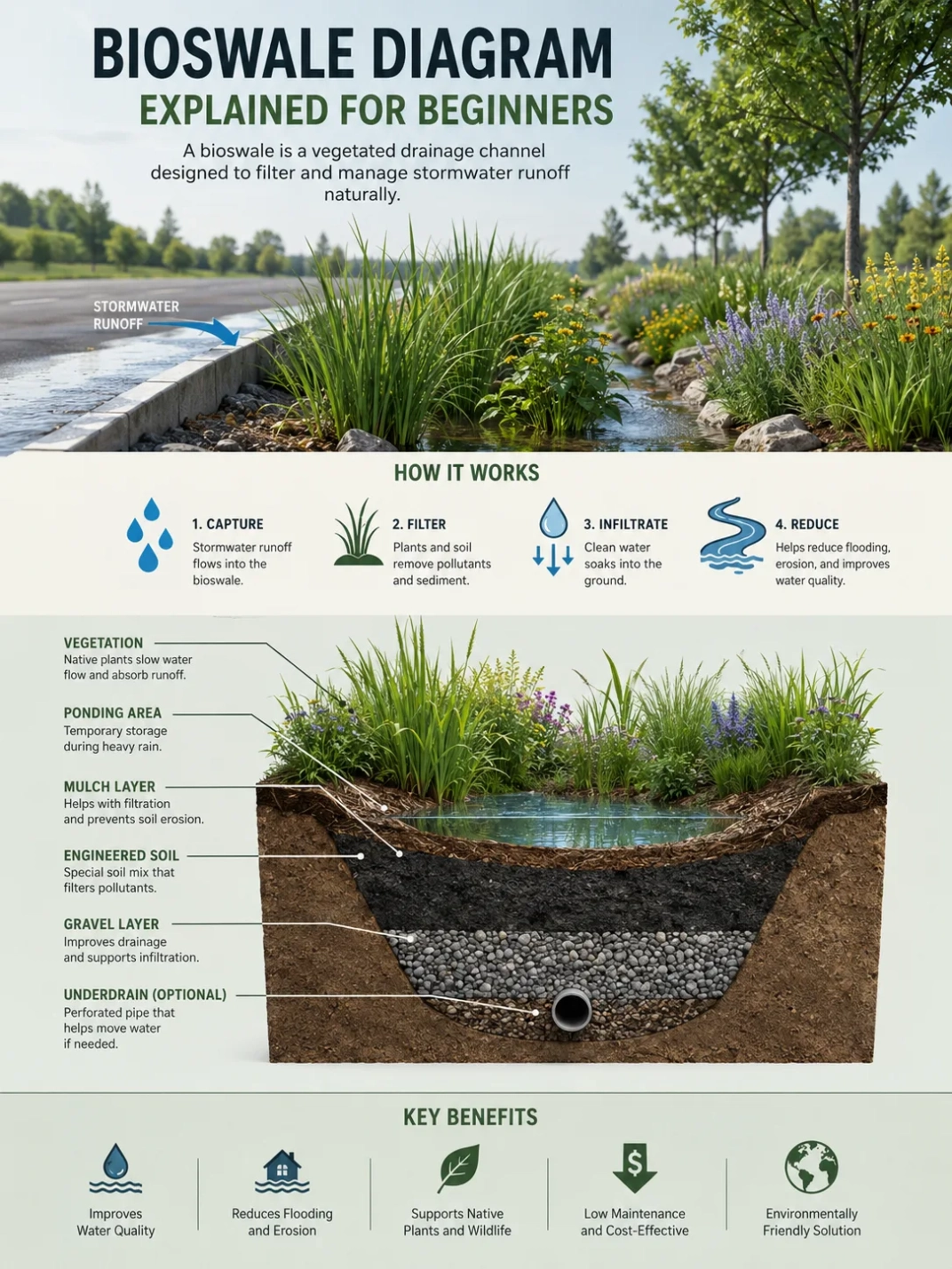
Good performance depends on the full drainage sequence:
- Inlet: where runoff enters without causing erosion.
- Surface channel: the shallow planted area that carries and slows water.
- Soil or filter media: the layer that supports infiltration and pollutant filtering.
- Plants and roots: vegetation that resists flow, holds soil, and supports soil structure.
- Outlet or overflow: the route for water that cannot soak in during larger storms.
If one part fails, the whole system may look green but perform poorly. A clogged inlet, buried outlet, compacted soil, or unstable side slope can reduce the benefit quickly.
| Function | What It Can Do | What It Cannot Reliably Do Alone |
|---|---|---|
| Slow runoff | Reduce flow speed by using a shallow, planted channel and a longer flow path. | Stop all surface water during large or repeated storms. |
| Filter sediment | Capture some soil particles, grit, organic debris, and coarse pollutants near the inlet and plant stems. | Stay effective if sediment is never removed or if the inlet keeps washing out. |
| Support infiltration | Allow water to soak into suitable soil or engineered media where site conditions allow. | Force infiltration in compacted clay, high groundwater, or restricted soils without proper review. |
| Improve runoff quality | Help treat runoff through vegetation, soil contact, settling, and biological activity. | Act as a stand-alone treatment system for every pollutant type or every land use. |
| Manage overflow | Route excess water toward a planned outlet, drain, or safe surface path. | Replace a safe overflow plan, storm drain design, or flood control system. |
How Bioswales Improve Stormwater Behavior
Water moving over pavement often travels fast because the surface is hard, smooth, and compact. A bioswale changes that movement. The channel is shaped to spread water across vegetation instead of letting it rush in a narrow line.
This matters because runoff treatment is partly about contact time. Water needs enough surface area and enough slowing to drop sediment, pass through plant stems, and interact with soil. A short, steep, bare channel may move water, but it will not behave much like a bioswale.
Flow Path and Slope
The flow path should be long enough and stable enough to avoid turning the bioswale into a small ditch. Gentle grading, check dams in some designs, and well-covered soil can help slow water. Exact slope choices depend on rainfall, available space, soil, and local design rules.
Side slopes also matter. If they are too steep or poorly planted, they can erode, slump, or become hard to maintain. Public-space bioswales often need extra attention to safe edges, visibility, access, and inspection.
Soil Contact and Infiltration
A bioswale can support infiltration, but it should not be treated as a magic drain. Water only soaks in well when the soil profile allows it. Sandy soils may drain quickly but may need organic matter and plant cover to hold moisture and support filtering. Clay-heavy or compacted soils may hold water longer and may need design changes, such as amended media or an underdrain.
Soil Note: The same bioswale layout can perform very differently on two sites. Soil texture, compaction, groundwater depth, construction disturbance, and the amount of runoff entering the swale all shape results.
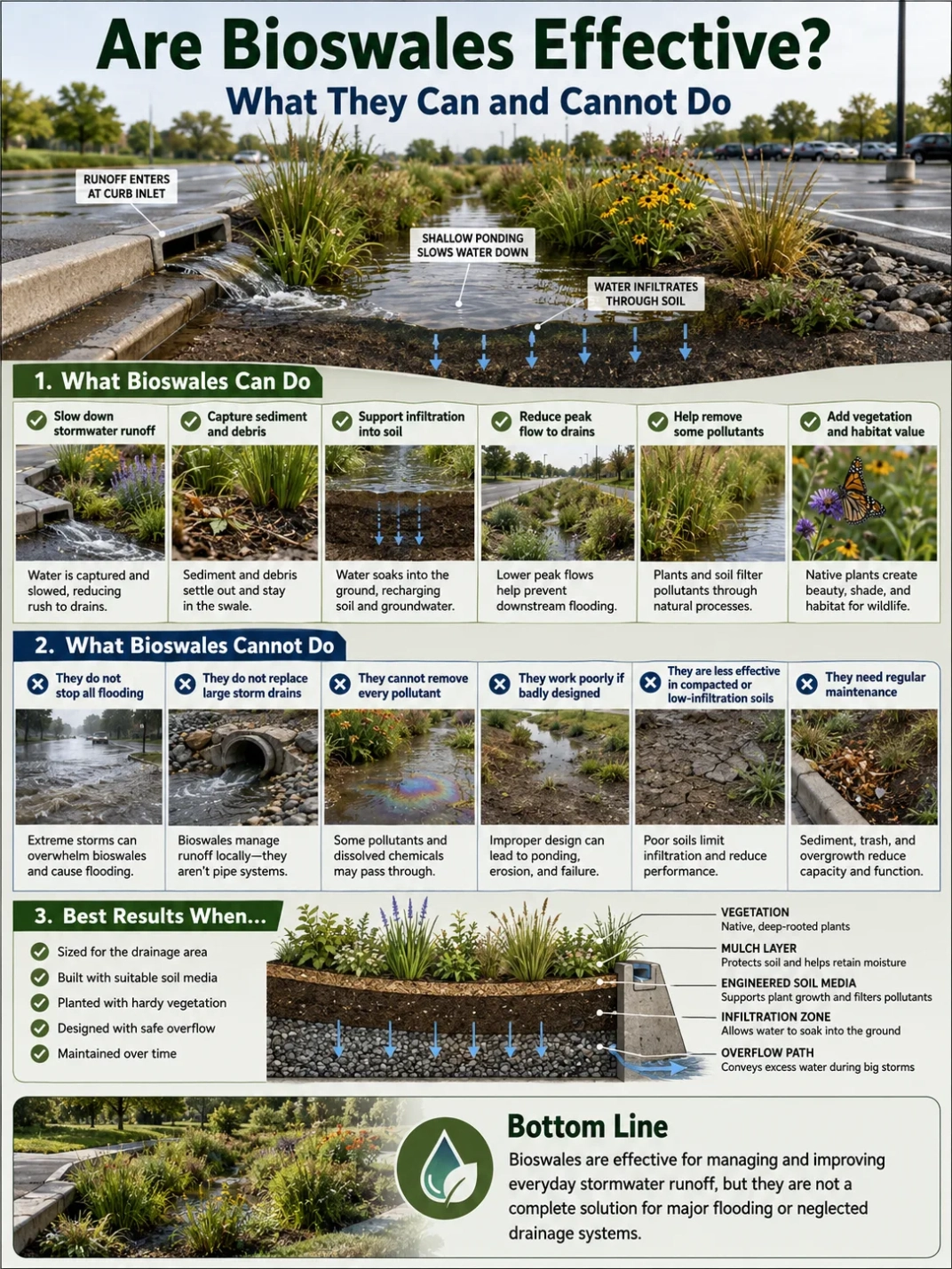
What Bioswales Can Do Well
They Can Reduce Runoff Speed
A well-planted bioswale slows runoff by adding surface roughness. Grasses, sedges, rushes, and low shrubs can all help break up shallow flow. The benefit is not just visual. Slower water is less likely to cut channels through soil or carry sediment straight to a drain.
They Can Capture Sediment and Debris
Many bioswales collect sediment near the inlet or in low points along the channel. This can be useful, especially near parking lots, roads, driveways, and construction-affected landscapes. But sediment capture creates a maintenance need.
If sediment keeps building up, it can smother plants, clog surface pores, change the slope, and send water around the planted area. Removal of built-up sediment is part of keeping the system effective.
They Can Support Pollutant Filtering
Runoff from impervious surfaces can carry soil particles, leaf litter, nutrients, oils, metals, and other urban residues. A bioswale can help reduce some pollutants through settling, plant uptake, soil filtration, microbial activity, and adsorption to soil particles.
The level of treatment varies by design. A simple vegetated swale may mainly slow water and trap sediment. A bioretention-style bioswale with suitable media, ponding area, plant diversity, and an underdrain may offer stronger runoff treatment when it is built and maintained correctly.
They Can Add Useful Landscape Structure
Bioswales can shape how a site looks and drains at the same time. They can define the edge of a parking lot, soften a sidewalk corridor, guide roof runoff away from a downspout area, or create a planted strip between pavement and open space.
This is one reason they are used in green infrastructure and low-impact development. They combine drainage, planting, and soil function instead of treating stormwater as a pipe-only issue.
What Bioswales Cannot Do
They Cannot Eliminate All Flooding
A bioswale can reduce runoff impact, but it should not be expected to remove every drainage problem. Large storms, undersized overflow routes, frozen or saturated soil, blocked outlets, and upstream runoff can overwhelm the system.
For sites with repeated ponding near buildings, basements, roadways, retaining walls, or neighboring properties, a bioswale may be only one part of the drainage plan.
They Cannot Work Well Without an Overflow Route
Every bioswale needs a planned place for excess water to go. This may be a stabilized outlet, storm drain connection, overflow structure, or safe surface route, depending on the site. Without overflow planning, water may leave the swale in an uncontrolled path.
Site Planning Note: Any design that could send water toward a building foundation, public right-of-way, steep slope, septic area, retaining wall, or neighboring property should be reviewed with site-specific drainage needs in mind.
They Cannot Fix Poor Soil by Appearance Alone
A bioswale can look healthy above ground while the soil below is compacted. This often happens when heavy equipment, foot traffic, or construction staging compresses soil before planting. Compaction reduces pore space, which limits infiltration and root growth.
Healthy plants help, but roots need workable soil to establish. The soil layer must be protected, loosened, amended, or rebuilt as needed for the site. A planted ditch in compacted subsoil is not the same as a functioning bioswale.
They Cannot Stay Effective Without Maintenance
Bioswales are living drainage features. They change over time. Plants grow, mulch moves, sediment builds up, weeds appear, and inlets collect debris. A system that worked well in its first year may lose performance if water can no longer enter, spread, soak, or exit properly.
Maintenance does not need to be dramatic. It does need to be regular and practical.
Why Some Bioswales Fail
Most poor bioswale performance comes from a mismatch between design and site conditions. The idea may be sound, but the details do not support it.
Common Reasons for Weak Performance
- Too much runoff for the available space: the swale receives more water than it can slow, store, or pass along safely.
- Poor inlet design: water enters too fast, cuts into soil, or bypasses the planted area.
- Compacted soil: infiltration is lower than expected, and plant roots struggle.
- No safe overflow: excess water leaves the system in an unplanned direction.
- Wrong plant choices: plants cannot tolerate both short wet periods and dry intervals.
- Neglected sediment: fine material fills surface pores and changes the channel shape.
- Steep or unstable grades: flow becomes erosive rather than slow and spread out.
These are not reasons to avoid bioswales. They are reasons to design them with the actual runoff source, soil condition, slope, and maintenance plan in mind.
How Plants Affect Bioswale Performance
Plants do more than decorate a bioswale. Their stems slow shallow flow, their roots help hold soil, and their growth supports the soil biology that helps planted drainage systems function.
Good plant selection depends on moisture zones. The bottom of a bioswale may hold water for short periods after storms. The upper edges may dry faster. Plants near inlets may face stronger flow and more sediment. Plants near outlets may need to tolerate occasional movement of water.
Plant Traits That Usually Matter
- tolerance of short-term wet soil after storms;
- ability to survive dry periods between rainfall events;
- dense roots or fibrous roots that help hold soil;
- stems that can slow shallow runoff without blocking the channel;
- fit for local climate, sun exposure, and maintenance capacity;
- avoidance of plants known to be invasive in the local area.
Native plants are often useful because they may be adapted to local climate and wildlife needs, but they still need to match the exact site. A native plant for a dry upland slope may not fit the wetter bottom of a bioswale.
Planting Note: Plant zones should follow water behavior. The wettest area is not always the whole swale. In many sites, the bottom, side slope, inlet edge, and upper bank need different plant choices.
Bioswales Compared with Similar Drainage Features
Bioswales overlap with several stormwater and landscape drainage systems, but the differences matter. Calling every planted drainage feature a bioswale can blur what the system is meant to do.
| Feature | Main Role | How It Differs from a Bioswale |
|---|---|---|
| Rain garden | Collects and holds runoff in a planted depression. | Often focuses more on temporary ponding in one basin, while a bioswale usually includes a longer flow path. |
| Drainage ditch | Moves water from one place to another. | May not be designed for soil filtration, plant-based treatment, or runoff quality benefits. |
| French drain | Moves water through gravel and a buried pipe. | Works mostly underground, while a bioswale treats water at the surface through plants and soil. |
| Detention basin | Temporarily stores runoff and releases it slowly. | Usually handles larger storage needs and may not rely on a narrow planted channel. |
| Permeable pavement | Lets water pass through a paved surface into a base layer. | Treats runoff where it lands, while a bioswale receives runoff from nearby surfaces. |
A site can use more than one of these systems. For example, permeable pavement may reduce runoff volume, while a bioswale along the edge handles overflow or runoff from nearby impervious areas.
Residential Effectiveness
A residential bioswale can work well for roof runoff, driveway runoff, or a low area in a yard when the site has enough space and a safe discharge route. It should not direct water toward a foundation, basement, crawl space, septic area, retaining wall, or neighboring lot.
Small residential bioswales are often judged by practical results: less fast-moving surface water, less erosion near downspouts, better use of planted soil, and a clearer route for runoff during storms.
What Homeowners Should Check First
- Where the runoff comes from.
- Where water already moves during storms.
- Whether soil drains, compacts, or stays wet for long periods.
- Where excess water can go when the swale is full.
- Whether the area can be maintained without damaging plants or soil.
- Whether local rules apply to grading, drainage, utilities, or stormwater connections.
For small, low-risk landscape areas, a simple planted swale may be enough. For water near structures or property edges, more careful review is usually the safer path.
Commercial, Roadside, and Public-Space Effectiveness
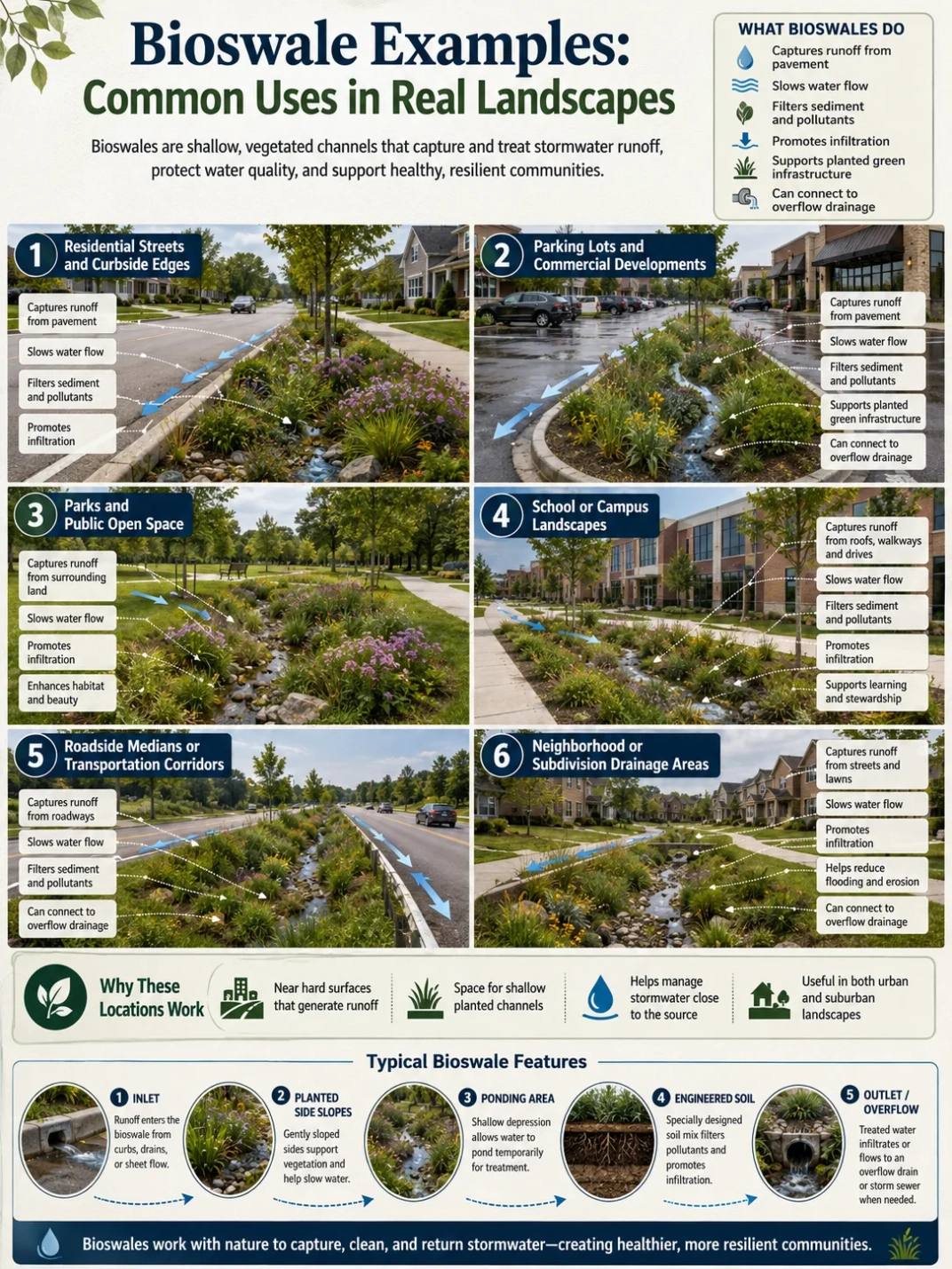
Bioswales near parking lots, streets, campuses, and public buildings often receive runoff with higher sediment load and more frequent disturbance. They may need curb cuts, pretreatment zones, stable inlets, underdrains, inspection access, and clear maintenance responsibilities.
Public-space bioswales also need to work with pedestrian routes, traffic edges, visibility, snow or leaf management where relevant, and safe overflow. These details are not decorative. They decide whether the bioswale keeps working after the first few seasons.
Design Note: Hardscape runoff often carries sediment to the first point of entry. A stable inlet and a cleanable sediment area can protect the planted and soil-filtering parts of the bioswale.
What Maintenance Usually Involves
Bioswale maintenance is mostly about keeping water movement, soil contact, and plant cover working together. The most useful inspections often happen after storms, because flow patterns become visible.
Maintenance Tasks That Protect Performance
- remove trash, leaves, and debris from inlets and outlets;
- clear sediment where it collects near inflow points;
- repair erosion before it forms a deeper channel;
- replace dead plants, especially in the bottom and inlet zones;
- manage weeds before they dominate the planting;
- refresh mulch where used, without burying plant crowns or blocking flow;
- check for standing water that lasts longer than expected for the design;
- protect soil from compaction caused by vehicles, storage, or repeated foot traffic.
Standing water is not automatically a failure. Many bioswales are designed to hold water for a limited period after rainfall. The concern is water that remains too long for the design intent, creates plant decline, blocks normal use, or points to clogged soil, a blocked outlet, or poor grading.
How to Tell If a Bioswale Is Working
An effective bioswale usually shows visible signs of stable flow and healthy function. Water enters without washing out soil. It spreads across the planted channel instead of cutting one narrow trench. Plants cover the soil. Sediment collects in places that can be cleaned. Overflow, when it happens, follows a planned route.
Weak performance often shows through the opposite signs: exposed soil, standing water that does not match the design, dead plants in repeated zones, bypass flow around the swale, clogged inlets, deep rills, or sediment buried across the whole channel.
Useful Field Checks
- During rainfall: look for bypass flow, erosion, fast water, or water missing the inlet.
- After rainfall: check where water ponded, where sediment settled, and whether water exited safely.
- During dry weather: look for plant stress, bare soil, compacted surfaces, and blocked outlets.
These observations can show whether the issue is water volume, inlet placement, grading, soil, plant selection, or maintenance.
When a Bioswale May Not Be the Right Fit
A bioswale may not be the best first choice where space is very limited, slopes are steep, soil is highly compacted, groundwater is shallow, or water must be removed quickly from a sensitive area. It may also be a poor fit where maintenance access is not realistic.
Other systems may fit better in some settings: a French drain for subsurface seepage, permeable pavement for distributed runoff reduction, a detention basin for larger storage, or a formal storm drain connection where surface routing is not suitable. The right answer depends on the site, not the label.
FAQ
Are bioswales effective for stormwater runoff?
Yes, bioswales can be effective for stormwater runoff when they are designed for the site. They can slow water, reduce erosion, trap sediment, support infiltration where soils allow, and help filter runoff through plants and soil.
Can a bioswale stop flooding?
A bioswale should not be expected to stop all flooding. It can reduce runoff speed and help manage smaller or moderate flows, but larger storms, saturated soil, blocked outlets, or undersized overflow routes can still cause excess water.
Do bioswales remove pollution from runoff?
Bioswales can help reduce some pollutants by slowing water, settling sediment, filtering runoff through soil, and supporting plant and microbial activity. Their performance depends on design, soil media, plant cover, pollutant type, and maintenance.
Why do some bioswales fail?
Some bioswales fail because they receive too much runoff, have compacted soil, lack a safe overflow route, use unsuitable plants, collect too much sediment, or have inlets that cause erosion or bypass flow.
Is a bioswale better than a rain garden?
A bioswale is not automatically better than a rain garden. A bioswale usually works as a planted flow path, while a rain garden often works as a planted basin. The better choice depends on runoff source, space, slope, soil, and drainage goals.
Does a bioswale need maintenance?
Yes, a bioswale needs maintenance to stay effective. Inlets, outlets, sediment areas, plants, mulch, and eroded spots should be checked so water can keep entering, spreading, filtering, and leaving the system as planned.