Flowering plants for bioswales must do more than add color. They need to tolerate changing soil moisture, hold soil during runoff, recover after dry periods, support pollinators, and remain manageable around inlets, outlets, sidewalks, and inspection areas. The best planting plan matches each flower to a specific moisture zone instead of treating the entire swale as one garden bed.
A well-planted bioswale may be briefly wet after rain and dry between storms. Some areas receive sediment and fast-moving water, while others stay relatively well drained. Plant placement matters as much as plant selection. A flower that performs well on the upper edge may decline in the lower channel, even when both locations are only a few feet apart.
What Flowering Plants Add to a Bioswale
Flowers can support several parts of bioswale performance when they are combined with suitable grasses, sedges, rushes, shrubs, and soil media. Their roots help hold surface soil, their stems interrupt shallow flow, and their foliage covers exposed ground where weeds might otherwise establish.
- Pollinator habitat: Nectar and pollen can support bees, butterflies, moths, beetles, hoverflies, and other insects.
- Seasonal color: A planned bloom sequence keeps the planting visually active for more than one short period.
- Soil protection: Dense roots and spreading foliage can reduce bare patches and surface erosion.
- Flow resistance: Upright stems and clustered vegetation help slow shallow runoff without forming a solid barrier.
- Public acceptance: Visible flowers can make green infrastructure look intentional rather than neglected.
- Plant diversity: A mixture of growth forms is less dependent on one species responding perfectly to every storm or dry spell.
Flowers do not replace hydraulic design. An undersized inlet, blocked outlet, compacted soil layer, or poorly located overflow route cannot be corrected by adding more plants.
Match Flowers to Bioswale Moisture Zones
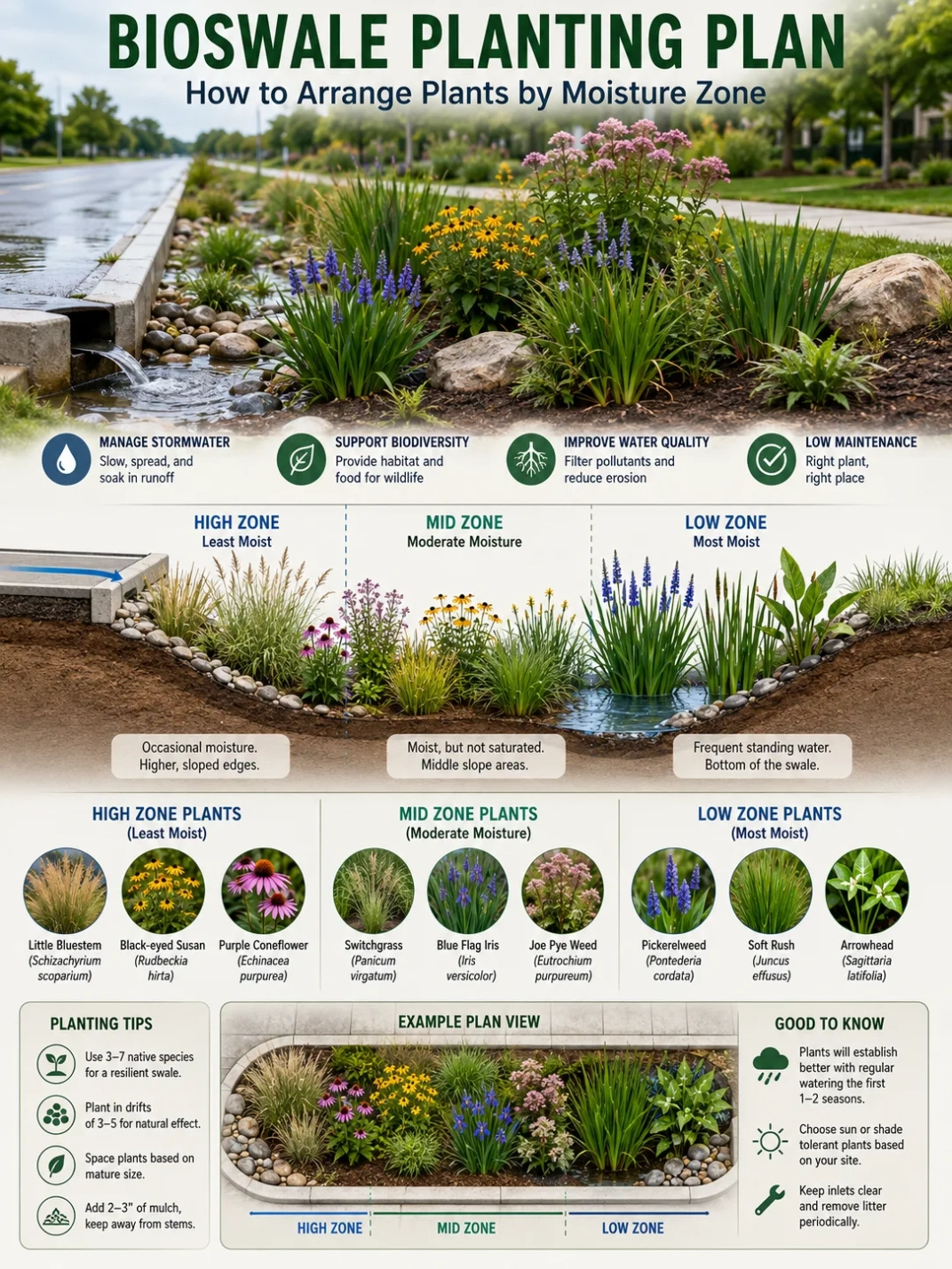
Most bioswales contain at least three planting conditions: a lower zone that receives the most water, a middle zone with alternating wet and dry periods, and an upper edge that drains sooner. The boundaries may shift with soil texture, slope, shade, rainfall pattern, underdrain design, and the runoff source.
| Planting Zone | Typical Conditions | Useful Flower Traits | Common Placement Limits |
|---|---|---|---|
| Lower Zone | Receives concentrated runoff and may remain moist longer after storms | Flexible stems, moisture tolerance, dense roots, ability to recover after short ponding | Avoid plants that collapse into the main flow path or obstruct an outlet |
| Middle Zone | Alternates between wet soil after rain and drier soil between events | Broad wet-dry tolerance, clumping growth, long flowering period, dependable regrowth | Plants must tolerate both temporary saturation and seasonal dryness |
| Upper Edge | Drains sooner and may resemble a normal dry garden bed | Drought tolerance, spreading roots, compact form near paths, late-season flowering | Do not assume plants here can survive in the lower channel |
| Inlet Area | Higher sediment load and stronger flow during runoff events | Tough crowns, fibrous roots, low or flexible growth, tolerance of occasional burial | Delicate flowers may be damaged by sediment, debris, or concentrated water |
| Outlet and Overflow Area | Needs clear drainage and easy inspection | Low, stable plants that allow access and preserve visibility | Tall or spreading flowers can hide erosion, clogging, or damaged structures |
Planting Note: “Moisture tolerant” does not necessarily mean a plant can remain submerged for long periods. Likewise, a drought-tolerant flower may fail if its crown sits in saturated soil after every storm. Use the expected water pattern at each planting position, not a broad wetland or upland label alone.
Choose Functional Traits Before Flower Color
Flower color is easy to compare. Root structure, stem strength, mature width, dormancy, and recovery after sediment deposition take more thought. These less visible traits often decide whether a planting remains useful after the first growing season.
Dense and Varied Root Systems
Fibrous roots near the soil surface can hold loose particles and protect the upper layer of soil media. Deeper roots may help plants reach moisture during dry periods and create channels through the soil as roots grow and decay. A mixture of root forms is usually more useful than a bed dominated by one shallow-rooted ornamental.
Roots cannot restore soil that has been heavily compacted during construction. Planting areas need suitable soil preparation before installation, and maintenance crews should avoid repeated vehicle or equipment traffic over the swale.
Stems That Stay Upright or Recover Easily
Tall flowering stems can bend after heavy rain. This is not automatically a failure, but flattened vegetation may cover nearby plants, block a narrow flow path, or create an untidy edge beside a sidewalk. Flowers with sturdy stems, flexible growth, or supportive neighboring grasses often recover better.
Foliage That Covers Soil
Open soil between widely spaced flowers gives weeds room to establish and allows raindrops to strike the soil surface directly. Ground-covering foliage, basal leaves, and low companion plants can close these gaps while keeping the surface visible enough for inspection.
Growth That Fits Maintenance Access
Plant height and spread should reflect nearby use. Tall flowers may be appropriate in a broad central planting, while shorter plants usually fit better beside curb openings, pedestrian crossings, driveways, signs, and inspection points. Mature dimensions matter more than nursery-pot size.
Plan a Bloom Sequence for Pollinators
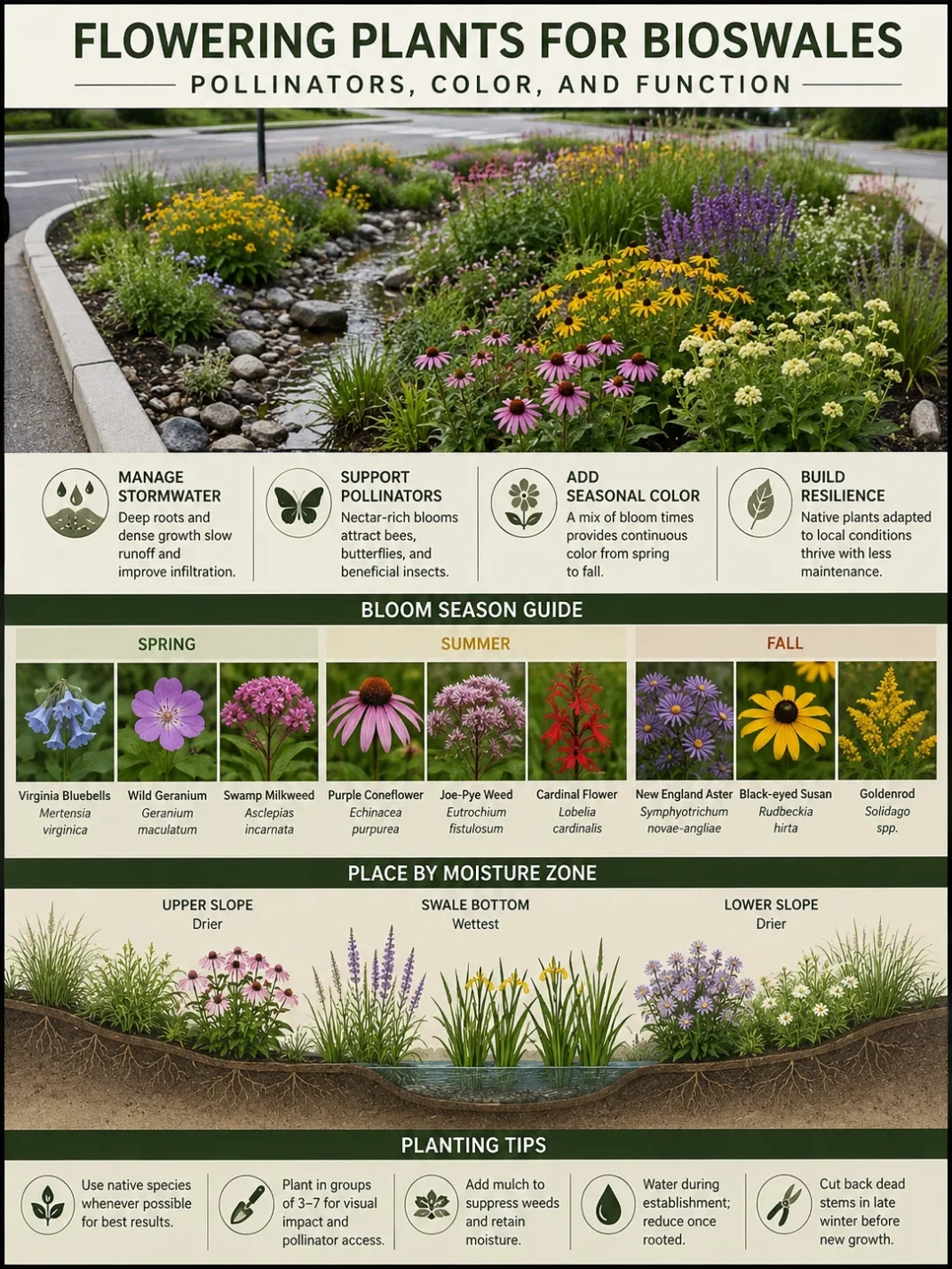
A bioswale planted with one flowering species may provide a strong burst of color and then little nectar or pollen for the rest of the season. A staggered sequence offers a steadier food supply and avoids long periods when the site looks empty.
| Flowering Period | Planting Role | Planning Considerations |
|---|---|---|
| Early Season | Provides resources when relatively few plants are blooming | Protect early growth from heavy leaf litter and avoid cutting before flowering is complete |
| Midseason | Creates the main period of color and pollinator activity | Use more than one flower shape and avoid relying on a single short-lived bloom |
| Late Season | Extends nectar and pollen availability before dormancy | Place taller late flowers where they will not block sight lines or drainage inspection |
| Dormant Season | Seed heads and hollow or pithy stems may provide food or shelter | Retain some stems where appearance, safety, and maintenance practices allow |
Pollinators use different flower structures. Flat flower clusters may suit small insects with short mouthparts, while tubular flowers can serve long-tongued bees, butterflies, and hummingbirds in regions where they occur. Mixing flower shapes helps broaden the range of visitors.
Continuous bloom does not require continuous maintenance. A restrained palette of dependable species can work better than a long list of plants with different cutting, staking, dividing, and watering needs.
Flowering Plant Groups That Often Fit Bioswale Conditions
Plant names should be selected from species suited to the local climate, soil chemistry, rainfall pattern, winter conditions, and ecological region. The following groups describe useful roles rather than a universal planting list.
Moisture-Tolerant Perennials
These plants may fit lower or middle zones where soil becomes wet after storms but later drains. Depending on region, suitable options may include locally native species related to cardinal flowers, swamp milkweeds, blue flags, sneezeweeds, turtleheads, or moisture-tolerant asters.
Check whether the plant tolerates temporary ponding, consistently moist soil, or both. Those conditions are not interchangeable.
Wet-Dry Transition Flowers
The middle slope often needs plants that can handle sharp changes in moisture. Regionally appropriate bee balms, coneflowers, black-eyed Susans, mountain mints, goldenrods, asters, and similar meadow perennials may fit this role in parts of North America. Other regions have their own native equivalents.
This zone can carry much of the visible flower display because it is less exposed to deep ponding than the bottom and receives more runoff moisture than the upper edge.
Dry-Edge Flowers
The upper bank may support flowers associated with dry meadows or open woodland edges. Locally suitable penstemons, yarrows, coreopsis, salvias, blanket flowers, and drought-tolerant asters are possible examples, subject to regional conditions.
Dry-edge plants should not be moved into the bottom of the swale only to repeat a color pattern. Their root crowns may decline where water collects.
Flowering Shrubs
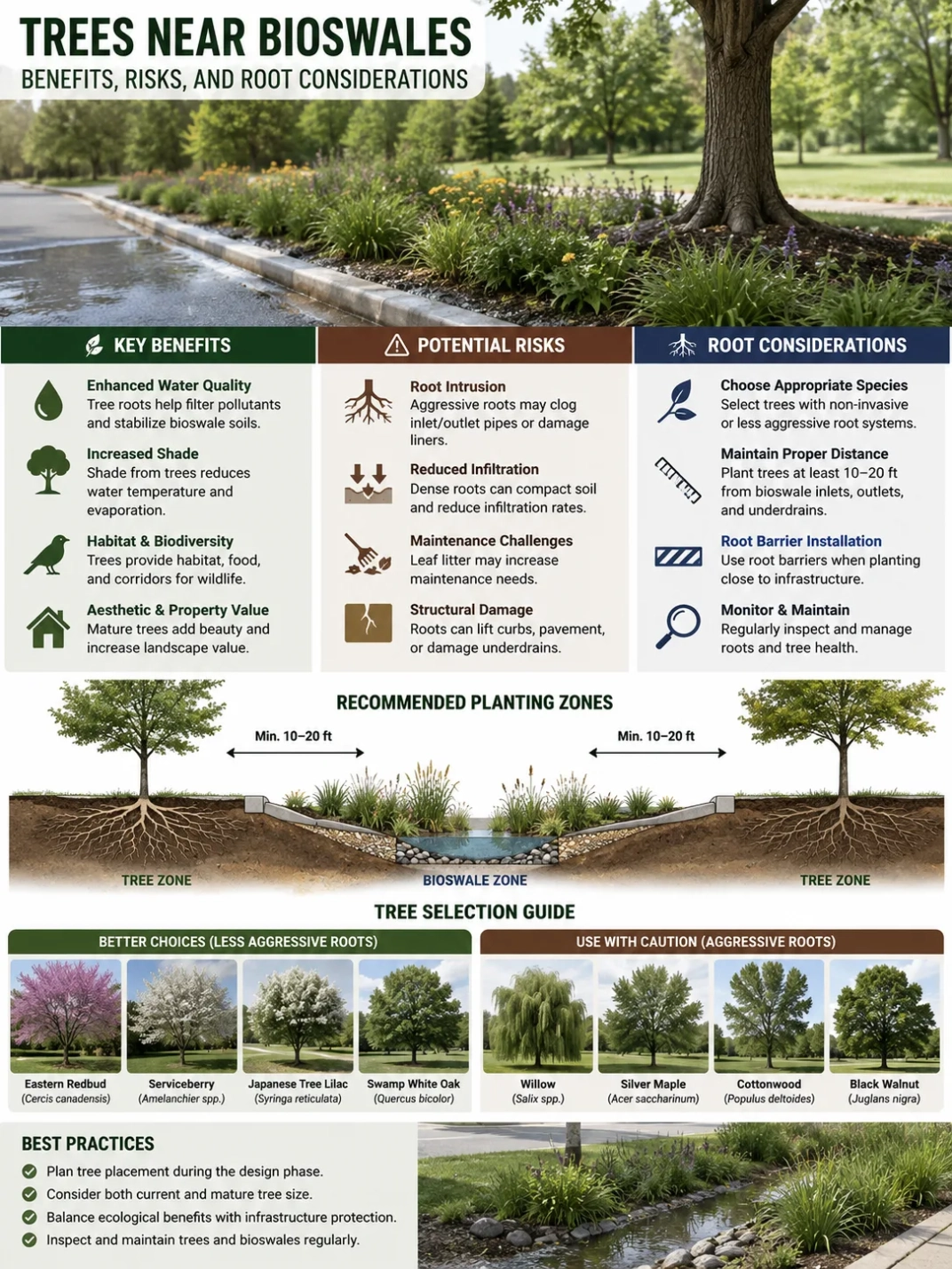
Where space allows, flowering shrubs can add woody roots, structure, shade, and seasonal habitat. They need careful placement so their mature canopy does not block visibility, narrow the flow path, interfere with utilities, or make inlet and outlet maintenance difficult.
Site Planning Note: Plant names shared in regional gardening lists may refer to species that are native in one area and introduced or invasive in another. Confirm local status and suitability before selecting seed, plugs, or nursery stock.
Flowers Work Better with Grasses, Sedges, and Rushes
A bioswale planted only with showy flowers may have weak winter structure, exposed soil after dormancy, or gaps when short-lived species decline. Grasses, sedges, and rushes can provide a stable matrix around flowering plants.
- Sedges often provide dense basal growth and fibrous roots in moist or transition zones.
- Rushes may suit wetter locations where local species tolerate periodic ponding.
- Grasses can support upright flowers, cover soil, move with flowing water, and remain visible during dormancy.
- Low ground layers can fill smaller openings without hiding drainage features.
The balance depends on the site. A roadside bioswale receiving sediment and deicing residue may need a different planting structure from a residential swale receiving relatively clean roof runoff.
Use Repetition Without Creating a Monoculture
Scattered single plants can look accidental and may be hard to maintain. Repeated groups or drifts create clearer color patterns and make it easier to identify weeds. Each group should still be mixed with other compatible species so one pest, disease, weather event, or moisture mismatch does not leave a large empty area.
A practical planting pattern may include:
- A stable matrix of locally suitable grasses, sedges, or low foliage plants.
- Repeated groups of early-, middle-, and late-flowering perennials.
- A smaller number of accent flowers placed away from strong inlet flow.
- Low plants around inspection areas and taller species in broader interior zones.
- Clear openings where sediment needs to be removed or structures need to be reached.
Color can also guide composition. Repeating two or three related colors through the swale often looks more intentional than using every available flower color once. Pollinator value comes from bloom timing, flower form, and plant suitability—not from color variety alone.
Protect the Inlet and Main Flow Path
The inlet receives the first pulse of runoff, sediment, leaves, and small debris. Fragile flowers placed directly in this area may be buried, bent, or washed out. Tough, low vegetation is often a better choice close to concentrated inflow.
Flowers can be placed behind a stabilized inlet area, along the middle slope, or in groups outside the strongest water path. Check dams, stone aprons, forebays, or other pretreatment elements may be part of some designs, but their form and placement depend on site-specific drainage needs.
Drainage Note: Keep outlets, overflow routes, curb openings, underdrain inspection points, and sediment collection areas visible. Dense flowers should not prevent routine inspection or hide erosion.
Maintenance Shapes the Plant Palette
A planting plan should match the time and skill available for maintenance. Some flowering perennials spread steadily and fill gaps. Others need division, deadheading, staking, or replacement. A public streetscape with limited maintenance may need fewer species and clearer plant groupings than a closely managed residential site.
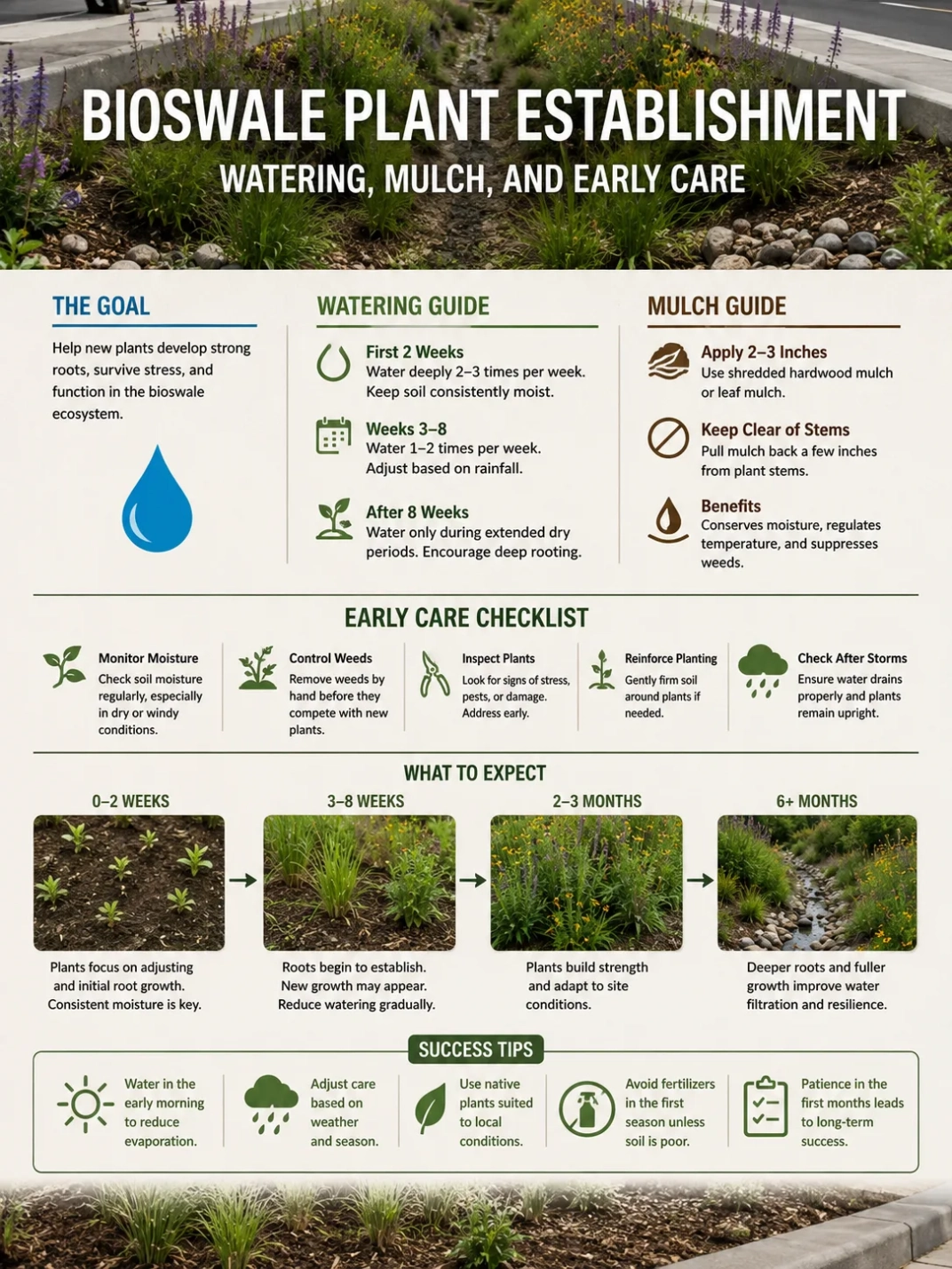
During Plant Establishment
New plants often need closer attention while roots develop. Watering needs depend on rainfall, soil moisture, plant size, season, and the runoff pattern. Stormwater alone may not provide dependable establishment moisture, especially during dry weather.
- Check for exposed roots, washout, sediment burial, and plant movement after storms.
- Remove weeds before they produce seed.
- Replace plants that repeatedly fail in the same moisture zone.
- Keep mulch, loose soil, and plant debris away from outlets and curb openings.
- Protect the soil surface from foot traffic and equipment compaction.
After the Planting Matures
Mature bioswale flowers still need inspection. Watch for one aggressive species crowding out the rest, dead patches along the main flow line, woody growth near structures, lodged stems over paths, and sediment that changes the intended grade.
Cutting every stem to ground level at the same time may remove winter structure and insect habitat. Where appearance and site use allow, maintenance can be phased so some stems remain temporarily. Material that could block drainage or spread unwanted seed should still be removed.
Common Planting Mistakes
- Selecting by flower color alone: Attractive plants may have the wrong moisture tolerance or growth habit.
- Using one moisture label for the whole swale: The bottom, slopes, edges, inlet, and outlet often behave differently.
- Planting tall flowers in inspection areas: Drainage problems become harder to see and reach.
- Leaving large bare gaps: Open soil invites weeds and may erode during plant establishment.
- Relying on one flowering species: A single failure can remove most of the color and soil cover at once.
- Ignoring dormant appearance: Some flowers disappear almost completely after frost, leaving weak winter structure.
- Assuming native means maintenance-free: Native plants still need suitable placement, establishment care, and periodic management.
- Choosing plants before checking drainage: Persistent standing water, compaction, or a blocked outlet should be addressed before failed plants are replaced.
When Site Conditions Need Closer Review
Plant selection becomes more site-dependent where runoff moves quickly, soil remains saturated, slopes show erosion, sediment loads are high, or the bioswale sits close to buildings, utilities, roads, retaining walls, or neighboring property. These conditions may need review by a qualified landscape, drainage, soil, or stormwater professional.
Local requirements may also affect plant height, sight distance, prohibited species, maintenance access, drainage discharge, or approved soil media. A flower list should follow the approved drainage function rather than reshape it without review.
Frequently Asked Questions
What are the best flowering plants for a bioswale?
The best choices are locally suitable plants matched to the swale’s lower, middle, and upper moisture zones. Look for appropriate wet-dry tolerance, useful root structure, manageable mature size, and flowering periods that complement one another.
Do bioswale flowers need to be native plants?
Locally native flowers are often useful because they may support regional insects and fit local seasonal patterns. Native status alone does not prove that a plant suits the swale’s soil, moisture zone, salt exposure, sunlight, or maintenance plan. Local suitability still needs to be checked.
Can pollinator plants grow in the bottom of a bioswale?
Some can, provided they tolerate the expected ponding and drainage pattern. Many popular pollinator flowers prefer the middle or upper zone and may decline if their crowns remain wet for too long.
Should a bioswale contain flowers only?
A mixed planting is usually more stable. Grasses, sedges, rushes, shrubs, and ground-covering foliage can support flowers, protect soil, provide dormant-season structure, and fill gaps between bloom periods.
How can a bioswale have color through more of the year?
Combine early-, middle-, and late-flowering species, then include plants with useful fall foliage, seed heads, berries where appropriate, or persistent stems. The exact sequence depends on the local growing season and maintenance schedule.
Why do flowering plants keep dying in the same part of a bioswale?
Repeated failure in one location may point to a moisture mismatch, compacted soil, sediment burial, erosion, salt exposure, shade, blocked drainage, or competition from nearby plants. Check the site condition before replacing the flowers with the same type.