Clay soil can support a bioswale, but it changes what the system can be expected to do. A bioswale in clay should not be treated as a fast-draining trench. It is usually better understood as a shallow, planted stormwater feature that slows runoff, spreads flow, filters sediment, and manages overflow carefully, with infiltration handled only where site testing shows it is realistic.
That difference matters. Sandy or loamy soil may let water move downward with less resistance. Clay soil holds water longer, drains more slowly, compacts easily, and can form a slick surface when it is worked while wet. Those traits do not make bioswales useless, but they do place clear limits on design, plant choice, ponding time, and maintenance.
Why Clay Soil Changes Bioswale Performance
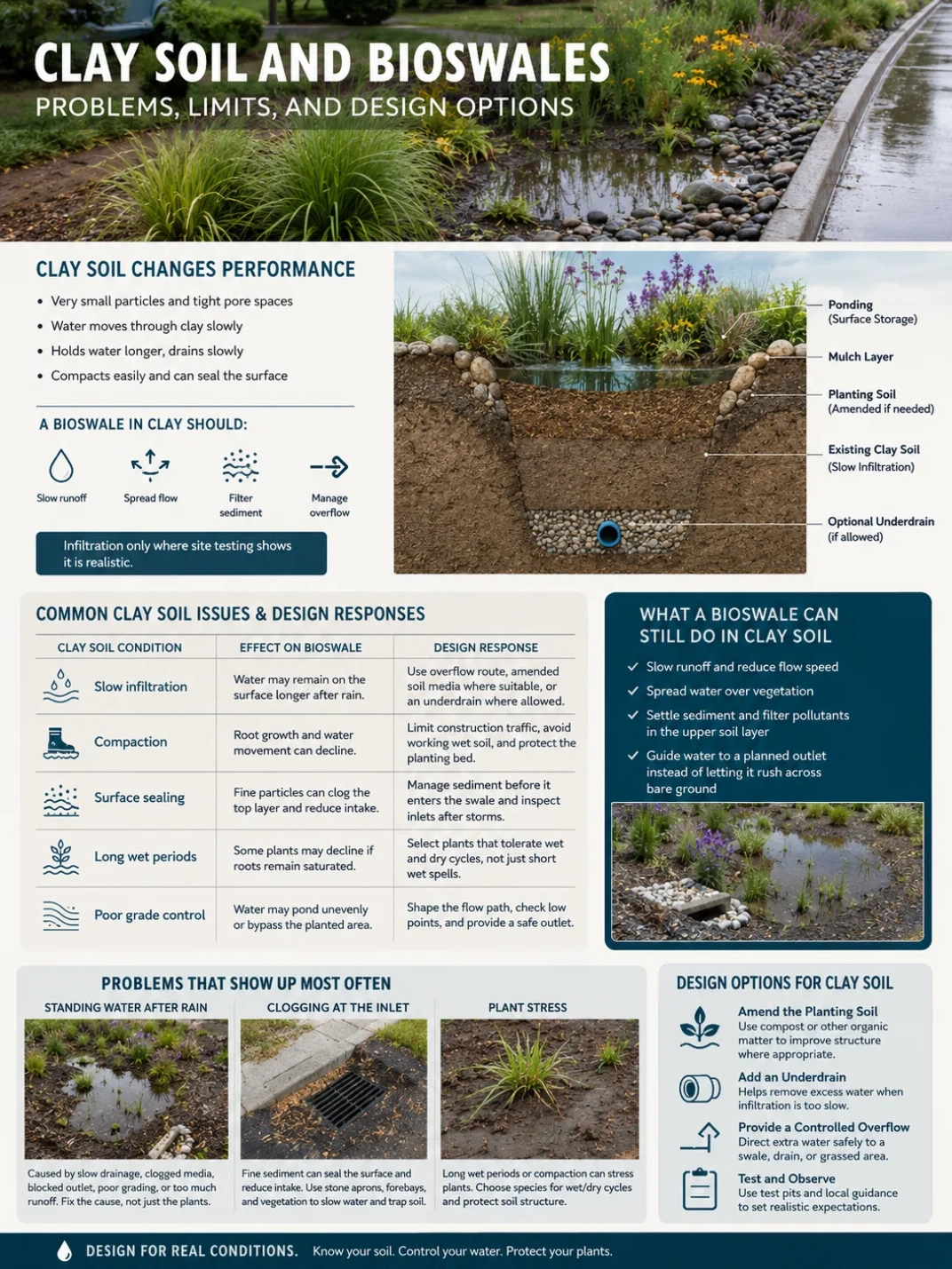
Clay soil has very small particles and tight pore spaces. Water moves through those pores slowly, especially when the soil is compacted or saturated. In a bioswale, that slow movement can affect both the surface flow and the soil layer below the plants.
A bioswale built in clay may still collect runoff from a roof, driveway, path, parking edge, or roadside area. It may still reduce flow speed and trap sediment. The limit is the rate at which water can leave the swale. If the design assumes rapid infiltration but the subsoil cannot accept water, the swale may stay wet too long.
| Clay Soil Condition | Effect on the Bioswale | Design Response |
|---|---|---|
| Slow infiltration | Water may remain on the surface longer after rain. | Use a controlled overflow route, amended soil media where suitable, or an underdrain where allowed. |
| Compaction | Root growth and water movement can both decline. | Limit construction traffic, avoid working wet soil, and protect the planting bed during installation. |
| Surface sealing | Fine particles can clog the top layer and reduce intake. | Manage sediment before it enters the swale and inspect inlets after storms. |
| Long wet periods | Some plants may decline if roots remain saturated too often. | Select plants that tolerate wet and dry cycles, not just short wet spells. |
| Poor grade control | Water may pond unevenly or bypass the planted area. | Shape the flow path, check low points, and provide a safe outlet. |
What a Bioswale Can Still Do in Clay Soil
A clay-site bioswale can still offer useful stormwater function when the design is honest about soil limits. It can slow runoff, spread water over vegetation, settle sediment, support pollutant filtering in the upper soil layer, and guide water toward a planned outlet instead of letting it rush across bare ground.
The main mistake is expecting clay to perform like engineered filter media. Native clay may help store water for a short period, but it may not drain fast enough for every site. A better design asks: Where does the water enter, how long can it safely stay, and where does extra water go?
Soil Note: Clay soil does not automatically rule out a bioswale. It does mean that infiltration should be checked, not assumed. Small test pits, soil observation, and local drainage guidance can show whether the swale should rely on infiltration, underdrainage, overflow conveyance, or a mix of these approaches.
Problems That Show Up Most Often
Standing Water After Rain
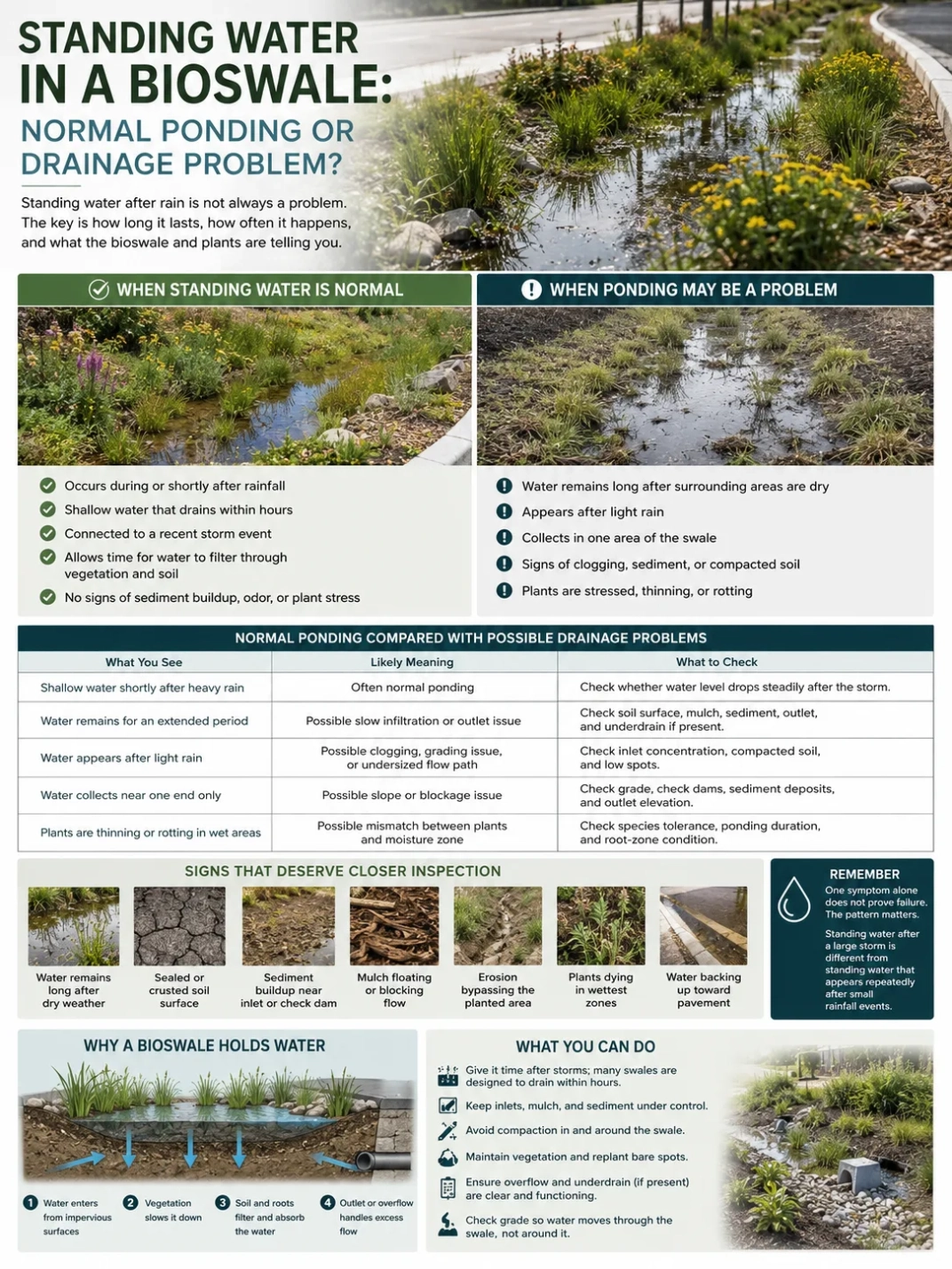
Standing water is one of the first signs that clay soil is controlling the system. Some temporary ponding can be part of a bioswale design, depending on local rules and site conditions. The concern begins when water remains long enough to stress plants, soften soil, create muddy access, or show that the outlet is not working as intended.
Persistent ponding may come from slow subsoil drainage, clogged surface media, a blocked outlet, poor grading, or too much runoff entering a small swale. The fix depends on the cause. Adding plants alone may not solve a drainage problem if the soil profile or outlet route is the real limit.
Clogging at the Inlet
Clay sites often carry fine sediment during construction, landscaping, or runoff from bare areas. When that sediment reaches the inlet, it can form a thin seal over mulch or soil media. Water then spreads poorly, cuts channels, or skips the planted zone.
A stable inlet helps. Stone aprons, dense vegetation near the entry point, forebay areas, or other sediment-catching details may be used in many designs. The goal is simple: slow the water before it reaches the main planting bed.
Compacted Planting Zones
Clay soil can lose pore space when walked on, driven over, or shaped with heavy equipment while wet. Once compacted, it may shed water across the surface rather than letting water move into the upper soil layer. Plant roots also struggle in dense, air-poor soil.
Construction timing matters. A bioswale bed should be protected from traffic as much as practical, especially before planting. If soil must be amended or loosened, that work should match the site plan and avoid creating a bathtub-like pocket with no outlet.
Plants That Fail in Wet-Dry Swings
Clay bioswales can be wet after storms and dry on the surface between rain events. Plants need to handle both conditions. Species that like constant moisture may struggle during dry weeks, while upland plants may fail when roots sit in wet clay for too long.
Grasses, sedges, rushes, and shrubs with fibrous or spreading root systems are often useful categories to consider. Exact plant selection should fit local climate, sun exposure, soil moisture, and maintenance capacity.
Design Options for Bioswales in Clay Soil
The best clay-soil bioswale design usually combines surface shaping with a realistic drainage strategy. It may not depend on native soil infiltration alone. Instead, it may use a planted flow path, amended upper media, check dams, an underdrain, or a clear overflow route, depending on site conditions and local requirements.
Use a Shallow, Stable Flow Path
A bioswale should move water slowly through vegetation, not create a narrow ditch that cuts through soil. On clay, a broad and shallow section can help spread runoff and reduce erosion. Side slopes should be gentle enough for planting, inspection, and maintenance access where space allows.
The longitudinal slope also matters. Too much slope can move water too fast. Too little slope can leave water trapped in one area. Small grade changes, check dams, or level spreader details may help shape flow, but they should be matched to the runoff volume and outlet location.
Improve the Upper Soil Layer Carefully
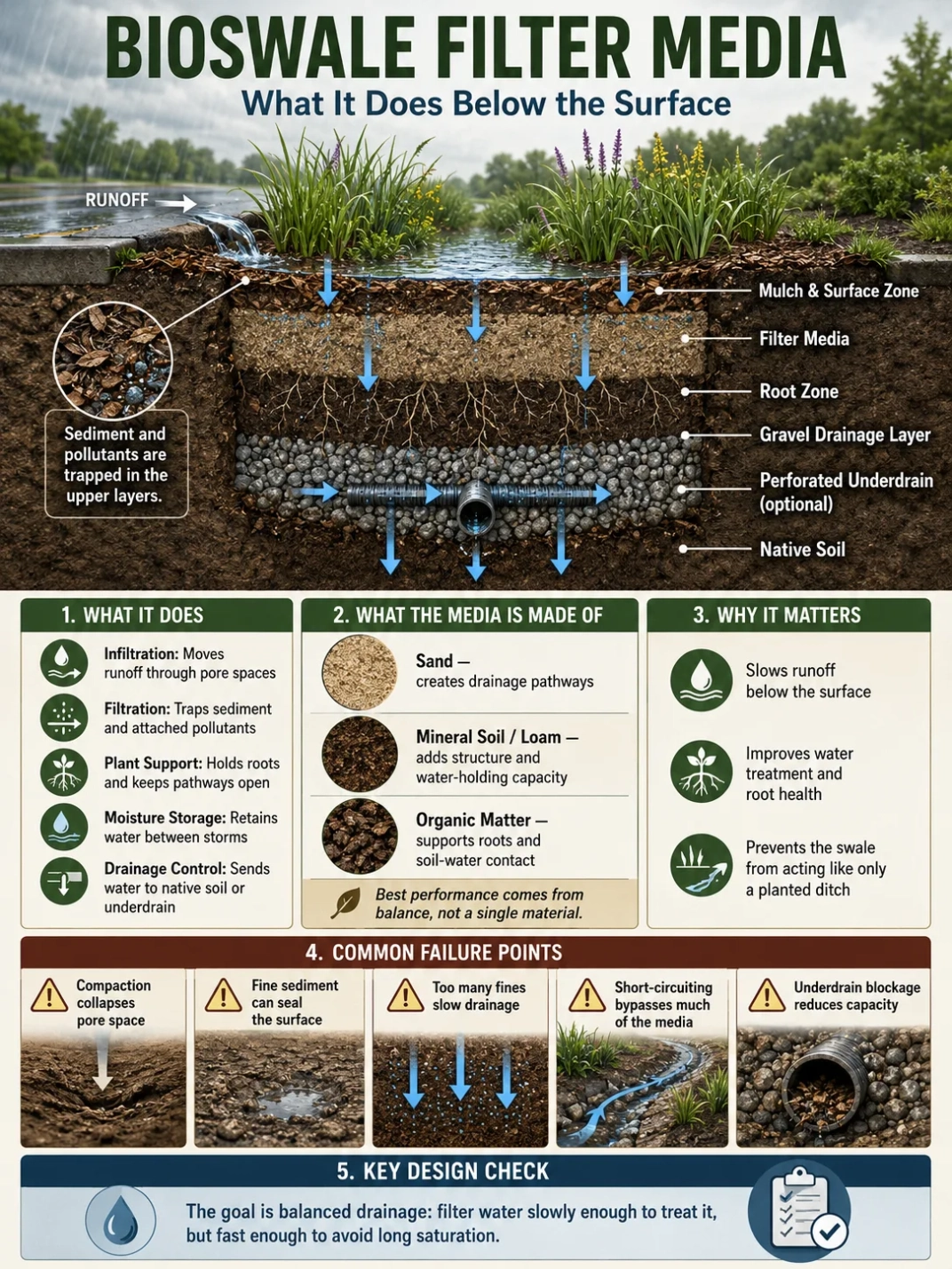
Some clay bioswales use amended soil media above the native clay. This layer may support plants, filtration, and surface drainage better than compacted native soil. However, the media must be selected with care. A loose, fast-draining layer over dense clay can hold water at the interface if there is no way for water to leave.
That is why soil media and drainage design should be considered together. Filter media, mulch, native soil, and underdrainage are not separate decisions. They shape one system.
Add an Underdrain Where Infiltration Is Too Slow
An underdrain can help a clay-site bioswale when native soil cannot move water fast enough. In many designs, the underdrain sits below the planting media and carries filtered water to an approved outlet. It does not remove the need for vegetation, sediment control, or a surface overflow route.
Underdrains need careful placement, cleanouts, and outlet protection. They also need to fit local rules. If the site connects to a storm drain, ditch, or other drainage system, professional review may be needed.
Design Note: An underdrain can make a clay bioswale more reliable, but it changes the function. The system may become more like a planted filtration and conveyance feature than a pure infiltration feature.
Plan a Safe Overflow Route
Every bioswale needs a way to handle water that exceeds its normal capacity. This is especially true in clay soil because drainage may slow during long or repeated storms. Overflow should move away from structures, avoid erosion, and follow an approved discharge path.
Overflow planning is not only for large public projects. A small residential swale near a driveway or downspout can still cause problems if extra water is directed toward a foundation, neighboring property, sidewalk, or low spot with no outlet.
Control Sediment Before It Reaches the Swale
Clay particles can stay suspended in runoff and settle later in the swale. Over time, this sediment can clog mulch, smother young plants, and reduce surface intake. During and after construction, bare soil areas should be stabilized before runoff is sent into the bioswale.
For driveways, parking edges, and roadside runoff, sediment load may be higher than from a clean roof. In those cases, inlet protection and inspection access become more valuable.
When Clay Soil Sets a Real Limit
Clay soil can limit a bioswale when runoff volume is too high, the available area is too small, groundwater is shallow, the site has no safe outlet, or the swale sits near sensitive structures. A bioswale is not a cure for every drainage problem.
It may be a poor fit when the only possible location is a tight, flat, poorly drained area with heavy foot traffic and no overflow path. It may also need engineering review when it receives runoff from larger paved areas, public streets, commercial hardscape, or slopes that can send water at high speed.
Site Planning Note: Clay soil makes site observation more important. Watch where water already flows, where it ponds, how fast it disappears after rain, and what lies downslope. These clues help decide whether a bioswale, rain garden, French drain, detention area, or another drainage feature fits better.
Clay Bioswale, Rain Garden, or Drainage Swale?
Clay soil often blurs the line between common landscape drainage features. The name matters less than the function. A planted swale that mainly moves water is not the same as a bioretention cell designed with engineered media and underdrainage.
| Feature | Main Function | Clay Soil Concern |
|---|---|---|
| Bioswale | Slows, filters, and conveys runoff through a planted channel. | Needs careful outlet planning if infiltration is slow. |
| Rain Garden | Collects water in a planted depression for short-term ponding and soil intake. | May hold water too long if native clay is not addressed. |
| Bioretention Cell | Uses engineered media, vegetation, and often underdrainage for treatment. | Requires more design control than a simple landscape swale. |
| Drainage Swale | Moves runoff from one area to another. | May offer less filtering if vegetation and soil media are not part of the design. |
| French Drain | Moves water underground through gravel and pipe. | Does not provide the same visible planted treatment zone. |
On a clay site, a bioswale may be paired with other drainage elements. That does not make the design weaker. It often makes the function clearer: surface runoff is slowed and filtered, while excess water has a planned way to leave.
Planting Strategy for Clay Soil
Plants in a clay bioswale need more than wet tolerance. They must also survive dry surface conditions, sediment exposure near inlets, and occasional water movement across the root zone. A mix of plant forms often works better than one uniform planting.
The lowest part of the swale may need plants that tolerate short wet periods. Side slopes may need species that handle drier soil and help hold the bank. Near inlets, tougher vegetation may be needed because water velocity and sediment are usually higher.
- Bottom zone: plants suited to periodic ponding and heavier soil.
- Side slopes: plants that help stabilize soil and tolerate faster drying.
- Inlet area: dense, resilient plants that can handle sediment and flow.
- Outlet area: vegetation that supports erosion control without blocking discharge.
Planting Note: Native plants can be useful in bioswales because many are adapted to local rainfall, soils, and seasonal stress. Plant choice should still be local. A species that works in one region may not fit another region’s climate, clay type, or maintenance pattern.
Maintenance Issues That Matter More in Clay
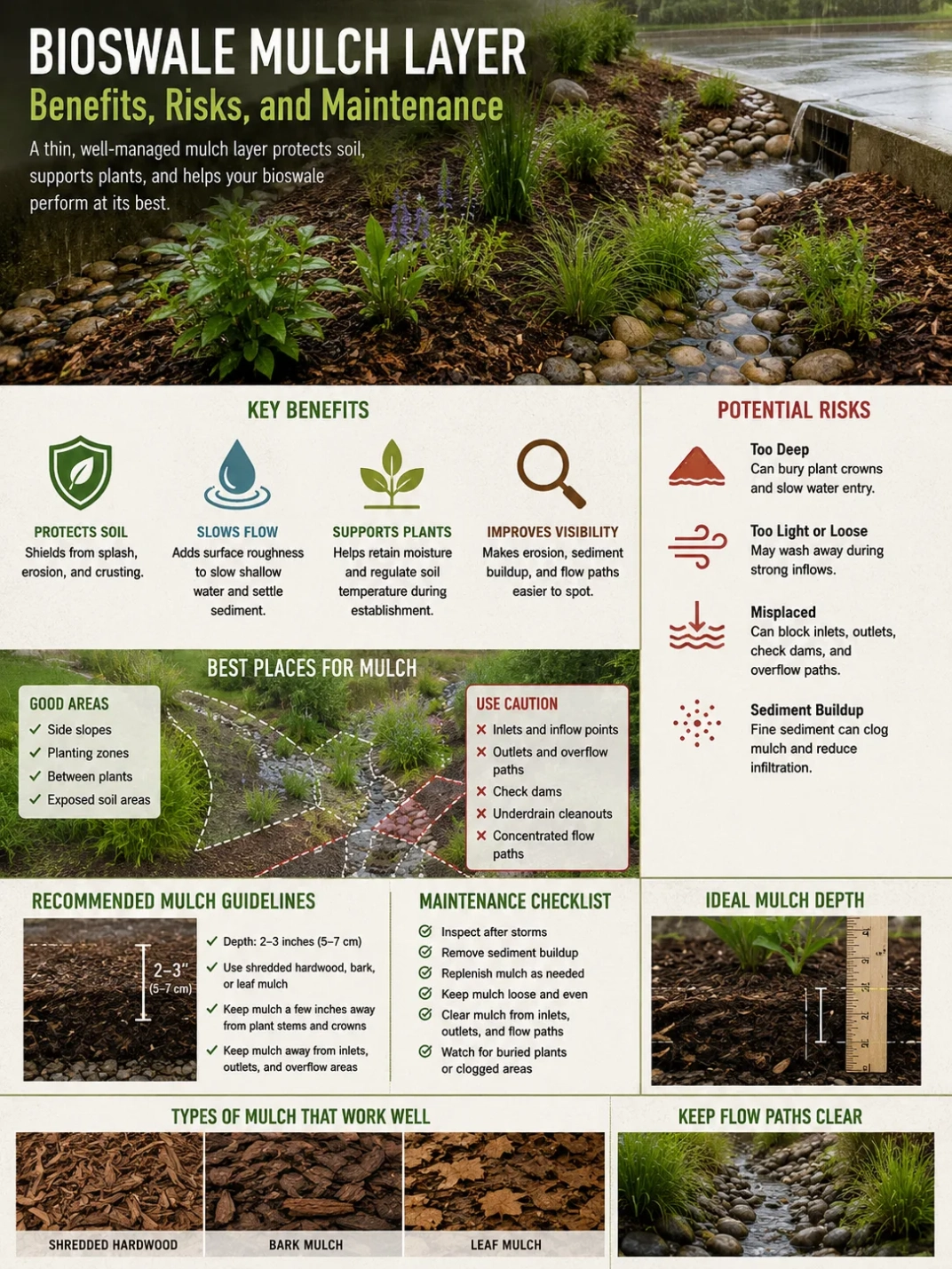
Maintenance in clay soil focuses on keeping water moving through the intended path. Small problems can change performance over time: sediment buildup at the inlet, compacted mulch, bare soil, blocked outlets, plant gaps, or erosion around check dams.
Inspections are most useful after rain, when the system shows how it is working. Dry-weather checks can miss ponding patterns, bypass flow, and outlet problems.
- Remove sediment where it collects near inlets or low points.
- Keep outlets and overflow paths open.
- Replace failed plants before bare soil spreads.
- Repair erosion channels before they deepen.
- Avoid driving or storing heavy materials in the swale.
- Refresh mulch only where it supports the design and does not block flow.
If water remains much longer than expected, the cause should be checked before adding more soil or mulch. Extra material can sometimes reduce capacity or cover the designed flow line.
Residential Design Limits
For homes, clay soil raises common questions about downspouts, driveway runoff, yard grading, and foundation distance. A small bioswale can help manage shallow runoff across a yard, but it should not send water toward a basement, crawl space, neighboring lot, public sidewalk, or road edge without a planned route.
Roof runoff can be concentrated and fast when it leaves a downspout. In clay soil, that water may need a splash pad, level spreader, stone inlet, or other energy-control detail before it enters the planted swale. The inlet should reduce erosion and help water spread across the vegetation.
Where local rules allow residential drainage changes, the design should still respect property lines and existing drainage patterns. If the site has steep slopes, recurring wet areas, retaining walls, or foundation drainage concerns, professional review is a careful step.
Public and Commercial Site Limits
Clay soil becomes more demanding when a bioswale receives runoff from parking lots, streets, loading areas, or large paved surfaces. These sites often bring more sediment, higher flow speed, and more maintenance needs than a small yard feature.
Public-space bioswales also need safe edges, inspection access, stable inlets, protected outlets, and planting that can handle disturbance. Curb cuts, pavement grades, snow storage practices, and pedestrian routes may all affect performance, depending on the location.
For larger paved drainage areas, clay soil usually calls for site-specific design rather than a generic swale shape. Soil testing, runoff calculations, underdrain layout, overflow design, and maintenance access may all need review.
Common Mistakes with Clay Soil and Bioswales
Most clay-soil bioswale problems come from treating the swale as a hole that will simply absorb water. A bioswale is a shaped stormwater system. It needs a controlled entry, planted treatment zone, stable soil surface, and exit path.
- Assuming infiltration without testing: clay texture alone does not tell the whole story, but it does warn against guessing.
- Digging too deep without drainage: a deep pocket in clay may hold water rather than improve performance.
- Ignoring overflow: heavy rain still needs a safe route out of the system.
- Using plants only for appearance: roots, density, wet tolerance, and slope stabilization all matter.
- Letting sediment enter unchecked: fine material can clog the surface and weaken plant growth.
- Working wet clay during installation: smearing and compaction can reduce soil function from the start.
What to Check Before Planning
Before planning a bioswale in clay soil, the site should be read as a drainage system. The soil is only one part of that system. Runoff area, slope, existing flow path, plant zone, outlet, and maintenance access all shape whether the design can work.
- Where does runoff come from: roof, driveway, road, lawn, or parking area?
- How fast does water arrive during a normal storm?
- Where does water already collect after rain?
- How long does the soil stay wet?
- Is there a safe overflow route?
- Can the inlet be protected from sediment?
- Will the swale be protected from foot traffic, vehicles, and storage?
- Do local drainage rules affect discharge, underdrains, or grading?
Good clay-soil design often looks modest on the surface. The value is in the details: gentle grades, protected inlets, realistic ponding expectations, suitable plants, and a drainage route that still works when the soil is saturated.
FAQ
Can a bioswale work in clay soil?
Yes, a bioswale can work in clay soil when the design does not rely on fast infiltration alone. It may need amended upper soil, an underdrain, a broader flow path, check dams, or a clear overflow route, depending on the site.
Why does clay soil cause standing water in a bioswale?
Clay soil has small pore spaces that slow water movement. If the swale receives more runoff than the soil and outlet can handle, water may remain on the surface longer than planned. Clogging, compaction, or poor grading can make the problem worse.
Does a clay bioswale need an underdrain?
Some clay bioswales need an underdrain, while others may not. The decision depends on soil testing, ponding goals, available outlet, runoff volume, and local requirements. An underdrain is often considered when native clay drains too slowly for the intended use.
What plants are best for bioswales in clay soil?
Good candidates are plants that tolerate both wet periods and dry intervals. Grasses, sedges, rushes, and shrubs with strong root systems are often considered, but the final selection should match the local climate, sun exposure, soil moisture, and maintenance plan.
Can clay soil be amended for a bioswale?
Clay soil can sometimes be amended or covered with suitable planting media, but the design must avoid trapping water above dense subsoil. Soil media, underdrainage, and overflow planning should be considered together rather than treated as separate fixes.
When should a clay-soil bioswale get professional review?
Professional review is wise when the swale receives runoff from large paved areas, sits near buildings, affects neighboring drainage, connects to a storm system, has no clear overflow route, or shows repeated standing water after storms.