A bioswale underdrain is a perforated pipe system placed beneath the planting soil to collect filtered stormwater when the native ground cannot absorb water fast enough, when a liner is used, or when the site must drain within a required time. It does not replace the surface swale; it gives the bioswale a controlled outlet after runoff has slowed, settled, and moved through soil and roots.
For many bioswales, the underdrain is the hidden part that decides whether the system stays healthy or turns into a wet, compacted channel. It can help prevent prolonged standing water, protect plant roots from long saturation, and route treated water to a storm drain, outlet structure, or approved downstream location. But it also changes the water balance. A bioswale with an underdrain often filters and drains water rather than allowing all of it to soak into the native soil.
The right answer depends on soil infiltration, groundwater depth, available grade, runoff volume, local drainage rules, and the purpose of the bioswale. A small residential swale on well-draining soil may not need one. A roadside, parking lot, or clay-soil bioswale often does.
What a Bioswale Underdrain Does
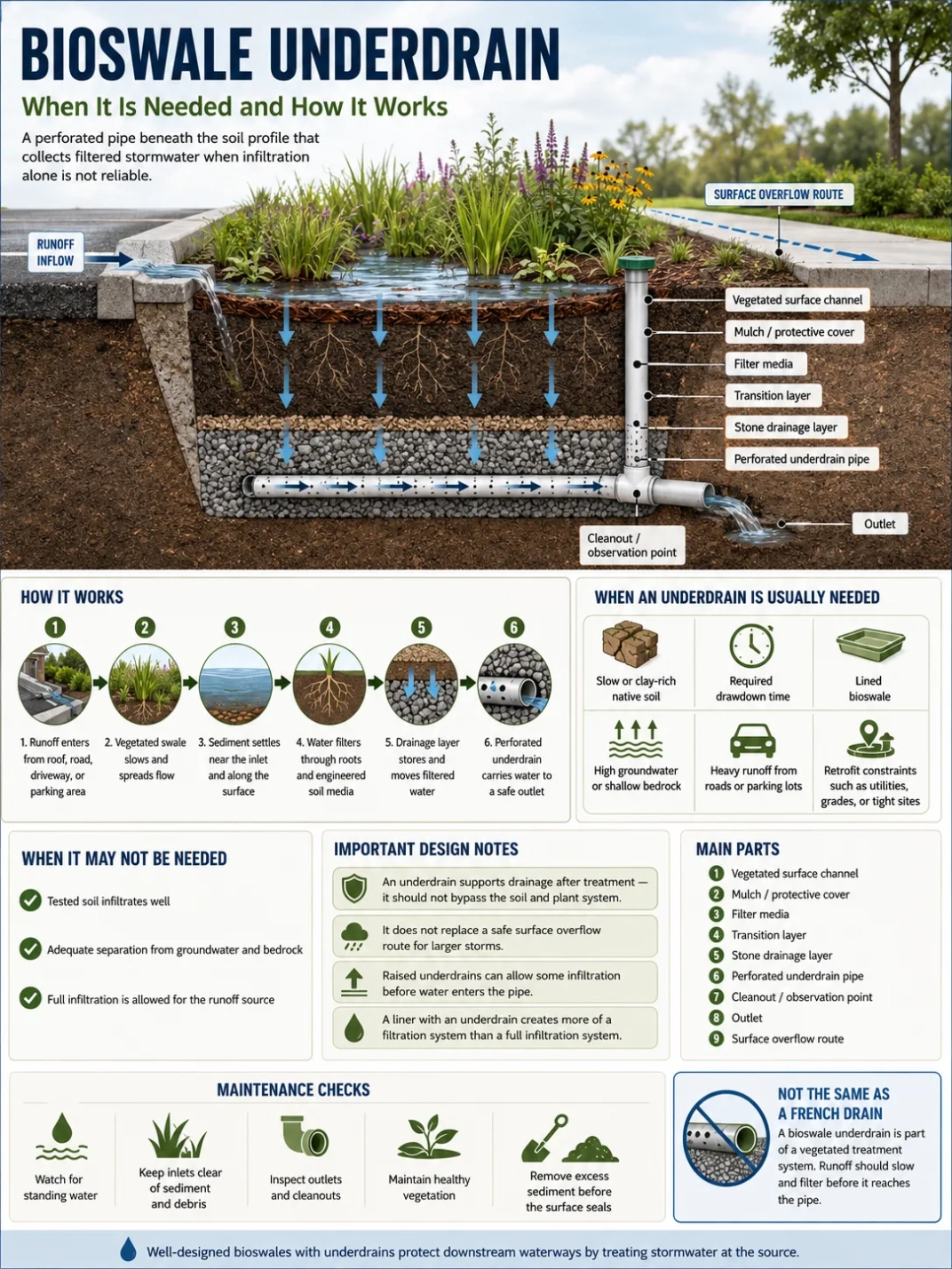
A bioswale underdrain is usually a slotted or perforated pipe set inside a drainage layer below the filter media. Water reaches it only after moving down through the surface vegetation, mulch or protective cover, and engineered soil media.
That order matters. The underdrain should not act like an open pipe that grabs dirty runoff before treatment. Its job is to receive filtered water from below the soil profile and carry it away at a controlled point.
In a typical underdrained bioswale, runoff follows this path:
- Stormwater enters from a roof edge, driveway, curb cut, parking lot, road edge, or other impervious surface.
- The shallow vegetated channel slows the water and spreads flow along the swale.
- Sediment and coarse particles settle near the inlet or along the surface flow path.
- Water ponds briefly, then moves down through the plant root zone and filter media.
- The lower drainage layer stores and moves filtered water toward the perforated pipe.
- The underdrain carries water to an outlet, storm sewer, daylight point, or other approved discharge location.
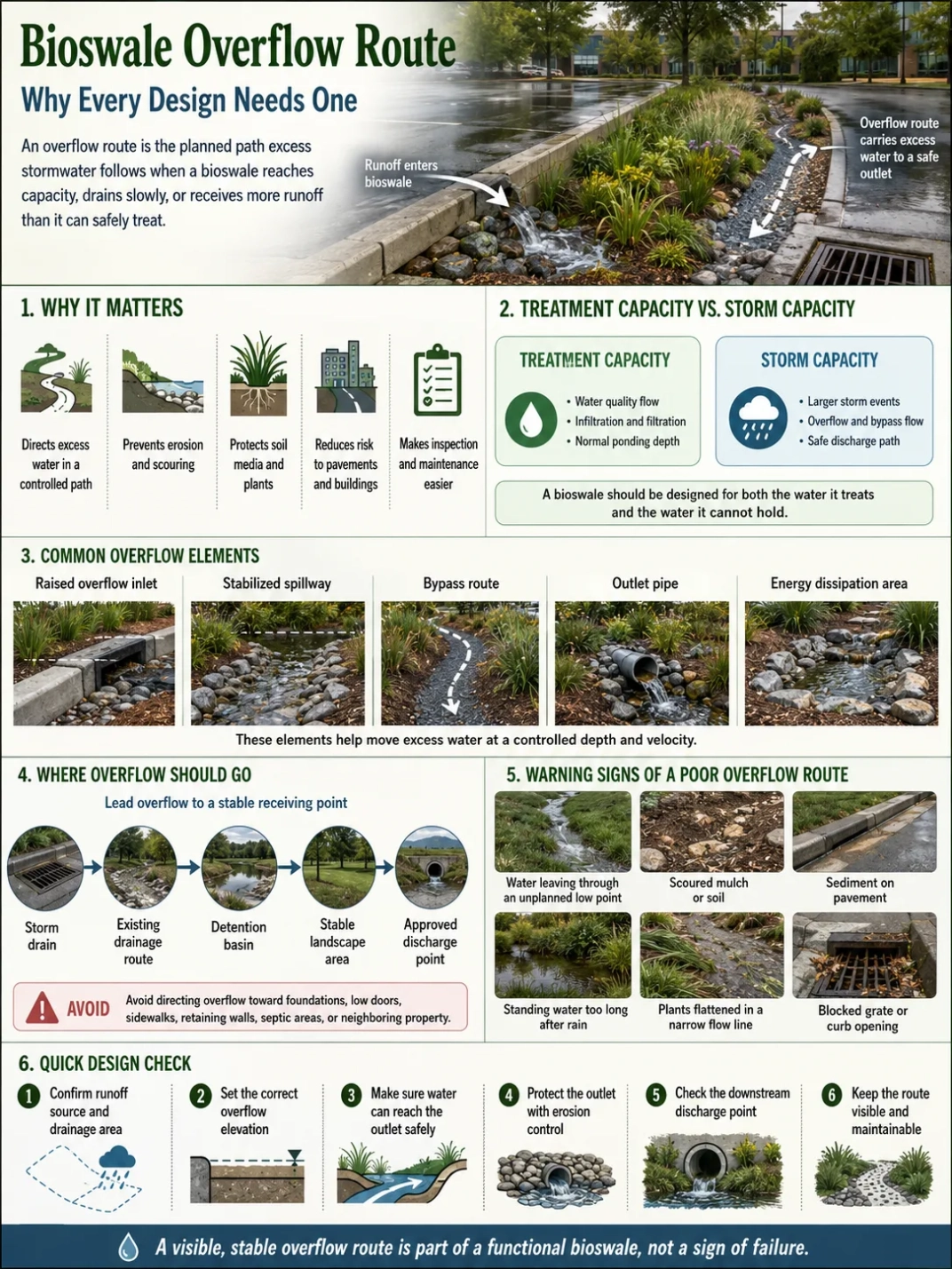
Drainage Note: A bioswale underdrain does not remove the need for a safe surface overflow route. Larger storms can exceed the soil and pipe capacity, so excess water still needs a visible, stable path away from buildings, pavement edges, and neighboring property.
When an Underdrain Is Usually Needed
An underdrain is most often used when infiltration alone cannot provide reliable drawdown. The word “needed” should be treated with care because local standards vary, and site testing can change the answer.
Still, several site conditions commonly point toward an underdrained design.
| Site Condition | Why It Matters | What the Underdrain Helps Do |
|---|---|---|
| Slow native soil | Clay-rich or compacted subsoil may hold water too long after storms. | Collect filtered water below the media and move it to an outlet. |
| Required drawdown time | Some projects must drain within a set period under local design rules. | Support predictable drainage when soil testing shows slow movement. |
| Lined bioswale | An impermeable liner blocks infiltration into the ground. | Carry treated water out of the lined system. |
| High groundwater or shallow bedrock | The bottom of the bioswale may not have enough separation from saturated ground or rock. | Allow a filtration-based design where local rules allow. |
| Heavy hardscape runoff | Parking lots, roads, and large paved areas can send fast, sediment-bearing flow. | Help the system recover after storms, along with pretreatment and overflow. |
| Retrofit constraints | Existing utilities, grades, pavement, or buildings may limit full infiltration. | Create a controlled drainage path without relying only on native soil. |
Slow soil is the most common reason. If water moves into the native ground too slowly, the bioswale can stay wet longer than intended. That can stress plants, reduce oxygen in the root zone, leave sediment in place, and make maintenance harder.
An underdrain can help, but it is not a cure for every poor-drainage problem. A compacted surface layer, clogged inlet, badly shaped bottom, or missing overflow route can still cause standing water even when a pipe is present.
When a Bioswale May Not Need an Underdrain
A bioswale may be designed without an underdrain when tested native soil can accept runoff at a suitable rate, the bottom has enough separation from groundwater and bedrock, and infiltration is allowed for that runoff source. These systems are often called full infiltration designs.
In this type of bioswale, water filters through the soil media and continues into the ground below. Some water also leaves through evapotranspiration and plant uptake. The surface overflow handles larger storms that exceed the design capacity.
Skipping the underdrain can support more groundwater recharge, depending on local soil and rainfall. It can also reduce pipe maintenance. But it requires more confidence in the soil, the surrounding grades, and the receiving area below the system.
Soil Note: A visual guess is not enough. Sand, loam, fill soil, and compacted clay can behave very differently after construction. Soil testing and a review of seasonal groundwater conditions are often needed before relying on full infiltration.
How the Underdrain Changes the Water Balance
The presence of an underdrain changes where water goes after treatment. A non-underdrained bioswale depends more on native soil infiltration. An underdrained bioswale provides a lower outlet, so filtered water can leave through the pipe when the media and storage layer fill.
That does not mean every underdrained bioswale sends all water to a pipe. Some designs use a raised underdrain, an internal water storage zone, or a controlled outlet. These layouts allow part of the water to sit below the pipe invert and soak into the native soil when conditions allow.
Other designs use a liner and underdrain. In that case, the bioswale functions more like a planted filtration system. Water is treated through the media and root zone, then discharged instead of infiltrating into the soil below.
| Configuration | Main Water Path | Common Use |
|---|---|---|
| No underdrain | Filtered water infiltrates into native soil below the bioswale. | Well-draining sites with enough separation from groundwater and bedrock. |
| Low underdrain | Filtered water enters the drainage layer and is collected near the bottom. | Sites where drawdown reliability is a main concern. |
| Raised underdrain | Some water can remain below the pipe and infiltrate before overflow into the pipe. | Partial infiltration designs where soil can accept some water. |
| Liner with underdrain | Water filters through media, then leaves through the pipe with little or no infiltration below. | Sites with groundwater concerns, contaminated soil concerns, tight setbacks, or other constraints. |
Main Parts of an Underdrained Bioswale
An underdrained bioswale is more than a pipe under plants. Its performance depends on the way each layer and outlet works with the surface channel.
Vegetated Surface Channel
The surface channel receives runoff and guides it along the swale. The bottom and side slopes should slow flow, limit erosion, and allow water to spread across the planted area instead of cutting a narrow rut.
Plants help roughen the surface. Grasses, sedges, rushes, shrubs, and other suitable vegetation can slow runoff and help hold the soil, but they must match the site’s wet and dry cycles.
Filter Media
The filter media is the engineered or amended soil layer where much of the treatment occurs. It should allow water to move through while supporting plant roots. If it is too compacted, too fine, or loaded with sediment, water may pond on the surface instead of reaching the drainage layer.
Filter media is not the same as ordinary fill dirt. Its texture, organic content, depth, and compaction level shape how the bioswale drains and how plants establish.
Transition or Choker Layer
Many underdrained designs include a transition layer between the filter media and stone reservoir. This layer helps keep finer soil particles from washing into the larger void spaces around the pipe. The exact material depends on the design standard used for the project.
Drainage Layer and Perforated Pipe
The perforated pipe sits within a drainage layer, often made of clean stone or another specified aggregate. Water enters the void spaces, moves into the pipe through slots or perforations, and flows toward the outlet.
The pipe needs access for inspection. Cleanouts, observation wells, or vertical access pipes are common in engineered systems because buried pipes can clog or shift without showing an obvious surface clue at first.
Outlet and Overflow
The outlet receives water from the underdrain and sends it to an approved discharge point. This may be a storm sewer connection, a daylighted outlet, a downstream swale, or another stormwater control where local rules allow.
The overflow is separate from the underdrain. It handles water that cannot enter or pass through the soil fast enough during larger storms. A good overflow route is visible, stable, and easy to inspect.
Why Slow Soil Often Leads to an Underdrain
Soil controls the pace of water movement. In sandy soil, water may move down quickly. In clay-rich soil, compacted fill, or construction-disturbed ground, water may move slowly or unevenly. A bioswale built on slow soil can hold water longer than plants and soil biology can tolerate.
An underdrain gives filtered water a lower escape route. It can help the surface dry between storms, which supports plant health and keeps the bioswale ready for the next runoff event.
Clay soil does not make a bioswale impossible. It changes the design question. The system may need engineered media, a drainage layer, an underdrain, a liner, a raised outlet, or a smaller drainage area. In some cases, another drainage practice may fit better.
Site Planning Note: If water already collects near a foundation, basement wall, retaining wall, septic area, steep slope, or neighboring property line, a bioswale underdrain should be reviewed as part of a broader drainage plan rather than treated as a simple landscape feature.
How an Underdrain Works During a Storm
During light rainfall, a bioswale may absorb and store much of the runoff near the surface and root zone. If the storm continues, water begins to pond shallowly and move downward through the media. The underdrain starts receiving water after the lower storage layer becomes wet enough to feed the pipe.
This delay is useful. It gives sediment time to settle and allows the media to filter water before discharge. A bioswale should not behave like a bare trench that rushes water straight into a pipe.
In larger storms, two flow paths may operate at the same time. Filtered water exits through the underdrain, while extra surface water moves along the overflow route. Both paths need to be stable. Both need maintenance access.
Underdrain Depth and Pipe Placement
There is no single pipe depth that fits every bioswale. Placement depends on media depth, storage depth, outlet elevation, frost conditions, groundwater separation, pipe slope, available head, and local design rules.
A pipe placed near the bottom of the drainage layer tends to remove water sooner. A raised pipe can leave a deeper internal storage zone below it, which may allow more infiltration into the native soil if the bottom is unlined and the soil can accept water.
Pipe placement also affects plant conditions. If the system drains too fast, some plants may struggle during dry periods. If it drains too slowly, plants that dislike long saturation may decline. The planting plan and underdrain design should be considered together.
Planting Note: Plants in an underdrained bioswale still need tolerance for short wet periods, sediment exposure near inlets, and dry periods between storms. Native plants are often useful when selected for the exact moisture zone, sun exposure, soil media, and local climate.
Why an Underdrain Is Not the Same as a French Drain
A French drain is mainly a subsurface drainage trench that collects water underground and moves it away. A bioswale underdrain is part of a vegetated stormwater treatment system. The surface channel, plants, soil media, and overflow route are all part of the design.
The difference is the treatment path. In a bioswale, runoff should slow and filter before it reaches the pipe. In a French drain, the goal is usually faster subsurface collection. Both can move water, but they are not meant to do the same job.
| Feature | Bioswale Underdrain | French Drain |
|---|---|---|
| Main purpose | Support filtered stormwater drainage below a vegetated swale. | Collect and move subsurface water through a gravel trench and pipe. |
| Surface treatment | Uses plants, shallow ponding, soil media, and sediment settling. | Usually has little or no vegetated treatment surface. |
| Runoff source | Often receives roof, driveway, parking lot, or roadside runoff. | Often handles groundwater, soggy lawn areas, or foundation-adjacent drainage needs. |
| Outlet need | Needs an approved outlet plus a surface overflow route. | Needs a suitable discharge point for collected subsurface water. |
Design Details That Shape Performance
The underdrain is only one part of the system. A well-placed pipe can still perform poorly if the water enters too fast, carries too much sediment, or leaves through an unstable outlet.
Inlet Protection
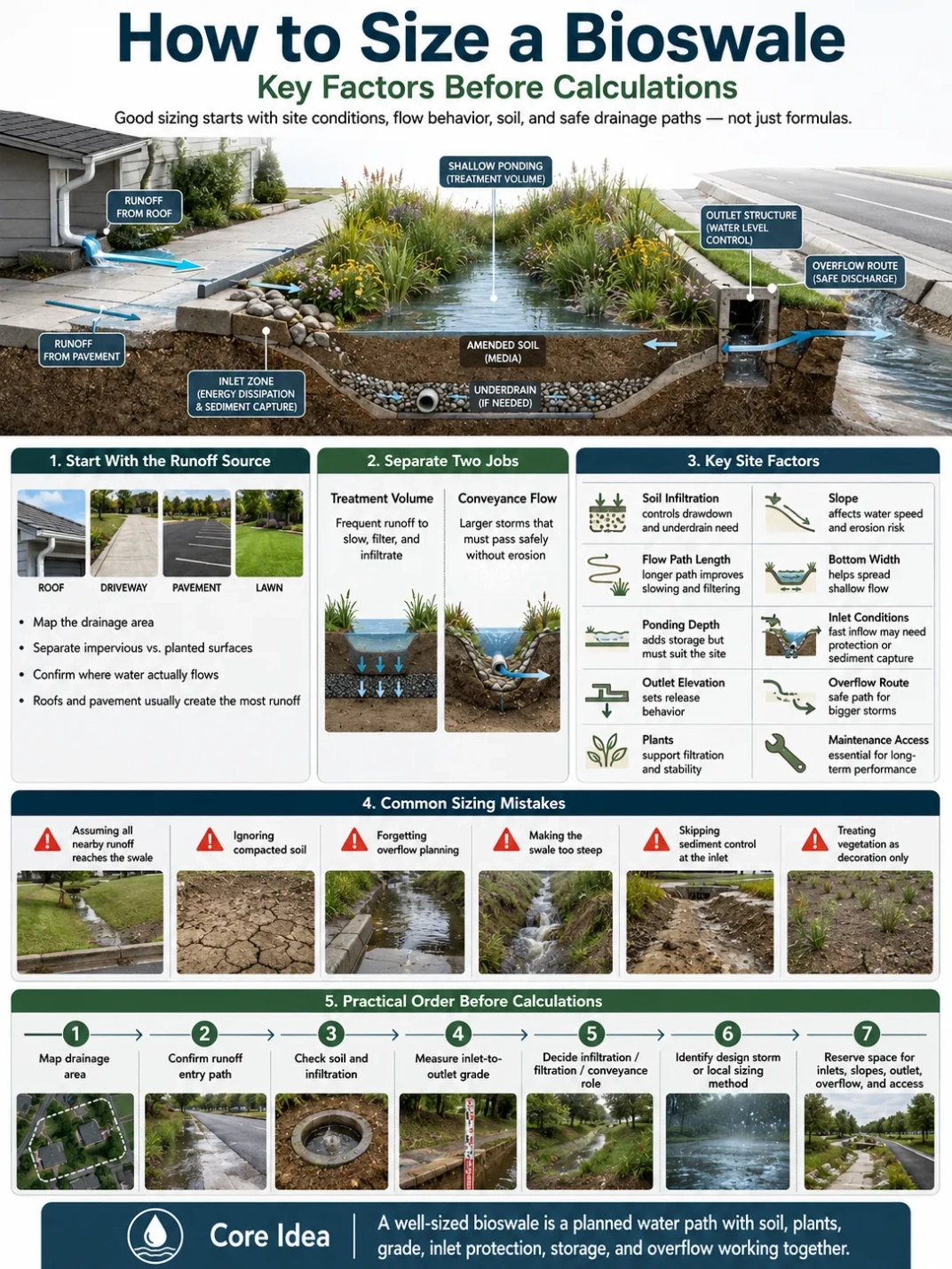
The inlet is where many problems begin. Concentrated flow from a curb cut, downspout, driveway, or pavement edge can scour soil and dump sediment into the bioswale. Stone aprons, forebays, level spreaders, or other pretreatment features may be used to slow water before it reaches the planted channel.
Surface Grade
The swale needs enough grade to move water, but not so much that runoff cuts through the soil and vegetation. Check dams may be used in some sloped systems to slow water and create short ponding sections. The exact layout depends on the runoff source and available space.
Outlet Elevation
The underdrain outlet elevation controls when water can leave through the pipe. If the outlet is too high for the intended design, water may back up. If it is too low, the system may drain faster than desired. Some designs use flow control at the outlet to balance drawdown and infiltration.
Inspection Access
Cleanouts and observation points make the hidden drainage layer easier to check. Without access, a clogged underdrain may only become obvious after repeated standing water, plant decline, or surface erosion.
Maintenance for Bioswale Underdrains
Underdrain maintenance begins above the pipe. Most clogging risk starts at the surface, where sediment, leaves, trash, mulch displacement, or bare soil can block infiltration into the media.
A practical inspection looks at both the visible swale and the hidden drainage system.
- Check inlets for sediment piles, erosion, debris, or concentrated flow cuts.
- Look for standing water after storms, especially water that remains longer than the design intent or local standard.
- Inspect outlets for blockage, animal activity, sediment, crushed pipe ends, or erosion at the discharge point.
- Use cleanouts where provided to confirm that water can move through the underdrain.
- Maintain vegetation so roots protect the soil and open patches do not become erosion points.
- Remove excess sediment before it buries plants or seals the soil surface.
Maintenance Note: If a bioswale stays wet after several dry days, has a foul odor, shows repeated surface crusting, or has water backing up from a cleanout, the issue may involve clogged media, a blocked underdrain, poor outlet elevation, or compacted soil. Larger systems should be evaluated by a qualified stormwater or drainage professional.
Common Mistakes with Bioswale Underdrains
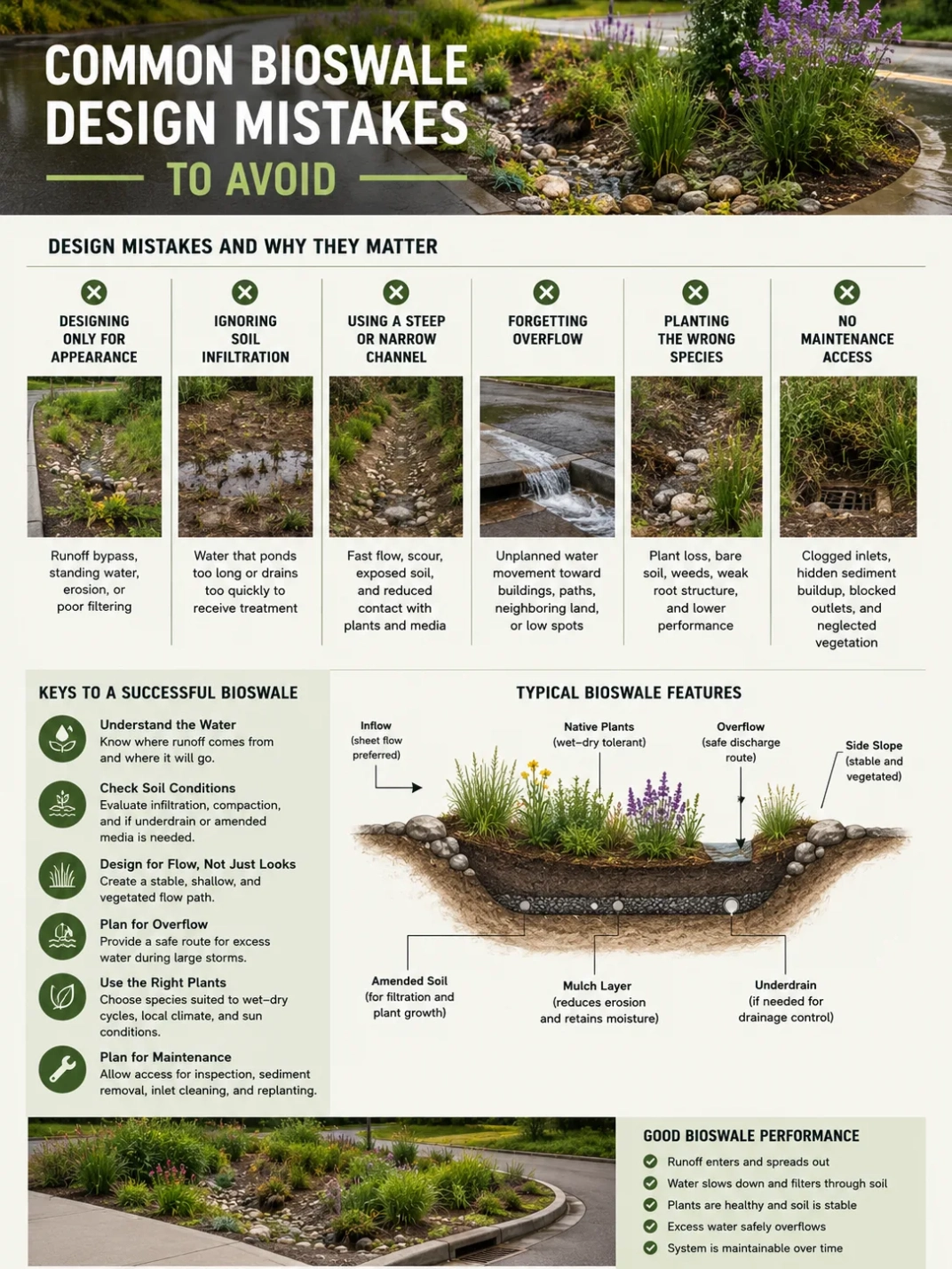
Underdrains often fail because the surrounding design is treated as an afterthought. The pipe may be buried correctly, but the system around it does not support clean, slow, filtered flow.
- Using the underdrain as the main inlet. Runoff should enter the bioswale surface first, not bypass the treatment media.
- Skipping pretreatment. High sediment loads can seal the media and shorten the life of the underdrain.
- Forgetting the overflow route. A buried pipe cannot safely handle every storm by itself.
- Compacting the soil media during construction. Heavy equipment and foot traffic can reduce infiltration before plants establish.
- Leaving no cleanout or inspection access. A hidden pipe needs a way to be checked and cleaned.
- Discharging to the wrong place. Underdrain outflow needs an approved, stable receiving point.
Residential and Public-Space Considerations
In a residential yard, an underdrain may be considered when roof runoff, driveway runoff, or lawn drainage collects in a low area and the soil drains slowly. The design should keep water away from foundations, basement walls, septic areas, retaining walls, and neighboring lots. A small swale can still create a drainage conflict if its outlet is poorly placed.
In streetscapes, parking lots, campuses, and public landscapes, the underdrain often becomes part of a larger stormwater network. These sites may receive more sediment, deicing residue, tire particles, and fast runoff from pavement. They also need maintenance access that works with curbs, sidewalks, traffic areas, snow storage, and public safety needs.
Commercial and public projects often require plan review, hydraulic sizing, pipe connection details, soil specifications, and inspection schedules. That does not make the concept hard to understand. It means the hidden pipe must match the surface design, the receiving system, and the long-term maintenance plan.
What to Check Before Planning an Underdrain
Before deciding that a bioswale needs an underdrain, the site should be read as a drainage system rather than a planting bed. The most useful questions are practical ones.
- Where does runoff come from: roof, driveway, road, parking lot, lawn, or a mix?
- How much impervious surface drains toward the bioswale?
- Does the native soil infiltrate, or does water already sit after rain?
- Is the soil compacted from construction, traffic, or past grading?
- Where is the seasonal high groundwater or shallow bedrock?
- Can the underdrain outlet flow by gravity to a safe discharge point?
- What happens when the bioswale receives more water than it can filter?
- Can maintenance crews or property owners reach the inlet, outlet, and cleanouts?
- Do local drainage rules require a specific drawdown time, separation distance, or outlet detail?
A good underdrain decision comes from these conditions, not from a fixed preference for piped or non-piped bioswales. Where the soil can infiltrate safely, a no-underdrain design may be suitable. Where drawdown is uncertain or infiltration is limited, an underdrain can make the system more reliable.
FAQ
What is the purpose of a bioswale underdrain?
A bioswale underdrain collects filtered water from below the soil media and carries it to an approved outlet. It helps the bioswale drain when native soil is slow, when a liner is used, or when the site needs more predictable drawdown.
Does every bioswale need an underdrain?
No. A bioswale may not need an underdrain when native soil infiltration is suitable, groundwater and bedrock separation are adequate, and local rules allow infiltration for the runoff source. Site testing is usually needed before relying on full infiltration.
Can an underdrain fix clay soil?
An underdrain can help a bioswale built over clay soil drain more reliably, but it does not fix every clay-soil problem. The system may still need engineered media, pretreatment, a safe overflow route, careful grading, and protection from compaction.
Where does water from a bioswale underdrain go?
Underdrain water usually flows to a storm drain, daylight outlet, downstream drainage feature, or other approved receiving point. The outlet should be stable, legal, and able to accept the flow without causing erosion or drainage conflicts.
Is a bioswale underdrain the same as a French drain?
No. A French drain mainly collects and moves subsurface water. A bioswale underdrain is part of a vegetated stormwater treatment system where runoff first slows and filters through plants and soil media before reaching the pipe.
How do you know if a bioswale underdrain is clogged?
Possible signs include repeated standing water, slow drawdown after storms, water backing up in cleanouts, wet soil that does not recover between rain events, plant decline, or blocked outlet flow. The cause may be surface sediment, compacted media, pipe blockage, or outlet problems.