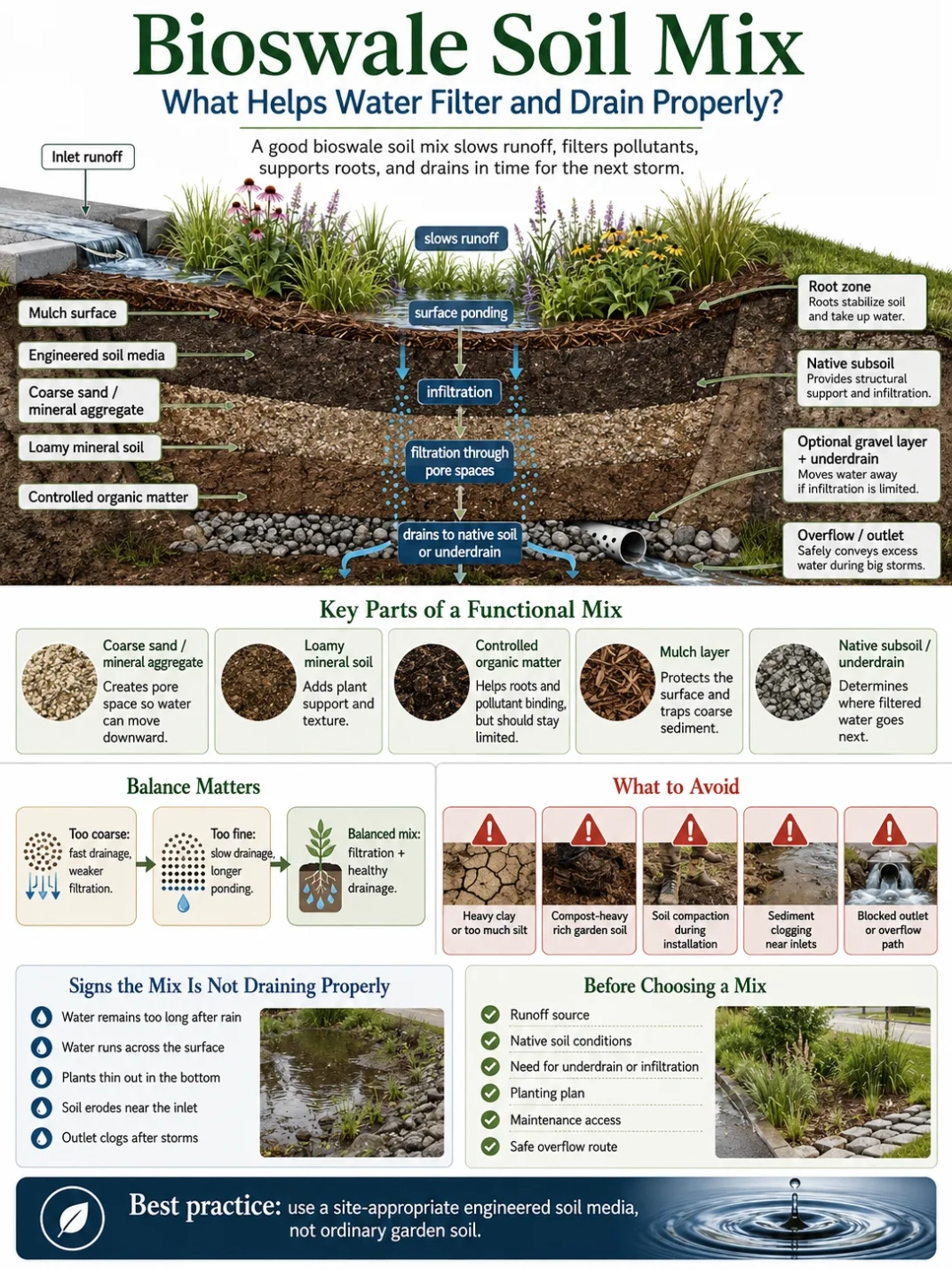
Bioswale soil mix works best when it lets stormwater move slowly enough to filter sediment and dissolved pollutants, but freely enough that the swale does not stay saturated for too long. The useful mix is not “good garden soil.” It is usually a designed soil media with mineral particles for drainage, enough fine material and organic content for filtering, and enough structure to support plant roots without becoming compacted.
A bioswale has two jobs that can pull against each other. It needs to slow runoff so particles can settle and water can pass through the root zone. It also needs to drain so the surface is ready for the next rain. The soil mix is where that balance is made.
What a Bioswale Soil Mix Needs to Do
A bioswale soil mix is usually selected for controlled infiltration, filtration, plant growth, and long-term drainage. It should not behave like loose beach sand, heavy clay, or rich potting mix. Each of those materials can solve one problem while creating another.
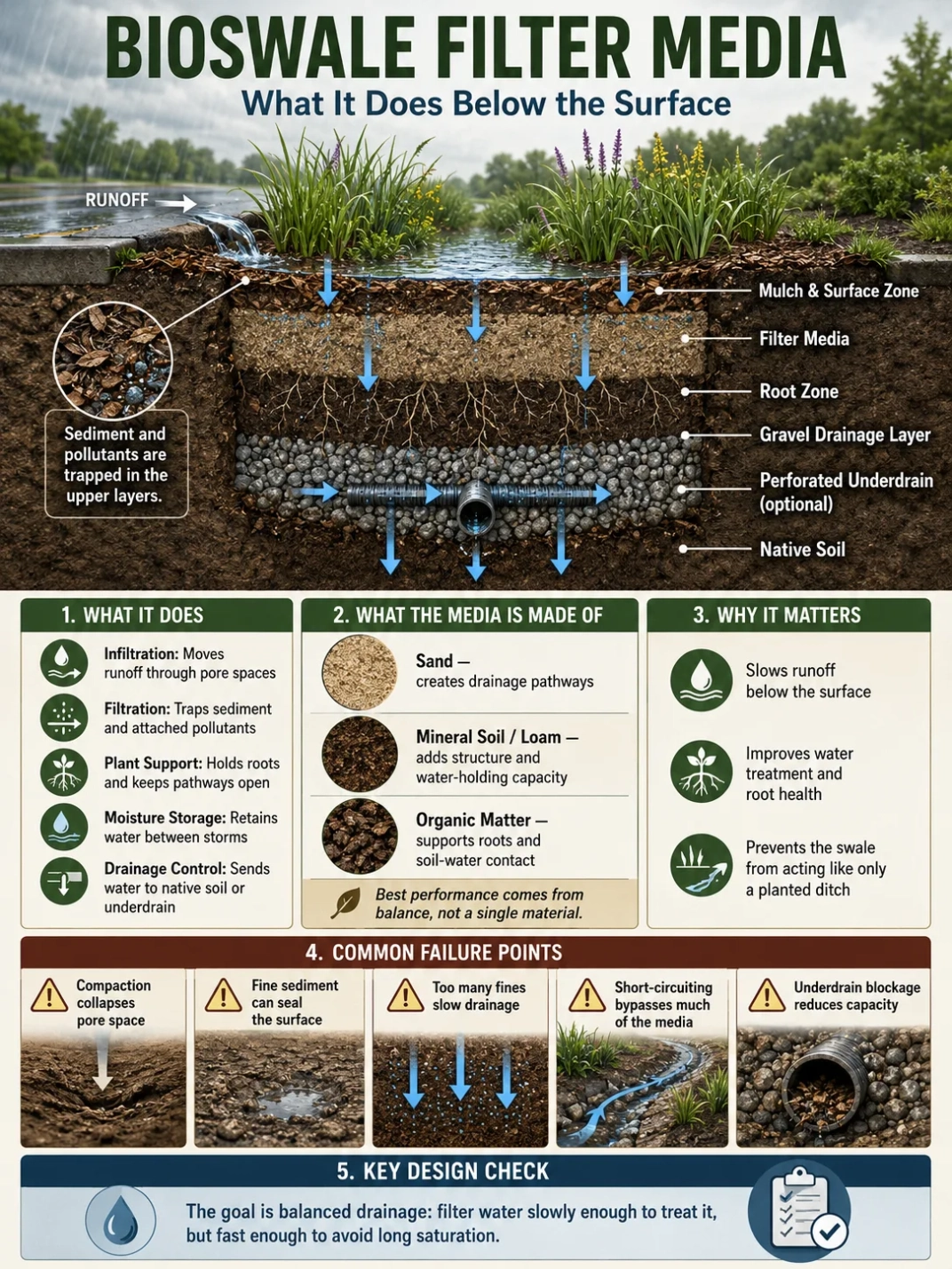
Good soil media allows runoff to enter the surface, pass through pore spaces, touch plant roots and organic matter, then either soak into native soil or move toward an underdrain. That movement helps remove sediment and some pollutants while reducing fast surface flow.
| Soil Mix Part | Main Role | What Can Go Wrong |
|---|---|---|
| Coarse sand or mineral aggregate | Creates pore space so water can move downward through the media. | Too much coarse material can drain fast but offer weak plant support and less contact time for filtering. |
| Topsoil or loamy mineral soil | Adds texture, nutrients, and root support. | Too much fine soil can slow infiltration, especially if it contains high clay or silt. |
| Compost or organic matter | Supports plants and can help bind some pollutants. | Too much organic matter can hold water, break down over time, or release nutrients in some settings. |
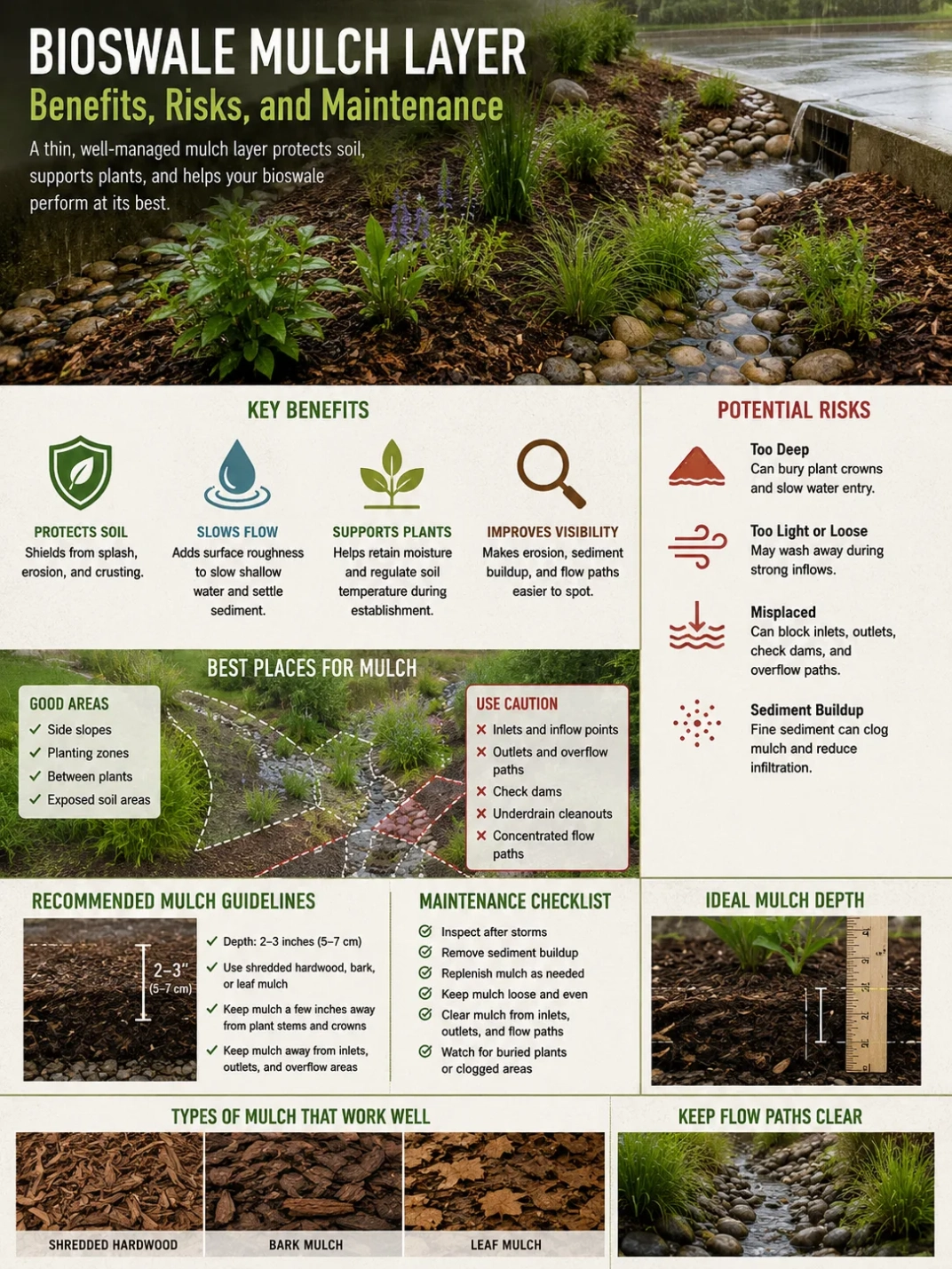
| Mulch layer | Protects the surface, reduces erosion, and traps coarse sediment. | Floating mulch, thick buildup, or washed-in sediment can block inlets and reduce surface infiltration. |
| Native subsoil below the mix | Receives infiltrated water where site conditions allow. | Compacted clay, shallow bedrock, or high groundwater can limit drainage and require another outlet strategy. |
The Balance Between Filtering and Draining
Water treatment in a bioswale depends on contact. Runoff should not rush across the surface like it would in a bare ditch. It should spread, slow, and enter the soil media. As water moves through the mix, sediment can be strained out, fine particles can settle, and pollutants can interact with roots, organic matter, and mineral surfaces.
Drainage depends on connected pore space. If the pores are too small, water sits near the surface. If the pores are too large, water can move through quickly with less filtration. The useful middle ground depends on rainfall, runoff volume, soil depth, slope, plant cover, and the native soil under the swale.
Many stormwater manuals use engineered bioretention or bioswale media with a high sand fraction, a smaller amount of topsoil or loam, and a controlled amount of organic matter. Exact ratios vary by region and design standard, so a single recipe should not be treated as universal.
Soil Note: A bioswale mix should be tested or specified for the site when drainage matters. Texture, organic content, infiltration behavior, and compaction can change performance more than the name of the product on an invoice.
Why Ordinary Garden Soil Often Drains Poorly
Garden soil can be useful for planting beds, but it is not automatically suitable for a bioswale. A garden bed may be built to hold moisture. A bioswale must receive runoff from roofs, driveways, sidewalks, parking lots, or landscaped slopes, then move that water through a planned flow path.
Fine-textured soil with high clay or silt can clog near the surface. This is more likely when runoff carries sediment from bare soil, construction areas, gravel edges, or eroding slopes. Once the top layer seals, water may pond even if the deeper soil could have drained.
Overly rich compost-heavy mixes can also create trouble. They may hold too much moisture, settle as organic material breaks down, or contribute nutrients where stormwater rules are strict. Organic matter can help filtration and plants, but it needs to be controlled.
The Main Ingredients in a Functional Soil Media
Mineral Material for Pore Space
The drainage backbone of many bioswale soil mixes is coarse mineral material, often sand that is washed and graded for predictable pore space. The goal is not just “sand,” but a mineral fraction that drains without collapsing into a dense layer.
Fine sand can pack tightly. Dirty sand can bring silt into the mix. Poorly graded material can create uneven drainage paths. For public, commercial, or regulated projects, the mineral portion is usually specified more carefully than it would be for a normal landscape bed.
Loam or Topsoil for Plant Support
A bioswale also needs living plants. Roots help hold soil, create channels, take up water, and keep the surface from becoming a bare erosion strip. A modest amount of loamy mineral soil can support plant establishment without turning the media into a slow-draining clay bed.
The quality of this portion matters. Topsoil that has been stripped, stockpiled, compacted, or mixed with construction debris may not behave like healthy soil. Screening for texture, debris, and excessive fines can prevent drainage problems before the swale is planted.
Organic Matter for Roots and Filtering
Organic matter can improve water-holding for plants, support soil biology, and help bind some pollutants. In a bioswale, it should be present in a measured way. More is not automatically better.
Fresh or unstable organic material can settle, float, or change the chemistry of runoff moving through the media. Mature compost or locally approved organic amendments are often preferred where allowed, but some regions limit compost in bioretention mixes because of nutrient concerns. Local standards should guide this part of the mix.
How Water Should Move Through the Soil
In a well-shaped bioswale, runoff enters through an inlet, spreads across vegetation or a protected surface, and moves along a shallow flow path. Some water filters into the soil media. During larger storms, extra water may continue toward an outlet or overflow route.
The soil mix should accept water at the surface without washing away. Below the surface, water should move downward through the root zone. Depending on the design, it may then infiltrate into native soil, collect in a gravel layer, or enter a perforated underdrain.
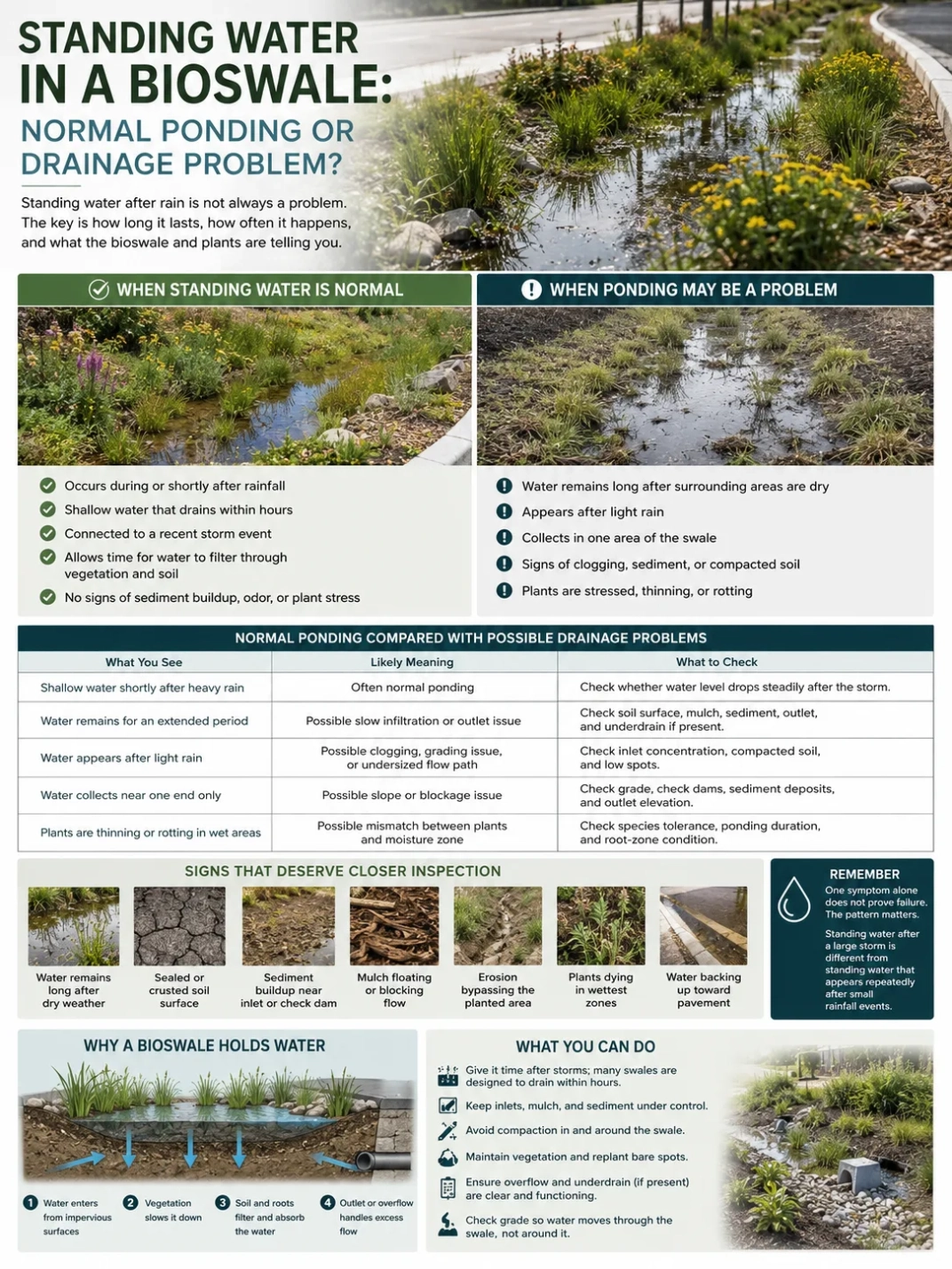
Standing water after rainfall is not automatically a failure. Bioswales are often designed to pond shallow water for a limited period. The concern begins when water remains for too long, plants decline, odors appear, or the surface stays soft and sealed. Design requirements for drawdown time vary by location.
Drainage Note: A bioswale should have a safe overflow route. Soil mix can improve filtration and drainage, but it should not be the only plan for larger storms.
When an Underdrain Helps
An underdrain is a perforated pipe placed below the soil media, often within a stone layer. It gives filtered water a way to leave when the native soil cannot absorb enough water quickly enough. This can be useful in compacted urban soils, clay-heavy sites, or places where the bioswale must drain within a set time.
An underdrain changes the function of the system. Without one, more water may infiltrate into the ground where soil and groundwater conditions allow. With one, water can still filter through the soil media, but more of it may be carried downstream after treatment.
The choice is not simply better or worse. It depends on native soil, available elevation, groundwater depth, outlet location, and local stormwater rules. On some sites, an underdrain helps the bioswale remain usable. On others, full or partial infiltration may be preferred.
Compaction Can Ruin a Good Mix
A well-chosen bioswale soil mix can fail if it is compacted during installation. Heavy equipment, repeated foot traffic, wet placement, and overworking the media can crush pore spaces. Once pore spaces close, water cannot move as planned.
Compaction is easy to miss because the surface may still look finished and planted. The problem shows up later as ponding, thin plant growth, erosion near the inlet, or water bypassing the soil and running along the surface.
- Place soil media in conditions that limit smearing and rutting.
- Avoid using the bioswale bed as a traffic route during construction.
- Protect the inlet from sediment while nearby soil is exposed.
- Do not mix clayey subsoil into engineered media during grading.
- Inspect the surface after early storms to see whether water enters evenly.
Plants Help the Soil Keep Working
Plants are not decoration in a bioswale. Their roots help hold the soil surface, improve small drainage channels, and create a living zone where water, soil, and microbes interact. Dense vegetation can also slow runoff before it reaches the soil surface.
Good bioswale planting usually favors species that can tolerate both wet and dry periods. The bottom of the swale may stay wetter after storms, while upper side slopes can dry faster. Native grasses, sedges, rushes, and shrubs may be useful where they fit the local climate and maintenance plan.
The soil mix must support those plants without becoming too rich or too wet. A mix that drains well but cannot support roots will leave bare areas. Bare areas invite erosion, sediment buildup, and clogging.
Planting Note: Match plants to moisture zones inside the swale. The bottom, side slope, and upper edge may not have the same soil moisture after a storm.
Clay Soil, Sandy Soil, and Compacted Sites
Native soil below the bioswale affects drainage as much as the imported mix. A sandy native soil may accept water readily, but it may also need careful design to protect groundwater and keep flow controlled. Clay soil may hold water near the surface and require an underdrain, a shallower storage approach, or another drainage outlet.
Compacted urban soil can behave like clay even when the original soil was loam. Construction traffic, fill, and grading can reduce infiltration. In those cases, replacing the top layer with a better soil mix may not solve the whole problem if the layer below remains dense and sealed.
Simple field observations can help early planning, but engineered projects often need infiltration testing and soil review. This is especially true near buildings, roads, basements, steep slopes, public drainage systems, or areas with high groundwater.
Surface Layers Matter Too
The top few inches of a bioswale often decide whether water enters the media or bypasses it. Sediment can collect near curb cuts, downspout outlets, driveway edges, and inflow points. If that sediment forms a crust, the deeper soil mix may not get a chance to work.
Mulch can help protect the surface, but it must be used with care. Heavy flows can move loose mulch and pile it against outlets. Fine mulch can mat together. In some bioswales, stone, dense vegetation, or erosion-control fabric may be used near concentrated inflow areas, depending on design needs.
- Near the inlet: protect the soil from scouring and sediment piles.
- Along the flow path: keep vegetation dense enough to slow water.
- Near the outlet: keep openings clear so larger storms can leave safely.
- On side slopes: prevent bare patches that can wash soil into the bottom.
Signs the Soil Mix Is Not Draining Properly
A bioswale does not need to look dry during a storm. The warning signs appear when drainage behavior changes, plants decline, or water stops following the intended route.
| Observed Problem | Possible Soil-Related Cause | What to Check |
|---|---|---|
| Water remains too long after rain | Clogged surface, compacted media, slow native soil, or blocked underdrain. | Surface crust, sediment depth, outlet condition, and drawdown behavior. |
| Water runs across the top without soaking in | Sealed surface, poor grading, or media that has become compacted. | Inlet spread, bare soil, mulch movement, and surface texture. |
| Plants thin out in the bottom | Media may stay too wet, lack oxygen, or receive heavy sediment. | Plant species, standing water duration, and sediment near inflow points. |
| Soil washes away near the inlet | Flow may be too concentrated for the surface protection. | Curb cut, downspout outlet, splash pad, stone apron, or vegetation density. |
| Outlet clogs after storms | Floating mulch, leaves, sediment, or plant debris may be collecting. | Overflow structure, pipe opening, mulch depth, and nearby vegetation. |
Bioswale Soil Mix and Rain Garden Soil Mix Are Related
Bioswales and rain gardens often use similar soil media ideas because both can rely on filtration and infiltration. The difference is how water moves through the feature. A rain garden is usually a basin-like planting area that collects water. A bioswale is more linear and also conveys runoff along a path.
Because a bioswale carries flow, its soil mix must work with slope, inlet protection, side slopes, check dams where used, and overflow behavior. A rain garden soil mix may be similar in texture, but the bioswale has more demand on erosion control and even flow distribution.
What to Check Before Choosing a Mix
Choosing a bioswale soil mix starts with the site, not the bag or truckload. The same blend may behave differently under roof runoff, parking lot runoff, roadside sediment, or yard drainage. Soil depth, slope, and maintenance access also shape the choice.
- Runoff source: roof water, driveway runoff, roadway runoff, and parking lot runoff may carry different sediment loads.
- Native soil: sandy, loamy, clayey, compacted, or fill soil can change the drainage plan.
- Available outlet: some sites can infiltrate; others need an underdrain or overflow connection where allowed.
- Planting plan: the mix must drain while supporting roots through wet and dry periods.
- Maintenance access: inlets, outlets, and sediment zones need to be reachable after storms.
- Local rules: public and commercial projects may need approved media specifications and testing.
Site Planning Note: Near foundations, basements, retaining walls, steep slopes, public streets, or neighboring properties, soil mix decisions should be reviewed with the full drainage path in mind. Filtering water is only useful when the water also has a safe place to go.
Maintenance Keeps the Soil Open
Even a good soil mix can clog if sediment keeps entering the swale. Maintenance is mostly about protecting pore space and keeping the flow path clear. Small tasks can prevent larger repairs.
After storms, check the inlet, the lowest part of the swale, and the outlet. Look for sediment fans, bare soil, floating mulch, blocked grates, erosion cuts, and areas where water is bypassing vegetation. These details show whether the soil surface is still receiving water evenly.
Plant care also protects drainage. Deep and fibrous roots help keep the surface stable. Replacing dead plants, controlling weeds before they dominate, and avoiding unnecessary soil disturbance can help the media keep its structure.
FAQ
What is the best soil mix for a bioswale?
The best bioswale soil mix depends on the site, but it usually balances coarse mineral material for drainage, some loamy soil for plant support, and controlled organic matter for roots and filtering. Public or regulated projects often need a locally approved engineered media specification.
Can I use regular garden soil in a bioswale?
Regular garden soil may hold too much water or contain too many fine particles for bioswale drainage. It can work only if its texture, infiltration behavior, and organic content fit the design needs. Many bioswales need a more controlled soil media.
Why is sand often used in bioswale soil media?
Sand or coarse mineral material helps create pore space so water can move through the soil. The sand should be suitable for drainage and filtration, not dirty fill sand that adds silt or compacts easily.
Does a bioswale need an underdrain?
A bioswale may need an underdrain when native soil drains slowly, groundwater is a concern, or the design must move filtered water to an outlet. Some sites can infiltrate without one, but the choice depends on soil testing, elevation, outlet options, and local requirements.
How does soil compaction affect bioswale drainage?
Compaction closes pore spaces in the soil media. When that happens, runoff may pond too long, run across the surface, or bypass the root zone. Protecting the swale from heavy traffic during and after installation helps preserve drainage.
What causes a bioswale soil mix to clog?
Clogging is often caused by sediment buildup, fine soil washing in from nearby areas, compacted media, matted mulch, or plant loss that leaves bare soil. Regular inspection of inlets, outlets, and the soil surface helps catch these problems early.