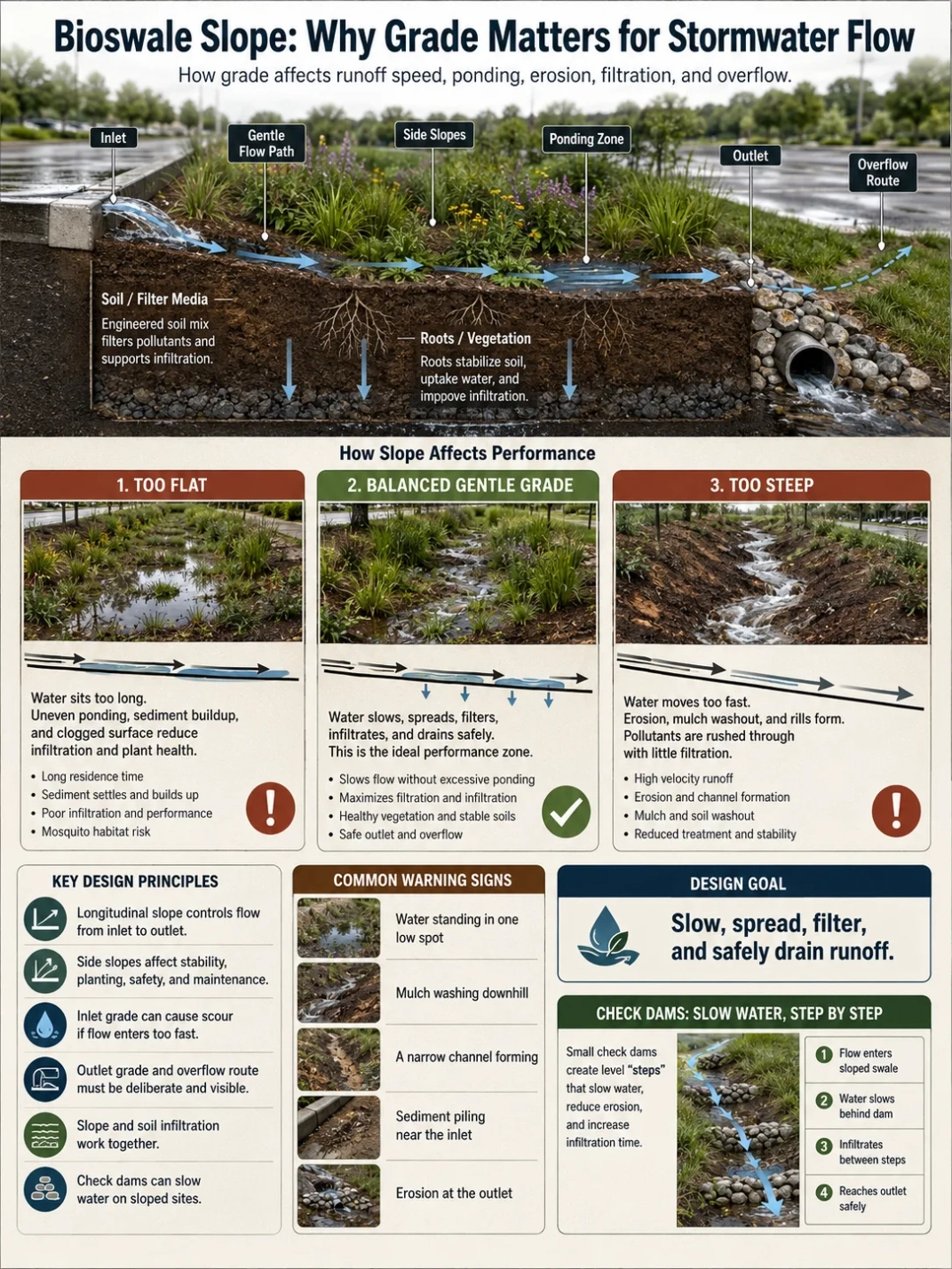
Bioswale slope controls how stormwater moves through the swale: too flat, and water may sit longer than intended; too steep, and runoff can rush through before soil, roots, and surface vegetation have time to slow and filter it. Grade is not just a shape detail. It affects flow speed, ponding, erosion, sediment buildup, plant stress, overflow behavior, and long-term maintenance.
A bioswale usually works best when water follows a clear, gentle flow path from inlet to outlet. The grade should help runoff spread, slow down, and drain in a controlled way. The right slope depends on rainfall pattern, soil infiltration, drainage area, surface cover, outlet elevation, and local rules. A slope that looks harmless on paper can behave very differently after heavy rain, soil compaction, or sediment buildup.
What Slope Means in a Bioswale
In bioswale design, slope means the change in elevation across the swale. It may refer to the lengthwise grade that carries water downstream, the side slopes that shape the basin, or the slope of nearby pavement, roofs, lawns, and driveways that send runoff into the system.
The most discussed slope is the longitudinal slope, which runs from the inlet toward the outlet. This slope decides whether water creeps, spreads, ponds, or rushes. Side slopes matter too because they affect mowing access, erosion risk, public safety, and how easily plants can establish along the swale edges.
| Slope Area | What It Controls | What Can Go Wrong |
|---|---|---|
| Longitudinal Slope | Moves stormwater from inlet to outlet along the swale bottom. | Water may stagnate if too flat or move too fast if too steep. |
| Side Slopes | Shape the banks and affect access, planting zones, and erosion resistance. | Steep sides may erode, slump, or become hard to maintain. |
| Inlet Grade | Controls how runoff enters from roofs, pavement, curb cuts, or lawns. | Fast entry flow can scour mulch, soil, or young plants. |
| Outlet Grade | Sets the path for excess water to leave during larger storms. | A poor outlet can cause backing up, bypassing, or erosion near the discharge point. |
| Nearby Site Grade | Determines where runoff comes from and where overflow may travel. | Water may move toward buildings, neighboring property, or unsuitable low points. |
Why Grade Matters for Stormwater Flow
Stormwater responds strongly to grade. A small change in elevation can change how much time runoff spends in contact with vegetation, mulch, soil media, and root zones. That contact time is one reason a bioswale can help reduce sediment and support pollutant filtering when it is properly planned and maintained.
A flat swale is not automatically better. Water that sits too long can stress some plants, leave sediment in uneven patches, and point to low infiltration or a blocked outlet. A steep swale is not automatically bad either, but it often needs more attention to flow control, erosion protection, check dams, or outlet design.
Design Note: The goal is not to make water disappear instantly. A bioswale should usually slow, spread, filter, and safely drain runoff. The grade should support that sequence rather than fight it.
The Longitudinal Slope: The Main Flow Line
The longitudinal slope is the bottom-line grade of the bioswale. It gives stormwater direction. Without enough grade, water may collect in unintended low spots. With too much grade, water can concentrate into narrow, fast-moving paths.
A well-shaped flow line helps water move as shallow sheet flow or slow channel flow rather than a small stream cutting through the soil. That matters because erosion often starts where flow becomes concentrated. Once a small channel forms, later storms tend to reuse it, deepen it, and carry more sediment downstream.
When the Slope Is Too Flat
A very flat bioswale may appear calm, but it can create hidden drainage problems. Water may remain in low pockets after storms, especially where soil is compacted or fine sediment has sealed the surface. Some ponding is normal in many designs, but long or uneven standing water can show that the grade, soil, or outlet needs review.
- Water may remain in shallow depressions instead of moving toward the outlet.
- Sediment may settle near the inlet or in low sections.
- Fine particles can clog the soil surface over time.
- Plants that prefer brief wet periods may weaken if the root zone stays saturated.
- Maintenance crews may have trouble seeing whether the problem is grade, soil, or blockage.
When the Slope Is Too Steep
A steep bioswale moves water faster. Fast water has less time to soak into soil media, pass through vegetation, or drop sediment. It may also carry mulch, expose roots, and cut small rills into the swale bottom.
Steeper sites may still use bioswale concepts, but they often need extra flow-control details. These may include check dams, level spreaders, terraced cells, stone protection at inlets, or a more engineered outlet. The right choice depends on site conditions and local drainage requirements.
Site Planning Note: A steep yard, roadside edge, parking lot, or commercial site may need professional review. The issue is not only plant choice. It is flow energy, erosion control, overflow safety, and where the water goes during larger storms.
Side Slopes and Swale Shape
Side slopes affect how the bioswale fits into the ground. Gentle side slopes can make the swale easier to plant, inspect, and maintain. They also reduce abrupt edges where water can undercut soil or where mulch can slide.
Steep side slopes may save space, but they can create maintenance and erosion concerns. In public landscapes, near walkways, or beside parking areas, side slope choices also affect visibility and safe movement around the feature. For residential sites, side slopes should be planned with mowing, plant access, and overflow direction in mind.
Plant Zones Change with Slope
A bioswale is not evenly wet from top to bottom. The lowest area may receive the most frequent wetting. The side slopes may dry faster. The upper edge may behave more like a normal landscape bed. This creates moisture zones.
Plants should match those zones rather than follow a single list. Sedges, rushes, grasses, shrubs, and other suitable plants may be used depending on region, sun exposure, soil texture, salt exposure, and local plant guidance. Native plants are often useful because many have root systems that support soil structure and seasonal resilience, but no plant is suitable for every site.
Inlet Grade: Where Runoff First Enters
The inlet is often the most stressed part of a bioswale. Roof runoff, driveway runoff, roadside runoff, and parking lot runoff can arrive with force, especially when water is collected through downspouts, curb cuts, or narrow channels.
If the inlet grade is too abrupt, runoff may hit the swale like a focused stream. That can move mulch, expose soil, flatten young plants, and create a scour hole. A better inlet spreads the water before it reaches the main flow path.
- Roof runoff may need a splash area, stone apron, or other energy-reducing detail.
- Driveway runoff often carries sediment from pavement edges and tire paths.
- Parking lot runoff may arrive through curb openings with higher speed and more debris.
- Lawn runoff can carry fine soil if the uphill area is bare, compacted, or newly graded.
Outlet Grade and Overflow Behavior
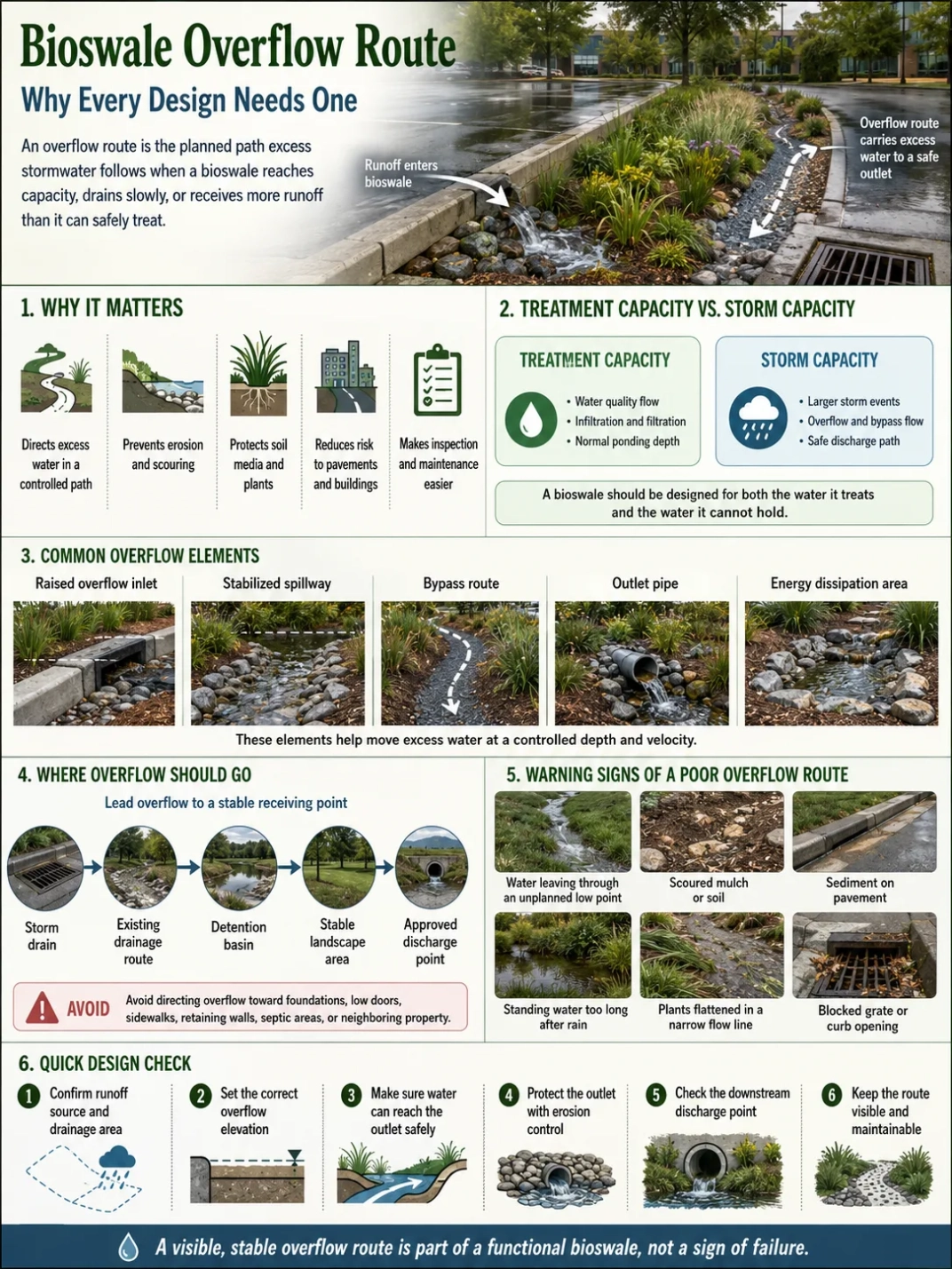
A bioswale needs a planned way for excess water to leave. Even a well-designed swale can receive more water than it can infiltrate during larger storms. The outlet and overflow route keep the system from backing up in the wrong place.
The outlet grade should allow water to exit without causing erosion or sending flow toward a sensitive area. In many designs, the outlet is raised or shaped so smaller flows pond briefly while larger flows pass safely. Where an underdrain is used, the surface overflow still matters because the underdrain may not handle every storm by itself.
Drainage Note: Overflow should be visible, deliberate, and directed. A bioswale should not rely on water finding its own escape path during a heavy storm.
How Slope Works with Soil Infiltration
Slope and soil work together. A gentle grade cannot make compacted soil drain well. A good soil media layer cannot fully fix a flow path that sends water through too quickly. The two conditions need to support each other.
Soils with more clay may drain slowly and hold water longer. Sandy soils may drain faster but may need care with filtration and plant moisture. Compacted soils can behave poorly even when the texture looks acceptable because pore spaces have been squeezed shut. Soil testing, infiltration checks, and site review can help separate a grade problem from a soil problem.
Filter Media and Ponding Depth
Some bioswales use amended soil or filter media to improve infiltration and treatment. Others rely more on existing soil and vegetation. The slope affects how evenly water reaches that media. If water cuts a narrow path through the swale, much of the soil surface does little work.
Ponding depth also depends on shape and grade. A shallow, even basin gives water more surface contact. Uneven grading creates isolated pockets. Deep or long-lasting ponding may need review because it can point to clogged media, poor outlet elevation, compacted soil, or a mismatch between runoff volume and available area.
Check Dams and Flow Slowing on Sloped Sites
Check dams are small barriers placed across the swale to slow water and create short, flatter sections. They may be made from stone, timber, concrete, or other approved materials, depending on the project and local practice. Their purpose is to reduce flow speed, encourage settling, and limit erosion on sloped sites.
Check dams are not decorative bumps. They need proper spacing, stable edges, and an overflow notch or low point so water passes in a controlled way. If water cuts around the sides, the check dam can make erosion worse.
- Water enters the upper swale section.
- The check dam slows and backs up shallow flow.
- Sediment has more chance to settle.
- Water spills over or through the designed low point.
- The next section repeats the slowing effect.
Where Slope Problems Usually Show Up
Grade problems often appear after several storms, not on the day the bioswale is planted. New mulch may hide uneven areas. Young plants may not yet protect the soil. Sediment from uphill construction, bare soil, pavement edges, or winter sanding can change the bottom elevation over time.
| Observed Sign | Possible Grade-Related Cause | What to Check |
|---|---|---|
| Water sits in one low spot | Uneven bottom grade or settled soil media. | Check the flow line, outlet elevation, and sediment depth. |
| Mulch washes downhill | Flow may be too fast or too concentrated. | Check inlet energy, slope, vegetation cover, and need for flow slowing. |
| A narrow channel forms | Water is not spreading across the swale bottom. | Check grading, surface roughness, plant density, and inlet shape. |
| Sediment piles near the inlet | Runoff enters with soil or debris and loses speed suddenly. | Check upstream erosion, pavement edges, and pretreatment area. |
| Outlet area erodes | Overflow may be too focused or too fast. | Check outlet protection, downstream slope, and overflow route. |
How Bioswale Slope Differs from a Drainage Ditch
A drainage ditch is often built mainly to move water away. A bioswale also moves water, but it usually aims to slow and treat runoff along the way. That difference changes how slope is judged.
A ditch may favor faster conveyance where the goal is quick removal. A bioswale usually benefits from controlled movement, contact with vegetation, and safe temporary ponding where the design allows it. This is why a bioswale should not simply be a ditch with plants added. The grade, soil, plant zones, and overflow route all need to work together.
Bioswale Slope and Rain Garden Shape
A rain garden is often a basin-like feature that collects runoff in a more contained area. A bioswale is more linear and usually has a clearer inlet-to-outlet path. The slope difference is one of the easiest ways to understand the two systems.
Both can use plants, soil media, and shallow ponding. But a bioswale must pay extra attention to lengthwise flow. If the grade is poorly shaped, the system may behave more like a fast channel or an uneven ditch than a planted stormwater feature.
Residential Sites: Small Slopes Can Matter
In a yard, small grade changes can decide whether roof runoff reaches a bioswale, bypasses it, or moves toward a foundation. A residential bioswale should be planned around downspouts, driveway edges, patios, low lawn areas, basement walls, and the safe overflow route.
Homeowners may build small landscape swales where local rules allow, but drainage near structures deserves caution. If water could move toward a building, neighboring lot, public sidewalk, or street drainage system, a qualified local professional may be needed.
Site Planning Note: A bioswale should receive runoff from a known area and release overflow to a known place. “Lower than the rest of the yard” is not enough planning by itself.
Public and Commercial Sites Need More Grade Control
Roadside, parking lot, campus, and public-space bioswales often receive runoff from larger impervious surfaces. That water may carry more sediment, arrive faster, and enter through curbs or paved edges. The grade must handle both normal storms and larger overflow events without creating unstable soil or unsafe edges.
These sites often require design review, maintenance access, inlet protection, outlet control, and clear inspection points. A bioswale beside pavement must also account for winter debris, leaf buildup, trash, tire sediment, and compaction from foot traffic or maintenance equipment.
Maintenance Depends on the Grade
Maintenance is easier when the slope is readable. Inspectors should be able to see where water enters, where it should spread, where it should pond briefly, and where it should leave. If the grade is irregular, maintenance becomes guesswork.
Seasonal inspection often focuses on sediment, erosion, plant cover, mulch movement, blocked inlets, damaged check dams, and standing water. These are not separate from slope. They are often the visible results of how grade, flow, and soil interact.
- Remove sediment before it buries plants or changes the flow line.
- Keep inlets open so water enters where intended.
- Repair small erosion paths before they deepen.
- Replace failed plants in areas where roots help hold soil.
- Check outlets and overflow paths after larger storms.
Common Misunderstandings About Bioswale Grade
A Steeper Swale Does Not Automatically Drain Better
Fast drainage is not the only goal. If runoff moves too quickly, the swale may lose much of its slowing and filtering value. It may also erode before plants have time to establish.
A Flat Swale Is Not Automatically More Natural
Flat areas can pond unevenly, collect sediment, or expose soil infiltration problems. A gentle, deliberate flow path is usually more reliable than a random low area.
Plants Cannot Fix Every Slope Problem
Roots help hold soil and improve surface texture over time, but plants cannot correct a badly placed inlet, unsafe overflow route, or steep concentrated flow path by themselves.
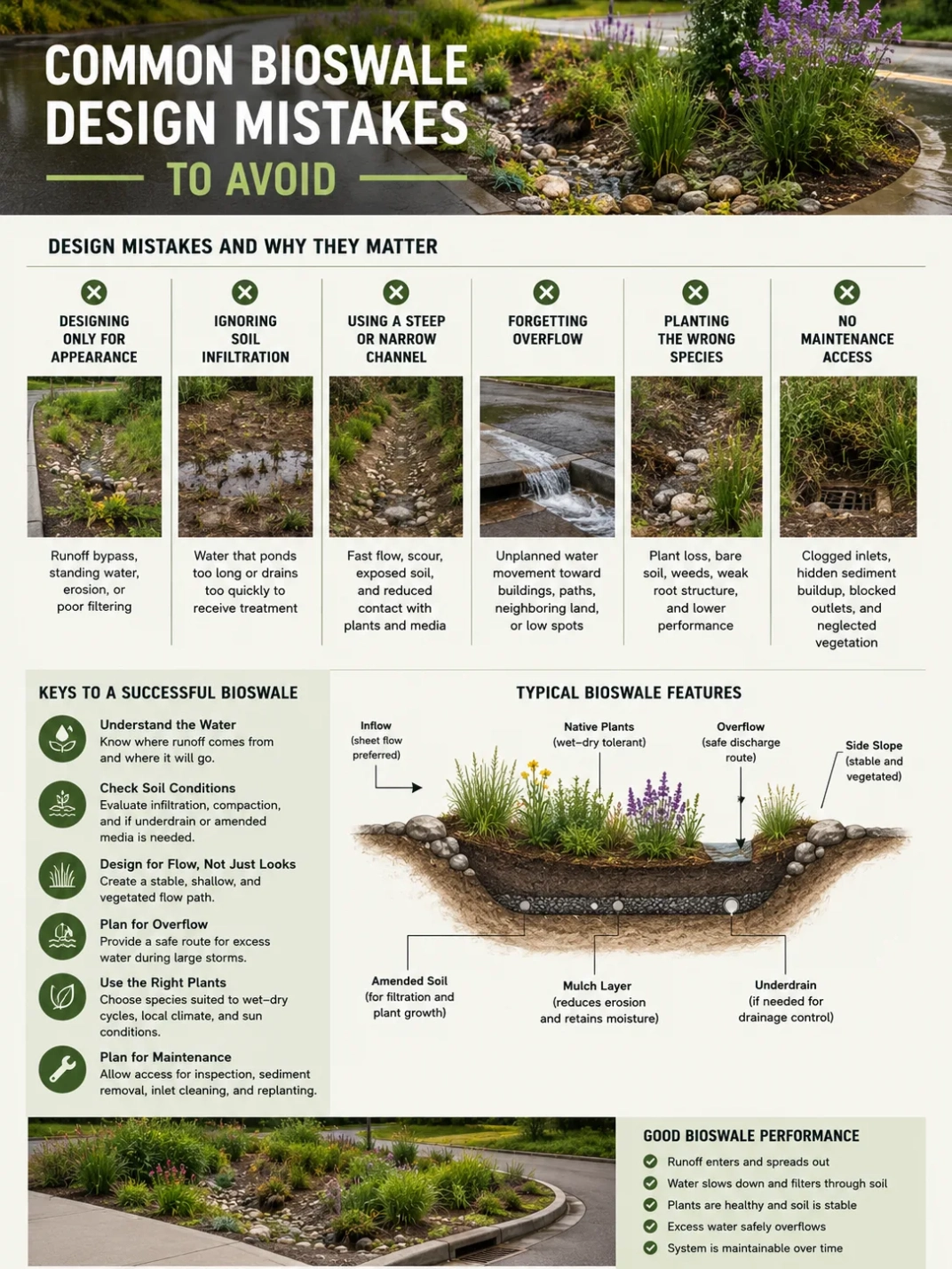
Underdrains Do Not Remove the Need for Surface Grade
An underdrain can help move water from the soil media, but the surface still needs to guide runoff. Water must enter, spread, pond if intended, and overflow safely during larger storms.
What to Check Before Planning Bioswale Slope
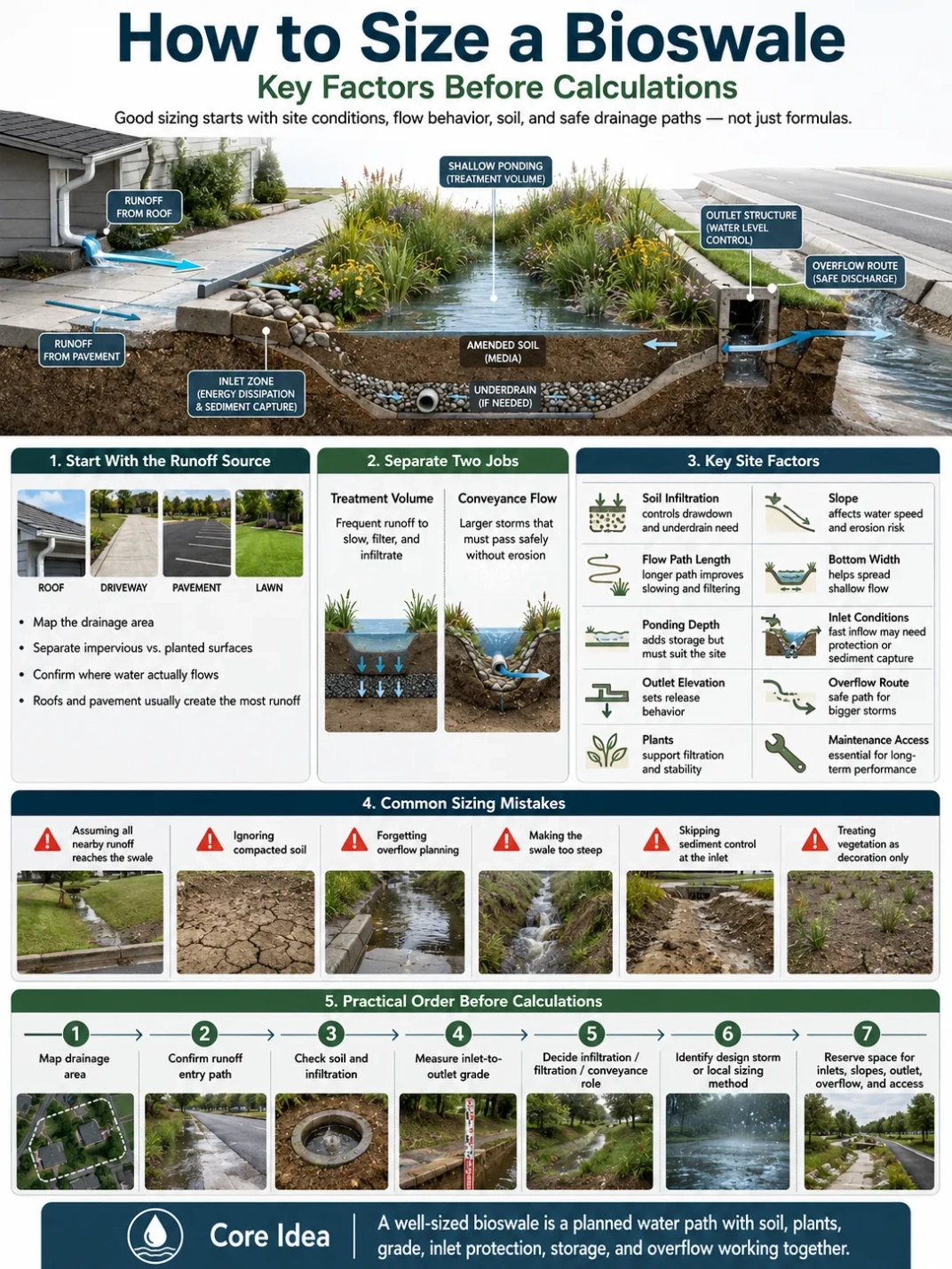
Before setting grade, the site needs a practical reading. The best slope is shaped by where water starts, how much area drains to the swale, what soil lies below, and where extra water can safely go.
- Runoff source: Identify whether water comes from a roof, driveway, road edge, parking area, lawn, or mixed surface.
- Flow path: Trace the route from inlet to outlet, including the overflow route.
- Soil condition: Check for compaction, clayey soil, sandy soil, fill, or poor infiltration signs.
- Available length: A short swale on a sloped site may need stronger flow control than a longer one.
- Plant zones: Match plants to wet bottom areas, drying side slopes, and upper edges.
- Maintenance access: Leave enough room to inspect, remove sediment, and repair erosion.
- Local requirements: Confirm drainage, setback, and stormwater rules where they apply.
FAQ
Why does slope matter in a bioswale?
Slope matters because it controls how fast stormwater moves through the bioswale. A suitable grade helps runoff slow, spread, filter through vegetation and soil, and leave through a planned outlet or overflow route.
Can a bioswale be too steep?
Yes. A steep bioswale can move water too quickly, which may reduce filtration time and raise the chance of erosion, mulch washout, and channel formation. Sloped sites may need check dams, inlet protection, or professional design review.
Can a bioswale be too flat?
Yes. A very flat bioswale may hold water in uneven low spots, collect sediment, or show signs of poor infiltration. Some ponding may be planned, but long-lasting standing water should be reviewed.
Do check dams fix bioswale slope problems?
Check dams can help slow flow on sloped sites, but they must be designed and placed correctly. If water cuts around the sides or spills in the wrong place, a check dam can create new erosion problems.
Does soil type change the best bioswale slope?
Soil type affects how long water remains in the swale and how much can infiltrate. Clayey, sandy, compacted, or amended soils may behave differently, so slope should be considered together with soil testing, runoff volume, and outlet design.
When should bioswale slope be reviewed by a professional?
Professional review is wise when the swale receives runoff from large paved areas, sits near buildings, handles roadside or parking lot runoff, uses an underdrain, has steep grades, or could send overflow toward neighboring property or public drainage systems.