A normal bioswale ponding depth is usually shallow: enough standing water to slow runoff and allow infiltration, but not so much that the swale looks like a small pond for days. In many designs, temporary ponding is expected after rain. The important question is not only “how deep is the water?” but also how long it stays, where it collects, and whether it drains through the soil or only sits on the surface.
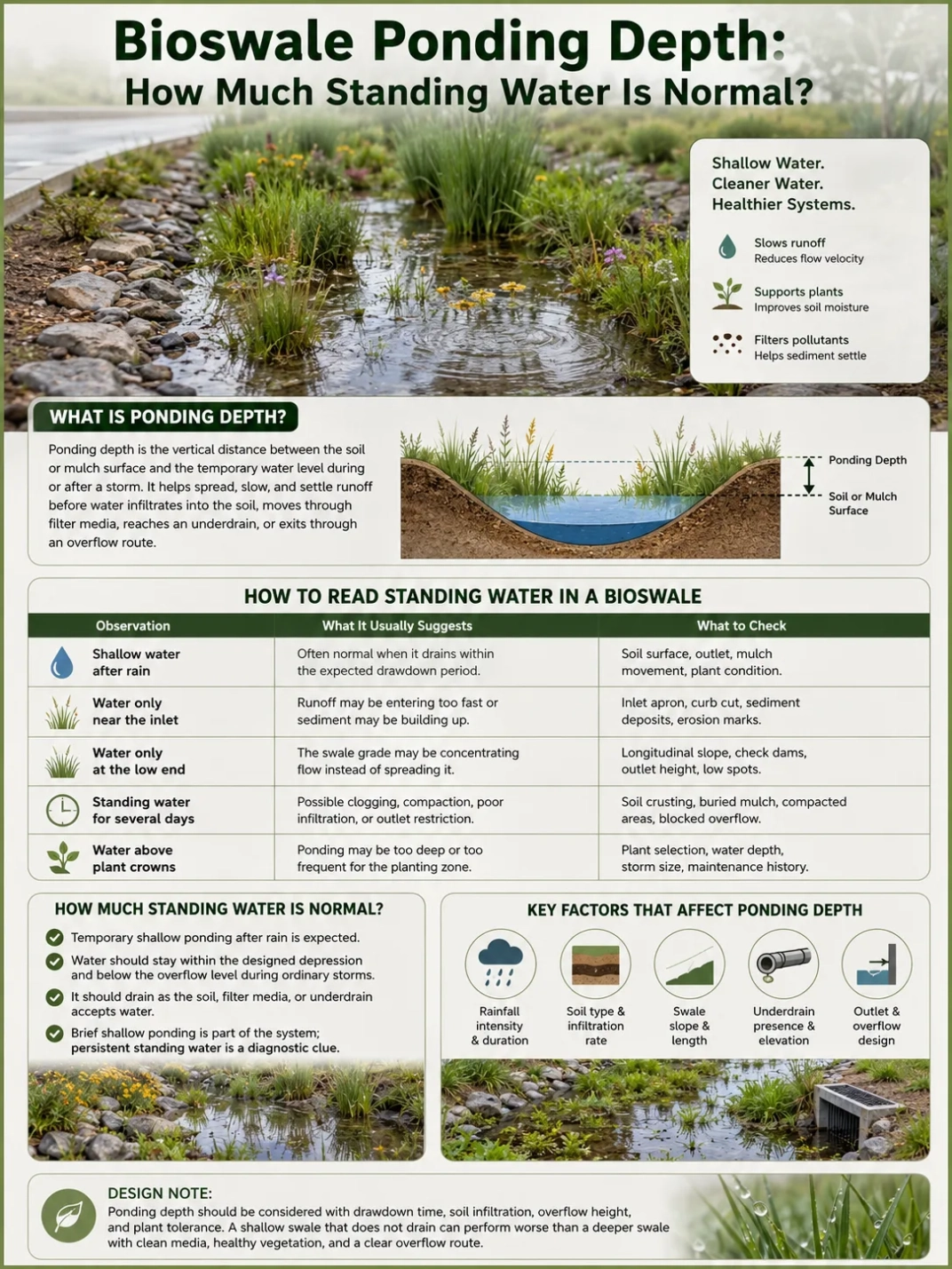
Ponding depth is the vertical distance between the soil or mulch surface and the temporary water level during or after a storm. It is part of how a bioswale manages stormwater runoff. Water enters from a roof, driveway, parking lot, road edge, or other impervious surface, spreads through vegetation, slows down, and either infiltrates into the soil, moves through filter media, reaches an underdrain, or exits through an overflow route.
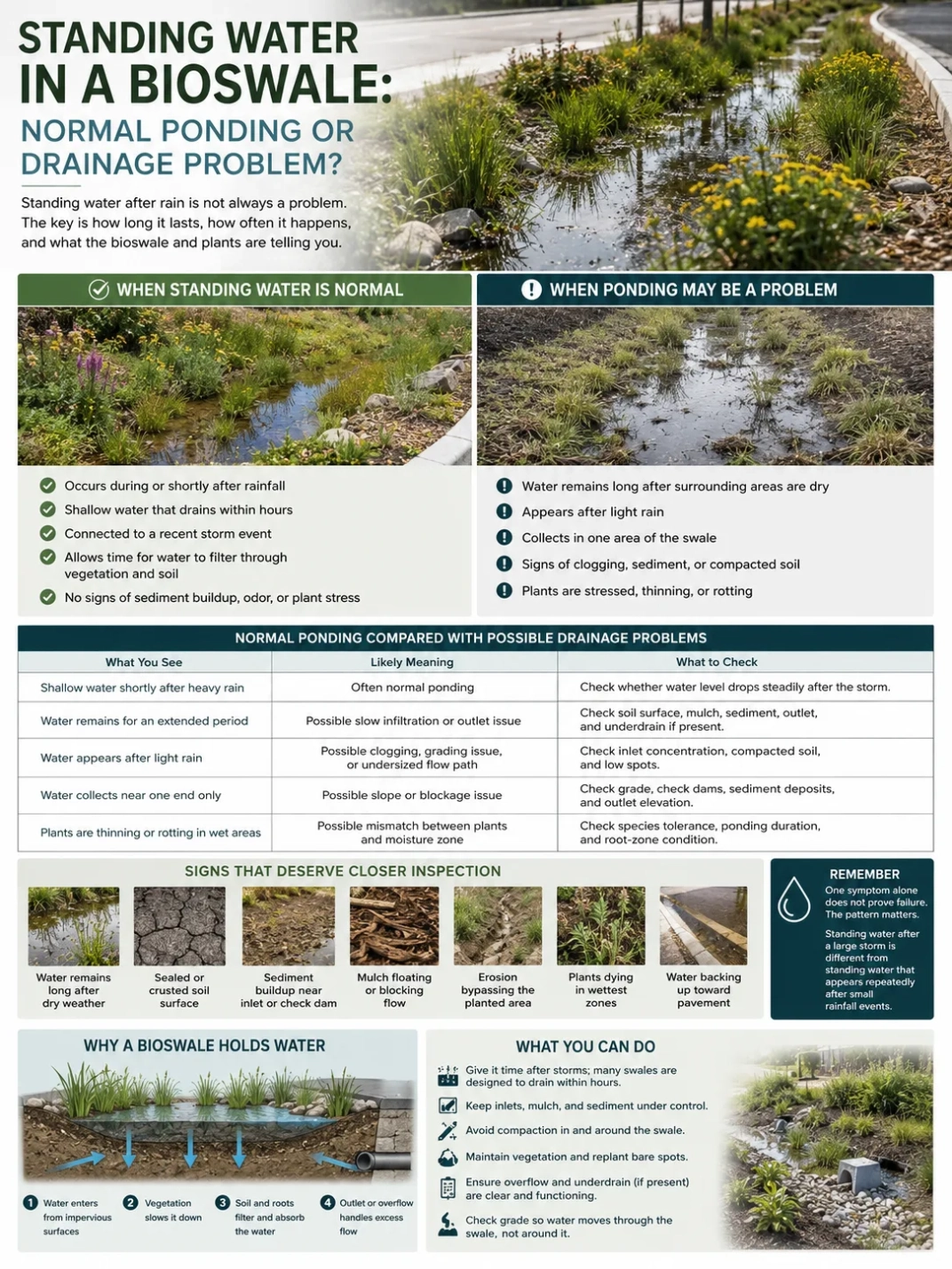
Standing water becomes a problem when it is too deep for the plants, stays too long after normal rainfall, bypasses the intended flow path, carries sediment into low spots, or creates wet soil conditions the system was not designed to handle.
What Ponding Depth Means in a Bioswale
Ponding depth is not the same as flood depth. It is a designed temporary storage zone above the soil surface. In a bioswale, this zone helps spread, slow, and settle runoff before the water drains away.
A shallow layer of water after rain can be normal. It gives suspended sediment time to settle, allows water to contact the soil and plant stems, and reduces fast surface flow. That temporary storage also keeps the inlet from acting like a pipe that shoots water straight through the swale.
The acceptable depth depends on site conditions, local rainfall patterns, soil infiltration, soil media depth, slope, outlet elevation, underdrain use, and local design requirements. A residential swale receiving roof or driveway runoff may have a different ponding depth than a roadside or parking lot bioswale with larger runoff volume and heavier sediment load.
| Observation | What It Usually Suggests | What to Check |
|---|---|---|
| Shallow water after rain | Often normal when it drains within the expected drawdown period. | Soil surface, outlet, mulch movement, plant condition. |
| Water only near the inlet | Runoff may be entering too fast or sediment may be building up. | Inlet apron, curb cut, sediment deposits, erosion marks. |
| Water only at the low end | The swale grade may be concentrating flow instead of spreading it. | Longitudinal slope, check dams, outlet height, low spots. |
| Standing water for several days | Possible clogging, compaction, poor infiltration, or outlet restriction. | Soil crusting, buried mulch, compacted areas, blocked overflow. |
| Water above plant crowns | Ponding may be too deep or too frequent for the planting zone. | Plant selection, water depth, storm size, maintenance history. |
How Much Standing Water Is Usually Normal?
For many bioswales, temporary shallow ponding after rain is expected. The water should look like a controlled surface layer, not a permanent pool. It should collect within the intended depression, stay below the overflow level during ordinary storms, and drain down as the soil, filter media, or underdrain accepts water.
There is no single safe depth that fits every bioswale. Some designs use only a modest surface storage layer. Others, especially engineered bioretention-style swales, may allow deeper temporary ponding where local rules and site conditions allow. The better test is whether the ponding matches the design intent and drains within the expected time for that system.
A useful rule of interpretation is simple: brief shallow ponding is part of the system; persistent standing water is a diagnostic clue. The clue may point to soil compaction, sediment buildup, clogged media, an outlet problem, a blocked overflow, or a runoff volume that is larger than the swale can manage.
Design Note: Ponding depth should be considered with drawdown time, soil infiltration, overflow height, and plant tolerance. A shallow swale that does not drain can perform worse than a deeper swale with clean media, healthy vegetation, and a clear overflow route.
Why Bioswales Are Designed to Hold Water Briefly
A bioswale is not only a ditch with plants. It is shaped to manage moving water. Temporary ponding gives the system time to do several jobs at once.
- Slow flow: Standing water reduces velocity so runoff does not cut channels through soil or mulch.
- Support infiltration: Water has more contact time with soil media, root zones, and pore spaces.
- Settle sediment: Heavier particles can drop out before water reaches the outlet.
- Protect vegetation: Even spreading helps avoid one narrow, erosive flow path through the planting area.
- Delay runoff release: The swale can reduce the speed at which water leaves the site when it is sized and maintained correctly.
The purpose is controlled storage, not permanent wetness. Most bioswale plants need to tolerate both wet periods and dry periods. A swale that stays saturated too long can stress plants that were selected for temporary stormwater conditions rather than wetland conditions.
Depth and Drawdown Work Together
Ponding depth alone does not tell the full story. A few inches of standing water that drains after the storm may be normal. A smaller amount of water that stays for days may show a drainage problem.
Drawdown means how long it takes for ponded water to leave the surface. Drawdown is shaped by soil texture, compaction, media condition, root density, underdrain function, outlet elevation, and rainfall sequence. If storms arrive one after another, water may remain longer than it would after a single light rain.
Local stormwater manuals often set their own drawdown expectations for public or engineered systems. Those values should be followed where they apply. For non-engineered residential systems, the practical warning sign is standing water that remains long after nearby soils have dried or that appears after small rainfall events.
Signs That Ponding Is Acting Normally
- Water appears during or shortly after rain, then gradually drops.
- The ponded area stays within the designed basin or channel.
- Plants remain upright, rooted, and healthy through wet and dry cycles.
- There is no exposed soil channel cutting through the swale.
- The overflow route is clear and only receives excess water during larger storms.
Signs That Ponding May Be Too Deep or Too Long
- Water remains on the surface for several days after ordinary rainfall.
- The same low area stays muddy even during dry weather.
- Sediment forms a sealed crust over the soil or mulch.
- Plants decline near the deepest water line while higher plants stay healthy.
- Water bypasses the swale, overtops the edge, or flows toward a foundation, sidewalk, driveway, or neighboring area.
What Controls Ponding Depth?
Ponding depth is shaped by both design and maintenance. Even a well-shaped bioswale can begin to hold too much water if sediment fills the low area, mulch mats down, plants die back, or soil becomes compacted by foot traffic or equipment.
Inlet Elevation and Flow Energy
The inlet controls how water enters the swale. Roof runoff from a downspout, driveway runoff, a curb cut, or parking lot runoff can all enter with different speed and sediment load. If the inlet is too concentrated, water may dig a small channel and pond unevenly near the entrance.
A stable inlet often includes stone, dense vegetation, a level spreader, or another energy-dissipating feature. The goal is to spread flow before it reaches the main planting area.
Soil Infiltration and Compaction
Soil controls how quickly water can move downward. Sandy soil may drain quickly but can need careful planting and erosion control. Clay soil may hold water longer. Compacted soil can limit infiltration even when the original soil texture seems suitable.
Soil compaction is one of the most common reasons a bioswale begins to pond longer than expected. Foot traffic, construction equipment, repeated mowing, or sediment sealing can reduce pore space. Once pore space is lost, water has fewer routes into the ground.
Filter Media and Mulch Condition
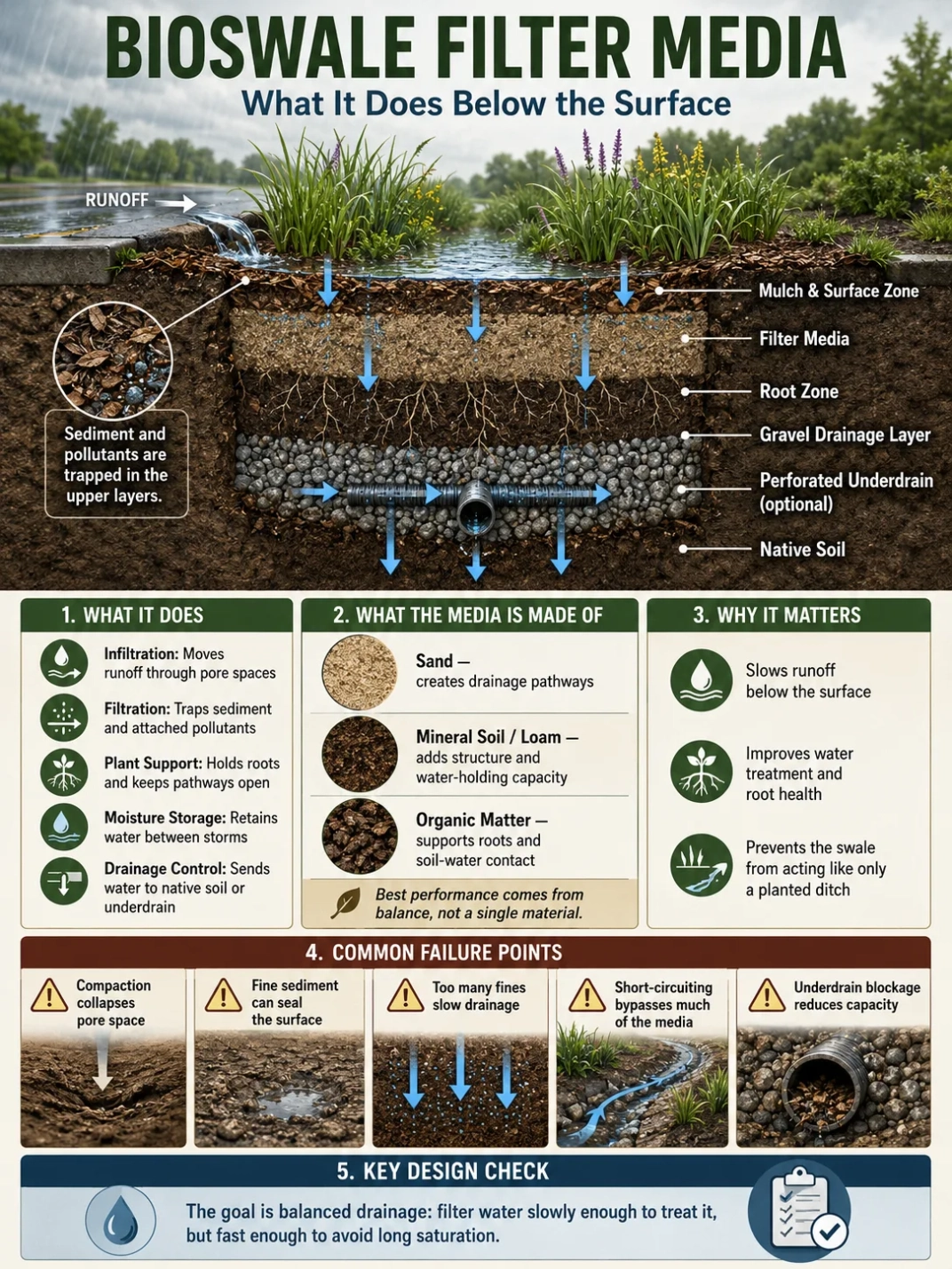
Engineered bioswales often use a filter media layer rather than relying only on native soil. This media helps support drainage, plant growth, and pollutant filtering. If it becomes clogged with fine sediment, the surface may act more like a sealed layer than a living filter.
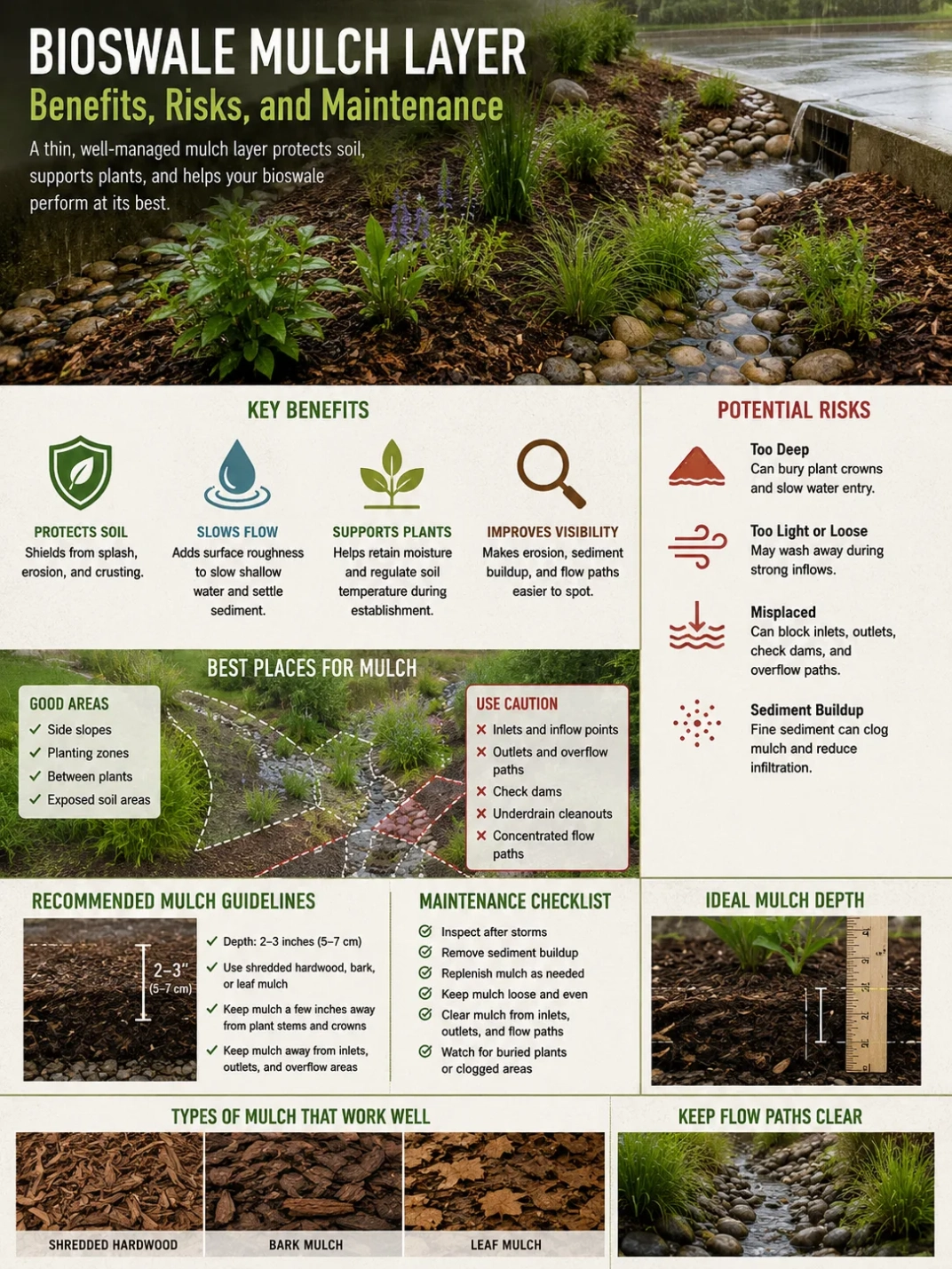
Mulch can help protect soil and reduce erosion, but it should not form a thick floating mat that blocks infiltration or moves into the outlet. In planted swales, mulch depth and type should fit the design and local maintenance practice.
Outlet and Overflow Height
The outlet sets the point where excess water leaves the system. If the outlet is too high, blocked, buried, or poorly placed, ponding can become deeper than intended. If the outlet is too low, water may leave before it has enough contact time with vegetation and soil.
The overflow route matters as much as the normal outlet. During larger storms, water needs a planned path that does not erode the swale edge or send runoff toward areas that should stay dry.
Check Dams and Slope
On sloped sites, check dams can create small storage steps. These low barriers slow water, reduce erosion, and help spread ponding along the flow path. They must be set carefully. Poorly placed check dams can trap too much sediment, push water around the side, or create one deep pool instead of several shallow zones.
The lengthwise slope of the bioswale also affects ponding. A very flat swale may drain slowly if the soil is tight. A steeper swale may move water too fast unless vegetation, check dams, and outlet controls are used to slow it down.
Standing Water by Location in the Swale
Where the water stands can reveal more than the depth itself. A healthy bioswale should use its storage area in a controlled way, not collect all runoff in one unintended pocket.
Near the Inlet
Ponding near the inlet may be normal during a storm, especially when runoff enters from pavement. But repeated sediment deposits at the inlet suggest that the swale is receiving more solids than the surface can handle. A forebay, stone apron, turf strip, or other sediment-control feature may be needed where local design allows.
Along the Center Flow Path
Water along the centerline can be expected if the swale has a defined low point. The warning sign is a narrow, bare channel. That means water is moving with enough force to strip mulch, expose soil, or bypass plant roots.
Behind Check Dams
Small pools behind check dams are often part of the design. They should step down through the swale and drain after the event. If one check dam holds water much longer than the others, check for sediment buildup, side bypass, buried stone, or uneven settling.
At the Outlet
Ponding at the outlet can mean the swale is backing up. Look for leaves, sediment, displaced mulch, crushed pipe ends, blocked overflow openings, or plant growth that has narrowed the exit. The outlet should be visible enough for inspection and stable enough to resist erosion.
Plant Tolerance and the Water Line
Bioswale plants live in uneven moisture zones. The lowest zone may see brief ponding. The side slopes may stay drier. The upper edge may behave more like a normal landscape bed. Good planting design uses this moisture pattern instead of fighting it.
Grasses, sedges, rushes, and some shrubs can help stabilize soil and create root channels. Root systems support infiltration by opening small pathways and holding the soil surface together. But plants still have limits. A species that tolerates temporary wet soil may not tolerate standing water that covers the crown for too long.
Planting Note: Plant decline can be a ponding-depth signal. If plants fail only in the lowest zone, the issue may be water duration, sediment cover, or unsuitable species for that moisture band. If plants fail across the whole swale, soil quality, compaction, sunlight, drought stress, or maintenance practice may also be involved.
When Standing Water Is Not Normal
Standing water is not normal when it becomes permanent or appears after small storms that should have drained through the system. It is also not normal when ponding damages plants, creates erosion, pushes water outside the intended route, or causes the swale to function like a detention basin without the design features of one.
Common causes include:
- Clogged surface media from fine sediment, leaf litter, or compacted mulch.
- Compacted soil from construction, equipment, repeated walking, or poor installation.
- Undersized storage for the actual runoff area draining into the swale.
- Blocked outlet or overflow from debris, sediment, plants, or displaced material.
- High groundwater or seasonal wetness that limits downward drainage.
- Unplanned grade changes that create a low pocket after settling or landscape work.
A small maintenance issue can look like a design failure if it is ignored. Sediment at the inlet, for example, can slowly raise the surface and redirect flow. Over time, water may skip the vegetated area and pond where it was not intended to stay.
How Ponding Depth Differs from a Rain Garden
A rain garden and a bioswale can both hold temporary stormwater, but they do not manage flow in exactly the same way. A rain garden is usually more basin-like. A bioswale is more linear and often carries water from one point to another while allowing infiltration and filtering along the path.
Because of that shape, ponding depth in a bioswale is tied closely to flow direction. Water depth must work with the inlet, side slopes, check dams, outlet, and overflow route. In a rain garden, the main concern is often how water fills and drains from a planted depression. In a bioswale, the pattern of movement through the channel matters just as much as the storage volume.
What to Inspect After a Storm
Inspection is easiest after moderate rain, when the swale has received water but has not been overwhelmed by an unusually large storm. The goal is to see whether ponding follows the intended design.
- Check the inlet. Look for sediment fans, exposed soil, displaced stone, or concentrated flow marks.
- Look at the water line. Note whether water depth is even, stepped, or concentrated in one low area.
- Inspect plant crowns. Standing water should not repeatedly bury plants that are not suited to that zone.
- Check the soil surface. Crusting, greasy-looking fines, bare soil, or sealed mulch can slow infiltration.
- Find the outlet and overflow. Make sure they are visible, open, and not blocked by debris or plant growth.
- Watch drawdown. Recheck later to see whether the water level is dropping as expected.
Maintenance Note: Do not judge a bioswale only during an unusually large storm. Large events may fill the system beyond normal ponding depth and activate the overflow. The better inspection window is after common rainfall, when the swale should show controlled storage and steady drainage.
Residential and Public-Space Differences
In a residential yard, ponding depth must be considered with downspouts, driveway runoff, property slope, nearby foundations, walkways, fences, and where overflow will go. Even shallow water can be poorly placed if it drains toward a basement wall, neighbor’s property, or an area with no safe overflow path.
In roadside, parking lot, school, park, or commercial settings, ponding depth often receives more formal design review. These sites may have larger drainage areas, heavier sediment loads, public access concerns, curb cuts, maintenance crews, and local stormwater requirements. The swale may need defined storage, underdrains, check dams, pretreatment areas, and inspection access.
Site conditions decide the limit. A depth that works in one engineered bioswale may not fit another site with clay soil, shallow groundwater, steep slopes, compacted subsoil, or sensitive overflow routes.
When Professional Review Is Worth It
Professional review is wise when ponding is deep, persistent, close to buildings, connected to public drainage, or tied to a large paved area. It is also useful when the swale receives runoff from a parking lot, road edge, steep slope, or multiple roof leaders.
A qualified designer, landscape architect, civil engineer, or local stormwater reviewer can check whether the issue is sizing, soil infiltration, outlet elevation, media clogging, underdrain condition, or overflow routing. That matters because lowering an outlet, digging deeper, or adding soil can change how water moves across the whole site.
Small maintenance tasks can often be handled by routine care: removing sediment at the inlet, clearing debris from outlets, replacing displaced mulch, protecting bare soil, and restoring vegetation. Larger grading or drainage changes should be treated as site-specific work.
FAQ
Is standing water normal in a bioswale?
Yes, temporary standing water can be normal after rain. A bioswale is designed to slow and store runoff briefly so water can infiltrate, filter through soil media, or move toward an outlet. Persistent standing water after ordinary rainfall may point to clogging, compaction, poor soil infiltration, or an outlet problem.
How deep should water be in a bioswale?
The normal depth depends on the design, soil, runoff source, slope, plants, and local stormwater rules. In general, ponding should stay within the intended storage area, remain below the overflow level during common storms, and drain within the expected drawdown period for that site.
How long should ponded water stay in a bioswale?
Ponded water should be temporary. The exact drawdown period varies by design and local requirements, but water that remains for several days after ordinary rainfall is a warning sign. Repeated long ponding may indicate compacted soil, clogged media, high groundwater, or a blocked outlet.
Why does my bioswale only hold water at one end?
Water collecting at one end may mean the grade is uneven, the outlet is too high or blocked, sediment has changed the surface, or the swale is not spreading flow evenly. If the low end stays wet long after the rest drains, inspect the outlet, overflow route, soil surface, and any check dams.
Can too much ponding hurt bioswale plants?
Yes. Many bioswale plants tolerate short wet periods, but not all can handle long-standing water over the crown or root zone. Plant stress in the lowest area can show that ponding is too deep, lasts too long, or that the selected plants do not match the wettest zone.
Should a bioswale have an overflow?
Most bioswales need a planned overflow route for larger storms. The overflow helps water leave safely when the swale receives more runoff than it can store or infiltrate. The route should be clear, stable, and directed away from areas that should not receive extra water.