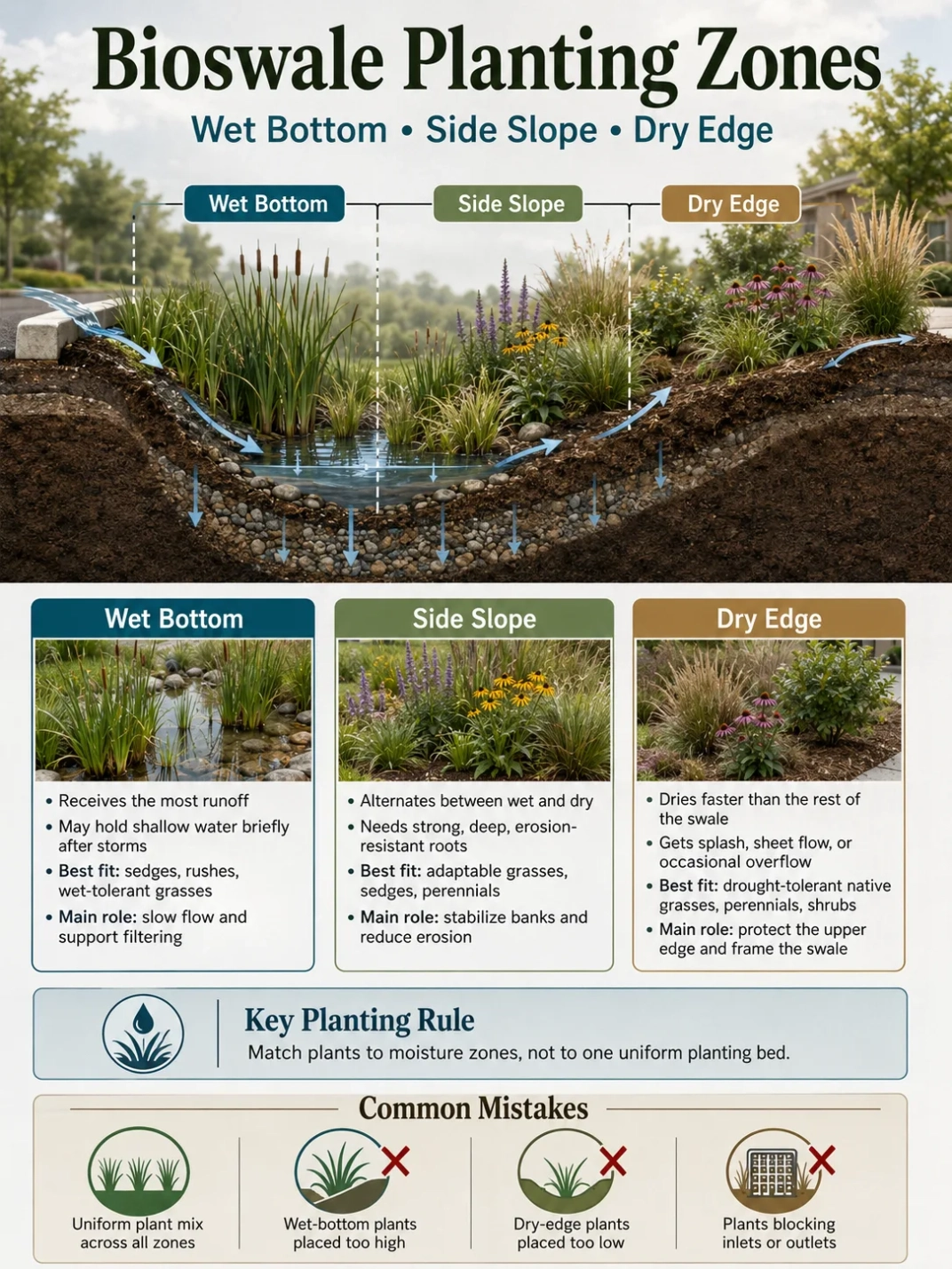
A bioswale rarely has one uniform planting condition from edge to edge. The bottom may stay wet after runoff enters, the side slope may shift between wet and dry, and the upper edge may dry out faster than the rest of the channel. Good bioswale planting zones match plants to those moisture patterns instead of treating the whole swale like a flat garden bed.
That zone-based approach helps plants survive, but it also supports the stormwater function of the swale. Roots hold soil, slow shallow flow, protect the side slope, and help keep the surface open enough for water to move into the soil media where site conditions allow.
What Bioswale Planting Zones Mean
Bioswale planting zones are moisture bands created by shape, elevation, runoff timing, soil texture, sun exposure, and drainage. The three common zones are the wet bottom, the side slope, and the dry edge.
The names are simple, but the zones are not rigid lines. A low area near an inlet may stay damp longer than the rest of the bottom. A sunny upper bank may dry faster than a shaded one. A side slope below a curb cut may receive more sediment and splash than a side slope near the outlet.
The goal is not to force exact boundaries. The goal is to read the swale as a small drainage landscape with changing water exposure.
| Planting Zone | Typical Moisture Pattern | Plant Traits That Usually Fit | Main Design Role |
|---|---|---|---|
| Wet Bottom | Receives the most runoff and may hold shallow water for a limited time after storms | Wet-tolerant grasses, sedges, rushes, and other plants that can handle short wet periods | Slows flow, protects soil, supports filtering near the main flow path |
| Side Slope | Alternates between wet runoff contact and drier exposure | Deep-rooted, erosion-resistant plants that tolerate both moisture and drying | Stabilizes banks, reduces erosion, connects bottom and upper edge |
| Dry Edge | Dries faster and may only receive splash, sheet flow, or occasional overflow | Drought-tolerant native grasses, perennials, or shrubs suited to local climate | Frames the swale, protects the upper shoulder, supports habitat and maintenance access |
Wet Bottom Zone
The wet bottom is the low part of the bioswale where stormwater runoff first collects or travels. It may be a broad flat base, a shallow channel, or a planted low strip between side slopes.
This zone does the hardest drainage work. It receives water from roofs, driveways, parking lots, roadsides, or other impervious surfaces, depending on the site. It may also receive sediment, leaf litter, mulch movement, and fine debris carried by runoff.
Plants in the wet bottom need to tolerate short periods of standing water, but they should not be chosen as if the swale were a permanent pond. In many bioswale designs, water should drain down or move through the system after a storm. The exact timing depends on soil media, compaction, underdrain use, rainfall, and local design requirements.
Best Plant Traits for the Wet Bottom
The most useful wet-bottom plants often share a few traits:
- Wet tolerance during and after runoff events
- Dense roots that help hold soil media near the flow path
- Flexible stems that can bend under shallow moving water
- Recovery after sediment contact, especially near inlets
- Seasonal resilience through heat, cold, dormancy, and dry periods where applicable
Sedges, rushes, moisture-tolerant grasses, and locally suitable herbaceous plants are often used here. Exact species should match the region, sun exposure, soil chemistry, salt exposure if present, and whether the swale is residential, roadside, or in a public landscape.
Planting Note: A plant that likes wet soil is not automatically right for the bottom of a bioswale. The plant also needs to handle changing water levels, runoff movement, sediment contact, and dry weather between storms.
Side Slope Zone
The side slope is the angled surface between the low channel and the upper edge. It is one of the easiest places to underestimate because it may look like a simple planted bank. In practice, it controls erosion, access, visibility, and how runoff enters the swale.
Water does not treat the side slope evenly. During small storms, only the lower part may get wet. During stronger flows, water may rise higher, press against the slope, or enter as sheet flow from pavement or lawn. Near an inlet, water may strike the slope with more energy.
For that reason, side slope plants need a mixed tolerance pattern. They should handle brief wetting, but they also need to survive drier periods because sloped soil drains and dries faster than the bottom.
Why Roots Matter on Side Slopes
Root structure is a major part of side slope performance. Dense roots help bind the surface, reduce rilling, and hold mulch or soil cover in place. Plants with weak root systems may look acceptable for a season but leave the slope exposed after heat, drought, foot traffic, or sediment buildup.
A varied planting mix can be useful on a side slope when local conditions allow it. Grasses and sedges can knit the surface. Perennials can add cover and seasonal diversity. Small shrubs may help in larger swales, but they should not block flow, hide inlets, or make inspection difficult.
Side Slope Mistakes to Avoid
- Using plants that flop into the main flow path and trap debris too heavily
- Leaving bare soil while plants establish
- Choosing shallow-rooted turf where runoff energy is higher
- Planting dense shrubs where crews need to inspect inlets or outlets
- Ignoring foot traffic shortcuts across the swale
Side slopes are also where maintenance patterns become visible. Bare patches, washed mulch, exposed soil, leaning plants, or small channels down the bank often show that runoff is entering too quickly, the soil is compacted, or vegetation has not established well.
Dry Edge Zone
The dry edge is the upper shoulder of the bioswale. It may sit beside lawn, pavement, a sidewalk, a planting bed, a curb, or a maintenance strip. It usually receives less direct ponding than the bottom and less flow contact than the lower side slope.
This zone still matters. The dry edge helps define the swale, protects the top of bank, and can keep nearby soil from crumbling or compacting into the channel. It also supports the transition between stormwater infrastructure and the surrounding landscape.
Dry-edge plants usually need better drought tolerance than wet-bottom plants. They may receive runoff only during larger storms, as splash, or as shallow sheet flow. In sunny sites, this zone can be hot and dry even when the swale bottom remains damp after rain.
Plant Traits That Fit the Dry Edge
Plants near the dry edge should support the swale without becoming a maintenance problem. Useful traits often include:
- Drought tolerance once established
- Roots that hold the upper shoulder of the swale
- Growth that does not block access or sight lines
- Suitability for local sun, wind, and soil conditions
- Low tendency to spread into the flow path where that would reduce function
Native grasses, drought-tolerant perennials, and some small shrubs may fit this zone depending on climate and site use. Regional plant selection matters more here than generic plant lists because dry-edge stress can vary widely between humid, arid, coastal, urban, and cold-climate sites.
How Water Movement Shapes the Zones
Planting zones come from hydrology. The wettest area is not always the middle of the swale, and the driest area is not always the farthest edge. Runoff source, grade, inlet placement, soil texture, compaction, and outlet behavior all shape where moisture stays.
A bioswale receiving roof runoff may get cleaner but concentrated water from downspouts. A roadside or parking lot bioswale may receive more sediment and debris. A swale on compacted soil may hold moisture differently than one with well-prepared filter media. Where an underdrain is used, the bottom may drain more consistently, but plants still need to tolerate wet periods at the surface.
The planting plan should follow the expected flow path. Water entering from one end may create a wetter inlet area. Check dams, if used, may create short zones of slower water upstream. An overflow route may create a dry-looking edge that still needs erosion-resistant vegetation during larger storms.
Drainage Note: Plant zones should not be used to hide drainage problems. Long-lasting standing water, repeated erosion, or water bypassing the swale may point to grading, soil, inlet, outlet, or maintenance issues.
Matching Plants to Wet-Dry Tolerance
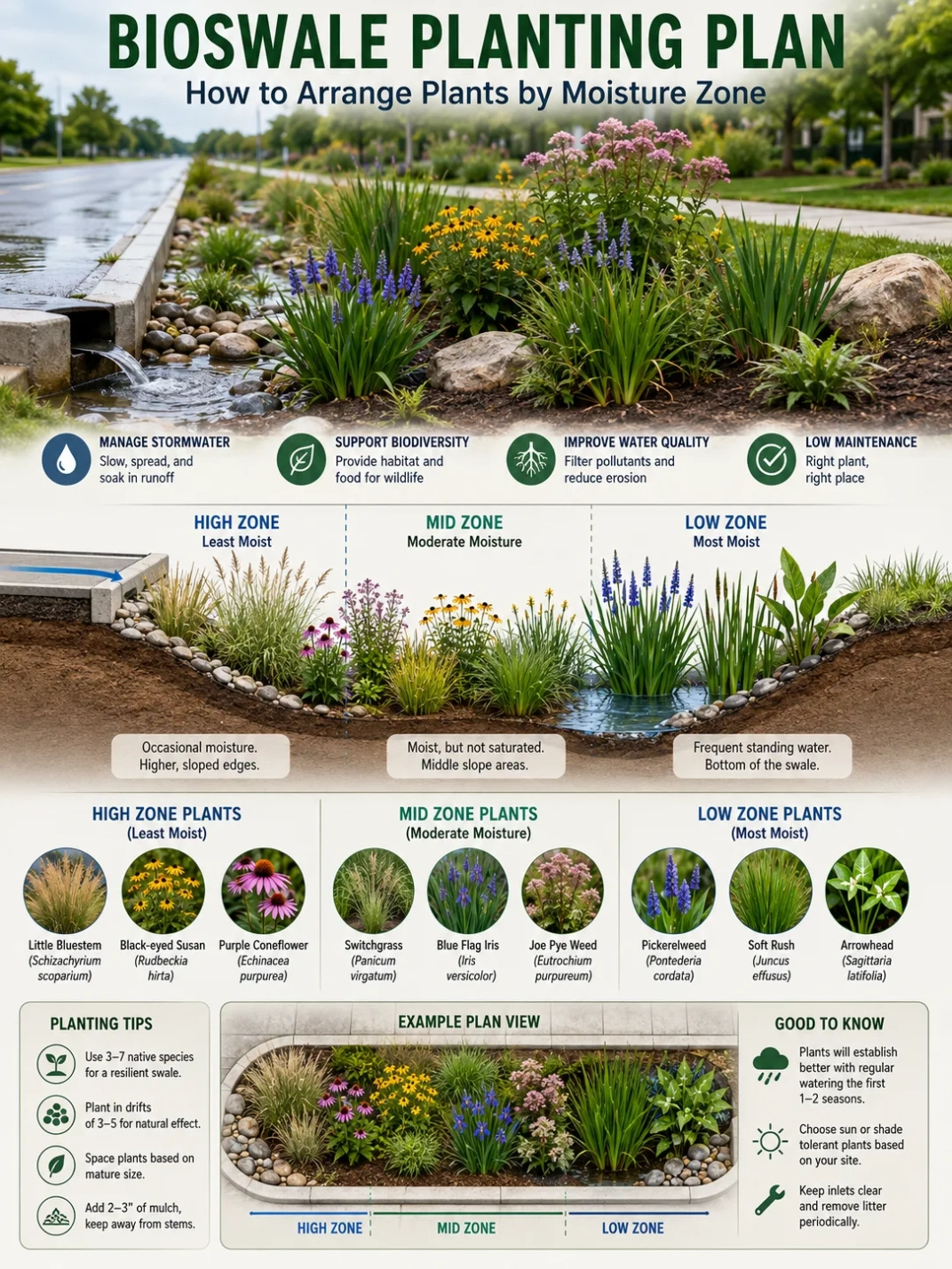
A common planting mistake is choosing only “water-loving” plants for the whole bioswale. Another is choosing ordinary dry-landscape plants and expecting them to survive in the bottom. Bioswales need plants that fit a wet-dry rhythm.
The bottom may be wet after storms but dry later. The side slope may receive splash and flow, then drain quickly. The dry edge may stay dry most days but still need to handle occasional overflow or saturated soil after larger rainfall.
For many sites, the best approach is to group plants by tolerance rather than by appearance alone:
- Place wet-tolerant plants in the bottom and near areas that receive repeated runoff.
- Use adaptable plants on the side slope where wet and dry conditions alternate.
- Use drought-tolerant plants along the upper edge where soil dries faster.
- Adjust for local exposure, including shade, heat, wind, road salt, and surrounding pavement.
Plant spacing also matters. Plants need enough room to mature, but the soil surface should not remain exposed for too long. Temporary erosion control, mulch suited to the flow condition, or staged establishment may be needed depending on the project.
Native Plants and Local Suitability
Native plants are often a good starting point for bioswale planting because they can support local ecology and may be adapted to regional rainfall, seasonal cycles, and soils. That does not mean every native plant fits every bioswale zone.
A native upland plant may fail in the wet bottom. A native wetland plant may struggle on a dry, sunny edge. Some plants may spread too aggressively for a small residential swale or create maintenance issues near inlets and outlets.
Local plant lists, nursery guidance, extension resources, or project specifications can help narrow species choices. The useful question is not simply whether a plant is native. It is whether the plant fits the moisture zone, soil condition, maintenance level, and runoff setting.
Residential and Public-Space Differences
A residential bioswale may handle roof runoff, driveway runoff, or yard drainage. Planting often needs to balance stormwater function with visibility, mowing edges, nearby foundations, and property use. Plants should not send water toward structures, block overflow routes, or make the swale hard to inspect.
Public-space, roadside, and commercial bioswales often face more demanding conditions. They may receive runoff from larger paved areas, more sediment, more trash, vehicle splash, deicing salt in some climates, and heavier maintenance needs. Plant choices may need to tolerate tougher establishment conditions and allow crews to see inlets, outlets, curb cuts, and overflow paths.
Where a bioswale affects public drainage, neighboring properties, streets, or regulated stormwater systems, plant selection should fit the approved drainage design. A planting plan should not reduce storage volume, block flow, or make required inspection harder.
Site Planning Note: Planting can improve a bioswale, but it cannot replace correct grading, overflow planning, soil preparation, or drainage review where those are needed.
How Planting Zones Affect Maintenance
Maintenance is easier when the planting zones are clear. A crew or homeowner can see which plants belong in the bottom, which plants stabilize the slope, and which plants frame the dry edge.
The wet bottom should be checked for sediment buildup, smothered plants, clogged inlets, and areas where water stands longer than expected. The side slope should be checked for bare soil, erosion channels, animal disturbance, or plants pulling away from the bank. The dry edge should be checked for weeds, compaction from foot traffic, and plants spreading into places where access is needed.
Plant replacement is normal during establishment. Some plants may fail because the actual moisture pattern differs from the plan. That observation is useful. It can show whether the swale bottom is wetter than expected, whether the edge is too dry, or whether runoff is entering with more force than the planting can handle.
Where the Design Can Fail
Planting zones can fail when they are drawn for appearance instead of water behavior. A neat pattern on paper may not survive the first season if it ignores flow direction, sediment load, soil compaction, or drought exposure.
Common problems include:
- Wet-bottom plants placed too high, where they dry out between storms
- Dry-edge plants placed too low, where they sit in saturated soil after runoff
- Side slopes left underplanted, leading to erosion and exposed soil
- Plants blocking inlets or outlets, making inspection and cleaning harder
- Dense planting that traps too much sediment near the entry point
- Uniform plant mixes that ignore wet, transitional, and dry areas
A bioswale does not need to look wild or messy to work well. It does need planting that respects the drainage shape. The best visual order comes from plants that fit the zone, not from forcing the same plant across every moisture condition.
Bioswale Planting Zones and Rain Garden Planting
Bioswales and rain gardens can use similar plant logic, but they do not handle water in the same way. A rain garden is often a basin that collects runoff in one planted depression. A bioswale is usually more linear, with a clearer flow path from inlet to outlet or overflow route.
That linear movement makes side slope planting especially important in a bioswale. Plants must handle water moving along the channel, not only water ponding in a low basin. The dry edge may also play a stronger role because it protects the long upper shoulder of the swale and helps keep the drainage corridor readable.
Both systems benefit from moisture-based planting, but a bioswale planting plan should pay closer attention to flow direction, bank stability, inlet behavior, and maintenance access along the channel.
Practical Planting Layout for a Bioswale
A practical layout starts by marking where water enters, where it slows, where it may pond, where it exits, and where overflow should safely move during larger storms. Planting zones can then follow those patterns.
In many designs, the bottom receives the most moisture-tolerant plants in bands or clusters that follow the main flow path. The lower side slopes receive adaptable plants with strong roots. The upper side slopes and dry edges receive plants that can handle drier soil while still protecting the swale shoulder.
The layout should leave inspection points visible. Inlets, curb cuts, check dams, cleanouts, outlets, underdrain observation points, and overflow areas should not disappear behind dense planting. A bioswale that cannot be inspected is harder to maintain.
FAQ
What are the main planting zones in a bioswale?
The main bioswale planting zones are the wet bottom, side slope, and dry edge. The wet bottom receives the most runoff, the side slope handles changing wet and dry conditions, and the dry edge usually dries faster than the rest of the swale.
Should the wet bottom use only wetland plants?
Not always. The bottom may be wet after storms, but many bioswales are designed to drain rather than stay wet all the time. Plants should tolerate short wet periods and dry intervals, depending on the soil, drainage design, and climate.
Why is the side slope so important in a bioswale?
The side slope helps control erosion and keeps soil from washing into the flow path. It also receives changing moisture levels, so plants in this zone need strong roots and tolerance for both wetting and drying.
Can the same plant be used across all bioswale zones?
Sometimes a very adaptable plant may work in more than one zone, but using one plant across the whole swale can lead to failures. Moisture, slope, sediment, sun, and runoff exposure usually change from bottom to edge.
Are native plants required for bioswale planting?
Native plants are often useful, but requirements depend on local rules, project goals, and site conditions. A plant should be chosen for moisture tolerance, root structure, climate fit, maintenance needs, and whether it behaves well in the specific zone.
What happens if plants are placed in the wrong bioswale zone?
Plants may fail, leave bare soil, trap sediment in the wrong place, or allow erosion on side slopes. Poor zone matching can also make the swale harder to inspect and maintain.