Bioswale plant maintenance is not mainly about keeping vegetation neat. It is about preserving plant cover, root function, open flow paths, and soil protection so stormwater runoff can move through the system without exposing bare ground or blocking drainage. Pruning, plant replacement, and establishment care should therefore respond to how the bioswale handles water, not just how the planting looks.
A healthy planting layer helps slow runoff, hold soil, trap sediment, reduce erosion, and support infiltration. Poorly timed pruning, repeated mowing, damaged roots, or delayed replacement can weaken those functions. Maintenance works best when crews recognize that different parts of a bioswale experience different moisture, sediment, and flow conditions.
Why Plant Condition Affects Bioswale Performance
Plants form the living surface of a bioswale. Their stems interrupt shallow flow, their leaves soften rainfall impact, and their roots help stabilize soil media. Dense vegetation can also limit the movement of loose mulch and reduce the chance that small areas of bare soil develop into erosion channels.
The vegetation layer must still allow water to enter, spread, and drain. Plants that collapse across an inlet, form a dense mat over the soil, or trap heavy sediment in one narrow area may interfere with the intended flow path. Plant maintenance should balance coverage with hydraulic access.
| Task | Main Purpose | What to Watch |
|---|---|---|
| Pruning | Remove damaged growth and keep inlets, outlets, and inspection areas open | Avoid cutting healthy plants so heavily that soil becomes exposed |
| Plant Replacement | Restore vegetation where plants have died, washed out, or failed to establish | Correct drainage, compaction, or placement problems before replanting |
| Establishment Watering | Support root development during the early planting period | Do not assume storm events provide steady moisture across every planting zone |
| Weed Removal | Reduce competition and prevent unwanted plants from dominating | Minimize soil disturbance and avoid leaving open patches |
| Debris Clearing | Keep runoff entry and exit points open | Check whether recurring debris indicates an upstream source problem |
Pruning for Plant Health and Open Drainage
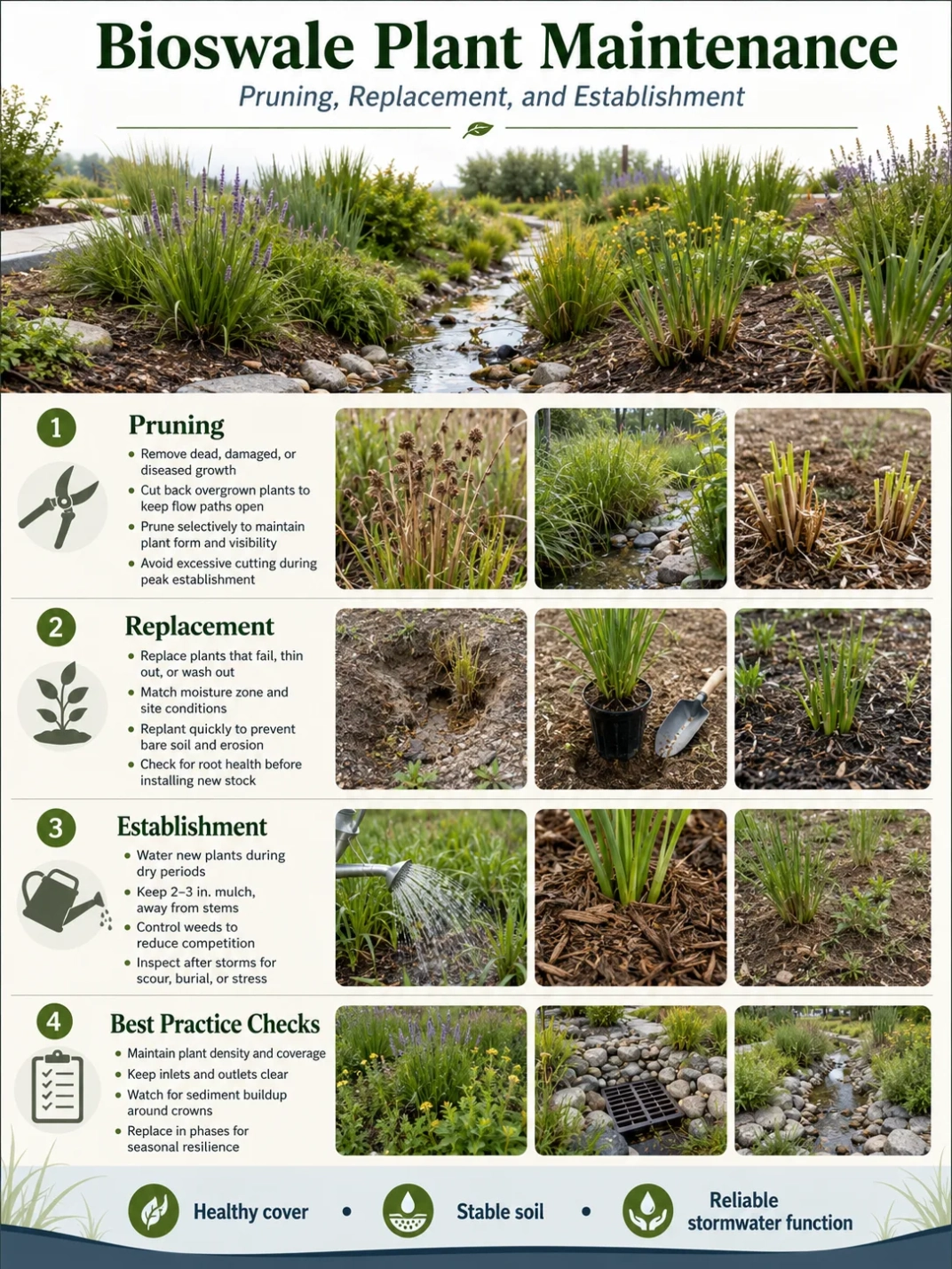
Pruning should remove dead, broken, diseased, or obstructive growth while keeping enough living material to protect the soil. The goal is not to shape every plant into a uniform form. Many bioswale grasses, sedges, rushes, flowering perennials, and shrubs perform best when their natural growth habit remains recognizable.
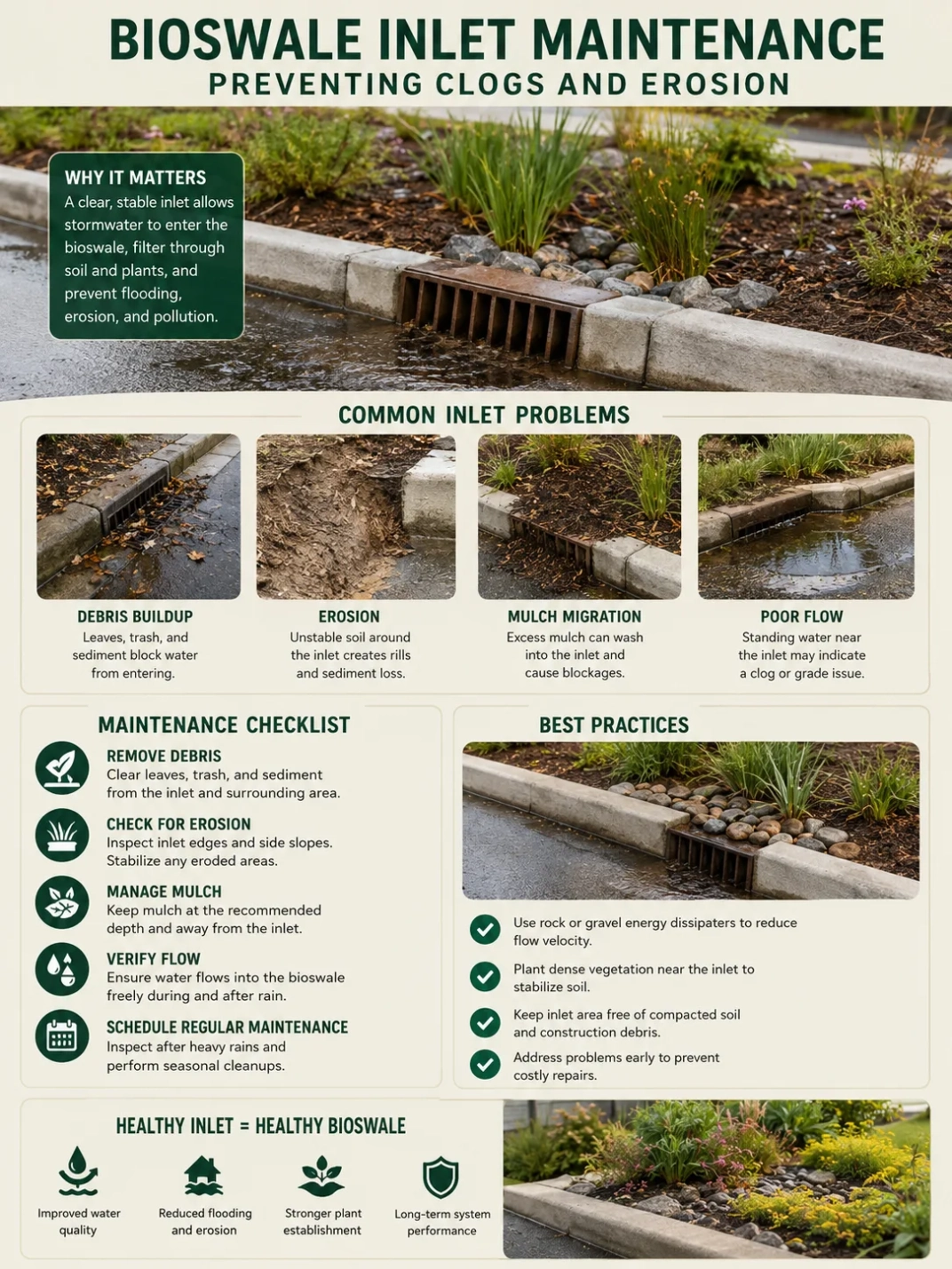
Clear Growth from Inlets and Curb Openings
Plants near an inlet may receive fast runoff, road sediment, leaf litter, and floating debris. Stems that bend across the opening can slow entry in the wrong place and cause water to bypass the bioswale. Trim only the growth that blocks the opening or prevents inspection.
Do not create a wide bare area around the inlet unless the design includes stone, a concrete apron, or another erosion-resistant surface. Vegetation near the entrance often helps slow water after it enters.
Keep Outlets and Overflow Routes Visible
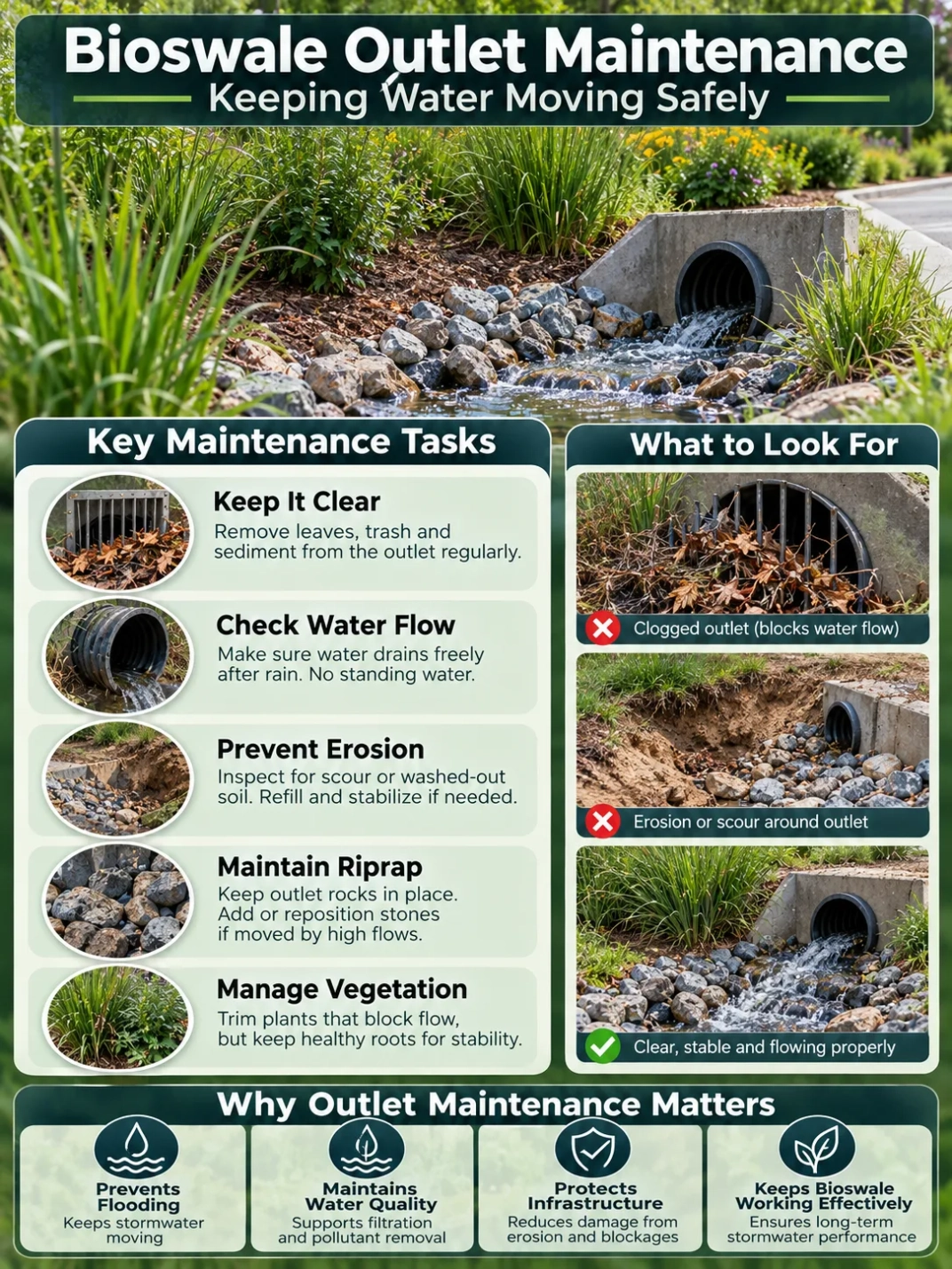
Outlet structures, overflow grates, underdrain cleanouts, and check dams should remain visible enough to inspect. Dense vegetation can hide sediment deposits, displaced stone, blocked grates, or erosion around an outlet.
Selective pruning is usually better than clearing the entire area. Retaining vegetation around drainage structures helps protect nearby soil from moving water.
Remove Damaged Stems Before They Mat Down
Storms, snow storage, maintenance equipment, vehicles, or foot traffic can flatten plants. Some species recover on their own. Others form a dense layer that covers new shoots, traps debris, or blocks shallow flow.
Remove damaged material when it clearly interferes with regrowth or drainage. Cutting should follow the plant type and season. Woody shrubs, ornamental grasses, sedges, rushes, and flowering perennials do not all respond to the same pruning method.
Maintenance Note: A plant should not be cut simply because it looks dormant. Standing stems may protect crowns, hold mulch, provide winter structure, and mark planting locations. Confirm whether the species benefits from seasonal cutback before removing healthy dormant growth.
Avoiding Over-Pruning
Over-pruning reduces shade at the soil surface, weakens plant reserves, and can expose mulch or soil media to runoff. Repeated close cutting may also favor weeds that tolerate disturbance better than the intended planting.
A bioswale is not a conventional lawn strip. Uniform mowing can damage species selected for deep roots, upright stems, seasonal flowers, or wet-dry tolerance. Where mowing is part of the original planting plan, cutting height and timing should match that design. Where the system uses mixed perennials, sedges, rushes, or shrubs, routine lawn-style mowing may be unsuitable.
- Do not scalp vegetation down to exposed crowns or bare soil.
- Do not remove all stems around an inlet before a wet season.
- Do not prune shrubs into forms that block inspection access at ground level.
- Do not cut plants while saturated soil is easily compacted by equipment.
- Do not leave piles of cut material where they can wash toward an outlet.
When Plant Replacement Is Needed
Plant replacement is needed when dead or missing vegetation leaves soil unprotected, breaks a designed planting band, or allows weeds and erosion to expand. A single dead plant may not affect performance. A widening bare patch in a concentrated flow area deserves faster attention.
Replacement should not begin with the plant list. It should begin with the reason the original plant failed.
Common Reasons Plants Fail
- Too much ponding: The planting zone remains wet longer than the species can tolerate.
- Too little moisture: Upper side slopes or inlet edges dry faster than expected.
- Buried crowns: Sediment or mulch accumulates around the base of the plant.
- Exposed roots: Runoff removes soil or mulch from the root zone.
- Compacted soil: Foot traffic or equipment limits air, water movement, and root growth.
- Wrong light conditions: A plant selected for sun may decline after nearby trees or structures create shade.
- Salt or pollutant stress: Roadside runoff may carry materials that some species cannot tolerate.
- Physical damage: Snowplows, parked vehicles, utility work, pets, or repeated trampling can destroy young plants.
Replacing a failed plant with the same species, in the same location, without correcting the cause often leads to another failure. The replacement may need a different moisture tolerance, root form, mature size, or resistance to roadside exposure.
Replace by Moisture Zone, Not by Appearance Alone
The bottom of a bioswale, the side slopes, and the upper edge may behave like different planting environments. The lowest zone may receive temporary ponding and sediment. Side slopes may drain quickly but experience erosion. The upper edge may remain comparatively dry except during large storms.
Replacement plants should match the conditions of the exact location. A species that performs well on the upper bank may not tolerate repeated saturation in the channel bottom. Likewise, a wet-tolerant plant may struggle on a dry outer slope.
Planting Note: Regional native plants can be useful because they may fit local climate and ecological conditions, but native status alone does not prove suitability. Moisture range, soil texture, sunlight, salt exposure, mature size, and maintenance needs still matter.
How to Replace Plants Without Damaging the Bioswale
Replacement work should disturb as little soil as possible. Digging in saturated soil can smear soil surfaces, collapse pore space, and compact the planting bed. Heavy equipment should remain outside the bioswale where practical.
- Inspect the failed area for erosion, buried crowns, standing water, sediment, or compaction.
- Remove dead material without enlarging the disturbed area more than needed.
- Restore displaced soil or mulch carefully, keeping the intended grade and flow direction.
- Select a plant suited to the location’s moisture, sunlight, and runoff exposure.
- Place the root crown at an appropriate level for the species rather than burying it under excess mulch.
- Water the replacement through establishment, even when the rest of the bioswale appears mature.
- Recheck the plant after rainfall to confirm that runoff is not exposing roots or depositing sediment over the crown.
Large areas of plant loss may indicate a drainage or soil problem rather than ordinary mortality. Repeated failure across one section can point to prolonged saturation, poor infiltration, an underdrain issue, an altered grade, concentrated flow, or unsuitable soil media. That pattern may need review by a landscape professional, stormwater specialist, or qualified site designer.
The Plant Establishment Period
New bioswale plants need closer care before their roots occupy the surrounding soil. During this period, the planting can look complete while still being vulnerable to drought, erosion, weeds, sediment burial, and physical damage.
Establishment length varies by plant type, climate, planting season, soil conditions, and irrigation. It should not be judged only by the number of weeks since installation. A plant is better established when it shows stable growth, resists minor dry periods, remains anchored after runoff events, and begins filling its intended space.
Watering During Establishment
Stormwater does not water every plant evenly. The channel bottom may receive runoff while upper slopes remain dry. A short storm may wet foliage and mulch without moistening the full root ball. Newly installed plants may therefore need supplemental watering even in a functioning bioswale.
Watering should encourage roots to grow into the surrounding soil rather than remain confined to the planting hole. Frequency should respond to weather, soil moisture, plant size, and season. Saturated soil should not be watered simply because a calendar says it is time.
Mulch Around Young Plants
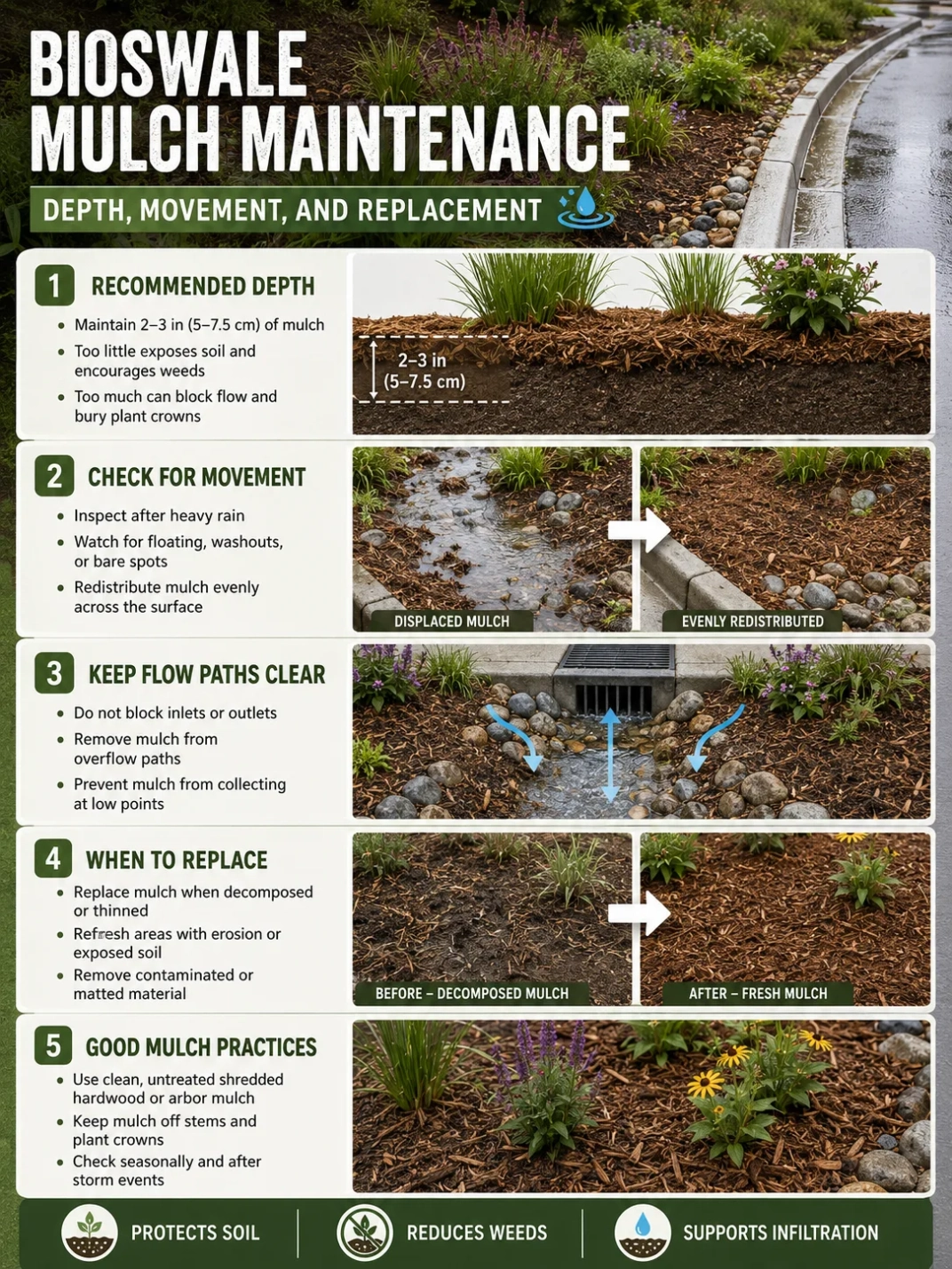
Mulch can reduce moisture loss, limit weeds, and protect exposed soil. It should not be piled against stems or crowns. Thick mulch around a young plant can hold excess moisture at the base, hide damage, and divert shallow runoff.
After storms, check whether mulch has moved downslope, collected at an outlet, or buried small plants. Reposition loose material carefully. Repeated mulch movement may show that runoff is too concentrated or that the chosen mulch is poorly suited to the flow conditions.
Weed Control While Plants Fill In
Young plantings leave open soil and mulch between plants. Weeds can occupy those spaces before the intended vegetation spreads. Early removal reduces competition for light, moisture, and root space.
Hand removal or other low-disturbance methods are often useful around small plantings. Pulling large weeds from wet soil can loosen nearby plants and create holes that collect water. Disturbed spots should be pressed back gently and monitored for erosion.
Inspecting Plants After Storms
Post-storm inspection shows how vegetation behaves under real flow. Look beyond broken stems. The pattern of flattened plants, sediment deposits, exposed roots, and debris lines can reveal where water enters too quickly, spreads poorly, or concentrates through a narrow path.
- Check whether plants near the inlet have been uprooted or buried.
- Look for narrow bare channels forming between plant clumps.
- Confirm that vegetation is not blocking an outlet or overflow grate.
- Check whether mulch has covered small plants or collected against stems.
- Look for soil deposited on leaves, which may indicate sediment-laden runoff.
- Inspect side slopes for leaning plants, exposed roots, or shallow slips.
- Note recurring damage in the same location rather than treating each event as isolated.
A plant that leans after one storm may recover. A repeated line of flattened or missing plants often shows a concentrated flow route. Replanting alone may not solve it.
Seasonal Plant Maintenance
Plant work changes through the year. Seasonal timing should follow local climate and plant behavior rather than a fixed national schedule.
Spring
Inspect crowns, new shoots, winter damage, sediment deposits, and mulch movement. Remove dead material where it blocks growth or drainage. Mark plants that have not resumed growth, but allow enough time to confirm whether late-emerging species are still dormant.
Summer
Watch for drought stress, wilting, weed competition, and dry upper slopes. Replacement plants may need separate watering from established vegetation. Avoid heavy maintenance during very wet conditions, when soil compaction is more likely.
Autumn
Remove debris that could block inlets and outlets. Replace plants when seasonal conditions support root growth and when local climate allows enough time before severe cold or prolonged wet conditions. Do not cut all standing vegetation automatically.
Winter
Limit traffic over frozen or saturated planting areas. Observe damage from snow storage, road salt, plowing, and accumulated debris. Some corrective work may need to wait until soil conditions improve, but blocked drainage structures should still be addressed promptly and safely.
Maintenance Mistakes That Lead to Repeat Problems
Replacing Plants Before Correcting the Cause
Repeated plant loss usually reflects more than bad luck. Inspect moisture, sediment, grade, sunlight, compaction, and physical disturbance before installing another plant.
Treating the Bioswale Like a Lawn
Frequent close mowing can weaken deep-rooted vegetation, remove flowers and seed heads, expose soil, and reduce the structure that slows shallow runoff. Maintenance methods should follow the intended plant community.
Working on Saturated Soil
Foot traffic, wheelbarrows, and machinery can compact wet soil media. Compaction may reduce infiltration and make future plant growth harder. Delay non-urgent work until the surface can support access without rutting or smearing.
Ignoring Small Bare Areas
A small opening may expand when runoff repeatedly crosses it. Early repair can include replanting, light soil restoration, mulch adjustment, or correction of a concentrated flow path.
Using One Plant Everywhere
Uniform planting is easy to order and maintain, but one species may not tolerate every moisture zone. Mixed planting can provide different root forms, seasonal growth patterns, and responses to temporary wet and dry periods, where the design and local conditions support it.
When Plant Problems Point to a Larger Site Issue
Plant maintenance cannot correct every bioswale problem. Broad plant decline, persistent standing water, repeated washouts, exposed soil media, large sediment deposits, or water bypassing the system may indicate a problem with grading, inlet design, outlet capacity, infiltration, an underdrain, or the upstream runoff source.
Professional review may be appropriate when plant failure appears across a large area, when erosion affects structural edges, when overflow moves toward buildings or neighboring property, or when repairs would change the original drainage design. Plant replacement should not conceal a hydraulic problem that still needs correction.
Site Planning Note: Public, roadside, commercial, and parking lot bioswales may receive heavier sediment loads and more physical disturbance than residential systems. Maintenance access, traffic safety, inspection requirements, and local stormwater rules may shape how pruning and replacement work is performed.
Plant Maintenance FAQ
How often should bioswale plants be pruned?
Pruning frequency depends on plant type, climate, growth rate, visibility needs, and drainage conditions. Plants should be checked during routine inspections and pruned when dead, damaged, or obstructive growth affects plant health, access, or water movement.
Should bioswale plants be cut back every year?
Not all bioswale plants need annual cutback. Some grasses and perennials benefit from seasonal removal of old stems, while sedges, rushes, shrubs, and evergreen species may need different treatment. The plant type and local climate should guide timing.
When should a dead bioswale plant be replaced?
Replacement is most important when plant loss exposes soil, creates an erosion path, weakens a planting zone, or allows weeds to spread. Before replanting, inspect the location for excess moisture, drought, sediment burial, compaction, or physical damage.
Do new bioswale plants need watering?
Yes, newly installed plants often need supplemental watering while roots establish. Runoff may wet the lowest part of the bioswale while leaving upper slopes and outer edges dry. Watering should respond to soil moisture and weather rather than follow a rigid schedule.
Why do replacement plants keep dying in the same spot?
Repeated failure can indicate unsuitable moisture conditions, compacted soil, concentrated flow, sediment buildup, poor sunlight, salt exposure, or physical disturbance. Replacing the plant without correcting the site condition may repeat the same result.
Can pruning improve drainage in a bioswale?
Selective pruning can keep inlets, outlets, overflow routes, and inspection points open. It should not remove so much vegetation that soil becomes exposed or runoff speeds up across a bare surface.