A bioswale outlet is the planned exit point for water that the swale cannot hold, infiltrate, or filter fast enough during a storm. Good bioswale outlet design does not try to trap every drop. It gives excess runoff a controlled path so water can leave without cutting through soil, flooding nearby pavement, backing up into the inlet, or sending a concentrated surge into a weak discharge area.
The outlet is easy to overlook because most bioswale drawings focus on the planted channel, soil media, and inlet. Yet the outlet often decides whether the system behaves calmly during a larger storm or becomes a narrow erosion path. It also shapes how the swale drains after the storm has passed.
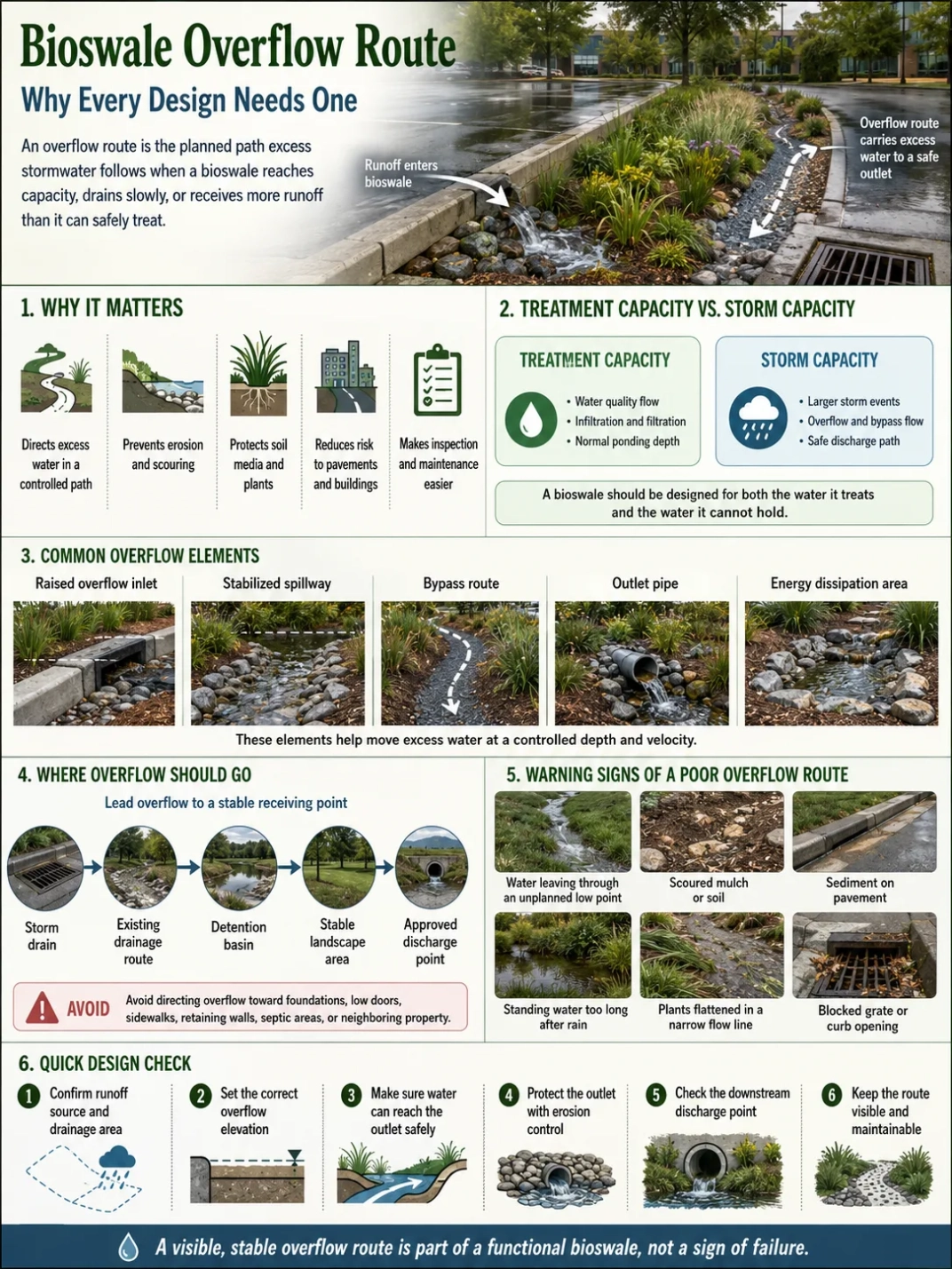
An outlet may be a surface overflow, a drop inlet, a curb opening, a pipe connection, an underdrain discharge, a stabilized swale end, or a bypass route to another drainage feature. The right choice depends on the runoff source, slope, soil, storage depth, downstream capacity, and local drainage rules.
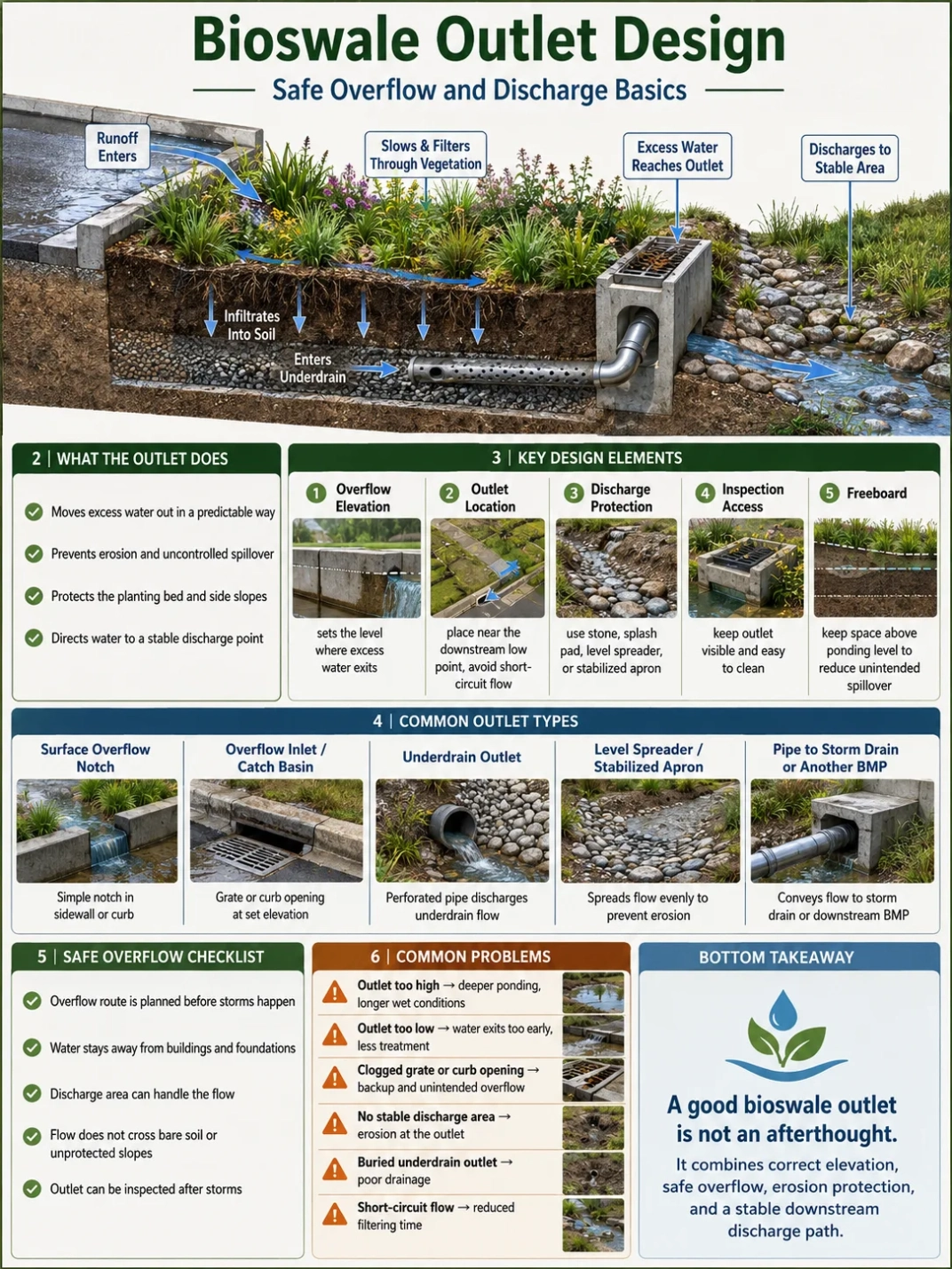
What the Outlet Is Supposed to Do
The outlet has a simple job: move extra water out of the bioswale in a predictable way. That sounds basic, but it involves several design decisions. The outlet must work when the swale is full, when sediment has collected near the low end, when plants are dense, and when a larger rainfall event sends more water than the soil can absorb.
A bioswale usually handles water in layers. First, runoff enters at the inlet and spreads across vegetation or stone. Then it slows along the flow path. Some water infiltrates into soil media or native soil. Some may enter an underdrain. If water rises above the intended ponding level, the outlet or overflow route should take over.
The outlet is not a failure point. It is part of the design. A bioswale without a planned overflow can still overflow, but it may do so through the lowest weak edge, a footpath, a driveway apron, a bare side slope, or an unintended gap in the berm.
Drainage Note: An outlet should be treated as a controlled hydraulic feature, not as an afterthought at the end of the planting bed. Its elevation, location, and discharge surface all affect how the bioswale performs.
Outlet Design and Overflow Are Related, but Not Identical
In everyday language, “outlet” and “overflow” often get used as if they mean the same thing. In a bioswale, they can overlap, but they are not identical.
| Term | What It Means | Why It Matters |
|---|---|---|
| Outlet | The planned place where water leaves the bioswale, either on the surface or through a pipe. | Controls discharge direction and helps prevent erosion at the downstream end. |
| Overflow | The route water uses after the swale reaches its intended ponding level or storage capacity. | Protects the bioswale during larger storms and reduces uncontrolled spilling. |
| Underdrain Outlet | The discharge point for filtered water collected by a perforated pipe below the soil media. | Helps the swale drain where native soil infiltration is limited or where a lined system is used. |
| Bypass Route | A path that sends higher flows around the bioswale rather than through the planting area. | Helps limit scour, sediment overload, and plant damage during flows above the intended treatment event. |
| Discharge Point | The receiving area or system, such as a storm drain, open channel, another green infrastructure feature, or a stable vegetated area. | Determines whether the outlet can release water without creating a new drainage problem. |
For many sites, the best outlet design includes both a normal drainage path and a separate overflow behavior. The underdrain may carry filtered water after small or moderate storms, while a surface overflow handles water that rises beyond the intended storage level.
The Main Parts of a Bioswale Outlet
A safe outlet is not just a pipe end or a grate. It is a small system made from elevation control, erosion protection, inspection access, and downstream routing. The form can be simple, but the logic should be clear.
Overflow Elevation
The overflow elevation sets the water level at which excess runoff begins to leave the bioswale. If the overflow is too low, water may leave before the swale has enough time to slow and filter runoff. If it is too high, the swale may hold more water than the plants, soil media, side slopes, or nearby pavement can tolerate.
Design manuals often place overflow above the surface of the soil or mulch layer, but the exact height should come from the storage target, local design method, public safety needs, and site grading. A shallow residential bioswale and a curbside public-space bioswale do not need the same outlet detail.
Outlet Location
The outlet is usually placed near the downstream end of the bioswale or at the intended maximum ponding point. It should match the way water naturally moves through the swale. Placing an outlet in a location that receives short-circuit flow can reduce treatment time because runoff enters and exits before moving through the planted flow path.
On a long swale, outlet location should also account for check dams, grade breaks, curb cuts, and areas where sediment may settle. The outlet should be reachable for inspection without trampling the planting bed.
Discharge Protection
Water leaving an outlet can have more energy than water moving slowly across a vegetated swale bottom. A stable discharge area may use stone, a level spreader, turf reinforcement, a paved apron, a splash pad, or another approved erosion-control detail, depending on flow and site setting.
The goal is not to decorate the outlet. It is to stop concentrated water from carving a groove at the end of the swale or washing sediment into the next drainage feature.
Inspection and Cleanout Access
Outlets collect leaves, sediment, mulch, litter, and plant stems. Grates and curb openings can block. Underdrain outlets can lose capacity if they are buried, crushed, or hidden by vegetation. A design that cannot be inspected is hard to maintain.
Cleanout ports, visible outlet markers, removable covers, and clear access from a walkway or service edge can make maintenance much easier. This matters in residential yards, but it matters even more in parking lots, streetscapes, campuses, and public landscapes.
Inline and Offline Outlet Behavior
A bioswale may be designed as an inline system or an offline system. This choice changes how the outlet and overflow should behave.
An inline bioswale accepts most or all flow from its drainage area. During larger storms, the swale must pass excess water through an overflow outlet or along a protected high-flow route. Inline designs need careful attention to flow velocity, erosion control, and downstream capacity because more water is allowed to move through the swale.
An offline bioswale receives only a selected portion of runoff. Higher flows bypass the swale through a curb line, splitter, bypass channel, storm drain, or other route. Offline layouts can protect soil media and plants from large flows, but the bypass still needs a stable and legal discharge path.
Design Note: The overflow route should be visible in the grading plan. If no one can point to where water goes after the bioswale fills, the outlet design is not complete.
Safe Overflow: What It Means on a Real Site
Safe overflow means excess runoff leaves without creating a hazard, damaging the bioswale, or sending water where it should not go. The details vary by site, but the same questions keep coming up.
- Where does water go when the bioswale reaches its planned ponding level?
- Does the overflow path avoid buildings, foundations, basement walls, and low door thresholds?
- Will discharge stay away from neighbor properties unless an approved drainage route exists?
- Can the receiving system accept the flow without backing up into the swale?
- Is the outlet protected against scour at the point where water speeds up?
- Can maintenance staff or a homeowner find and clear the outlet after storms?
The outlet should not send a narrow stream across bare soil, loose mulch, an unprotected slope, or a pedestrian surface where ponding would be likely. In public spaces, outlet location also needs to consider curb ramps, walkways, bicycle areas, utility covers, and sight lines.
Common Outlet Types and Where They Fit
Outlet type should follow the site, not the other way around. A small yard swale may need only a stabilized overflow notch that releases water to a safe lawn area. A roadside bioswale may need a grated overflow inlet tied to a storm sewer. A lined bioretention swale may need an underdrain outlet and a separate surface overflow.
Surface Overflow Notch
A surface overflow notch is a low, planned point in the berm or downstream end of the swale. It lets water spill over a protected edge once the intended storage level is reached. It is simple, visible, and easy to inspect.
This approach works best when discharge can spread onto a stable vegetated area or another prepared drainage feature. It is less suitable where water would leave as a concentrated flow onto a steep or erodible surface.
Overflow Inlet or Catch Basin
A drop inlet, grate, or catch basin can collect overflow at a set elevation and connect it to a storm drain or downstream pipe. This is common in streets, parking lots, civic landscapes, and other hardscape settings where water cannot simply spread across open ground.
The grate should be placed where it does not pull small flows away too early. It also needs a maintenance plan because sediment, leaves, and mulch can cover the opening.
Underdrain Outlet
An underdrain outlet carries filtered water from below the soil media to a discharge point. It can help in compacted soils, clayey sites, lined systems, or areas where the design depends on filtration more than deep infiltration.
The underdrain outlet should not be confused with the surface overflow. An underdrain manages water after it passes through the media. A surface overflow handles water that exceeds storage capacity before it can filter down.
Level Spreader or Stabilized Apron
A level spreader or stabilized apron helps reduce outlet energy. Instead of letting water leave as a narrow jet, it spreads or cushions discharge so the receiving area is less likely to erode.
This can be useful where the outlet discharges to turf, a vegetated buffer, a dry swale, a rain garden, or another open landscape drainage feature. The detail must fit the expected flow and slope.
Pipe to a Storm Drain or Another BMP
Some bioswales discharge to a storm drain, detention basin, rain garden, bioretention cell, or other stormwater feature. This can be appropriate where the downstream system is designed for that connection and local rules allow it.
Pipe outlets need enough cover, cleanout access, stable joints, and protection against clogging. They also need a receiving point that will not push water back into the bioswale during larger storms.
How Outlet Elevation Shapes Ponding
The height of the outlet sets the upper limit of normal surface storage. A lower outlet creates less ponding depth and may reduce the time water contacts plants and soil. A higher outlet creates more storage, but it also raises the water surface and may increase stress on vegetation, side slopes, and nearby pavement edges.
Outlet elevation should be coordinated with the inlet elevation. If the outlet is too high and the inlet is low, water can back up toward the inflow point. If the outlet is too low, runoff may move through the swale like a shallow ditch rather than pausing long enough for sediment settling and filtration.
In many designs, the planned ponding level sits above the soil or mulch surface but below the top of the swale. The space between the intended water surface and the top edge is freeboard. Freeboard helps reduce unintended spilling when flow is uneven, wind moves water, sediment changes the surface, or vegetation slows one side more than another.
Site Planning Note: Outlet height should not be copied from a generic detail without checking the inlet, side slopes, flow length, downstream connection, and intended ponding area.
Downstream Discharge Needs Its Own Check
A bioswale outlet can be well built and still cause trouble if the discharge point is weak. The downstream area should be able to accept flow without erosion, nuisance ponding, or unwanted backflow. This check is especially important where the swale drains toward a roadside ditch, steep lawn, public curb, shallow pipe, or older drainage system.
For a residential site, the discharge route should be kept away from structures and should not shift runoff onto adjacent property in a way that creates a new drainage concern. For a commercial or public site, discharge often needs review with civil drainage plans, storm sewer capacity, curb grades, and maintenance access.
Where local rules require a specific connection, an overflow outlet may need to tie into an approved storm drain, an existing catch basin, a controlled outlet structure, or a downstream stormwater practice. Where open discharge is allowed, the receiving surface should still be stable.
Outlet Problems That Reduce Performance
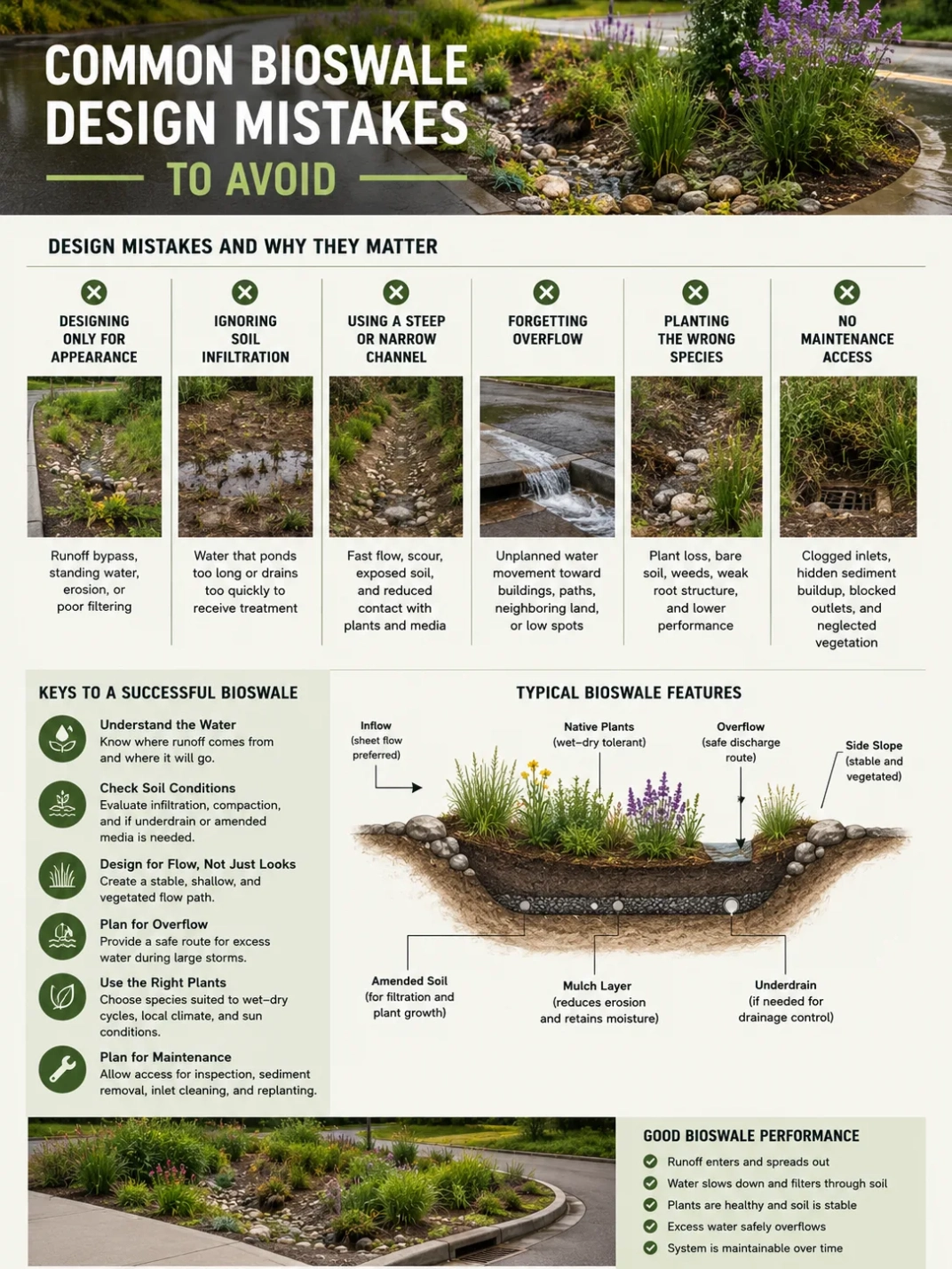
Most outlet problems are not dramatic at first. They show up as small signs: sediment at the grate, mulch washed toward the low end, bare soil near the outlet, longer ponding after storms, or plants dying in one wet pocket. These signs matter because they show how water is really moving.
- Outlet set too high: water ponds deeper than intended and may remain too long after storms.
- Outlet set too low: runoff exits before the swale provides enough slowing, settling, or filtration.
- No stable discharge area: water cuts a channel at the downstream end.
- Clogged grate or curb opening: overflow backs up and finds an unintended route.
- Buried underdrain outlet: filtered water cannot leave freely, which may extend wet conditions in the media.
- Short-circuit flow: water moves from inlet to outlet without using the full flow path.
- Poor downstream capacity: water leaves the swale but backs up from the receiving system during storms.
Outlet problems often connect to inlet problems. Too much concentrated inflow can carry sediment to the outlet. Poor pretreatment can clog grates and underdrains. Compacted soil can push more water toward the overflow because less water infiltrates into the media.
Maintenance Access Is Part of Outlet Design
An outlet that looks neat on day one may fail quietly if it cannot be maintained. Leaves, grit, mulch, and plant debris tend to move toward low points. That makes the outlet a natural collection zone.
Good maintenance access includes a visible outlet location, room to remove sediment, safe footing near the structure, and a way to inspect pipe or underdrain connections. In public or commercial settings, it may also require access for vacuum equipment, hand tools, or small maintenance vehicles without compacting the bioswale soil.
Maintenance Note: Outlet checks should look for blockage, erosion, displaced stone, buried pipe ends, sediment depth, standing water, and signs that overflow is leaving by a route that was not planned.
Bioswale Outlets Compared with Related Systems
A bioswale outlet is related to outlet details used in rain gardens, drainage swales, bioretention cells, and detention basins, but the design purpose is not the same in each case.
A rain garden often stores water in a basin-like depression and may overflow through a notch, standpipe, or low edge. A bioswale is more linear, so outlet design must consider movement along the channel as well as storage.
A drainage ditch mainly conveys water. A bioswale should convey water while also slowing, filtering, and supporting vegetation. If the outlet pulls water out too quickly, the system behaves more like a ditch.
A French drain moves water below ground through gravel and pipe. A bioswale outlet deals with both surface overflow and, in some designs, underdrain discharge. These are different drainage paths and should not be merged in planning without checking capacity and maintenance needs.
What to Check Before Choosing an Outlet Detail
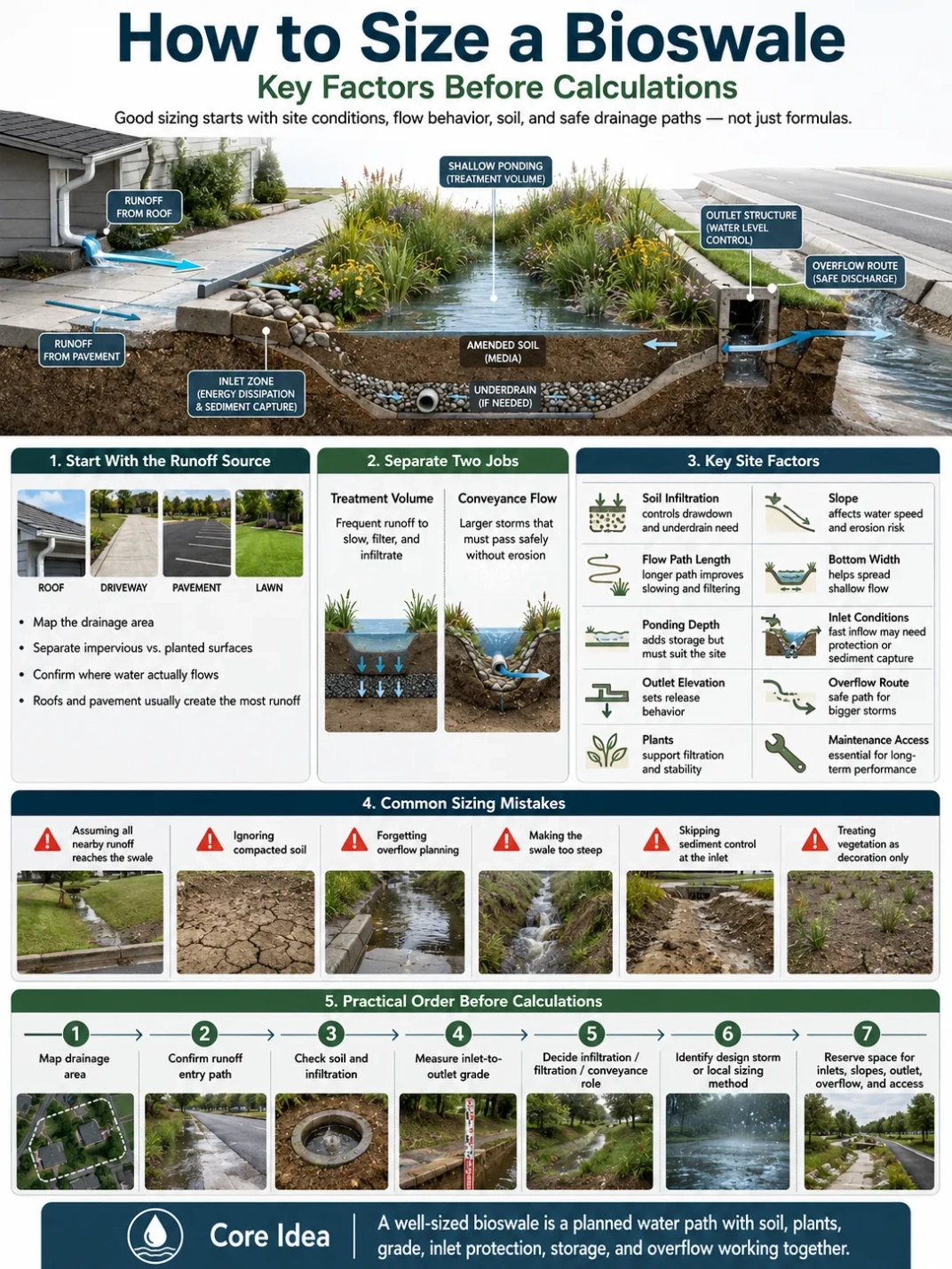
Outlet choice should come after the site has been read carefully. A detail that works in a public streetscape may be too formal for a yard. A simple open notch may be too exposed for a parking lot receiving high sediment loads. The right design begins with the water source and the receiving point.
- Identify the runoff source. Roof runoff, driveway runoff, roadside runoff, and parking lot runoff carry different flow patterns and sediment loads.
- Trace the full flow path. Water should have a clear route from inlet to outlet without jumping across the swale or cutting through side slopes.
- Check soil and infiltration behavior. Slow infiltration increases reliance on the outlet, overflow, or underdrain.
- Confirm the discharge area. The receiving point must be stable and allowed by local drainage rules.
- Allow for inspection. The outlet should be visible, reachable, and simple to clear.
- Plan for larger storms. The overflow route should handle excess water without damaging the swale or nearby surfaces.
For sites near building foundations, basements, retaining walls, public roads, steep slopes, contaminated soils, high groundwater, or shared drainage systems, a qualified professional should review the outlet and overflow plan. This is not about making the design complicated. It is about avoiding a discharge path that looks fine in dry weather but performs poorly during a storm.
Residential and Public-Space Outlet Basics
In a residential setting, the outlet often needs to solve a small but very practical problem: where will roof or driveway runoff go after the swale fills? The answer should not be “toward the foundation” or “wherever the yard is lowest.” A small stabilized overflow path can be enough where local conditions allow, but the route should be deliberate.
In parking lots, campuses, streets, and civic landscapes, outlet design usually needs more control. Hard surfaces send faster runoff, curb cuts can concentrate flow, and sediment can build near inlets and outlets. These settings may need overflow structures, curb-compatible grates, stone energy dissipation, cleanouts, and coordination with the storm drain network.
Public-space outlets also need to be legible for maintenance crews. If the outlet is hidden under plants or placed where crews cannot reach it, routine inspection becomes less likely. A small maintenance oversight can turn into standing water, plant decline, or erosion at the discharge edge.
FAQ
What is the purpose of a bioswale outlet?
A bioswale outlet gives excess runoff a planned exit path. It helps control overflow, reduce erosion, protect the planting bed, and move water toward an approved discharge point when the swale reaches its intended storage level.
Does every bioswale need an overflow outlet?
Most bioswales need some form of planned overflow route because storms can exceed the swale’s storage and infiltration capacity. The route may be a surface notch, overflow inlet, bypass channel, pipe connection, or another approved outlet detail.
Is an underdrain outlet the same as a surface overflow?
No. An underdrain outlet carries water that has filtered through the soil media into a perforated pipe. A surface overflow handles water that rises above the planned ponding level before it can filter down.
Where should a bioswale overflow discharge?
Overflow should discharge to a stable and approved receiving area, such as a storm drain, open channel, vegetated buffer, another stormwater feature, or a protected landscape drainage route. The best option depends on site grading, downstream capacity, soil, and local rules.
What happens if the outlet is too high?
An outlet set too high can create deeper ponding than intended. That may extend wet conditions, stress plants, increase standing water, or cause water to spill from an unintended edge of the bioswale.
How often should a bioswale outlet be checked?
A bioswale outlet should be checked during routine landscape maintenance and after storms that leave visible sediment, debris, mulch movement, standing water, or erosion. Public and commercial sites often need a more formal inspection schedule.