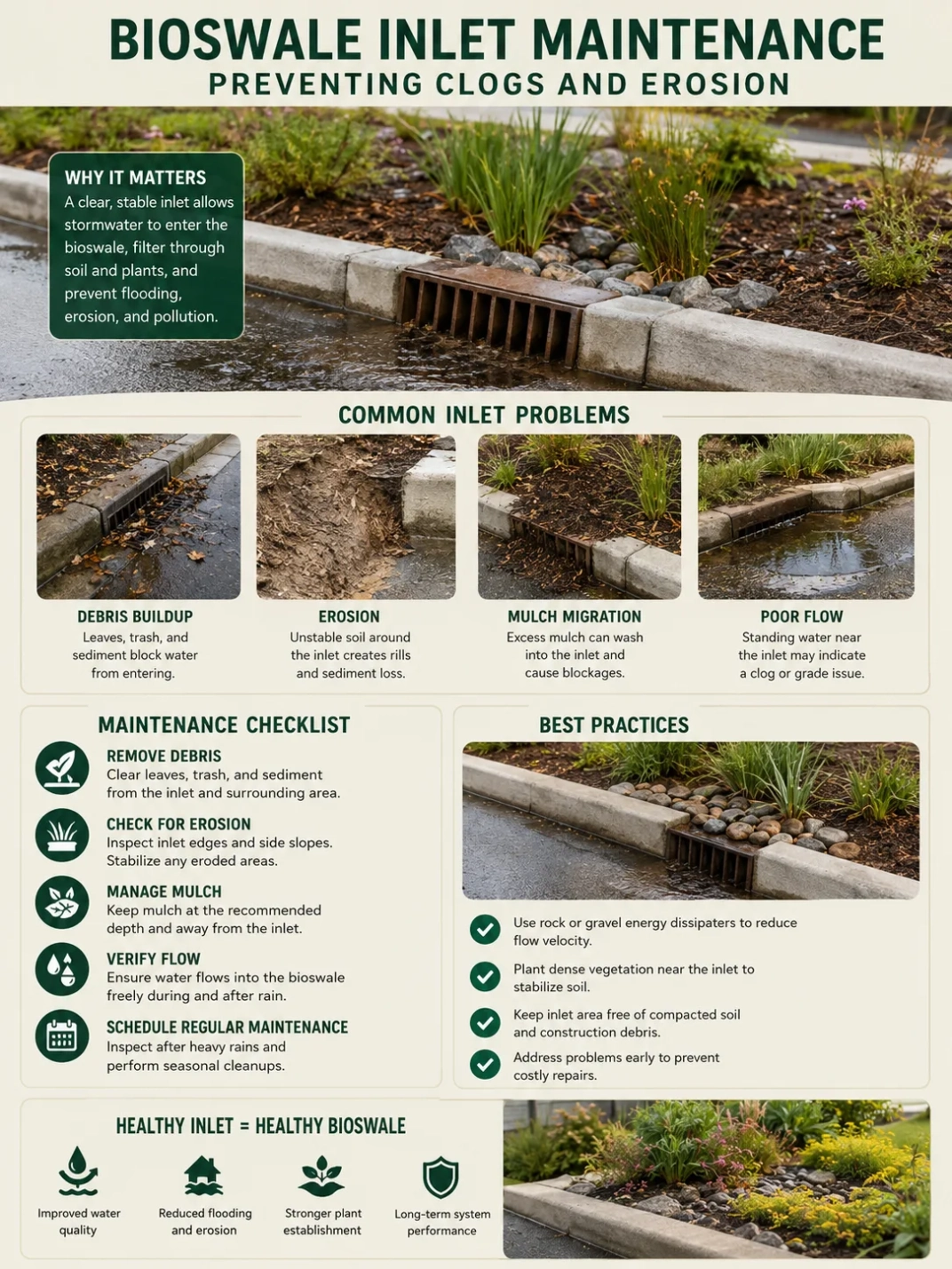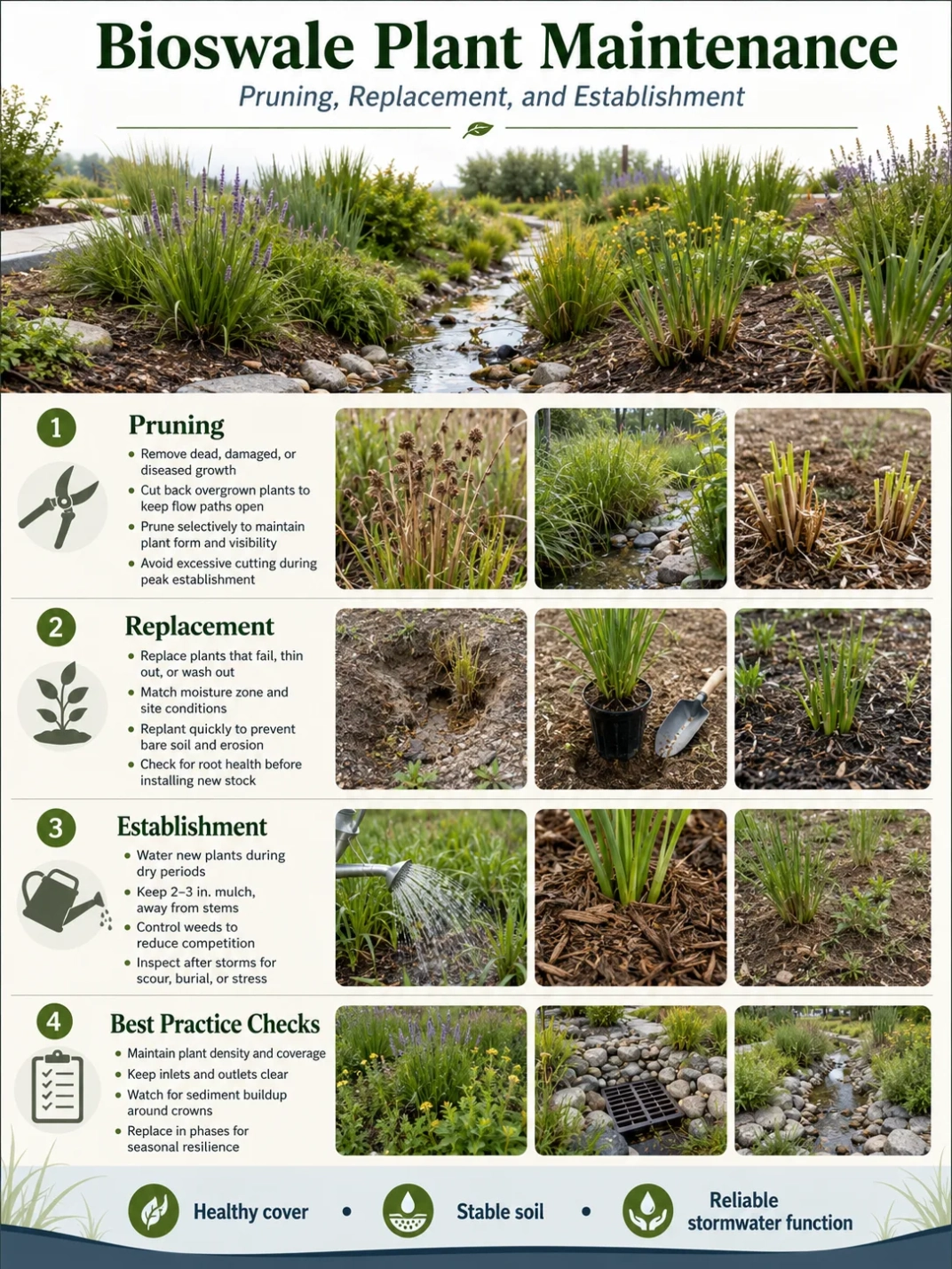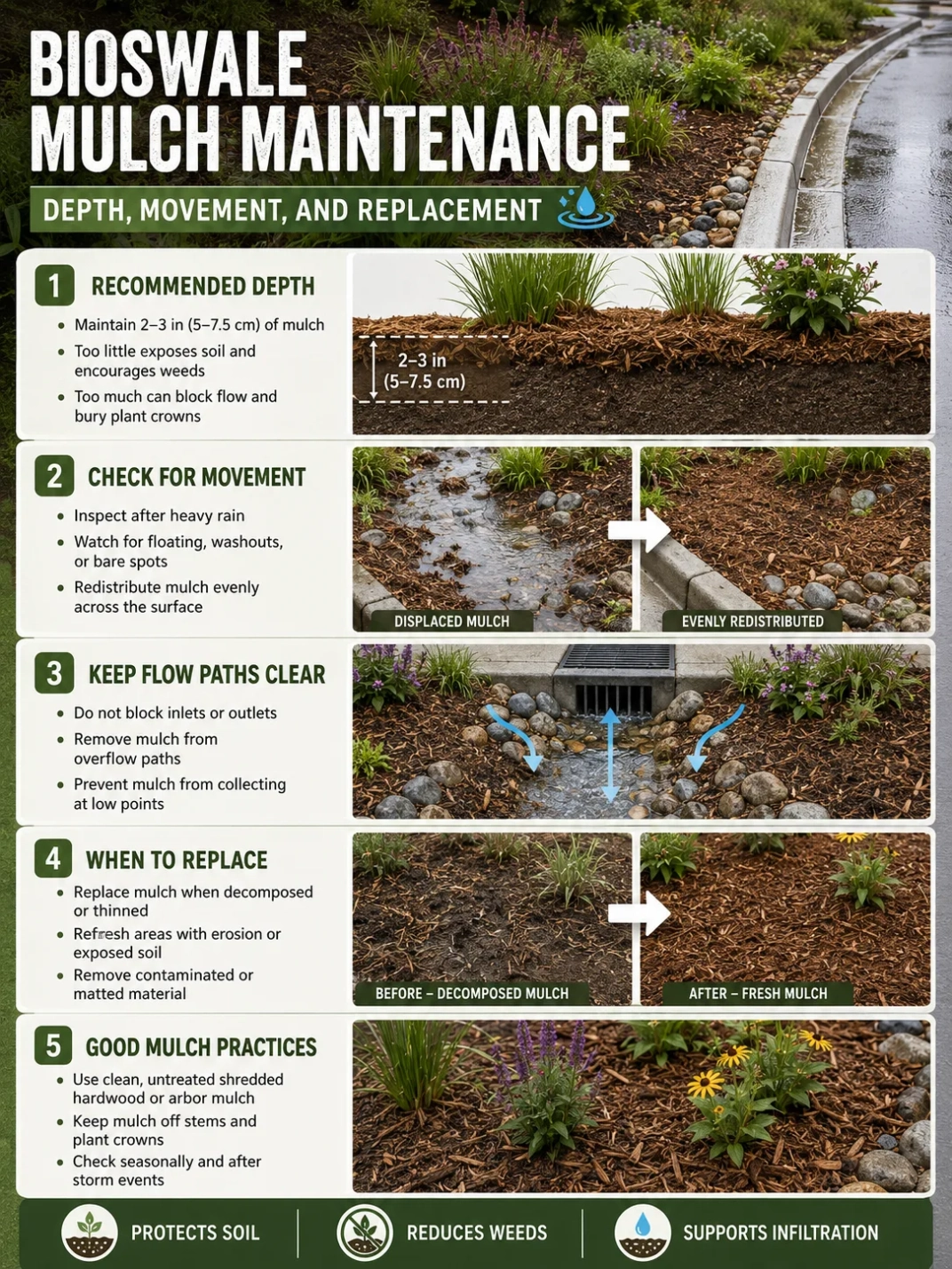
Mulch is more than a surface covering in a bioswale. It helps reduce soil erosion, cushions the impact of incoming runoff, limits weed growth, supports moisture balance during plant establishment, and protects the filter media below. None of these benefits last without routine inspection. Mulch gradually shifts, decomposes, or washes away, making depth, movement, and timely replacement essential parts of bioswale maintenance.
Why Mulch Condition Matters
A healthy mulch layer supports both vegetation and stormwater performance. While runoff enters the bioswale, the mulch slows surface flow, reduces splash erosion, and helps trap fine sediment before it reaches the underlying soil media.
When mulch becomes too thin, bare soil may appear, increasing the chance of erosion and weed establishment. When it becomes too thick, it may reduce air exchange around plant crowns, delay water movement into the soil, or create uneven flow paths.
| Condition | Likely Effect | Maintenance Response |
|---|---|---|
| Even mulch layer | Protects soil and supports infiltration | Continue routine inspections |
| Bare soil patches | Higher erosion potential | Replace missing mulch after checking runoff patterns |
| Mulch piled at outlet or edges | Uneven flow distribution | Redistribute mulch evenly |
| Heavy decomposition | Reduced surface protection | Add fresh mulch where needed |
| Floating mulch after storms | Loss of surface cover | Inspect inflow velocity and restore the mulch layer |
Maintaining Proper Mulch Depth
Consistency matters more than excessive thickness. A uniform mulch layer helps distribute runoff evenly across the bioswale instead of forcing water into narrow channels.
The preferred depth depends on the mulch material, local rainfall, vegetation, and project specifications. Instead of adding new mulch every season automatically, inspect the existing layer first. Many bioswales only need localized replenishment rather than complete replacement.
Fresh mulch should not bury plant stems, cover emerging shoots, or block surface drainage around established vegetation.
Uneven mulch depth often indicates a hydraulic issue rather than a mulch problem. Before adding more material, inspect runoff entry points, side slopes, and flow paths.
Why Mulch Moves During Storm Events
Some mulch movement is normal during intense rainfall. Water entering from roof drains, curb openings, parking lots, or concentrated discharge points may temporarily lift lightweight mulch and carry it toward lower sections of the bioswale.
Movement becomes a maintenance concern when it repeatedly exposes filter media, blocks outlets, forms mulch piles, or creates channels where runoff bypasses planted areas.
Common Reasons for Mulch Displacement
- High-velocity inflow at inlets.
- Steeper-than-expected surface grades.
- Very lightweight mulch materials.
- Large runoff volumes from impervious surfaces.
- Limited vegetation holding the surface together during establishment.
- Concentrated flow caused by sediment buildup.
Inspecting Mulch After Heavy Rain
Storm inspections often reveal developing maintenance issues before they become larger drainage problems. The goal is not only to replace lost mulch but also to understand why it moved.
- Check inlet areas for exposed soil.
- Look for mulch accumulation near the outlet.
- Identify narrow flow channels cutting through the mulch.
- Inspect around plant crowns for excessive buildup.
- Confirm that overflow routes remain clear.
- Look for sediment buried beneath or mixed into the mulch layer.
Repeated mulch displacement often points to concentrated runoff rather than inadequate mulch alone. Adjusting inflow conditions may provide a longer-lasting solution than frequent replacement.
When Replacement Is Appropriate
Replacement becomes useful when the mulch no longer provides reliable soil protection or has lost its structure through decomposition. It is usually unnecessary to remove every remaining piece of mulch if much of the layer still performs well.
Localized replacement is often appropriate where runoff consistently removes mulch near inlets or where maintenance activities have disturbed the surface.
Signs That New Mulch May Be Needed
- Persistent bare soil.
- Visible filter media exposed over large areas.
- Extensive weed emergence after surface thinning.
- Mulch reduced to fine organic fragments.
- Repeated washouts despite redistribution.
- Noticeable mixing of mulch with accumulated sediment.
Choosing Replacement Material
Replacement mulch should match the original design where possible. Material type affects moisture retention, decomposition rate, movement during runoff, and appearance. Projects using engineered filter media or specialized planting plans may specify particular mulch products.
Organic shredded wood mulch is commonly used because it provides surface protection while gradually decomposing into organic matter. Extremely fine materials may move more easily or contribute to clogging if allowed to accumulate in low areas.
How Mulch Supports Plant Health
Young native grasses, sedges, rushes, shrubs, and other bioswale plants often benefit from stable surface moisture during establishment. A maintained mulch layer helps reduce rapid drying between rainfall events while also limiting competition from unwanted vegetation.
As plant roots mature and vegetation becomes denser, the bioswale surface generally becomes more resistant to erosion, reducing the amount of mulch movement during typical storms.
Details That Shape Long-Term Performance
Mulch maintenance should be viewed together with sediment removal, inlet inspection, vegetation care, and surface grading. Restoring only the mulch without correcting underlying flow issues may lead to repeated maintenance after every major rainfall.
Sites receiving runoff from large parking lots, roads, or other hard surfaces may experience heavier sediment loads than residential bioswales, making inspections more frequent depending on local conditions.
Frequently Asked Questions
How often should bioswale mulch be inspected?
Routine inspections are commonly performed after major storm events and during scheduled maintenance visits. Sites with high runoff volumes may require more frequent checks.
Should all mulch be replaced every year?
No. Many bioswales only need spot repairs where mulch has washed away or decomposed. Full replacement depends on site conditions and the remaining quality of the mulch layer.
Why does mulch collect near the outlet?
Runoff can gradually transport lightweight mulch downslope. This may indicate concentrated flow, uneven grading, or high inflow velocity that should also be evaluated.
Can mulch reduce erosion inside a bioswale?
Yes. An even mulch layer helps protect exposed soil from raindrop impact and slows shallow surface flow, especially while vegetation is becoming established.
What should be checked before adding new mulch?
Inspect the inlet, outlet, surface grading, sediment accumulation, vegetation condition, and runoff flow path first. Correcting those issues may prevent repeated mulch loss.