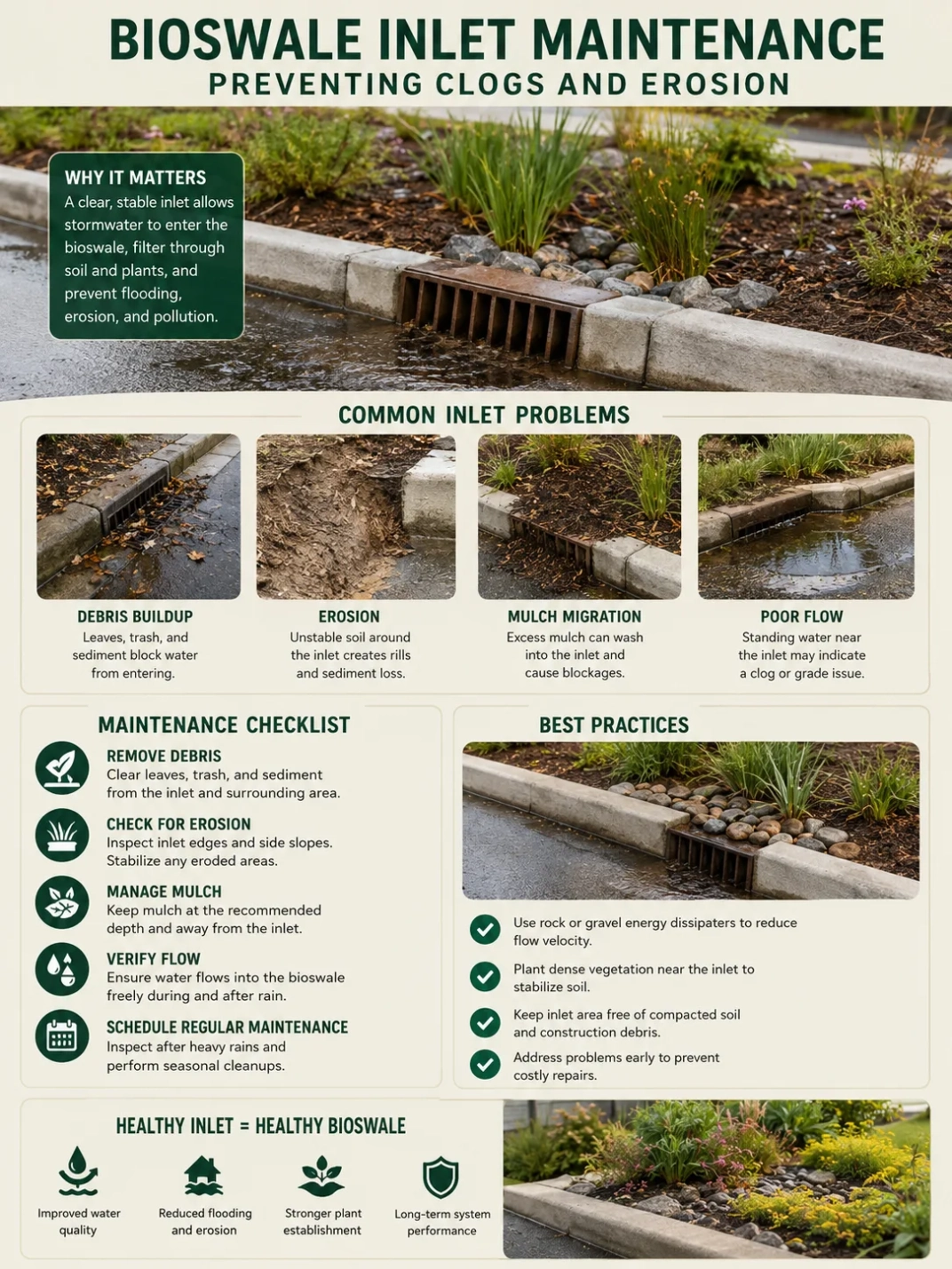
A bioswale inlet is the point where stormwater runoff first enters the planted drainage area. When sediment, leaves, trash, or displaced mulch block that opening, water may bypass the bioswale, spread across pavement, or cut an erosive channel through the soil. Regular inlet maintenance keeps the intended flow path open while protecting soil media, plants, and downstream drainage components.
Most inlet problems begin as small changes: a thin sediment layer, a pile of wet leaves, exposed soil below a curb cut, or water entering from one narrow corner. These conditions are easier to correct before they develop into deep rills, compacted deposits, damaged vegetation, or repeated overflow.
What a Bioswale Inlet Needs to Do
The inlet connects an impervious surface—such as a road, parking lot, driveway, sidewalk, or roof drainage route—to the bioswale. Its job is not simply to admit water. It should also help spread runoff, reduce concentrated flow, and direct sediment toward an area that can be inspected and cleaned.
A working inlet usually supports four basic functions:
- Allows runoff to enter without backing up across the contributing surface.
- Moves water toward the intended ponding or conveyance area.
- Reduces the force of concentrated flow before it reaches exposed soil.
- Keeps coarse sediment and debris where maintenance crews can remove them.
The exact inlet form depends on the site. Common examples include curb cuts, curb openings, paved flumes, trench drains, pipe outlets, stone aprons, level spreaders, and shallow transitions from pavement into vegetation. Each type can fail in a different way, but clogging and erosion often occur together.
Common Inlet Problems and What They Indicate
| Observed Condition | Likely Cause | Maintenance Response |
|---|---|---|
| Water bypasses the inlet | Leaves, litter, sediment, or displaced mulch blocking the opening | Remove loose material and confirm that the approach grade remains open |
| A sediment ridge forms at the entrance | Road grit or soil settles where runoff slows | Remove the deposit without digging into the underlying soil media |
| A narrow channel forms below the inlet | Runoff enters with too much force or is not spread across the inlet zone | Stabilize the damaged area and assess energy dissipation |
| Mulch collects against the curb cut | Flow has moved loose mulch toward the opening | Pull mulch away from the entrance and correct excessive mulch depth |
| Plants are flattened or uprooted | Concentrated flow repeatedly strikes the same location | Restore the inlet transition before replacing plants |
| Standing water remains near the inlet | Compacted sediment, poor grading, clogged soil surface, or downstream blockage | Check the full flow path rather than treating the inlet alone |
These visible symptoms are clues. Removing debris may restore flow for the next storm, but repeated deposits or recurring scour often point to a problem with runoff concentration, grading, upstream sediment, or the inlet’s physical transition.
How Inlet Clogging Develops
Clogging rarely consists of one material. A curb opening may collect leaves first, then trap litter, fine sediment, grass clippings, and mulch. As the pile grows, incoming water presses the material into a dense mat. Fine particles can then settle behind it and form a compacted layer.
Runoff sources shape the type of maintenance needed:
- Roadside runoff may carry grit, soil, leaf fragments, and winter maintenance residue.
- Parking lot runoff may bring fine pavement sediment, litter, and material from landscaped islands.
- Driveway runoff may carry soil from adjacent beds or unpaved shoulders.
- Roof runoff may carry leaf fragments, roofing granules, or material from clogged gutters.
- Construction-area runoff can deliver heavy sediment loads that overwhelm an inlet and soil surface.
Fine sediment deserves close attention because it may look harmless when dry. Once compacted, it can seal surface pores, slow infiltration, bury plant crowns, and alter the elevation of the inlet zone.
Maintenance Note: Remove accumulated sediment before it becomes mixed deeply into mulch or filter media. Scraping too aggressively can lower the inlet zone and create a new low channel, so work should stop at the original soil or surface layer.
A Practical Inlet Inspection Sequence
An inlet inspection should follow the direction of water. Looking only at the curb opening can miss upstream causes and downstream restrictions.
- Check the runoff approach. Look for sediment trails, leaf piles, pavement depressions, wheel ruts, or landscape soil washing toward the inlet.
- Inspect the opening. Confirm that curb cuts, grates, pipes, or flumes are not narrowed by debris, mulch, roots, or damaged edging.
- Examine the transition. Look for exposed soil, loose stone, undercut edges, cracks, displaced blocks, or a drop between pavement and the bioswale surface.
- Follow the initial flow path. Note rills, flattened plants, sediment fans, bare patches, or water marks that show concentrated flow.
- Check the downstream route. Confirm that the bioswale, check dams, outlet, overflow route, and underdrain features are not causing water to back up toward the inlet.
- Record recurring conditions. Repeated clogging at the same location may need more than routine cleaning.
Inspections are most informative during rainfall or soon afterward, when flow marks are still visible. Work near roads, parking areas, or flowing water should follow suitable site safety procedures.
Removing Debris Without Damaging the Bioswale
Loose litter, leaves, twigs, and grass clippings can usually be removed by hand tools. Wet material may need to be lifted rather than pushed farther into the bioswale. Debris should not be left on a nearby slope where the next storm can return it to the inlet.
When removing sediment, preserve the designed surface elevation. The goal is to expose the original inlet surface, not create a deeper basin. A visible boundary between deposited sediment and underlying soil media may help guide removal.
Heavy equipment can compact the inlet zone, damage roots, and disturb grading. Small tools are often better for routine work. Larger sediment deposits may require a planned restoration, especially where the inlet connects to public pavement or where buried utilities may be present.
What to Do With Removed Material
Collected sediment and debris should be handled according to site conditions and local requirements. Material from ordinary landscaped runoff may differ from sediment collected beside a heavily used road, industrial area, fueling area, or active construction site. Unknown or visibly contaminated material should not be spread in planting beds without suitable review.
Preventing Erosion Below the Inlet
Erosion begins when incoming runoff has enough speed or concentration to move mulch, soil, stone, or plant material. The first warning may be a shallow groove. Over time, that groove can deepen and focus even more water into the same path.
Effective erosion control usually combines flow spreading, surface protection, stable grading, and suitable vegetation. Simply filling a channel with loose soil may provide only temporary repair because the next storm follows the same route.
Stabilize the Transition
The point where pavement ends and planted soil begins often receives the greatest hydraulic stress. A stable transition may use stone, a paved apron, reinforced soil, dense vegetation, or another site-specific treatment. The surface should not create an abrupt drop that allows water to plunge onto bare soil.
Spread Concentrated Runoff
A narrow jet of water can cut through an otherwise healthy bioswale. Inlet geometry may need to distribute flow across a wider area before it reaches the soil media. A level edge, broad apron, shallow forebay, or carefully placed stone can help in some designs, depending on the drainage area and local site conditions.
Use Stable Materials
Loose decorative stone or lightweight mulch may move during concentrated flow. Material selection should reflect expected runoff energy. Stone used near an inlet should be placed so that water does not simply cut around its edges or wash out the soil beneath it.
Design Note: Repeated scour, exposed geotextile, undercut pavement, or movement of large stone may indicate that the inlet receives more concentrated flow than the existing treatment can manage. A landscape architect, civil engineer, drainage professional, or other qualified reviewer may need to assess the contributing area and inlet geometry.
Managing Sediment Before It Reaches the Soil Media
Sediment is easier to remove from an accessible inlet zone than from the planted interior of a bioswale. Some systems include a forebay, stone strip, pretreatment cell, sump, or hardened apron that allows coarse material to settle before runoff spreads across the filter media.
These features still need maintenance. A sediment forebay that fills above its intended level may stop trapping material and begin passing sediment farther into the bioswale. It can also redirect water around its edges.
Where no formal pretreatment area exists, the first few feet of the bioswale often serve that role. This zone should remain visible and reachable. Dense plant growth, deep mulch, or ornamental edging should not hide the location where sediment collects.
Mulch Problems at the Inlet
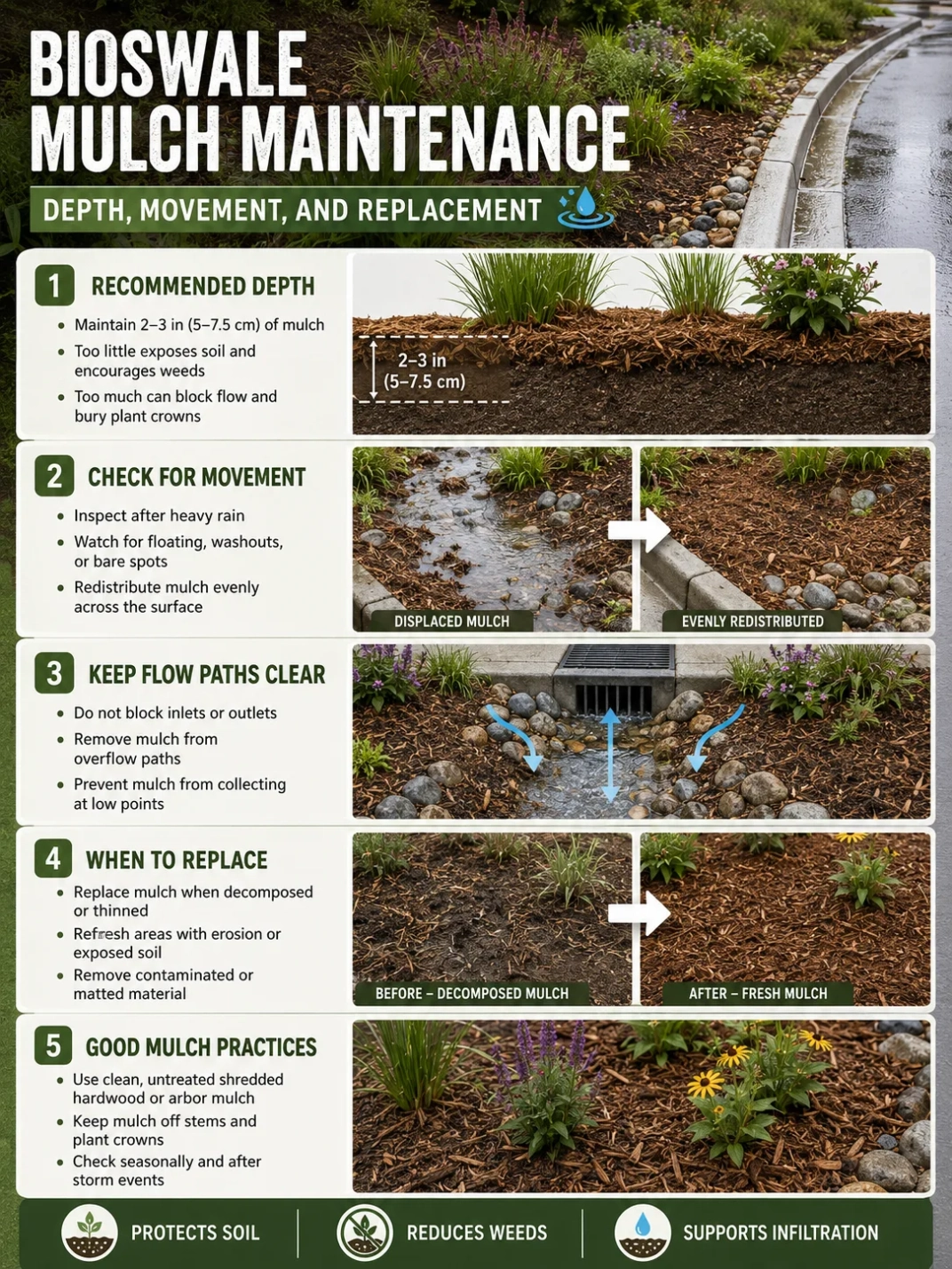
Mulch can protect soil, reduce weed growth, and limit surface crusting, but it may also become inlet debris. Floating mulch can lodge in curb openings, cover grates, form dams, or move into the street.
Common warning signs include mulch piled against the upstream side of plants, exposed soil where mulch has washed away, and a thick ridge at the inlet. Repeated movement may indicate excessive depth, unsuitable material, or concentrated flow that should be corrected.
Do not replace washed-out mulch without first checking the cause. Adding another layer can raise the inlet elevation, bury plant crowns, and create more material for the next storm to move.
Plant Care in the Inlet Zone
Plants near an inlet face different conditions from plants farther upslope. They may receive stronger flow, more sediment, longer wet periods, and physical disturbance during cleaning. Species used in this zone should tolerate the expected wet-dry pattern and have roots that help hold the soil.
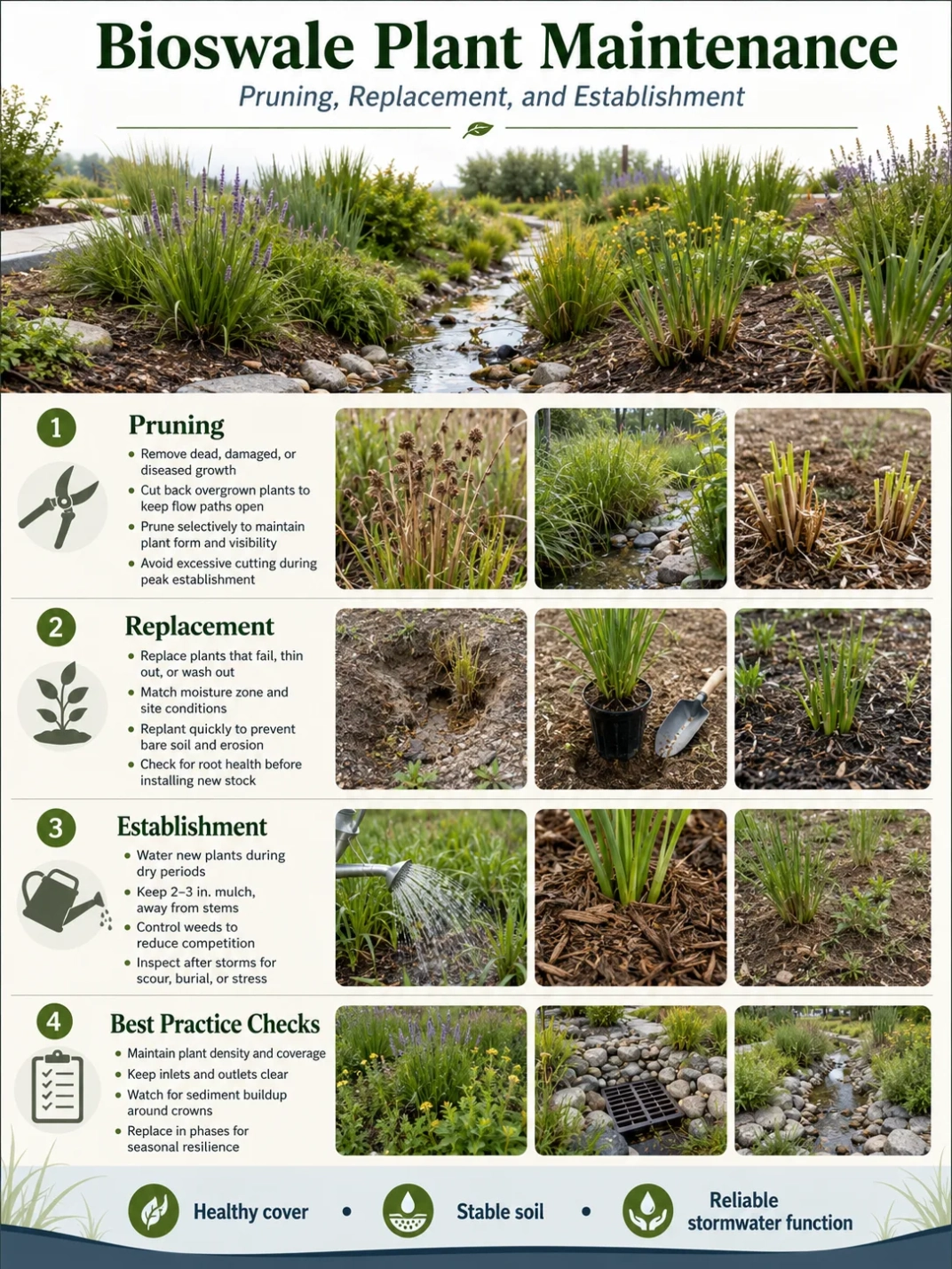
Plant cover can reduce erosion, but plants should not block the opening. Stems, fallen leaves, dense groundcover, and volunteer woody growth may narrow the inlet or hide sediment deposits. Pruning should preserve healthy growth while maintaining a visible water path.
Replace uprooted or buried plants only after stabilizing the flow path. Otherwise, new plants may fail for the same reason. Where repeated flow is too forceful for vegetation, the immediate inlet area may need a hardened or stone-protected transition before planting begins.
Planting Note: Avoid placing delicate plants directly in the strongest inlet jet. Plant arrangement should respond to actual water movement, not only to the visual edge of the bed.
Seasonal Inlet Maintenance
Inlet conditions change through the year. A maintenance schedule should reflect local rainfall, leaf drop, snow management, landscape work, and nearby construction rather than rely on one fixed calendar.
After Heavy Rain
- Check whether runoff entered the bioswale or bypassed it.
- Look for new channels, displaced stone, exposed soil, and flattened plants.
- Remove debris that could block the next storm.
- Note sediment depth and where deposits formed.
During Leaf-Fall Periods
- Clear wet leaves before they mat across curb cuts or grates.
- Inspect upstream gutters and pavement edges.
- Remove leaf piles without stripping established plant cover.
After Winter Weather
- Remove accumulated grit and material left by snow storage where applicable.
- Check for damage from plows, shovels, or piled snow.
- Inspect stone aprons and pavement transitions after freeze-thaw movement.
- Look for salt-stressed vegetation near roadside inlets.
During Dry Periods
Dry weather offers a good opportunity to remove compacted sediment, repair small erosion areas, reset displaced stone, and restore plant cover. It is also easier to see cracks, elevation changes, and soil crusting when the inlet is not holding water.
Why the Upstream Area Matters
An inlet may clog repeatedly even when it is cleaned well. The cause may be outside the bioswale.
Check for bare soil, eroding slopes, unprotected planting beds, damaged pavement edges, unpaved vehicle areas, gutter deposits, and construction access points within the contributing drainage area. Reducing sediment at its origin can lower maintenance demand and protect infiltration surfaces.
Landscape maintenance practices also affect inlet performance. Blowing leaves, grass clippings, or loose mulch toward a curb opening can load the system before rainfall begins. Clear communication with grounds crews may prevent recurring blockages.
When Standing Water Points to a Larger Problem
Water near the inlet does not always mean the inlet itself is blocked. The bioswale may be full because the outlet is obstructed, the soil surface is sealed by sediment, an underdrain is restricted, a check dam is holding water higher than intended, or the downstream drainage route is backed up.
Follow the full system before changing the inlet grade. Lowering an inlet to release standing water can unintentionally deepen ponding, alter storage, or create a permanent low point.
Persistent ponding, water reaching adjacent buildings, repeated pavement flooding, or unexplained changes in drainage should receive site-specific review. Bioswale maintenance can restore intended function, but it cannot correct every grading, capacity, or downstream drainage problem.
Temporary Repairs That Often Fail
Some quick repairs improve appearance without correcting water movement. Watch for these common patterns:
- Filling an erosion channel with loose topsoil. Concentrated runoff may wash it out during the next storm.
- Adding more mulch to a scoured inlet. The replacement mulch may float, block the opening, or move onto pavement.
- Piling small stone into a hole. Water may undermine the stone or cut around its edges.
- Planting directly into an active flow jet. Roots may not establish before the next high-flow event.
- Deepening the inlet by repeated scraping. This can change grade and draw more water into one narrow route.
- Cleaning only the visible opening. A downstream blockage may continue to cause backup.
A durable repair should address the reason material moved, accumulated, or eroded.
Maintenance Access and Documentation
An inlet should remain easy to see and reach. Shrubs, dense grasses, signs, fences, parked vehicles, or decorative features should not prevent inspection. Public and commercial sites may also need safe access for workers without requiring them to stand in traffic or disturb planted soil.
Simple records help identify recurring patterns. Useful notes include:
- Date and recent weather conditions
- Type and approximate amount of debris or sediment removed
- Location of erosion or bypass flow
- Plant damage or bare soil
- Condition of stone, pavement, curb cuts, pipes, or grates
- Photos taken from the same viewpoint
- Repairs completed and follow-up needs
A repeated sediment fan, blocked curb cut, or scour channel becomes easier to diagnose when records show how quickly it returns and which storms produce it.
When Professional Review Is Appropriate
Routine debris removal and minor plant care are normal maintenance tasks. Professional review may be appropriate when the inlet shows structural damage, severe erosion, repeated pavement flooding, exposed utilities, undermined curbs, displaced large stone, or continued failure after cleaning.
Review may also be needed when changes to grading, curb geometry, pipe size, pretreatment areas, overflow routes, or downstream connections are being considered. These features affect more than appearance; they influence how runoff moves through the site.
Site Planning Note: Do not redirect runoff toward neighboring property, building foundations, pedestrian routes, or public drainage areas without suitable site evaluation. Local drainage rules and design requirements may apply.
Bioswale Inlet Maintenance FAQ
How often should a bioswale inlet be inspected?
Inspection frequency depends on rainfall, sediment load, leaf drop, traffic, nearby construction, and the inlet type. Checks after heavy storms and during periods of heavy debris accumulation are often more useful than relying only on fixed calendar dates.
What should be removed from a bioswale inlet?
Remove litter, leaves, twigs, grass clippings, displaced mulch, excessive sediment, and other material that blocks the opening or changes the intended flow path. Avoid removing the original soil media or lowering the inlet surface.
Why does sediment keep returning after cleaning?
The upstream drainage area may contain bare soil, eroding landscape beds, pavement deposits, construction sediment, or an unstable shoulder. Repeated buildup can also mean the inlet lacks an effective sediment collection area.
Can mulch block a curb-cut inlet?
Yes. Loose or overly deep mulch can float into a curb opening and form a dense blockage with leaves and sediment. Mulch should be kept back from the immediate opening and monitored for movement after storms.
Should stone be added where the inlet is eroding?
Stone may help protect an inlet transition in some designs, but random placement can redirect flow or cause erosion around the edges. The stone size, depth, foundation, and placement should match site conditions and expected runoff.
Why is water bypassing the bioswale even though the inlet looks clear?
The pavement approach may have settled, the inlet may be higher than the runoff path, or downstream water may be backing up. Sediment can also create a low ridge that is hard to notice when dry. Observing the site during rainfall can reveal the actual route.