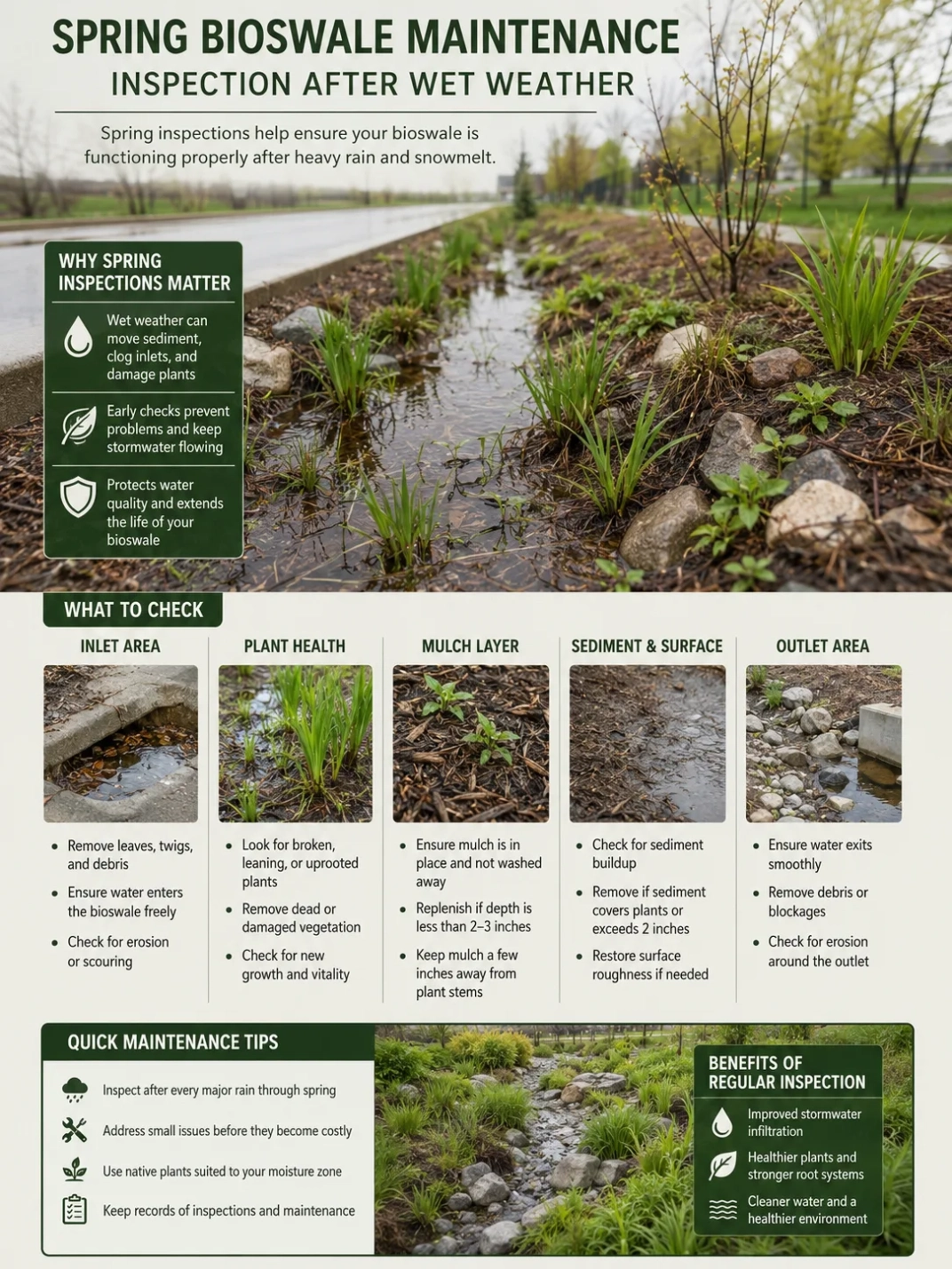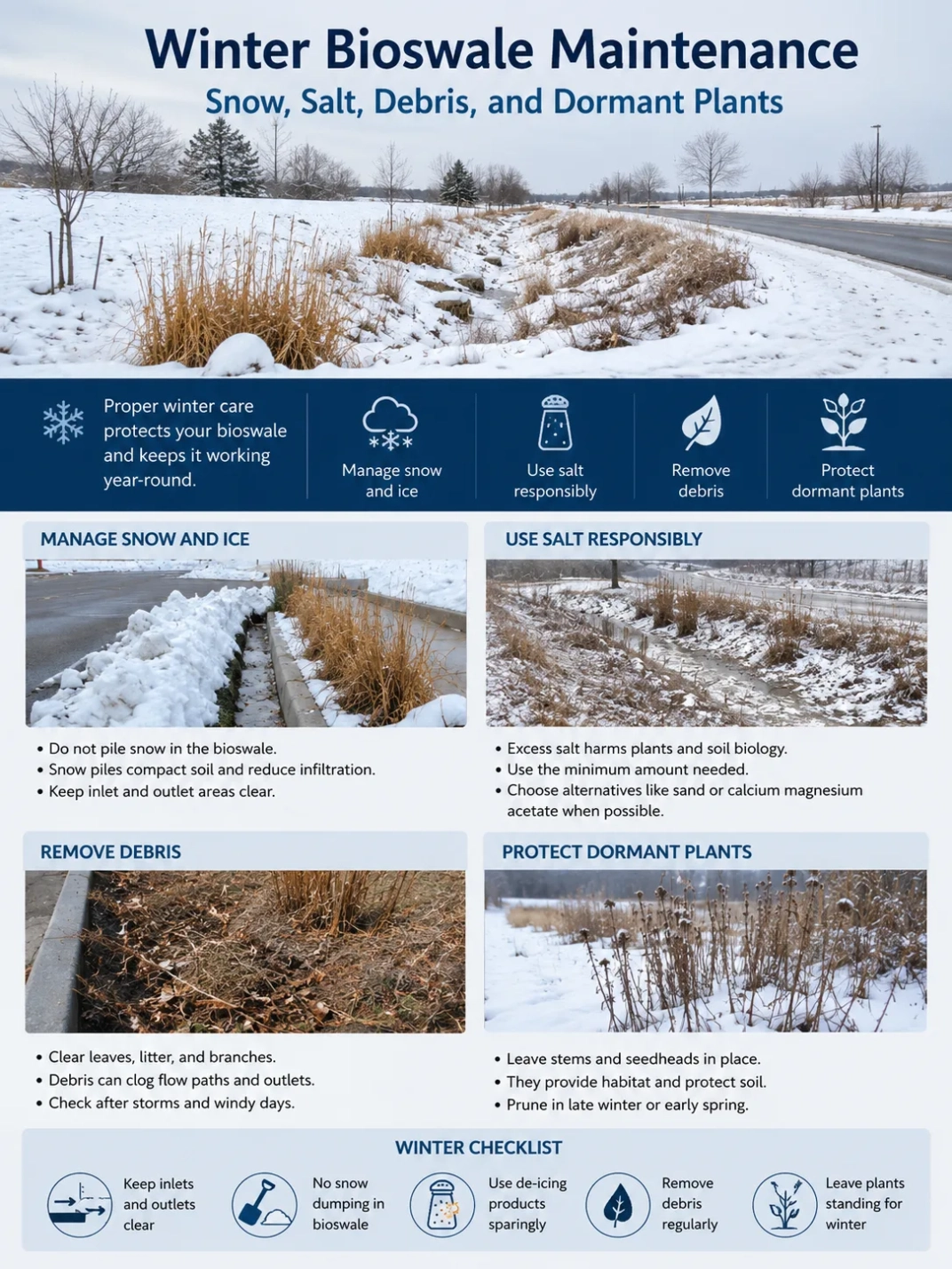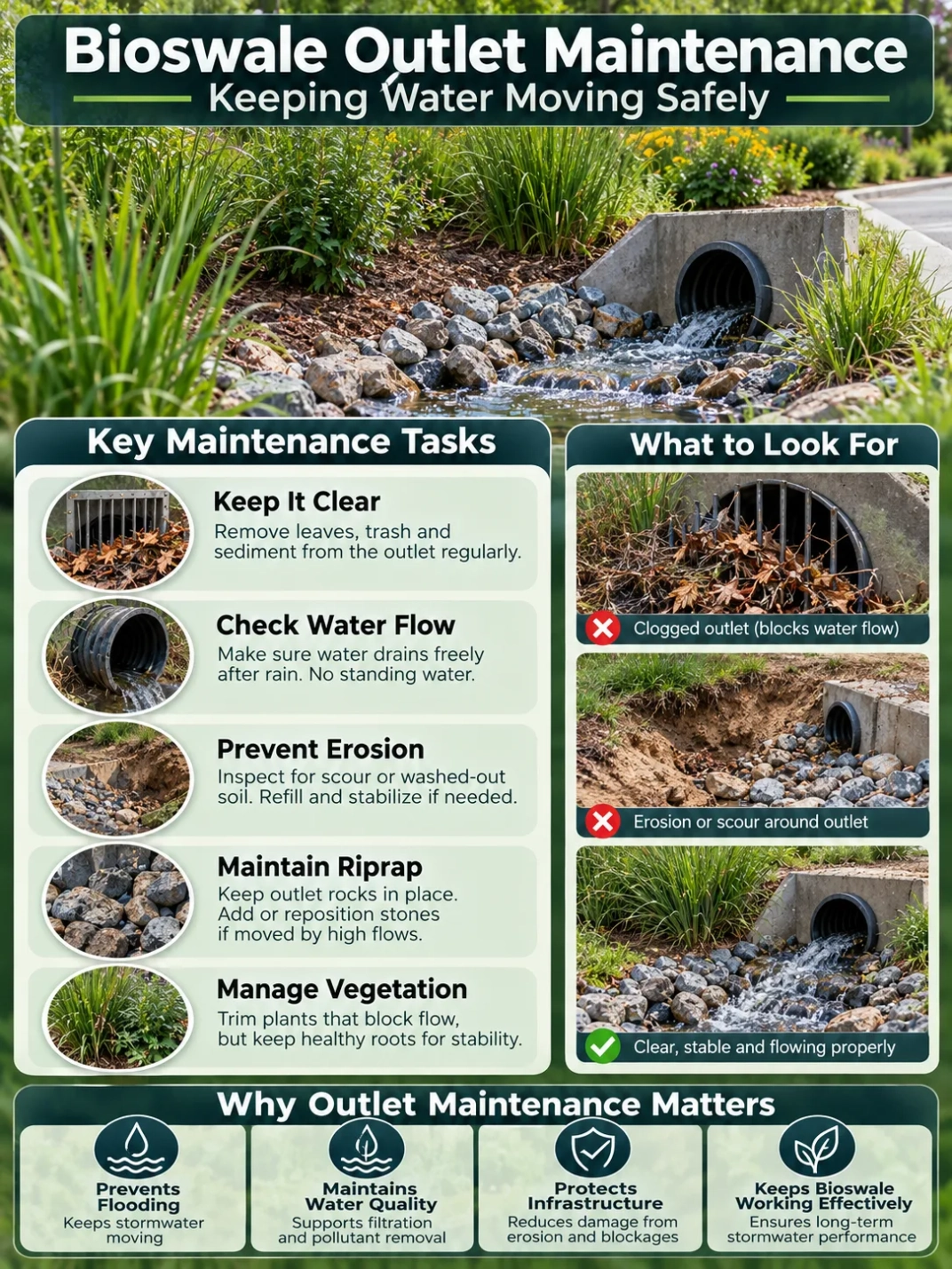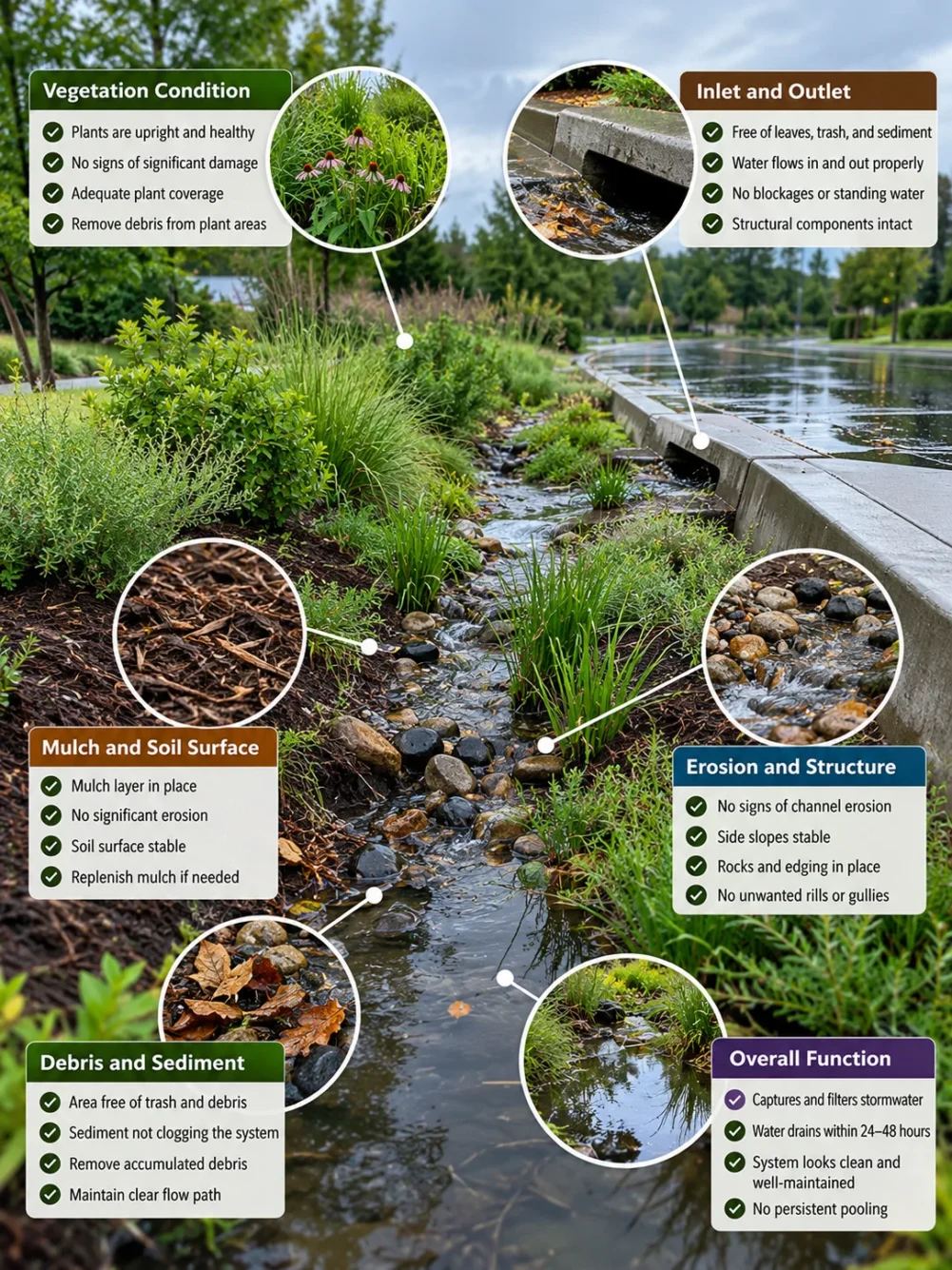
A post-storm bioswale inspection should follow the same path as the runoff: start where water approaches the system, inspect the inlet and main flow path, then check ponding areas, check dams, the outlet, and the overflow route. The most useful evidence is often not standing water itself, but where the water traveled, what it moved, and how quickly the bioswale returns toward its normal condition.
Fresh sediment fans, exposed roots, flattened vegetation, displaced mulch, debris lines, new rills, and high-water marks can reveal problems that are hard to see during dry weather. A second visit after the storm is also useful because drainage problems may become clearer only after runoff has stopped entering the bioswale.
Safety Note: Storm inspection does not require entering flowing water, flooded pavement, unstable slopes, or areas where traffic creates a hazard. Hydraulic behavior can often be observed safely from the edge of the site, with closer inspection performed after water levels fall.
Inspect the Storm in Three Stages
A single inspection can miss part of the story. The most useful approach separates flow behavior from drawdown behavior.
During or Just After Rain: Follow the Water
Observe the bioswale while runoff is still moving, if this can be done safely. The goal is to see whether water follows the intended route.
- Does runoff actually reach the inlet?
- Does water pass the inlet and continue down the curb or pavement?
- Does the inlet spread flow into the bioswale or concentrate it into one narrow path?
- Does water stay within the intended treatment area?
- Are check dams distributing water as expected?
- Does excess water use the intended overflow route?
- Is the outlet releasing water without visible scour?
A bioswale that looks dry during a substantial runoff event may deserve attention. The cause may be upstream diversion, an obstructed curb cut, changed pavement grades, accumulated sediment, or runoff bypassing the facility.
Several Hours Later: Read the Storm Marks
Once active flow subsides, look for what the storm left behind. Debris lines and sediment patterns are often a map of the highest and fastest flow.
Useful clues include displaced mulch, fresh sediment deposits, bent vegetation, exposed soil, small erosion channels, material trapped against check dams, and debris collected at the outlet.
About 24 to 48 Hours Later: Check Drawdown
A follow-up inspection can show whether temporary ponding is draining normally for that particular system. The accepted drawdown period depends on the bioswale design, soil, underdrain configuration, rainfall conditions, and local maintenance requirements, so a universal time limit should not be applied to every site.
What matters most is whether the water level is clearly declining and whether the bioswale behaves differently from its normal pattern.
| Inspection Time | Main Question | Useful Evidence |
|---|---|---|
| During or just after rain | Is runoff moving through the intended route? | Bypass, concentrated flow, overtopping, inlet behavior, outlet flow |
| Several hours later | What did the storm move or damage? | Sediment fans, debris lines, scour, mulch movement, flattened plants |
| 24–48 hours later | Is the system recovering as expected? | Persistent ponding, surface sealing, wet zones, outlet restriction |
Start Upstream Before Inspecting the Bioswale Itself
Not every post-storm problem originates inside the bioswale. Changes in the contributing drainage area can alter where runoff enters and how much sediment reaches the system.
Look at nearby pavement, curbs, roof drainage points, parking areas, driveways, landscaped slopes, and any recently disturbed ground. A new layer of asphalt, moved landscape edging, accumulated gravel, construction soil, leaf piles, or wheel ruts can redirect runoff enough to change bioswale performance.
Signs That Runoff Bypassed the Inlet
- A debris line continues past the inlet along the gutter.
- The bioswale remains unusually dry while downstream pavement shows clear runoff marks.
- Sediment has built a small ridge in front of a curb cut.
- Mulch, leaves, or road grit partially cover the inlet opening.
- Runoff enters farther downstream than it did during previous storms.
This is an important distinction: a dry bioswale is not automatically a well-drained bioswale. During a storm, it may mean the water never entered.
Check the Inlet for Blockage and Scour
The inlet often receives the fastest runoff and the highest sediment load. Post-storm inspection should focus on two opposite problems: too little flow entering and too much energy entering at one point.
Look for Material That Narrows the Opening
Leaves, trash, road grit, gravel, branches, mulch, and deposited soil can reduce the inlet opening. A partial obstruction may still admit water while pushing part of the runoff around the bioswale.
A thin sediment layer is not automatically a defect. Bioswales are expected to intercept material carried by runoff. The problem begins when sediment changes the grade, restricts the inlet, buries vegetation, seals the soil surface, or redirects water.
Inspect the Area Immediately Below the Inlet
Fresh scour often appears where concentrated runoff enters the treatment area. Look for:
- new bare soil;
- exposed plant roots;
- displaced stone;
- a fresh depression beneath the inlet;
- mulch pushed downstream in a fan shape;
- a narrow groove that did not exist before the storm.
Drainage Note: Repeated repair at the same inlet location can point to a flow-energy problem rather than a simple landscaping problem. Replacing mulch or filling a scour hole may provide only short-lived improvement if concentrated runoff continues to strike the same spot.
Walk the Main Flow Path for New Channels
A vegetated bioswale usually performs best when runoff maintains contact with a broad soil and plant surface rather than cutting a narrow shortcut through it. After a storm, inspect the full length of the swale for a newly preferred path.
Early channelization may appear as a small rill, a bare strip, a line of flattened plants, exposed roots, or mulch removed along one narrow route. The exact width or depth is less useful than the change from previous inspections.
Signs That a Small Rill Is Becoming a Larger Problem
- It becomes longer or deeper after repeated storms.
- Roots are becoming exposed.
- The flow path is bypassing planted areas.
- Sediment is collecting farther downstream from the eroded section.
- The channel is cutting around a check dam.
- The original cross-section of the bioswale is changing.
Photographs taken from the same position make these gradual changes much easier to detect.
Look for Water Leaving the Treatment Area
Runoff may enter the bioswale correctly but escape before moving through the intended treatment length. Inspect side slopes and adjacent ground for evidence of bypass.
Useful indicators include flattened vegetation outside the swale, mud streaks, mulch deposited over the edge, erosion on a side slope, or a sediment trail continuing toward nearby pavement.
Overflow is not automatically a defect. Many systems include a planned route for water that exceeds temporary storage or infiltration capacity. The concern is uncontrolled overflow that takes a new path or causes erosion.
Inspect Check Dams from Upstream and Downstream
Where a bioswale uses check dams or grade-control features, each structure should be viewed from both sides. Storm damage is often more visible downstream than from the approach side.
Upstream Side
- Check whether sediment has accumulated enough to alter storage or flow.
- Look for debris blocking a notch or intended low point.
- See whether water is being forced toward only one side.
Crest and Ends
- Look for moved stones, timber, or other components.
- Confirm that the intended overflow point remains visible.
- Inspect both ends for water cutting around the structure.
Downstream Side
- Look for a fresh scour hole.
- Check for undermining.
- Note exposed filter media or soil.
- Inspect displaced erosion-control stone.
Flow around the end of a check dam is especially informative. It can show that water has found a lower or less resistant route than the designed control point.
Decide Whether Sediment Capture Is Normal or Restricting Flow
Sediment commonly settles where runoff slows: near the inlet, behind check dams, in dense vegetation, at grade transitions, and in low portions of the bioswale.
Post-storm inspection should focus less on whether sediment exists and more on what the sediment is doing to the system.
Sediment Deserves Attention When It:
- reduces the inlet opening;
- buries plant crowns or lower stems;
- changes the intended surface grade;
- forms a smooth fine layer over filter media;
- reduces available ponding volume;
- pushes water around part of the treatment area.
Maintenance thresholds vary among designs and operating requirements. A fixed sediment depth should not be treated as a universal removal rule unless it comes from the site-specific maintenance plan or applicable local requirements.
Separate Normal Ponding from a Drainage Problem
Standing water immediately after rain can be part of normal bioswale operation. Temporary ponding gives runoff time to slow, settle sediment, and move into the soil or drainage system.
The better question is: Is the ponded area shrinking at the expected rate for this site?
Use the Waterline as Evidence
Take a photograph from a fixed position after the storm and repeat it later. Stems, check dams, stones, curbs, or other fixed features can act as reference points for changing water depth.
A visibly falling waterline is different from water that remains almost unchanged through the follow-up period.
Warning Signs Around Persistent Ponding
- Water occupies a much larger area than after comparable storms.
- The waterline changes very little over time.
- The inlet and outlet are open, yet drainage remains unusually slow.
- Fine mud has formed a smooth crust over the soil or filter media.
- Plants in previously well-drained areas remain saturated for repeated periods.
- Persistent wetness is appearing where it was not documented before.
Soil Note: One slow-draining storm does not prove that the soil or filter media has failed. Long-duration rainfall, already saturated soil, frozen ground, downstream water levels, or an unusually large runoff event can all slow drawdown. Repeated behavior under ordinary site conditions provides better evidence of a developing drainage problem.
Use Ponding Location to Narrow Down the Cause
| Observation | First Conditions to Check |
|---|---|
| Water remains mainly near the inlet | Localized sediment, surface clogging, or a low spot near the entry |
| Most of the bioswale remains wet | Saturated soil, restricted filter media, underdrain condition, or downstream limitation |
| Water backs up from the downstream end | Outlet obstruction or downstream drainage restriction |
| Water remains behind one check dam | Blocked opening, sediment accumulation, or changed grade control |
| Ponding started after nearby earthwork | Fine sediment loading or muddy runoff reaching the surface |
| Wet areas follow tire tracks or repeated foot traffic | Soil compaction and reduced surface infiltration |
| Water appears during dry weather | Irrigation, a leaking utility, groundwater influence, or another non-stormwater source |
Check the Surface for Sealing and Compaction
Heavy sediment loading can leave a thin layer of fine material over the soil. Once dry, this may appear as a smooth crust. During later storms, water can pond over the sealed area even when the material below it is capable of draining.
Also inspect for tire tracks, deep footprints, equipment paths, or other compressed areas. Compaction can create a drainage problem without changing the visible slope of the bioswale.
Surface sealing and compaction are different problems, so the repair should match the cause rather than treating every slow-draining area the same way.
Read Vegetation as Hydraulic Evidence
Plants can show where water moved even after the bioswale looks dry. Post-storm inspection should therefore consider vegetation as part of the drainage record, not only as landscape appearance.
Plants Flattened in One Direction
A clear line of bent stems can reveal the path of faster flow. If the pattern repeats after storms, water may be concentrating instead of spreading across the intended section.
Freshly Exposed Roots
Roots that were previously covered can indicate local scour. Check the upstream side of the exposed area to identify where flow is entering or accelerating.
Plants Buried by Sediment
Fresh sediment around plant bases can point to heavy sediment delivery from the contributing area. Repeated burial can reduce plant health and gradually change surface grades.
Plant Damage Concentrated in One Zone
Damage near an inlet may relate to flow velocity or sediment. Damage concentrated in a low basin may be associated with longer ponding. A narrow strip of plant loss may follow a developing channel.
The pattern matters more than a few individual broken stems.
Check Mulch for Movement Rather Than Just Depth
Where mulch is part of the surface treatment, storm movement can show how runoff is behaving.
Look for bare areas, mulch piled against downstream plants, material floating outside the treatment zone, mulch blocking an outlet, or repeated accumulation at the same check dam.
If mulch repeatedly leaves the same area, adding more material without examining the flow path may only reset the problem for the next storm.
Inspect the Outlet and Downstream Area
An outlet can look open from above while still being partly restricted by sediment, roots, debris, or downstream conditions. Inspect the outlet area after the storm has receded enough to see the structure clearly.
- Check grates and openings for debris.
- Look for soil or sediment covering part of the outlet.
- Inspect for displaced stone or erosion protection.
- Look for fresh downstream scour.
- Check for exposed pipe or undermined soil.
- Note whether water appears to have backed up into the bioswale.
Use High-Water Marks
Leaves caught in stems, mud lines on structures, and flattened vegetation can show how high water rose during the event. These marks are useful when the inspector arrives after most ponding has disappeared.
Confirm the Overflow Route Still Works
A planned overflow route gives excess runoff a predictable path when the bioswale cannot temporarily store or infiltrate all incoming water.
After a storm, confirm that this route has not been blocked by soil, landscape edging, dense debris, moved stone, or vegetation growth. Also look for fresh erosion along the route.
The main concern is not that overflow occurred. The useful question is whether it occurred where the design intended and whether it caused new erosion or redirected water toward an unsuitable area.
Look for Indirect Signs of an Underdrain Problem
Some bioswales include an underdrain below the soil or filter media. Because most of the pipe is hidden, post-storm inspection often relies on indirect evidence.
- A zone that formerly drained well now remains wet.
- Ponding repeatedly develops near the downstream end.
- An accessible observation point remains full longer than expected.
- The surface inlet and outlet appear clear but drainage behavior has changed.
- The system shows the same slow-drawdown pattern after several ordinary storms.
These observations do not prove that an underdrain has failed. Pipe condition, soil saturation, outlet elevation, sediment sealing, and downstream drainage may produce similar symptoms. Persistent changes may require a more detailed site assessment.
Different Storms Leave Different Clues
Short, Intense Rain
Give extra attention to inlet scour, new rills, check-dam bypass, displaced mulch, side-slope overtopping, and erosion near the outlet. High flow velocity may leave a clear path even when total ponding duration is short.
Long-Duration Rain
Watch drawdown behavior, widespread saturation, outlet restrictions, and ponding that expands beyond the areas normally observed after storms.
Rain After Nearby Construction or Soil Disturbance
Fine sediment may be the main issue. Check for muddy runoff, sediment fans at the inlet, a smooth layer over filter media, and new deposits behind check dams.
Wind-Driven Storms
Branches, leaves, and lightweight debris may create temporary blockages even when little sediment is delivered.
Winter Rain or Snowmelt
In cold climates, check for snow blocking curb openings, road grit, freeze-thaw erosion, shifted stone, and runoff paths altered by snow storage. Frozen or partly frozen soil can also change drainage behavior during a single event.
Rate Findings by What They Need Next
A simple three-level inspection record helps separate ordinary storm evidence from maintenance needs and problems that deserve technical review.
| Level | Typical Findings | Typical Response |
|---|---|---|
| Observe | Minor debris, small sediment deposit, clearly receding ponding, light plant flattening | Document and compare at the next inspection |
| Maintenance | Partly blocked inlet, localized sediment buildup, fresh small rill, blocked check-dam opening, outlet debris | Correct the maintenance issue and recheck after later storms |
| Technical Review | Repeated bypass, deepening erosion, slope movement, structural damage, persistent drawdown change, undermined outlet, recurring uncontrolled overflow | Investigate grading, drainage capacity, soil condition, structures, or underdrain performance |
Post-Storm Bioswale Inspection Checklist
Runoff Entry
- ☐ Runoff reached the intended inlet.
- ☐ Water did not clearly bypass the treatment area.
- ☐ The inlet remains open.
- ☐ No new severe scour appeared below the inlet.
Flow Path
- ☐ No new rills or gullies are forming.
- ☐ Runoff did not create a narrow shortcut through the bioswale.
- ☐ Side slopes show no new washout.
- ☐ Water remained within the intended flow area.
Sediment and Soil Surface
- ☐ Sediment is not redirecting flow.
- ☐ Plant bases are not heavily buried.
- ☐ Fine sediment has not sealed large areas of the soil surface.
- ☐ No new vehicle or equipment compaction is visible.
Check Dams
- ☐ Check dams remain in position.
- ☐ Intended openings or low points remain clear.
- ☐ Water did not cut around the ends.
- ☐ No new downstream scour or undermining is visible.
Vegetation and Mulch
- ☐ No broad plant washout occurred.
- ☐ Roots are not newly exposed.
- ☐ Plant damage does not reveal a new concentrated flow path.
- ☐ Mulch movement has not blocked another component.
Outlet and Overflow
- ☐ Outlet openings are clear.
- ☐ No new downstream scour is visible.
- ☐ Overflow routes remain open.
- ☐ High-water marks do not show runoff taking an unintended route.
Drawdown
- ☐ Ponded water is visibly receding.
- ☐ The drainage pattern is similar to previous normal storms.
- ☐ A follow-up visit is planned if water remains unusually long.
- ☐ Repeated slow drainage is documented rather than judged from one storm alone.
Keep a Simple Storm Inspection Record
Short records are more useful than relying on memory. A repeatable log can show whether sediment, erosion, or ponding is stable or getting worse.
| Storm date | Record date or approximate period |
|---|---|
| Storm character | Short/intense, long-duration, snowmelt, wind-driven, or other relevant condition |
| Time since rain ended | Record when the inspection occurred |
| Inlet | Open, partly restricted, or damaged |
| Flow path | Stable, watch, or repair needed |
| Ponding | None, receding, or persistent |
| Sediment | Minor, affecting flow, or heavy |
| Vegetation | Stable, locally damaged, or broadly damaged |
| Outlet | Clear, restricted, or damaged |
| Overflow | Normal route or unintended route observed |
| Follow-up | None, maintenance, reinspection, or technical review |
Photograph the Same Locations After Major Storms
Photographs become far more useful when they are taken from consistent positions. A simple photographic record can reveal gradual changes that are hard to notice during individual inspections.
- Inlet: shows obstruction, sediment accumulation, and scour.
- Main flow path: shows channel development, bare soil, and vegetation change.
- Lowest ponding area: allows water levels and drawdown patterns to be compared.
- Check dam or grade-control feature: shows sediment buildup, displacement, and bypass.
- Outlet and overflow area: records debris, scour, high-water marks, and changing drainage patterns.
Including a fixed object in the frame, such as a curb edge, post, stone, or check dam, makes later comparison easier.
Repeated Repairs Can Point to the Real Problem
Storm inspections are most useful when repeated defects are treated as evidence rather than isolated maintenance tasks.
Mulch Keeps Washing Away
The issue may be concentrated velocity, inlet energy, or a developing channel rather than insufficient mulch.
The Same Erosion Groove Keeps Returning
Refilling the groove may not change the runoff path that created it. Grade, flow concentration, or check-dam behavior may need review.
The Same Plants Keep Failing
Repeated plant loss can reflect burial, scour, extended saturation, or a moisture zone that has changed over time.
Ponding Keeps Returning in the Same New Area
Check sediment sealing, compaction, changed grade, outlet behavior, and underdrain conditions before assuming the problem is simply excess rainfall.
Maintenance Note: A recurring defect at the same location often provides more useful diagnostic information than the size of the defect during a single inspection.
When the Problem Is Larger Than Routine Maintenance
Some post-storm findings move beyond debris removal, light sediment cleanup, plant care, or minor surface repair. A closer technical review may be appropriate when the bioswale shows repeated deep erosion, recurring bypass, slope settlement, structural inlet or outlet damage, undermined check dams, unexplained changes in drawdown, or overflow moving toward areas that were not intended to receive it.
The purpose of further review is to identify the underlying condition. Possible causes can include changed site grading, altered drainage area, excess flow concentration, soil compaction, filter-media restriction, underdrain problems, outlet elevation, or downstream drainage limitations.
Large repairs should match the original drainage function of the site. Changing check-dam elevations, reshaping an overflow route, excavating filter media, or altering an underdrain can affect how water is stored and released.
Frequently Asked Questions
Is Standing Water After a Storm a Sign That a Bioswale Has Failed?
No. Temporary ponding can be part of normal operation. The useful test is whether the water level is declining in a way that is consistent with the system’s design and previous normal storm behavior.
How Soon Should a Bioswale Be Inspected After Heavy Rain?
An initial inspection during or soon after runoff can reveal bypass, concentrated flow, and overflow behavior. A second visit after water recedes can expose erosion and sediment patterns. Where drawdown is uncertain, another check roughly one to two days later can provide more information, subject to the site’s design and maintenance requirements.
What Is the Most Useful Sign of Erosion After a Storm?
Fresh exposed soil, roots, new rills, scour below an inlet, and erosion around check-dam ends are useful indicators. Comparing them with earlier photographs helps show whether the condition is new or expanding.
Should All Sediment Be Removed After Every Storm?
No. Some sediment capture is expected. Removal becomes more important when deposits restrict an inlet, alter grades, bury vegetation, reduce storage, seal the soil surface, or redirect runoff. Site maintenance requirements may also specify their own thresholds.
Why Is the Bioswale Dry Even Though It Rained Heavily?
The site may be draining quickly, but runoff may also be bypassing the bioswale. Check the upstream drainage area, curb cuts, inlet elevation, debris lines, pavement flow marks, and any recent changes that could have redirected water.
When Does Repeated Ponding Need More Investigation?
Further investigation is useful when drainage has clearly changed from previous conditions, the same area remains wet after repeated ordinary storms, surface inlets and outlets are clear, or other clues suggest compaction, sediment sealing, underdrain restriction, or downstream backup.