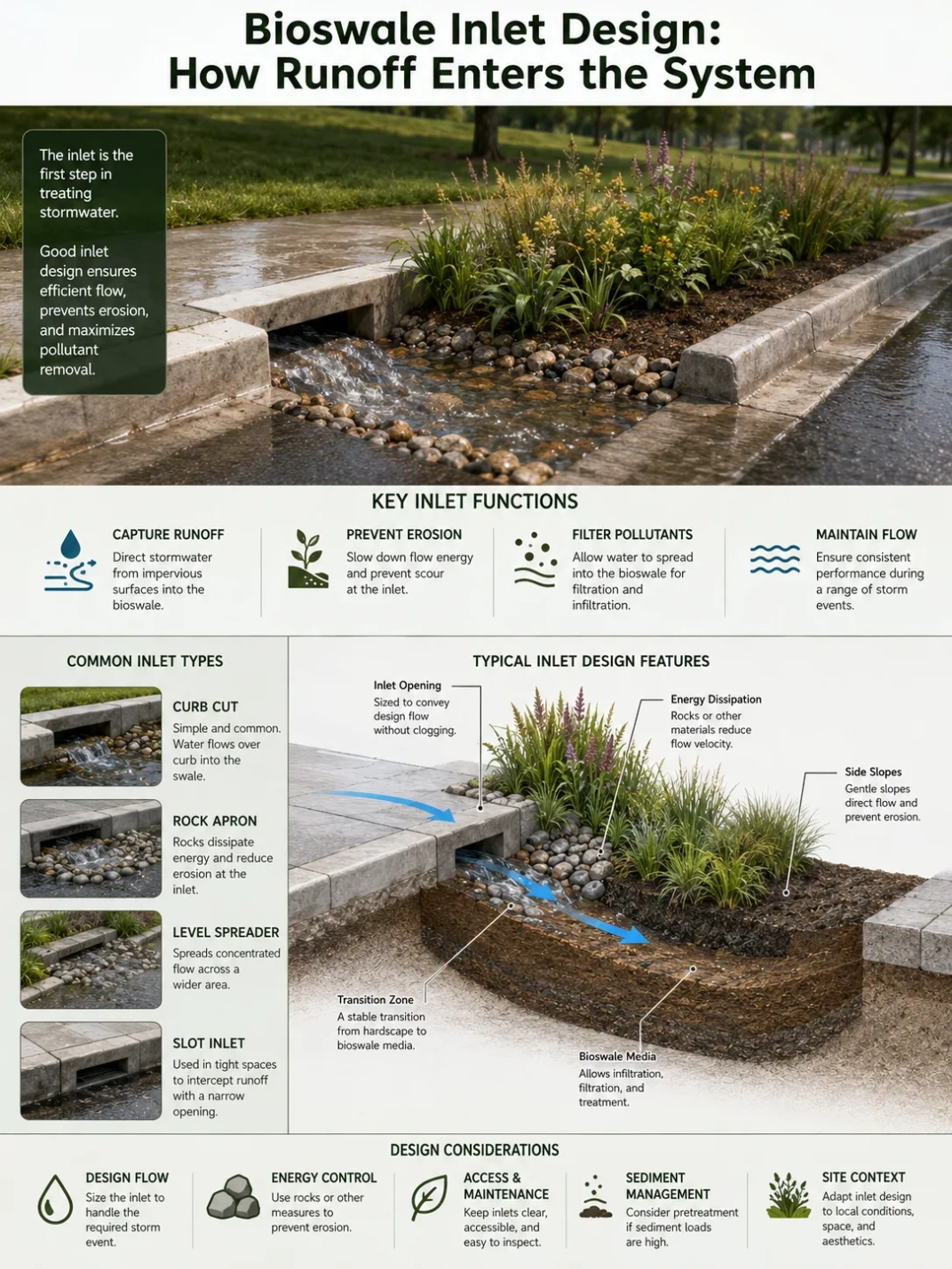
A bioswale inlet is the point where stormwater runoff first enters the planted channel, and that small transition often decides whether the system works smoothly or struggles with erosion, clogging, bypass flow, or uneven ponding. A good inlet does not simply “let water in.” It slows, spreads, and directs runoff so the soil, plants, mulch, and overflow route can do their jobs without being overwhelmed.
Inlet design matters because runoff usually arrives from hard surfaces with speed, sediment, and debris. Roofs, driveways, sidewalks, parking lots, curbs, and road edges all send water toward the bioswale in different ways. The inlet has to match that source.
Design Note: The inlet is not only an opening. It is a transition zone between a faster, harder surface and a slower, vegetated drainage system.
What a Bioswale Inlet Is Supposed to Do
A bioswale inlet should guide runoff into the system without cutting into the soil, washing away mulch, flattening plants, or sending water straight to the outlet. It should also allow sediment and coarse debris to settle where maintenance crews or homeowners can reach it.
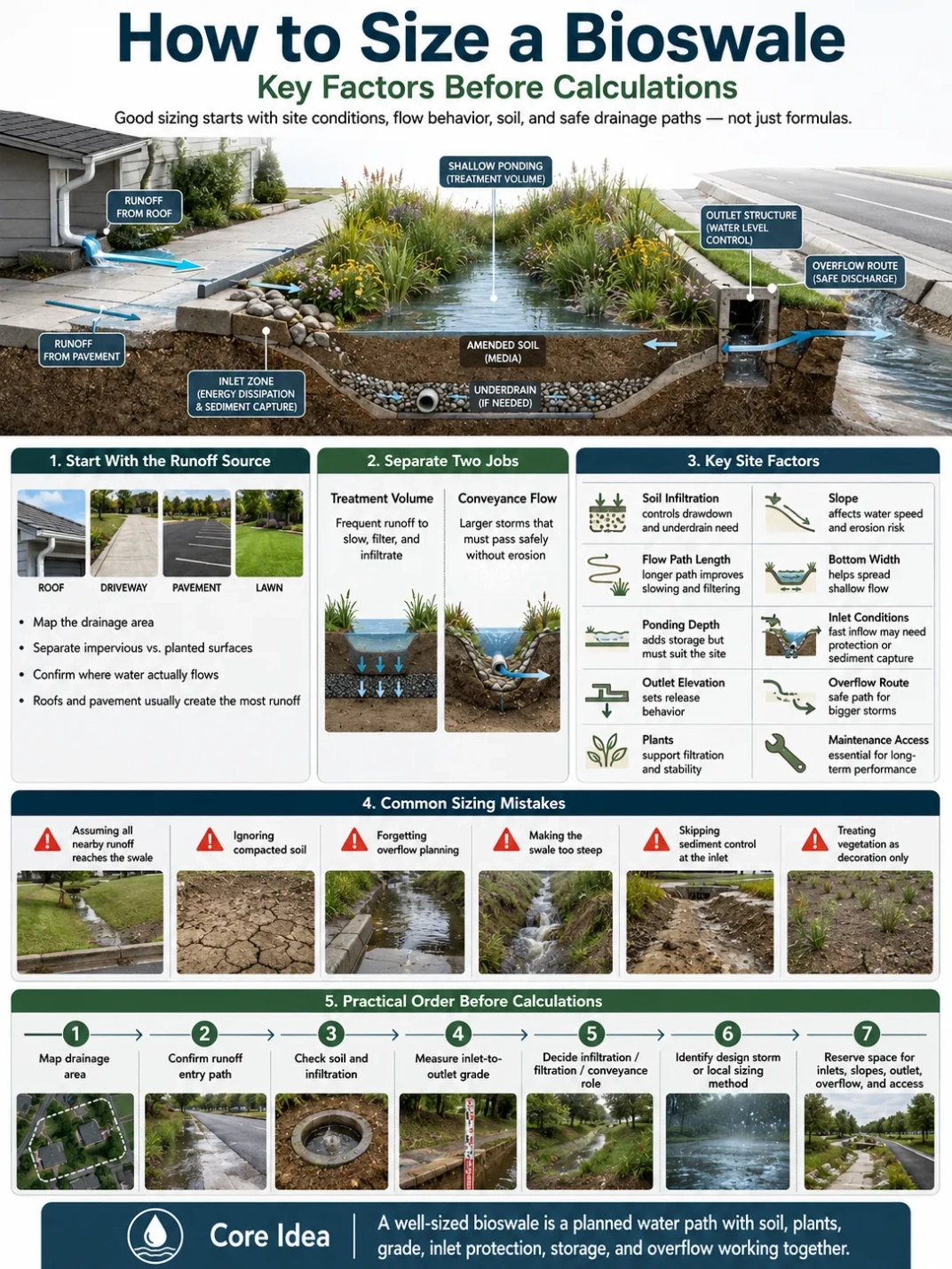
The best inlet choice depends on the runoff source, site slope, expected flow, soil conditions, available space, and whether the bioswale serves a residential yard, street edge, parking area, or public landscape.
- Collect runoff from a defined surface such as a roof, curb, driveway, or paved area.
- Reduce entry speed before water reaches planted soil.
- Spread flow across the swale instead of creating one narrow channel.
- Limit erosion at the inlet and along the first part of the flow path.
- Trap sediment where it can be removed before it clogs the soil media.
- Protect overflow behavior during larger storms or blocked-inlet conditions.
Common Runoff Sources That Feed a Bioswale
Runoff does not enter every bioswale the same way. A roof downspout may produce a narrow stream. A parking lot may send shallow sheet flow mixed with grit. A roadside curb cut may deliver water in pulses when gutters fill during rain.
| Runoff Source | Typical Entry Pattern | Main Inlet Concern | Common Design Response |
|---|---|---|---|
| Roof Downspout | Concentrated flow from one pipe or splash point | Scour where water hits soil or mulch | Splash pad, stone apron, level spreader, or short conveyance channel |
| Driveway Edge | Shallow flow from pavement, often at one low point | Sediment, tire grit, and narrow flow paths | Small forebay, stabilized opening, or widened inlet zone |
| Street Curb Cut | Runoff enters through a curb opening | High velocity, debris, and bypass during larger storms | Armored curb cut, sediment pad, graded entry, and clear overflow route |
| Parking Lot Runoff | Sheet flow or curb-directed flow from a wide hard surface | Heavy sediment load and uneven distribution | Multiple inlets, pretreatment strip, forebay, or level entry edge |
| Sidewalk or Plaza Drainage | Low-depth sheet flow from pedestrian surfaces | Trip edges, ponding near pavement, and plant damage | Flush edge, stable grade, and protected planting setback |
The table shows why inlet design should start with the runoff source, not with a standard opening shape. A curb cut, a downspout, and a broad paved edge may all feed a bioswale, but they do not behave alike.
How Water Should Enter the Bioswale
Runoff should enter the bioswale in a controlled way, then move along the planted channel with enough time for filtering, slowing, and infiltration where site conditions allow. The inlet should not point water straight down the center like a small stream unless the swale is designed to handle that energy.
From Fast Flow to Slow Flow
Stormwater often arrives faster than the soil surface can accept it. A driveway, roof, gutter, or curb line can speed up water because the surface is smooth and compact. When that flow reaches a planted depression, the inlet has to absorb the change.
Stone aprons, turf reinforcement, check dams, shallow forebays, and widened entry zones can help reduce velocity. The right choice depends on expected flow and local design rules.
From Concentrated Flow to Spread Flow
A narrow stream entering one point can carve a channel through mulch or exposed soil. That channel may then carry water too quickly through the bioswale, reducing contact with plants and soil media.
A wider inlet, a level spreader, or a gently fanned entry can help distribute water across more of the swale bottom. This is especially useful where runoff comes from a broad paved surface but reaches the bioswale through a small opening.
From Dirty Flow to Maintainable Flow
Runoff may carry leaves, sand, grit, fine sediment, mulch fragments, and pavement debris. If that material enters the soil media directly, the first part of the bioswale may clog before the rest of the system has a chance to work.
A small sediment forebay or stable inlet pad gives heavier material a place to settle. It also creates a visible maintenance point.
Maintenance Note: The easiest sediment to remove is the sediment that collects near the inlet. Once fine material moves into the soil pores, performance can become harder to restore.
Main Types of Bioswale Inlets
There is no single inlet shape that fits every bioswale. Most designs use one of a few common approaches, sometimes combined with pretreatment or erosion control.
Curb Cut Inlet
A curb cut inlet allows street or parking lot runoff to leave the gutter and enter the bioswale through an opening in the curb. This is common in streetscapes, parking islands, and public-space green infrastructure.
The curb opening should direct water into the swale without creating a drop that scours soil. Many curb cut designs use stone, concrete, or another stable surface at the entry point. The opening also needs to stay clear of leaves, trash, and sediment.
Where it fits: roadside bioswales, parking lot bioswales, curbside planting areas, and public landscapes where runoff is already moving along a curb line.
Sheet Flow Inlet
Sheet flow enters along a long, low edge instead of through a single point. This can be useful beside walkways, driveways, plazas, and parking areas where the pavement is graded gently toward the bioswale.
Sheet flow often creates a calmer entry pattern, but only when the paved edge and swale lip are graded well. If one low spot forms, water may stop acting like sheet flow and concentrate into a small channel.
Where it fits: broad paved surfaces, shallow slopes, landscape strips beside hardscape, and sites where a flush edge can be maintained safely.
Pipe or Downspout Inlet
A pipe or downspout inlet sends roof runoff or collected surface runoff into the bioswale. This can work in residential landscapes, institutional sites, and small commercial properties, but it needs careful energy control at the discharge point.
Water leaving a pipe may strike the ground with enough force to move mulch or expose soil. A splash block, stone apron, level spreader, or small stabilized basin may be used to reduce impact before water enters the planted area.
Where it fits: roof runoff, disconnected downspouts, small catchment areas, and sites where water can be routed away from foundations and toward a safe overflow path.
Side Opening from a Driveway or Path
A side opening allows runoff from a driveway, path, or small paved area to enter the bioswale at a selected low point. The opening should be wide and stable enough to prevent rutting or soil washout.
In residential settings, this type of inlet often looks simple, but it still needs planning. Water should not be sent toward building foundations, neighboring lots, steep slopes, septic areas, or places where standing water creates a nuisance.
Inlet Parts That Shape Performance
A bioswale inlet may look like a small opening, but several parts work together. Each one shapes how water enters, slows, spreads, and moves into the swale.
Entry Edge
The entry edge is where water crosses from pavement, turf, curb, pipe, or roof drainage into the bioswale. It should be low enough to accept runoff, but stable enough to avoid collapse or erosion.
A raised lip can block low flows. A weak edge can break down during heavier storms. A clean, stable transition is usually better than a sharp drop.
Apron or Splash Area
An apron is a stabilized area just inside the inlet. It may use stone, turf reinforcement, concrete, or other locally accepted materials. Its job is to take the first impact of incoming water.
The apron should not become a chute that speeds water through the swale. It should protect the inlet while still helping the flow spread.
Forebay or Sediment Zone
A forebay is a small settling area near the inlet. It gives coarse sediment and debris a place to collect before water reaches the main planted soil. Not every small residential bioswale needs a formal forebay, but many public, roadside, and parking lot systems benefit from one.
The forebay must be reachable. If maintenance access is poor, sediment removal becomes less likely and inlet performance can decline.
Grade Break
A grade break is a small change in slope that helps slow water as it enters. It can reduce the chance that runoff cuts a direct channel through the planting bed.
Grade breaks need careful shaping. A steep drop can cause erosion; a poorly drained flat spot can hold water in the wrong place.
Overflow Route
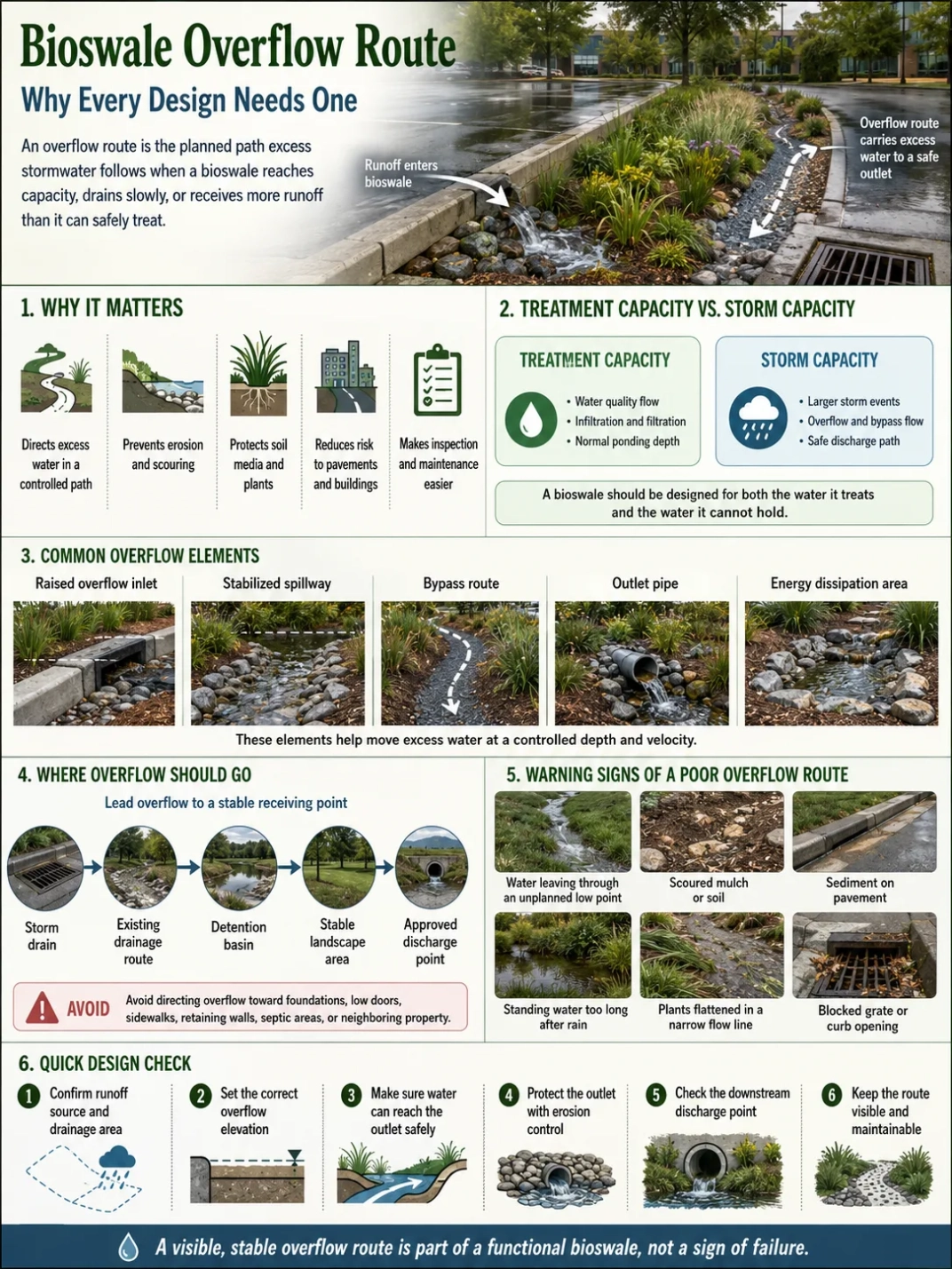
The inlet should be planned with the overflow route in mind. During larger storms, blocked inlets, frozen ground, saturated soil, or very intense rainfall, water may bypass the normal entry path or leave the bioswale through an overflow point.
Overflow planning helps keep water moving toward a safe location instead of back toward buildings, walkways, or neighboring property.
Site Planning Note: Inlets near buildings, basements, retaining walls, public sidewalks, or neighboring lots may need professional review. A bioswale should manage runoff, not redirect a drainage problem to a sensitive place.
Inlet Slope, Flow Direction, and Energy Control
Slope is one of the easiest details to underestimate. Even a small paved area can create erosive flow if water enters the bioswale at a narrow point on a steep grade.
The inlet should guide water in the intended direction without creating turbulence, short-circuiting, or side-wall erosion. Short-circuiting happens when water enters and quickly exits without moving through enough of the planted flow path.
Longitudinal Slope
The longitudinal slope is the slope along the length of the bioswale. If it is too steep for the selected materials and planting design, incoming water may keep moving too fast after it enters.
Check dams, step-down sections, denser vegetation, or wider flow paths may be used in some designs to slow water. The exact method depends on site conditions and local standards.
Side Slope
The side slope affects how water enters from the side and how stable the swale edges remain. Steeper side slopes can be harder to plant, maintain, and protect from erosion. Gentler slopes often support safer access and better vegetation establishment where space allows.
Entry Angle
A sharp entry angle can send water against the opposite bank. A smoother entry angle can help water turn into the flow path with less erosion. This detail matters in curb cut and driveway-edge inlets.
For public or commercial sites, designers often pay close attention to how runoff turns, spreads, and slows at the inlet because these locations receive repeated flows over many storms.
Sediment and Debris at the Inlet
The inlet is often the dirtiest part of a bioswale. That is not a design failure by itself. It means the system is receiving runoff from real surfaces.
What matters is whether sediment collects in a place that can be inspected and cleaned before it blocks the inlet or seals the soil surface.
- Leaves can block curb openings and pipe outlets.
- Sand and grit can settle at the first low point.
- Fine sediment can clog soil pores over time.
- Mulch movement can expose soil or block flow paths.
- Trash and pavement debris can reduce inlet capacity in public areas.
A visible inlet pad or forebay makes these issues easier to spot. Hidden or cramped inlets can fail quietly until water starts bypassing the bioswale.
How Inlet Design Affects Plants and Soil
Plants near the inlet often face the toughest conditions. They may receive fast water, sediment deposits, changing moisture, and occasional burial by mulch or grit. This first planting zone should be chosen and maintained with that stress in mind.
Plants Near the Inlet
Dense grasses, sedges, rushes, and other locally suitable plants may help slow water and stabilize soil. Woody shrubs can also be useful in some bioswale designs, but they should not block inspection or trap debris in a way that clogs the inlet.
Native plants are often preferred where they match the local moisture pattern, soil, sun exposure, and maintenance plan. Still, a plant is not suitable just because it is native. It also needs to tolerate the wet and dry cycles of that exact inlet zone.
Soil Near the Inlet
The soil or filter media near the inlet may receive more sediment than the rest of the bioswale. If runoff enters too quickly or carries a heavy sediment load, the soil surface can seal or compact.
Soil infiltration depends on texture, compaction, organic matter, groundwater conditions, construction quality, and maintenance. A bioswale inlet should protect the soil from unnecessary impact, not rely on the soil to absorb poorly controlled flow.
Planting Note: The inlet planting zone may need tougher, lower, easier-to-clean vegetation than the middle or upper edges of the bioswale.
Residential Bioswale Inlet Details
Residential bioswale inlets often handle roof runoff, driveway runoff, or yard drainage. They may look less formal than street or parking lot systems, but the same water movement rules apply.
A homeowner-scale inlet should answer three basic questions:
- Where is the runoff coming from?
- How fast will it arrive during ordinary storms?
- Where will water go if the inlet or soil cannot accept it?
Downspouts should discharge onto a stable surface before water reaches soil. Driveway inlets should not create a rut at the pavement edge. Yard drainage should not be sent toward foundations, crawl spaces, basement walls, or neighboring properties.
Small systems still need a safe overflow route. A bioswale can help manage runoff, but it should not be treated as the only protection for a site with major drainage, grading, or structural water concerns.
Public, Roadside, and Parking Lot Inlets
Public and commercial bioswale inlets often receive runoff from larger impervious surfaces. They may also receive more sediment, road grit, leaves, and maintenance disturbance than a residential swale.
These inlets usually need more attention to safety, access, curb geometry, sediment pretreatment, and overflow behavior. A curb cut beside a road or parking aisle must let water enter while also fitting pedestrian movement, vehicle edges, snow or debris conditions where relevant, and local maintenance practices.
Multiple smaller inlets may work better than one overloaded opening in some parking lot or streetscape designs. Spreading inflow can reduce erosion and help the full bioswale surface receive water more evenly.
Where Inlet Design Often Fails
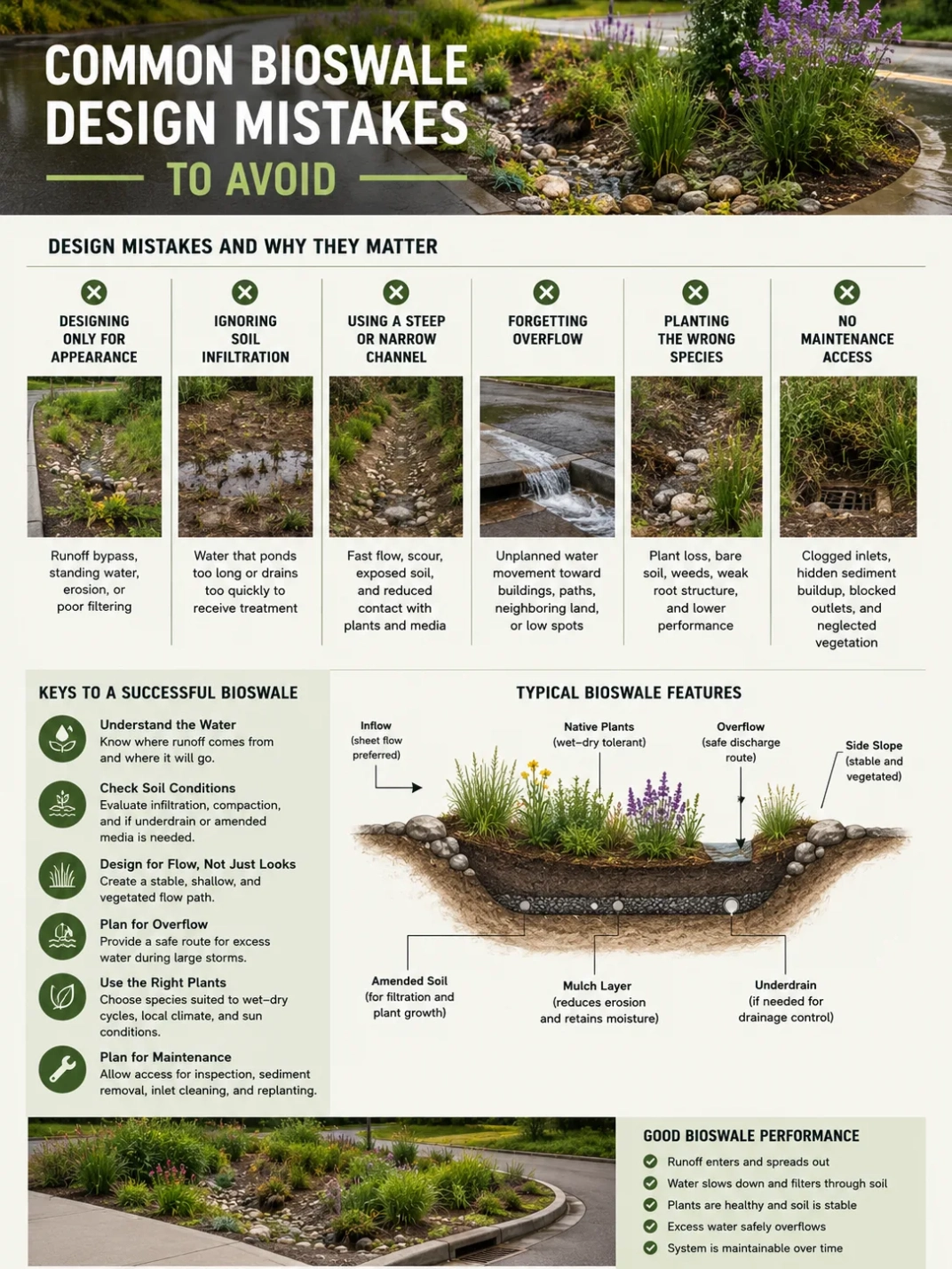
Most inlet problems are simple to recognize after rain. Water bypasses the opening, cuts a channel, ponds where it should not, carries mulch away, or drops sediment in a place no one can clean.
The Inlet Is Too High
If the inlet edge sits above the drainage surface, small storms may not enter the bioswale. Water may instead remain on pavement or search for another low point.
The Inlet Is Too Narrow
A narrow inlet can concentrate flow. This may cause erosion, especially where runoff from a broad surface is forced through one small opening.
The Entry Point Is Unstable
Bare soil at the inlet is vulnerable. Repeated flows can dig into the surface, move mulch, and expose roots.
Sediment Has No Place to Settle
If sediment goes straight into the main soil media, the inlet zone can clog faster. A cleanable settling area may help, especially for curb, driveway, and parking lot runoff.
The Overflow Route Is Unclear
Every inlet should be considered together with bypass and overflow. If water cannot enter, or if the bioswale fills, the next route should be predictable and safe.
How It Differs from a Drainage Ditch Inlet
A drainage ditch inlet often focuses on moving water away. A bioswale inlet has a different job: it should bring runoff into a vegetated system at a speed and pattern that supports slowing, filtering, and possible infiltration.
That difference affects the entry design. A ditch may tolerate a more direct flow path in some settings. A bioswale usually needs a gentler transition, better sediment control, and more care around plant and soil protection.
How It Differs from a Rain Garden Inlet
A rain garden inlet usually feeds a basin-like planted area where water spreads and ponds before soaking in or overflowing. A bioswale inlet feeds a longer, linear system that also conveys water along a flow path.
This means a bioswale inlet must think about both entry and movement. Water should enter cleanly, then travel through the swale without rushing straight to the outlet.
What to Check Before Planning an Inlet
Before choosing an inlet type, the site should be read like a drainage map. The surface tells where water wants to go. The design should work with that pattern where possible, then control it where needed.
- Identify the runoff source: roof, driveway, street, parking lot, sidewalk, or yard.
- Watch where water already flows during rain if it is safe to do so.
- Look for sediment, leaf piles, stains, rills, or low spots.
- Check whether the inlet area has enough room for a stable transition.
- Confirm that overflow can move away from sensitive areas.
- Consider maintenance access before placing plants, stones, or structures.
- Review local drainage rules when runoff connects to streets, public systems, or nearby properties.
For larger catchment areas, steep sites, poor soils, public streets, commercial hardscape, or water near buildings, professional design review may be needed. That review can address drainage capacity, grading, soil testing, overflow, and local requirements.
Maintenance Around the Inlet
The inlet should be one of the first places checked after storms and during seasonal maintenance. It is where small problems appear early.
Maintenance usually involves removing leaves, sediment, trash, and displaced mulch; checking for erosion; clearing curb cuts or pipe outlets; and replacing damaged plants near the entry zone. The right schedule varies by site, rainfall pattern, vegetation, and how much debris the runoff carries.
A well-designed inlet makes this work visible and reachable. A hidden inlet under dense plants or loose mulch may look natural, but it can become hard to inspect.
FAQ
What is the main purpose of a bioswale inlet?
The main purpose of a bioswale inlet is to bring runoff into the swale in a controlled way. It should slow and spread the water, reduce erosion, and direct sediment to a place where it can be cleaned out.
Can roof runoff enter a bioswale through a downspout?
Yes, roof runoff can enter a bioswale through a downspout when the discharge point is stable and the overflow route is safe. A splash pad, stone apron, or spreader may be needed so water does not scour soil or mulch.
Why do curb cut inlets clog?
Curb cut inlets can clog when leaves, sediment, trash, or pavement grit collect at the opening. A clear entry edge, cleanable sediment zone, and regular inspection help keep water moving into the bioswale.
Should a bioswale inlet have a forebay?
A forebay can be useful where runoff carries noticeable sediment, such as from streets, driveways, or parking lots. Small residential systems may not need a formal forebay, but they still need a stable place where sediment can settle and be removed.
What causes erosion near a bioswale inlet?
Erosion near a bioswale inlet often comes from fast, concentrated flow entering at one point. Bare soil, steep entry grades, narrow openings, and missing splash protection can make the problem worse.
Does inlet design affect the plants in a bioswale?
Yes, inlet design affects plant health because the inlet zone receives the first rush of water, sediment, and debris. Plants near the inlet often need to tolerate wet and dry cycles, occasional sediment deposits, and maintenance activity.