Bioswale infiltration means stormwater does not simply move across the surface of a planted channel. Part of the runoff soaks down through soil, root zones, and filter media before it either enters the native ground, reaches an underdrain, or leaves through a controlled outlet. That underground movement is one reason a bioswale can do more than carry water away: it can slow runoff, reduce surface flow, support pollutant filtering, and help a site manage rain with soil and vegetation instead of relying only on pipes.
The word infiltration sounds simple, but in a bioswale it depends on several connected details: soil texture, compaction, slope, ponding depth, plant roots, sediment load, rainfall pattern, and whether the design includes an underdrain. A bioswale with poor infiltration may still move water, but it will behave more like a planted drainage channel than a true soil-based stormwater system.
What Bioswale Infiltration Means
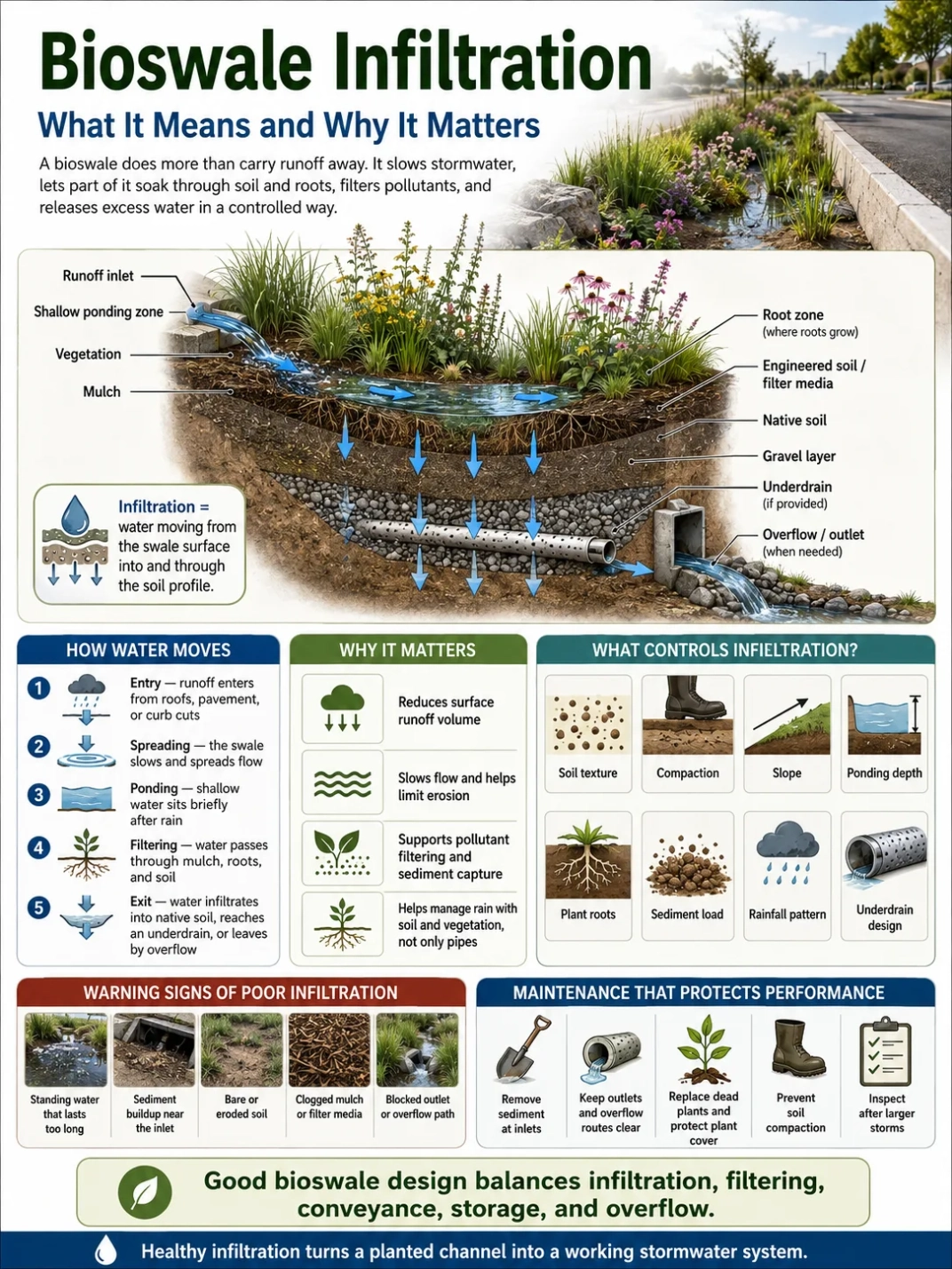
In a bioswale, infiltration is the movement of captured runoff from the swale surface into the soil below. The water may pass through mulch, vegetation, engineered soil media, and native soil. In some designs, it continues downward into the surrounding ground. In others, it reaches a gravel layer and a perforated underdrain that carries excess water to an outlet.
This matters because a bioswale is not only a shallow ditch with plants. It is a surface-and-soil drainage feature. The surface slows and spreads the flow. The plants protect the soil and support filtering. The soil profile decides how much water can move downward, how quickly it can drain, and how long the system holds moisture after a storm.
Good infiltration does not mean water disappears instantly. A bioswale often works by holding a shallow layer of runoff for a limited time, then letting it drain through the soil at a controlled pace. Too fast can reduce treatment time. Too slow can create standing water, plant stress, odor, erosion, or clogging concerns.
| Function | What Happens | Why It Matters |
|---|---|---|
| Surface slowing | Runoff enters the swale and spreads along a vegetated flow path. | Lower flow speed can reduce erosion and give sediment time to settle. |
| Soil infiltration | Water moves downward through mulch, roots, filter media, and native soil. | The swale can reduce surface runoff volume where soil conditions allow. |
| Filtering | Soil particles, organic matter, and root zones help trap fine material. | Pollutants attached to sediment may be reduced before water leaves the system. |
| Controlled drainage | Excess water exits through an underdrain, outlet, or overflow route. | The site has a path for larger storms or slow-draining soils. |
Why Infiltration Is Not the Same as Simple Drainage
A drainage ditch mainly conveys water from one place to another. A bioswale may also convey water, but infiltration adds a second layer of performance. The swale becomes a place where runoff can be held, filtered, and partly absorbed, not just moved away.
That difference is easy to miss. A bioswale can look like a landscaped channel from above, while the real performance happens below the surface. The soil may be doing as much work as the plants.
Infiltration is also not the same as storage. A bioswale may temporarily store water in surface ponding, open soil pores, and gravel layers. Infiltration is the movement of that water into or through soil. Storage buys time. Infiltration decides where much of the water goes next.
How Water Moves Through an Infiltrating Bioswale
Runoff usually enters a bioswale from an impervious surface such as a roof, driveway, parking lot, sidewalk, street edge, or compacted landscape area. The inlet may be a curb cut, pipe, downspout extension, sheet flow edge, or shallow channel.
Once runoff enters, the bioswale should slow the water before it cuts through the soil. Vegetation, a gentle flow path, check dams in some designs, and a stable inlet area can help spread energy. If water rushes through one narrow path, infiltration usually suffers because the swale becomes eroded, uneven, and sediment-loaded.
- Entry: runoff enters from a hard surface or drainage point.
- Spreading: the swale shape helps distribute flow across soil and vegetation.
- Ponding: shallow water may sit for a limited period after rain.
- Filtering: water passes through mulch, roots, and soil media.
- Exit: water infiltrates into native soil, reaches an underdrain, or leaves through an overflow route.
Drainage Note: A bioswale should have a planned overflow route. Infiltration may handle small and moderate storms in many designs, but larger storms still need a safe path that does not send water toward foundations, neighboring properties, unstable slopes, or traffic areas.
The Soil Decides Much of the Result
Soil is the main control point for bioswale infiltration. Sandy soils may accept water quickly but may need careful design to support filtering and plant health. Clay-heavy soils may hold water longer and may need amended media, an underdrain, or another drainage approach. Compacted soil can block infiltration even when the original soil type looks suitable on paper.
That is why field conditions matter. A design based only on a soil map or a quick visual check can miss problems such as construction compaction, buried fill, shallow groundwater, restrictive soil layers, or poor outlet conditions.
In many projects, infiltration is tested at the site before final design. The exact method and required drain-down target depend on local standards and project type. Some programs expect water to drain within a defined window after a design storm, but the acceptable timing can vary by location and by the type of stormwater practice.
Soil Note: Soil that drains well before construction may perform poorly after heavy equipment traffic. Protecting the swale area from compaction is often as useful as choosing the right soil media.
Native Soil, Filter Media, and Underdrains
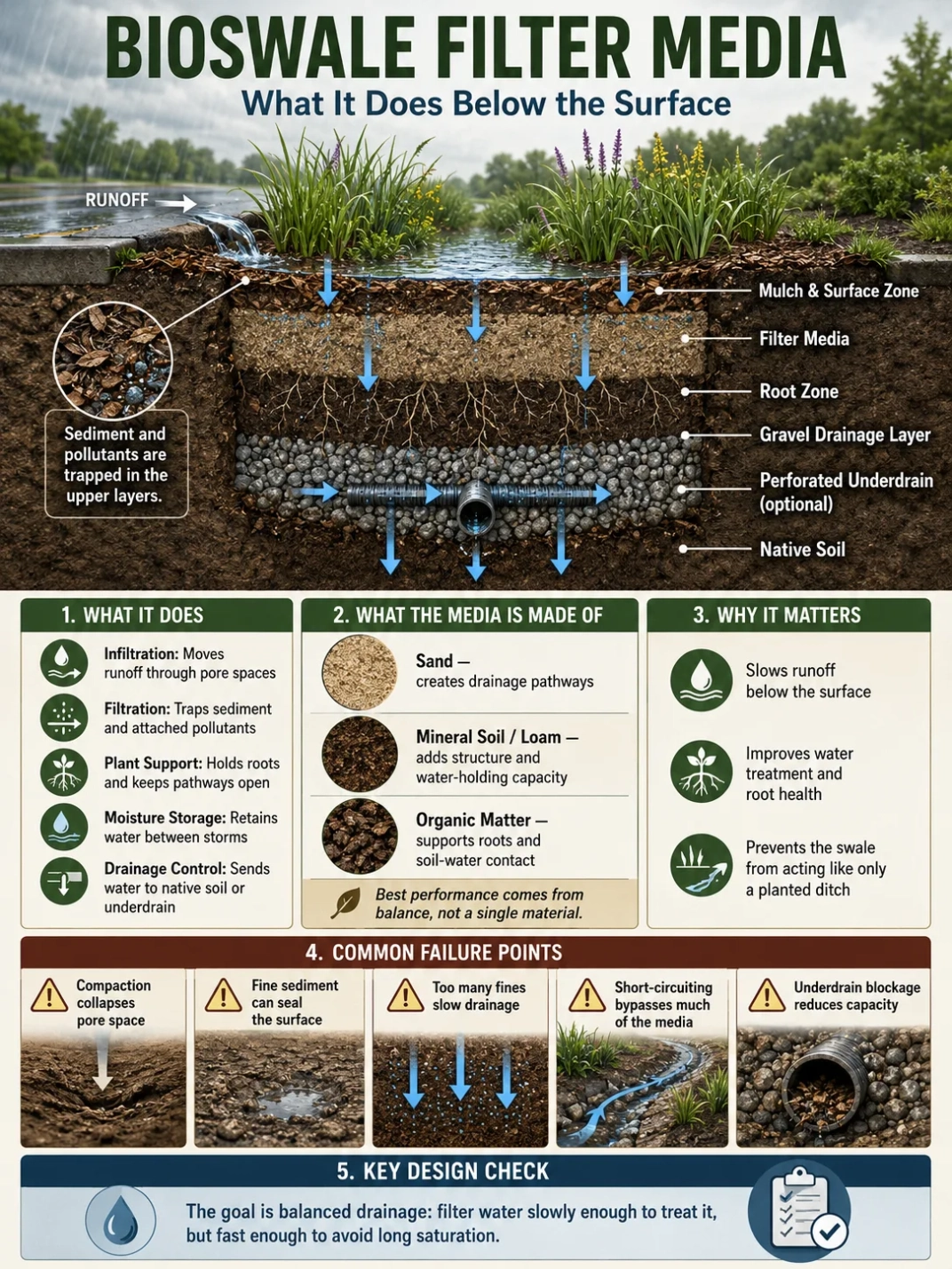
A bioswale can be built with different subsurface arrangements. Some rely mainly on native soil. Others include a designed filter media layer. Some use gravel storage and an underdrain. The best choice depends on rainfall, soil, runoff area, local rules, available space, and the risk of water sitting too long.
Native soil infiltration works best where the existing soil can accept water at a suitable rate and where water can safely move downward without causing site problems. This approach can support groundwater recharge in some settings, but it still needs careful attention to setbacks, slope, groundwater, and nearby structures.
Filter media is often used when the goal is to improve drainage consistency and water treatment. It may include a blend of mineral soil, sand, organic matter, or other locally accepted materials. There is no single soil mix that fits every bioswale. A media that drains too quickly may reduce contact time; one that holds too much fine material may clog.
Underdrains are used when native soil drains slowly, when the swale must meet a drain-down requirement, or when the site needs a predictable outlet. An underdrain does not mean infiltration has failed. It means the design uses soil filtering first, then provides a controlled way for excess water to leave.
Why Infiltration Matters for Runoff Volume
Hard surfaces create runoff because they block water from soaking into the ground. Roofs, pavement, compacted paths, and parking areas shed water quickly. A bioswale adds a lower, planted area where some of that water can slow down and move into soil.
Where site conditions allow, this can reduce the amount of water leaving the surface during smaller storms. It can also delay runoff from reaching pipes, streets, or downstream drainage systems. The effect depends on the size of the swale, the amount of impervious area draining to it, the soil profile, and how wet the soil was before the storm started.
A bioswale should not be described as a cure for every drainage problem. If the contributing area is too large, if slopes are too steep, if soil is highly compacted, or if the outlet is poorly planned, the swale may overflow often or erode. Infiltration helps, but it works within site limits.
Why Infiltration Matters for Water Quality
Stormwater often carries sediment, organic debris, nutrients, metals from paved surfaces, and other pollutants linked to urban runoff. A bioswale can help reduce some of this load by slowing water and allowing sediment to settle before water leaves the site.
Infiltration adds another treatment path. As water moves through soil and root zones, fine particles can be trapped. Organic matter and soil surfaces can hold some pollutants. Plant roots help maintain soil structure and create small pathways for air and water movement.
This does not mean every pollutant is removed, or that a bioswale should receive any type of runoff without review. Areas with heavy sediment, unusual contaminants, industrial activity, or high winter deicing loads may need pretreatment, special media, or a different stormwater practice. For common residential or landscape runoff, the main value is often simpler: slow the water, settle sediment, protect soil, and let the profile filter what it can.
Plant Roots Help Keep Infiltration Working
Plants are not decoration in a bioswale. Their roots help hold soil, reduce erosion, create pore spaces, and support water movement through the upper soil layer. Dense grasses, sedges, rushes, and suitable shrubs can also slow surface flow and catch debris before it reaches the outlet.
The best planting approach usually includes species that can handle both wet and dry periods. A bioswale may be wet shortly after rain and dry during long periods without storms. Plants that only tolerate constant moisture may fail in dry weather. Plants that only tolerate dry soil may fail near the lower swale bottom.
Plant zones matter. The lowest area may need plants that tolerate temporary ponding. Side slopes may need species that handle faster drying and help stabilize soil. Upper edges may need plants that tolerate splash, sediment, and occasional runoff contact.
Planting Note: Native plants are often useful because they can be matched to local rainfall, soil, and habitat conditions. The right choice is regional. A plant that performs well in one climate may be a poor fit in another.
What Can Reduce Bioswale Infiltration
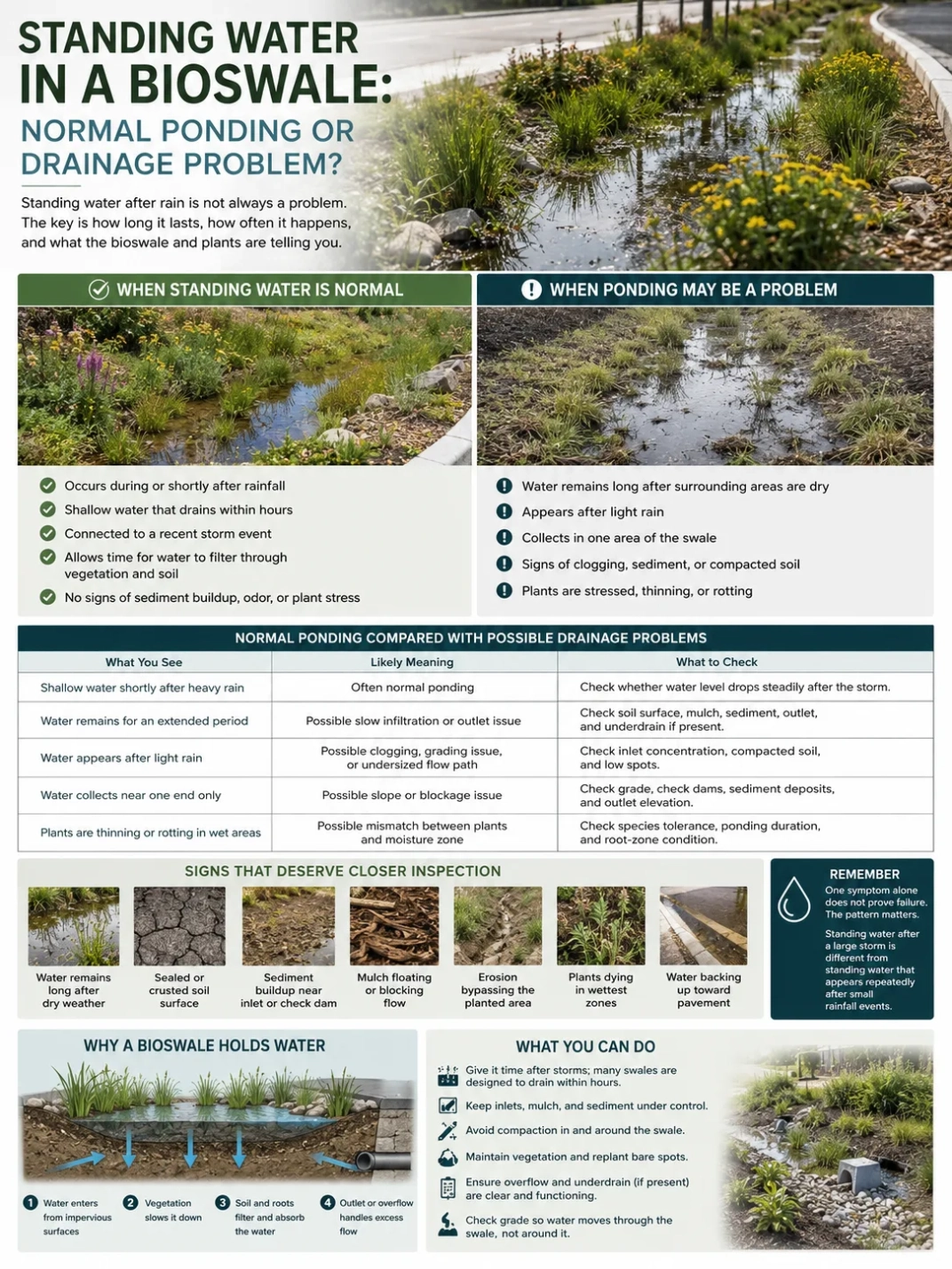
Infiltration can decline over time if the swale receives more sediment than it can handle or if the soil surface becomes sealed. The problem often starts at the inlet. Fast, dirty runoff enters the swale, drops sediment near the first low spot, then forms a compacted crust. Water ponds in that area instead of spreading through the full swale.
Other issues can come from construction and maintenance. Driving across the swale, storing materials on the soil, using unsuitable fill, removing too much vegetation, or allowing bare patches to expand can all reduce infiltration.
- Sediment buildup near inlets or check dams
- Soil compaction from foot traffic, vehicles, or construction equipment
- Clogged mulch or filter media after repeated dirty runoff events
- Poor plant cover that leaves soil exposed to erosion
- Unstable side slopes that send soil into the flow path
- Blocked outlets or overflow areas that keep water from leaving safely
How to Tell Whether Infiltration Is Working
The simplest visible clue is how the bioswale behaves after normal rain. Some temporary ponding can be part of the design. Water that remains for too long, appears in the same clogged spot after every storm, or leaves a greasy-looking sediment layer may point to a problem.
Healthy infiltration is usually uneven in a natural way. Some areas dry sooner than others. The lower channel may stay damp longer than the side slopes. Plants may show different moisture zones. The concern is not minor variation. The concern is a pattern of standing water, erosion, bare soil, sediment fans, or flow bypassing the planted area.
For engineered projects, visual inspection is only the first step. Drain-down checks, soil testing, outlet inspection, and review against local stormwater requirements may be needed. A residential swale near a driveway is not the same as a public streetscape bioswale receiving road runoff.
Infiltration in Residential Settings
For homes, bioswale infiltration often relates to roof runoff, driveway runoff, yard drainage, or water moving across a sloped lawn. A small swale can help collect and slow runoff, but placement matters more than appearance.
Water should not be directed toward a foundation, basement wall, septic area, unstable slope, or neighboring property. A bioswale also needs a clear overflow route for storms larger than it can handle. Local rules may limit where roof or driveway runoff can be sent, especially near property lines or public drainage systems.
A small residential bioswale can be practical when the contributing area is modest, the soil can drain, and the overflow path is safe. If water is already entering a building, pooling near a foundation, crossing a property boundary, or backing up from a public system, professional review is a better starting point.
Infiltration in Streets, Parking Lots, and Public Spaces
Bioswales in streetscapes, parking lots, campuses, and public landscapes often receive runoff from larger hard surfaces. The flow may carry more sediment, tire residue, leaf litter, trash, and winter road material than a residential roof or lawn area. These systems need stronger attention to inlets, pretreatment, access, overflow, and maintenance responsibility.
Curb cuts can concentrate flow, so the inlet area must resist erosion. Parking lot runoff may need sediment forebays, stone aprons, or other pretreatment features before water reaches the planting soil. Public-space bioswales also need designs that account for pedestrians, vehicles, visibility, snow storage in cold regions, and routine inspection.
In these settings, infiltration is part of a managed stormwater system, not a stand-alone landscape feature. The soil profile, underdrain, overflow, and outlet must work together.
How It Differs from a Rain Garden
A rain garden and a bioswale can both use plants and soil to manage runoff, but their shapes and flow behavior differ. A rain garden is usually a basin-like planted depression that collects water in one area. A bioswale is usually a linear channel that receives, slows, treats, and conveys flow along a path.
Infiltration matters in both systems. The difference is that a bioswale must also manage movement from one end to the other. This makes slope, inlet protection, flow length, check dams, erosion control, and outlet behavior especially important.
| Feature | Main Shape | Infiltration Role |
|---|---|---|
| Bioswale | Linear planted channel | Allows runoff to soak into soil while also moving along a flow path. |
| Rain garden | Planted depression or basin | Holds runoff in one area so it can soak into the soil profile. |
| French drain | Subsurface gravel trench with pipe in many designs | Moves water underground; usually does not provide the same planted surface filtering. |
| Dry creek bed | Decorative or functional stone channel | May slow and guide water, but infiltration depends on soil, base material, and design. |
Where Infiltration Can Fail
Bioswale infiltration usually fails for ordinary reasons, not mysterious ones. The swale receives too much concentrated flow. Sediment blocks the surface. The soil was compacted during construction. The plants never established. The outlet is too high, too low, blocked, or missing. The overflow route was not planned.
Another common issue is treating infiltration as the only goal. A bioswale also needs stable conveyance. If water cannot move safely through or out of the swale during larger storms, the soil may erode even if infiltration is good during smaller rain events.
Good design balances infiltration, filtering, conveyance, storage, and overflow. Focusing on only one part can weaken the whole system.
Site Planning Note: Professional review is often needed where a bioswale is near a building, road, retaining wall, steep slope, utility corridor, high groundwater area, or regulated drainage system. The issue is not whether bioswales work. The issue is whether the site can support the way water will move.
Maintenance That Protects Infiltration
Maintenance keeps infiltration from turning into surface ponding and erosion. The most useful tasks are often simple: remove sediment at inlets, keep outlets clear, replace dead plants, prevent bare soil, manage weeds before they dominate, and check for standing water after storms.
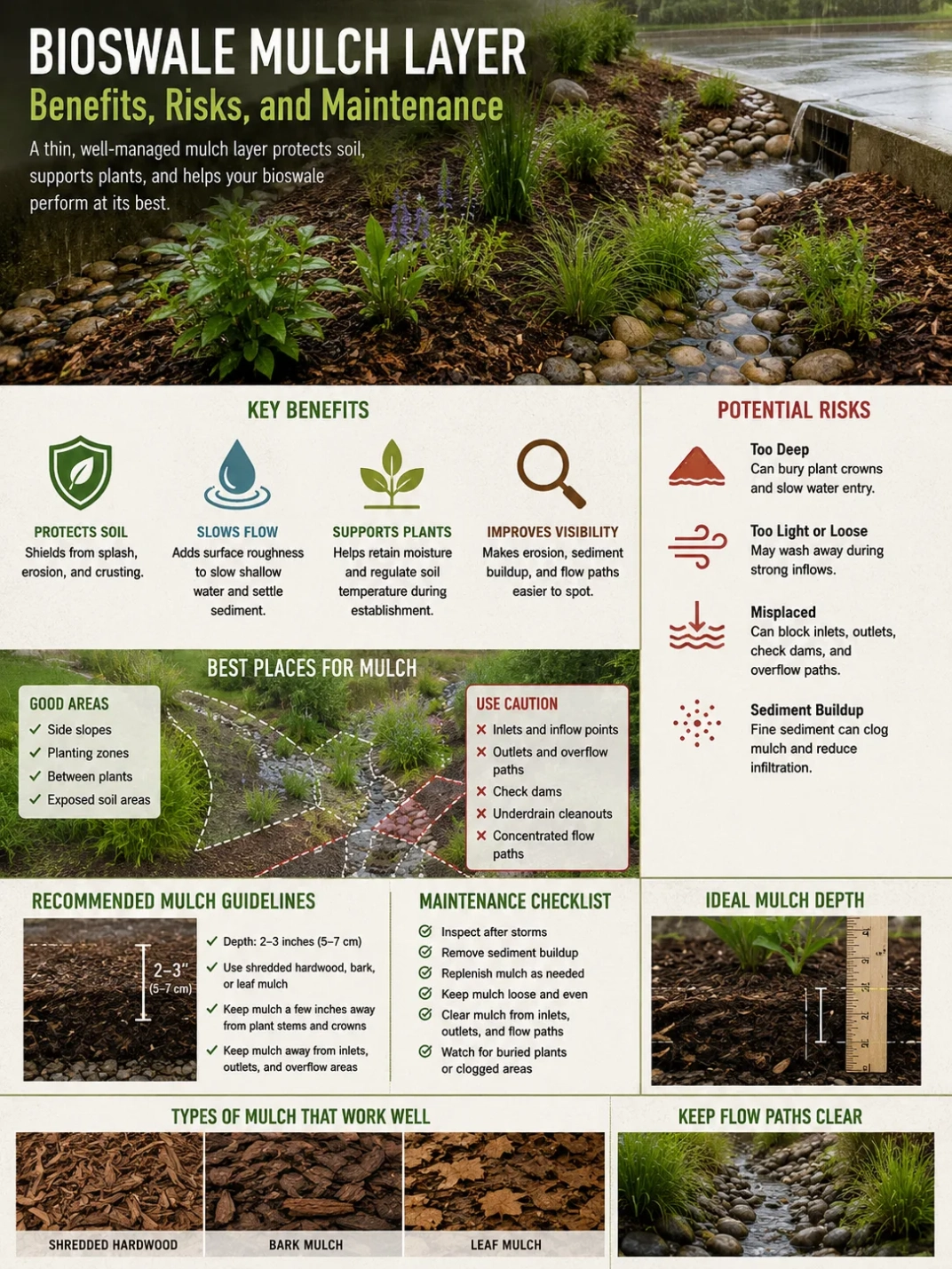
Mulch may help protect soil in some bioswales, but it should not float away, mat into a sealed layer, or block inlets. Dense vegetation can be better than loose mulch in areas with steady flow, depending on the design and local plant choices.
Inspection after larger storms can show whether water is using the intended path. Look for sediment fans, rills, exposed roots, flattened plants, clogged curb cuts, and water bypassing the swale. These small signs often appear before the system develops larger drainage problems.
What This Means for a Real Site
Bioswale infiltration is not a single feature that can be added at the end of design. It is shaped by the whole site. The runoff source affects sediment load. The inlet affects flow speed. The soil affects drain-down. The plants affect erosion and pore structure. The outlet and overflow route decide what happens when the swale reaches its limit.
A well-planned bioswale does not need to look complicated. It may look like a simple planted depression along a driveway, street, or parking edge. The hidden value is in the grading, soil protection, plant establishment, and drainage path.
When those parts work together, infiltration helps a bioswale act as a living stormwater feature rather than a planted ditch. It gives runoff time and space to slow down, soak in, filter through soil, and leave the site in a more controlled way.
FAQ
What does infiltration mean in a bioswale?
Infiltration means stormwater moves from the surface of the bioswale into the soil profile. The water may pass through mulch, plant roots, filter media, native soil, gravel storage, or an underdrain, depending on the design.
Does a bioswale need infiltration to work?
A bioswale can still slow and convey runoff with limited infiltration, but infiltration improves its ability to reduce surface runoff and support soil-based filtering. If native soil drains poorly, an underdrain or amended media may be needed.
How long should water stay in a bioswale?
Temporary ponding can be normal after rain, but water should drain within the time required by the local design standard or project specification. Long-lasting standing water may point to clogging, compaction, poor soil drainage, or an outlet problem.
Can a bioswale infiltrate water in clay soil?
Clay soil can make infiltration slower. Some bioswales in clay areas use engineered soil media, gravel storage, or underdrains to improve drain-down. Site testing is useful because clay content, compaction, and soil layering can vary even across one property.
Why does sediment hurt bioswale infiltration?
Sediment can seal the soil surface, clog mulch or filter media, and create shallow crusts where water ponds instead of soaking in. Inlets and pretreatment areas often need the most attention because they receive the first load of dirty runoff.
Is an underdrain a sign that the bioswale is not infiltrating?
No. An underdrain can be part of a planned bioswale design. Water may still filter through soil media before reaching the underdrain. The underdrain helps remove excess water where native soil is slow, space is limited, or a reliable outlet is needed.