Bioswale dimensions are not fixed numbers copied from a single template. Width, depth, length, side slope, soil condition, and flow path all work together to decide whether a bioswale can slow runoff, spread water safely, filter sediment, and drain without turning into a narrow wet ditch.
A well-sized bioswale gives stormwater enough room to move across vegetation and soil instead of racing through one eroded channel. The goal is not only to collect water. The goal is to shape flow so runoff slows down, spreads out, touches plant stems and soil media, and has a clear overflow route when a larger storm arrives.
Site Planning Note: Bioswale sizing may depend on local rainfall, drainage rules, soil infiltration, available space, and the amount of impervious surface draining into the swale. Exact dimensions for a real project may need site testing, local code review, or professional design input.
What Bioswale Dimensions Really Control
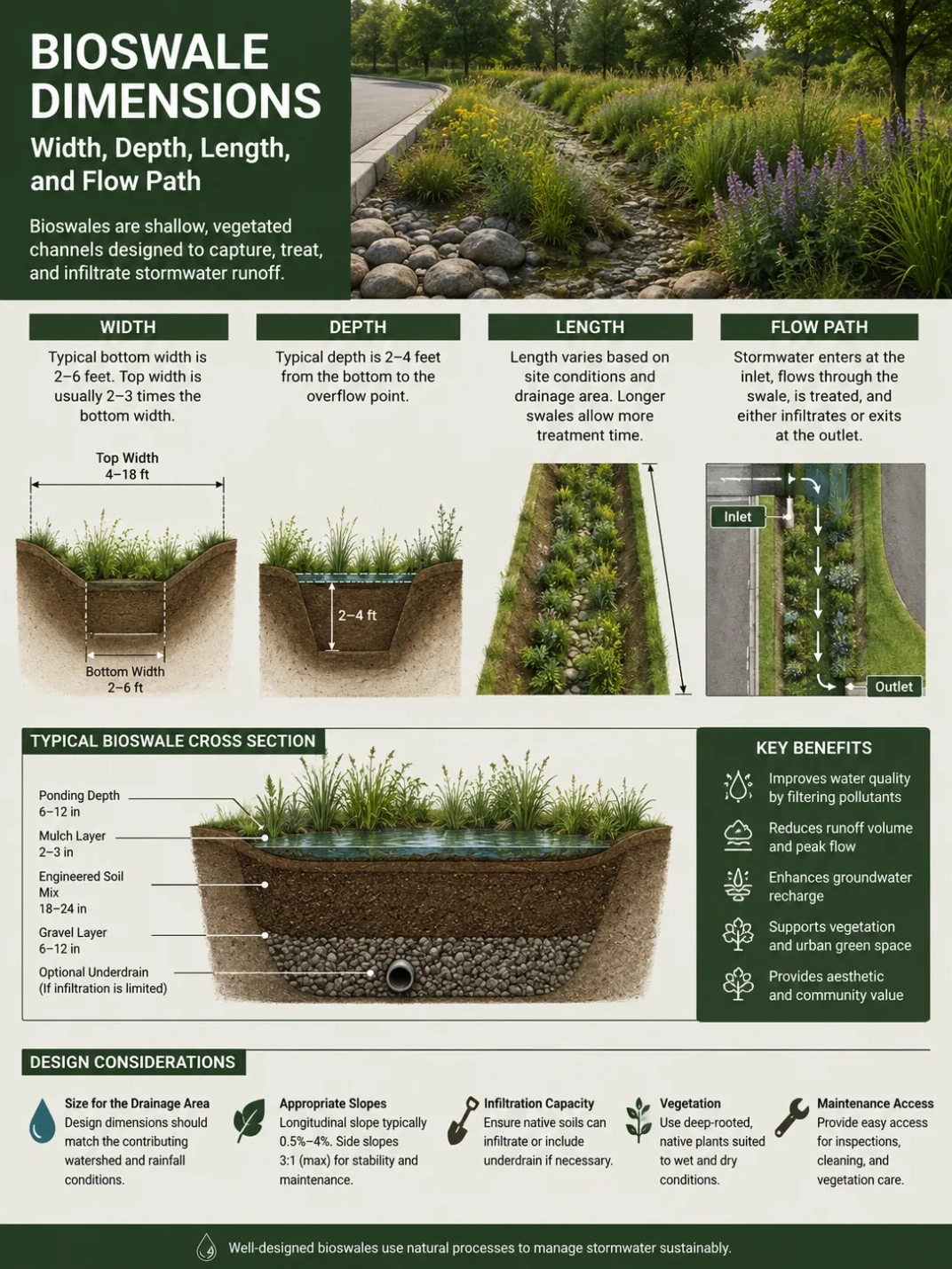
The main dimensions of a bioswale are width, depth, length, slope, and flow path. Each one affects a different part of stormwater performance.
A wider swale can spread water over more soil and vegetation. A deeper swale can hold temporary ponding, but too much depth can make the feature hard to maintain or unsafe in some public areas. A longer flow path gives runoff more contact time with plants, mulch, and soil media. The side slope affects access, mowing, planting, erosion, and safety.
| Dimension | What It Shapes | Why It Matters |
|---|---|---|
| Width | Surface area, flow spread, vegetation zone | A wider swale can reduce concentrated flow and give runoff more contact with soil and plants. |
| Depth | Temporary storage, ponding behavior, side slope | Depth helps hold runoff briefly, but excessive depth can create access and safety concerns. |
| Length | Travel distance and contact time | A longer path can improve settling and filtering when slope and inlet conditions are well managed. |
| Side Slope | Bank stability, maintenance access, planting zones | Gentler sides are easier to plant, inspect, and maintain than steep cut banks. |
| Longitudinal Slope | Water speed along the swale | Too much grade can cause fast flow and erosion; too little grade may leave standing water. |
| Flow Path | How runoff enters, moves, and exits | A clear path helps prevent bypass, short-circuiting, and uncontrolled overflow. |
Width: Giving Runoff Room to Spread
Bioswale width affects how water behaves the moment it enters the channel. If the swale is too narrow for the runoff source, water may concentrate in the center and cut a small trench through the soil or mulch. If the swale is wider and well graded, runoff can spread into a shallow sheet or broad low-flow channel.
Width is often shaped by three practical limits:
- Available land: A residential side yard has different limits than a parking lot edge or roadside corridor.
- Runoff volume: Roof runoff, driveway runoff, parking lot runoff, and road runoff can place very different demands on the swale.
- Maintenance access: The swale should be wide enough to inspect, remove sediment, manage plants, and repair erosion without damaging the system.
A bioswale does not need to be wide everywhere. Some designs use a defined low-flow zone, planted side slopes, and a broader top width for larger storm events. This approach can help the system handle smaller flows without leaving the whole swale wet after every rainfall.
Bottom Width and Top Width
Two width measurements matter: bottom width and top width. The bottom width is the flat or gently curved area where water usually flows. The top width includes the side slopes and planted edges.
A very tight bottom can create a ditch-like channel. A broad bottom can spread flow, but only if the inlet allows water to enter evenly. This is why dimension planning should not treat width as a stand-alone number.
Design Note: A bioswale with a good top width but a poorly shaped inlet may still fail to spread water. The inlet, surface grade, and first few feet of the flow path often decide whether water enters calmly or cuts into the soil.
Depth: Storage Without Turning the Swale Into a Pit
Bioswale depth is the vertical distance from the upper edge or surrounding grade down to the bottom of the swale. It helps create temporary storage for stormwater, but deeper is not automatically better.
A deeper swale may hold more water during a storm. It also needs stable side slopes, safe access, suitable plants, and a clear outlet. In many sites, a moderate shallow profile works better than a narrow deep cut because it is easier to plant, easier to inspect, and less likely to concentrate flow.
Ponding Depth Is Not the Same as Total Depth
Ponding depth means the temporary water depth allowed above the soil surface before water drains, infiltrates, or leaves through an overflow. Total swale depth may include soil media, mulch, freeboard, and side slopes. These are not the same measurement.
This distinction matters because a swale can look deep on the surface but still be designed for shallow temporary ponding. The extra depth may be part of the side slope, overflow allowance, or planting profile.
Depth and Safety in Public Areas
In public spaces, near sidewalks, road edges, campuses, parks, and parking lots, depth must be considered with visibility, side slope, pedestrian movement, and maintenance. A swale that works hydraulically can still be a poor fit if it is hard to cross, hard to see, or hard to maintain.
For residential sites, depth also needs care near foundations, basements, retaining walls, utilities, fences, and neighboring property. A bioswale should move water to a planned location, not push it toward a structure or across a boundary.
Length: Contact Time and Travel Distance
Bioswale length controls how far runoff travels through vegetation and soil before it exits. A short swale may collect water but offer little time for sediment settling or filtering. A longer swale can improve contact with grasses, sedges, rushes, shrubs, mulch, and soil media when the slope is controlled.
Length is not useful by itself. A long swale on a steep grade may move water too quickly. A short swale with a broad shape, calm inlet, and good soil may perform better than a long narrow channel with fast flow.
When Length Is Limited
Many real sites do not have a long straight strip of open land. A bioswale may need to curve, step down with grade changes, or use small check dams where allowed and suitable. These features can help extend the functional flow path without forcing water into a steep straight line.
Curves should be gentle. Tight bends can collect sediment, push flow into one bank, or create erosion at the outside edge. The swale should look like a planned drainage landform, not a leftover strip of low ground.
Flow Path: The Part Many People Underestimate
The flow path is the route water follows from inlet to outlet. It includes where runoff enters, how it spreads, how fast it moves, where it ponds, and where it goes when the swale is full.
A good flow path is easy to read during a storm. Water enters at a planned point or along a planned edge. It slows. It moves through vegetation. It has no hidden shortcut to the outlet. If the storm is larger than the swale can manage, overflow leaves in a controlled direction.
Inlet Behavior
The inlet is where many bioswale problems begin. Runoff from a roof downspout, curb cut, driveway, parking lot, or road edge can arrive with more force than the swale surface can handle. If that energy is not reduced, sediment can pile up at the inlet or water can carve a small channel.
Common inlet concerns include:
- Sediment loading from pavement, exposed soil, or road grit
- High entry speed from downspouts, pipes, curb openings, or steep pavement
- Uneven spreading that sends most water down one side
- Blockage from leaves, mulch, trash, or deposited sediment
In many designs, the inlet area needs stone, dense planting, level spreading, pretreatment, or another method that reduces erosion. The exact method depends on the site and local practice.
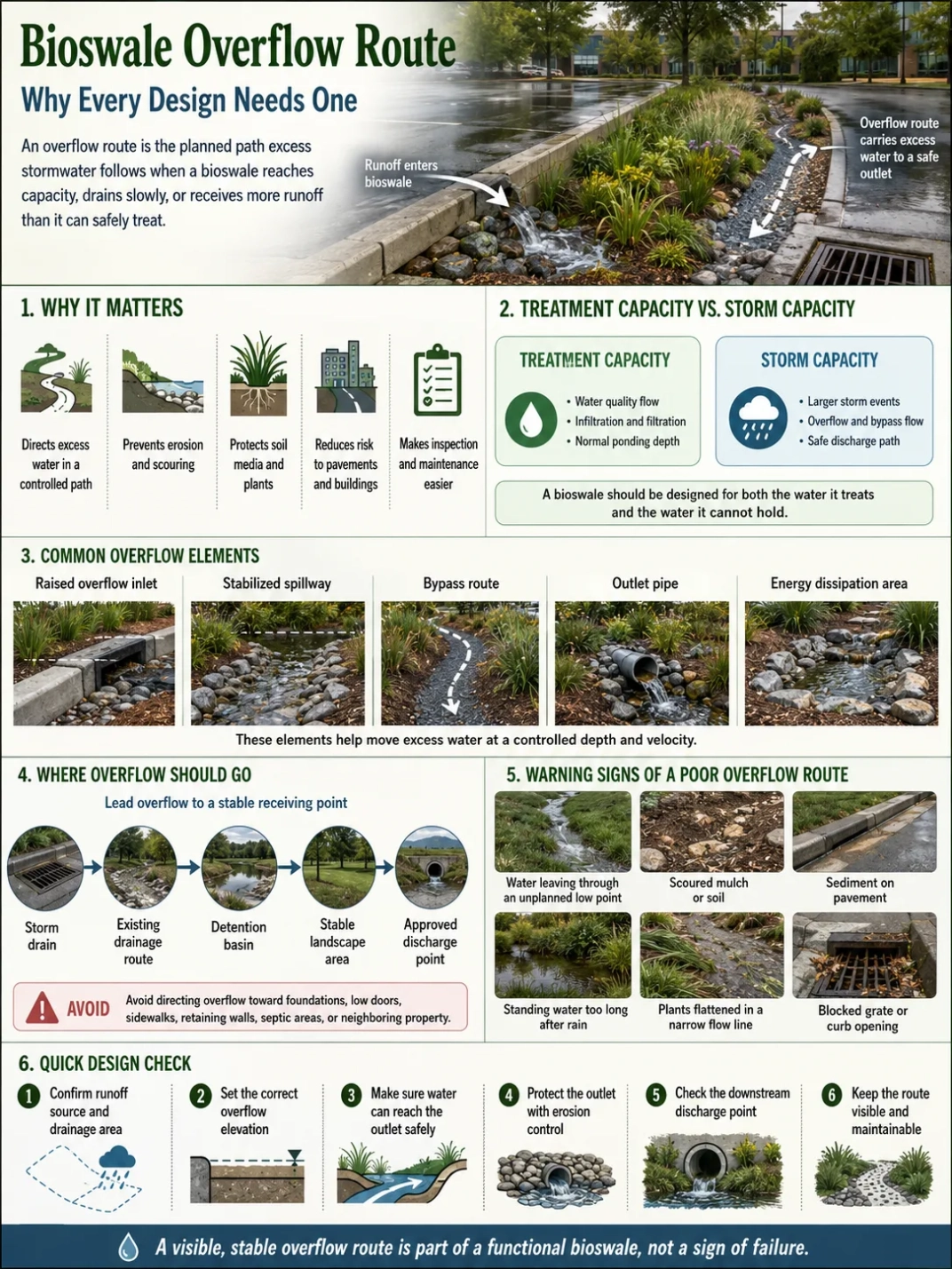
Outlet and Overflow Route
The outlet is not only the end of the swale. It is the safety release point for water that cannot infiltrate or be held during a larger storm. A bioswale without a planned overflow route can send water to places that were not meant to receive it.
The overflow route may lead to a storm drain, another landscape drainage feature, a stabilized outlet, or a safe discharge area where local rules allow. The main point is simple: the system needs a planned path for excess water.
Drainage Note: A bioswale should not be sized only for the pleasant, average storm. The design also needs to consider what happens when water exceeds the intended temporary storage. Overflow planning protects the swale shape and the surrounding site.
Side Slope and Longitudinal Slope
Two slopes shape a bioswale: the side slope and the longitudinal slope. The side slope runs from the edge down to the bottom. The longitudinal slope runs along the length of the swale, from inlet toward outlet.
Gentle side slopes usually support better planting, easier inspection, and lower erosion risk. Steeper side slopes may save space, but they can be harder to stabilize and may limit plant choices. In public or high-use areas, steep sides can also create access concerns.
The longitudinal slope affects water speed. If the grade is too steep, runoff may move through the swale too quickly and scour the bottom. If the grade is too flat, water may stand longer than intended, especially where soil is compacted or the outlet is poorly set.
Check Dams and Grade Breaks
Where a site has more slope than the swale can comfortably handle, some designs use check dams, weirs, stone bands, or planted grade breaks. These features can slow water, create small step-like ponding zones, and reduce erosion pressure.
They need careful placement. Poorly built check dams can trap too much sediment, force water around the sides, or create standing water problems. They should match the soil, expected flow, maintenance plan, and overflow route.
Soil and Infiltration Affect the Needed Size
Soil can change the meaning of every dimension. A bioswale in loose, well-structured soil may drain very differently from one in compacted fill or heavy clay. The same width and depth can perform one way on one site and very differently on another.
Infiltration depends on soil texture, compaction, organic matter, groundwater conditions, construction disturbance, and whether the swale uses engineered soil media or existing soil. Where infiltration is limited, the design may need an underdrain, amended soil, a different outlet strategy, or another drainage system.
Soil Note: A bioswale should not be judged by surface shape alone. If the soil below is compacted, sealed, or poorly draining, water may sit longer than expected even when the swale appears correctly sized.
Soil Media and Storage Below the Surface
Some bioswales include engineered soil media, filter media, gravel layers, or underdrains. Others rely mainly on existing soil and surface vegetation. These choices affect depth and storage, but they should not be reduced to one universal recipe.
Filter media can support pollutant filtering and plant growth when it is matched to the project. An underdrain can help water leave the system where native soil drains slowly. Yet either feature can fail if sediment clogs the surface, if the inlet delivers too much concentrated flow, or if maintenance access is poor.
Plants Need Space in the Dimension Plan
Plants are not decoration in a bioswale. Their stems slow shallow flow, roots help maintain soil structure, and dense cover helps protect the surface from erosion. For this to work, the dimensions must leave enough room for planting zones.
A bioswale often has different moisture zones:
- Bottom zone: Handles the most frequent wetting and temporary ponding.
- Lower side slope: May receive occasional saturation and sediment deposits.
- Upper side slope: Often dries faster and may need plants that tolerate drier conditions.
- Edge zone: Must blend with nearby pavement, lawn, path, planting bed, or curb conditions.
Native plants can be a good fit where they match the local climate, moisture pattern, sun exposure, and soil. Still, no single plant list fits every region. Plant choice should respond to the actual wet and dry pattern of the swale.
Planting Note: A narrow swale with steep sides may leave little room for stable plant communities. Good dimension planning gives roots, stems, mulch, and maintenance work enough space to function together.
How Dimensions Change by Runoff Source
The runoff source affects the size and shape of a bioswale. Clean roof runoff behaves differently from sediment-heavy road runoff. A small residential downspout does not create the same loading as a large parking lot edge.
| Runoff Source | Common Dimension Concern | Planning Response |
|---|---|---|
| Roof Runoff | Concentrated flow from downspouts | Use a calm entry point, spread flow, and keep water away from foundations. |
| Driveway Runoff | Short bursts of pavement runoff | Control entry speed and provide a clear overflow route. |
| Parking Lot Runoff | Larger hardscape area and more sediment | Allow for pretreatment, access, sediment removal, and design review. |
| Roadside Runoff | Curb flow, sediment, debris, and grade limits | Coordinate inlet shape, erosion control, visibility, and maintenance access. |
| Landscape Runoff | Variable soil and slope conditions | Match swale depth and slope to soil stability and plant cover. |
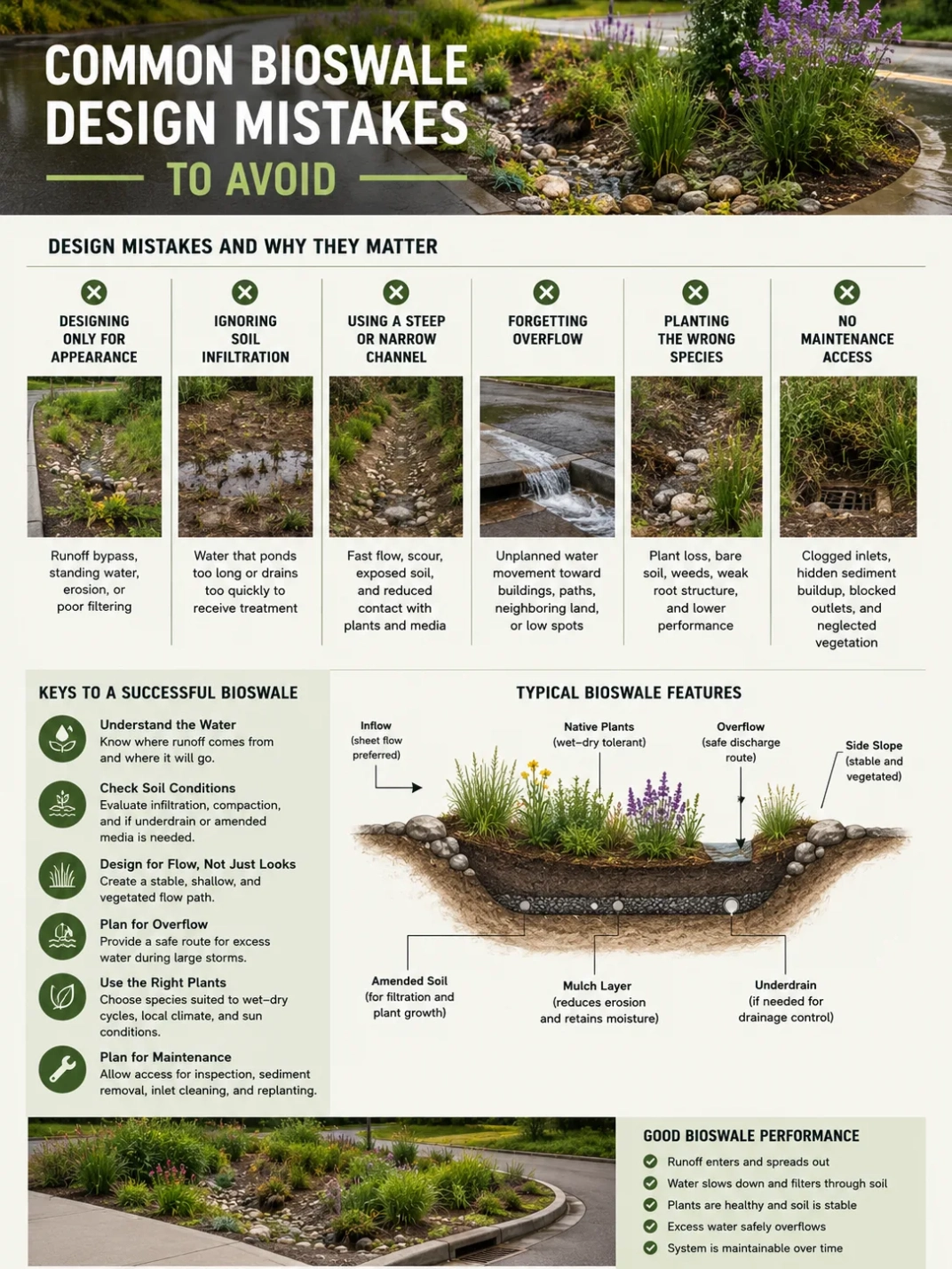
Common Dimension Mistakes
Most bioswale dimension problems come from treating the swale as a trench rather than a planted stormwater system. The shape may collect water, but it may not slow, filter, or drain it well.
Making the Swale Too Narrow
A narrow swale can force water into a single line. This may create erosion, expose soil, move mulch, and reduce contact with plants. Narrow designs need extra care at the inlet and along the bottom.
Making It Too Deep for the Site
Depth can help with temporary storage, but too much depth may create steep sides, awkward planting zones, and difficult maintenance. In some areas, it may also create a feature that feels out of place in the landscape.
Forgetting the Overflow
A bioswale needs a place for excess water to go. Without a planned overflow route, water may cut around the edge, jump the bank, or move toward a sensitive part of the site.
Ignoring Soil Compaction
Construction traffic, foot traffic, parked vehicles, and heavy equipment can compact soil. Compacted soil may reduce infiltration and weaken plant establishment. A swale that looks finished can still underperform if the soil below is damaged.
Using a Straight Fast Channel
A straight swale on a strong slope can act more like a drainage ditch than a vegetated filter. Where grade is a challenge, the design may need grade breaks, check dams, wider spreading areas, or another drainage approach.
How Bioswale Dimensions Differ from Related Systems
A bioswale overlaps with rain gardens, vegetated swales, bioretention cells, and drainage ditches, but the dimension logic is not identical.
A rain garden is often a shallow planted basin that collects runoff and allows ponding in a defined area. A bioswale is usually more linear, with a flow path from inlet to outlet. A drainage ditch is mainly built to move water away, while a bioswale also aims to slow, filter, and support vegetation. A bioretention cell may use a more engineered soil profile and underdrain, depending on the project.
These systems can overlap in real landscapes. The label matters less than the actual design: where water enters, how it moves, how long it stays, what soil it meets, and where it exits.
What to Check Before Choosing Dimensions
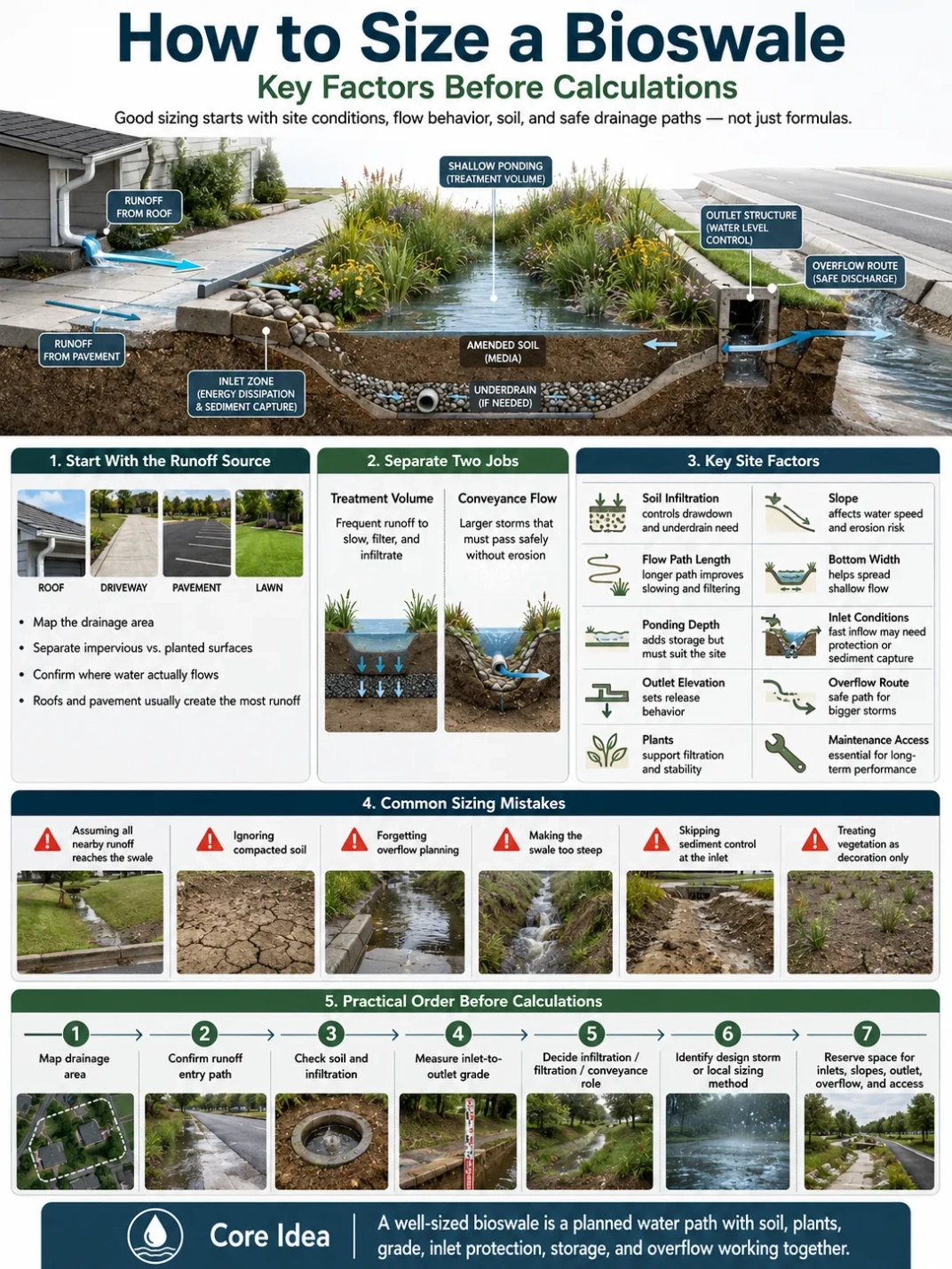
Before setting width, depth, and length, the site needs a plain reading. Water movement should be observed or mapped, not guessed from surface appearance alone.
- Identify the runoff source. Note whether water comes from a roof, pavement, slope, roadway, or mixed area.
- Find the natural flow direction. Look for low points, stains, sediment lines, eroded soil, and wet spots after rain.
- Check soil behavior. Consider compaction, infiltration, clay content, fill soil, and seasonal wetness.
- Plan the inlet. Decide how water will enter without cutting into the swale.
- Plan the outlet. Make sure excess water can leave safely.
- Leave room for plants. Match the swale shape to plant establishment and future maintenance.
- Review site limits. Consider foundations, utilities, property edges, public paths, curbs, and local drainage rules.
When Professional Review May Be Needed
Small landscape bioswales can be simple in appearance, but some sites need more than a basic layout. Professional review may be needed where runoff comes from a large impervious area, where water could affect buildings, where slopes are steep, where soil drains poorly, or where the swale connects to public drainage infrastructure.
Commercial, roadside, school, park, and public-space bioswales often need closer review because they must handle more flow, more sediment, more foot traffic, and more maintenance demands. In those settings, dimensions are part of a larger stormwater design, not a casual planting choice.
Site Planning Note: A bioswale should not redirect water toward a building, basement, neighboring property, unstable slope, or public path. Where the outlet route is uncertain, the dimension plan is not complete.
Maintenance Access Should Shape the Size
Maintenance is easier when the swale dimensions allow people to see and reach the parts that collect sediment. Inlets, outlets, check dams, low-flow channels, and dense planting zones all need inspection.
Common maintenance tasks include removing sediment, clearing blocked inlets, replacing failed plants, managing weeds, repairing erosion, refreshing mulch where suitable, and checking whether water drains as expected after storms.
A swale that is too narrow, too steep, or too hidden may become difficult to maintain. This can reduce performance over time even if the original dimensions looked good on paper.
Practical Dimension Logic for Real Sites
Good bioswale dimensions come from matching the landform to water behavior. The shape should slow water without trapping it for too long. It should be wide enough to spread flow, deep enough for temporary storage, long enough for useful contact, and graded enough to drain through a planned path.
The best dimension plan usually starts with these questions:
- Where does the water come from?
- How fast does it enter?
- Can the swale spread the flow before erosion starts?
- Will the soil infiltrate, drain slowly, or need support?
- Where will larger storm overflow go?
- Can the plants survive both wet and dry periods?
- Can the inlet, outlet, and bottom be maintained without damaging the swale?
When those questions are answered, width, depth, length, and flow path become design choices tied to site behavior, not isolated measurements.
FAQ
How wide should a bioswale be?
A bioswale should be wide enough to spread runoff, support vegetation, and allow maintenance access. The needed width depends on runoff source, soil, slope, available space, and local drainage requirements.
How deep should a bioswale be?
Bioswale depth should allow shallow temporary ponding without creating steep, unsafe, or hard-to-maintain sides. Ponding depth, total depth, soil media, and overflow height should be considered separately.
Does a longer bioswale work better?
A longer bioswale can give runoff more contact time with vegetation and soil, but length alone does not ensure good performance. Slope, inlet design, soil infiltration, and outlet control also matter.
What is the most overlooked bioswale dimension?
The flow path is often overlooked. A bioswale needs a planned route from inlet to outlet so water enters calmly, moves through the planted area, and overflows safely during larger storms.
Can a bioswale be too deep or too narrow?
Yes. A swale that is too deep may have steep sides and poor access, while a swale that is too narrow may concentrate flow and erode. The shape should match water volume, soil, slope, and maintenance needs.
Do bioswale dimensions depend on soil type?
Yes. Soil texture, compaction, infiltration, and seasonal wetness can change how the same swale dimensions perform. Poorly draining or compacted soils may need amended soil, an underdrain, a different outlet strategy, or professional review.