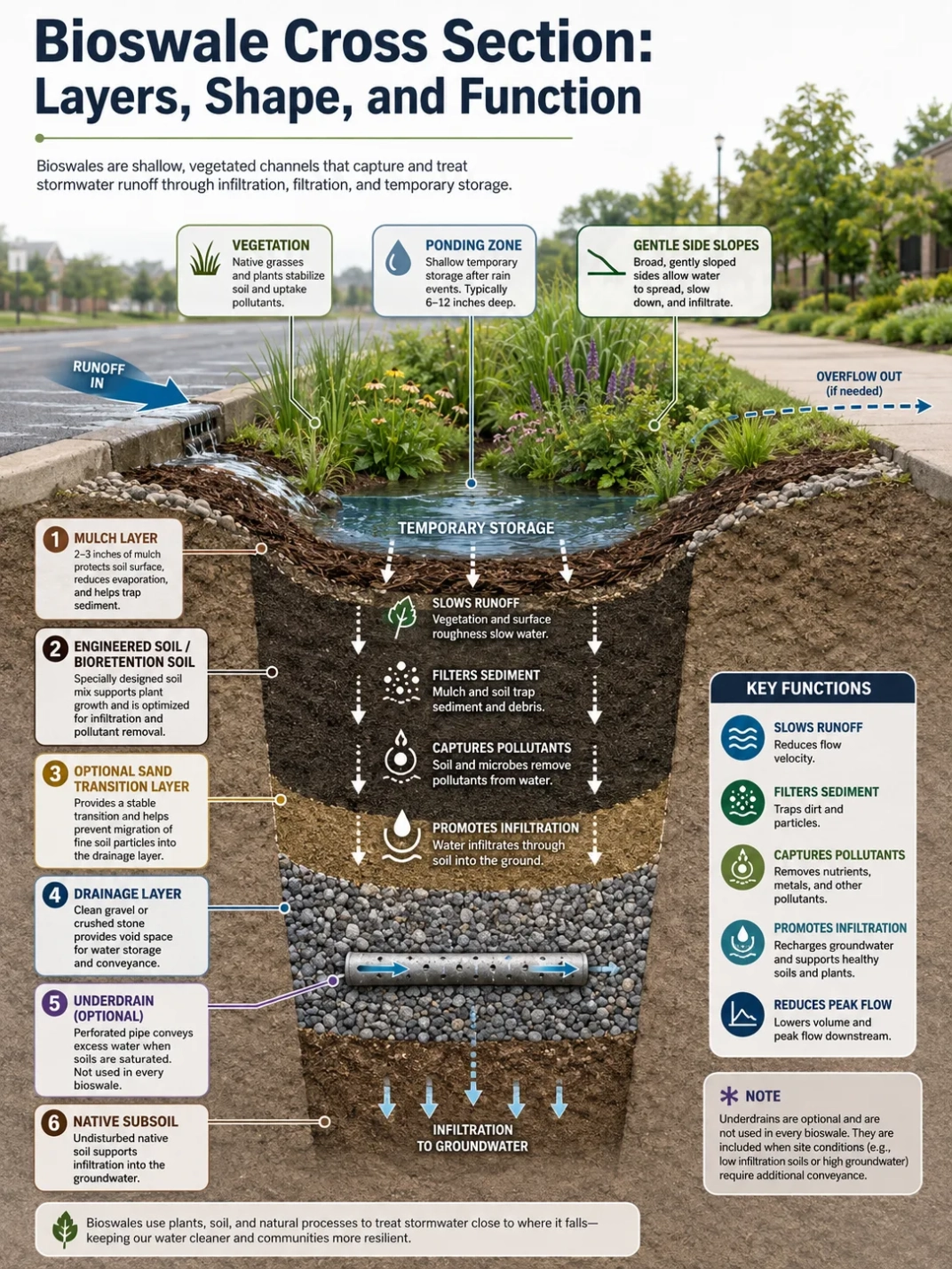
A bioswale cross section shows what happens below the visible strip of plants: runoff enters a shallow vegetated channel, spreads across a shaped surface, passes through soil or filter media, and leaves by infiltration, underdrain flow, or a safe overflow route. The cross section matters because a bioswale is not just a planted ditch. Its layers, slopes, soil, roots, storage space, and outlet behavior all shape how water slows, filters, drains, and moves through the site.
The surface may look simple, but the section usually carries the real work. A shallow depression collects runoff. Side slopes hold the channel shape. Vegetation protects the surface from erosion. Soil media filters sediment and allows water to move downward. A drainage layer or underdrain may be included where native soil drains slowly, where the water table is a concern, or where the project has a defined outflow point.
Bioswale Cross Section Meaning
A bioswale cross section is a cut-through view of the swale from one side to the other. It shows the channel shape, planting surface, soil profile, drainage layers, and any buried pipe or overflow feature. Designers use it to understand how the bioswale will handle runoff after rain, not just how it will look from above.
In plan view, a bioswale may look like a long planted strip beside a road, driveway, roof edge, sidewalk, or parking lot. In cross section, the same system shows its hydraulic and soil structure: where water enters, how deep it can pond, where roots grow, how the base drains, and where excess water should go when the swale receives more runoff than it can hold or infiltrate.
The cross section is especially useful because many bioswale problems begin with invisible details. Poor soil compaction, an undersized overflow path, blocked inlets, thin vegetation, or a shape that concentrates flow in one narrow line can reduce performance even if the surface planting looks healthy.
Main Parts of a Bioswale Cross Section
Most bioswale sections include several working zones from top to bottom. The exact profile varies by climate, rainfall, soil, drainage area, local rules, and maintenance needs, but the same basic parts appear in many designs.
| Cross-Section Part | Typical Function | What Can Go Wrong |
|---|---|---|
| Inlet Edge | Allows roof, driveway, sidewalk, curb, or parking lot runoff to enter the bioswale in a controlled way. | Water can cut into soil if the inlet is too steep, blocked, or not protected from concentrated flow. |
| Vegetated Surface | Slows shallow flow, protects soil, traps sediment, and supports root growth. | Bare soil, weak turf, or poorly suited plants can lead to erosion and clogging. |
| Ponding Area | Temporarily holds runoff above the soil surface during and after rain. | Too little storage can send water straight to overflow; too much standing water may indicate poor drainage. |
| Side Slopes | Shape the channel, connect surrounding grade to the bottom, and allow safe maintenance access. | Steep or unstable sides can erode, slump, or become hard to plant and maintain. |
| Filter Media or Amended Soil | Filters sediment and supports infiltration, plant roots, and microbial activity. | Compaction, too much fine material, or unsuitable imported soil can slow drainage. |
| Drainage Layer | Provides storage and helps water move toward native soil or an underdrain where included. | Poor separation between layers may allow fines to migrate and reduce flow over time. |
| Underdrain | Collects filtered water when infiltration into native soil is limited or when a defined outlet is needed. | A blocked, poorly placed, or unnecessary underdrain can reduce the intended storage or infiltration behavior. |
| Overflow Route | Moves excess runoff safely away when the bioswale is full. | An unclear overflow path can cause water to back up, bypass the swale, or move toward sensitive areas. |
This table is not a fixed recipe. It is a way to read the section. A small residential bioswale, a roadside bioswale, and a parking lot bioswale may share the same logic while using different depths, materials, inlet details, and outlet controls.
Surface Shape: Why the Channel Profile Matters
The visible shape of a bioswale is usually a shallow channel. It may have a flat bottom, a rounded base, or a gently sloped profile. In many designs, the section is closer to a broad, shallow trough than a narrow ditch. That wider shape helps water spread out instead of racing through one line.
Shape controls flow speed. When runoff spreads across a vegetated bottom, plants and soil have more contact time with the water. Sediment can settle. Fine particles can be trapped near the surface. The soil profile can receive water more evenly.
Flat-Bottomed Sections
A flat or nearly flat bottom is common where the goal is to slow runoff and encourage even infiltration. It gives water a broader contact area and can reduce the chance of a narrow erosion channel forming through the center.
Flat bottoms still need careful grading. A bottom that is uneven may create low spots that hold water longer than intended, while a bottom that is too steep may behave more like a conveyance ditch than a filtering system.
Trapezoidal and Rounded Sections
Trapezoidal sections have a bottom and two sloped sides. Rounded or parabolic sections soften that shape. Both can work when the channel is wide enough, stable, and matched to the expected runoff. The choice often depends on space, mowing or maintenance access, plant type, and the surrounding grade.
A narrow V-shaped profile may move water too quickly for some bioswale goals. It can also focus flow near the center, which may increase erosion unless check dams, dense vegetation, or other controls are used.
Longitudinal Slope and Check Dams
The cross section shows the side-to-side shape, but the lengthwise slope also matters. Water moves along the swale from inlet to outlet. If the run is steep, water can gain speed. Small check dams, level spreaders, or grade breaks may be used in some designs to slow water and create shallow ponding zones.
Check dams are not decorative blocks. They affect water depth, sediment drop-out, overflow behavior, and maintenance. If used, they need a stable center or notch so excess water passes through a planned route rather than around the sides.
Design Note: A bioswale section should slow water without trapping it in the wrong place. The goal is controlled temporary ponding, not a permanently wet trench unless the system is specifically designed as a wet swale.
Surface Layer: Plants, Mulch, and Soil Protection
The top layer of a bioswale is where runoff first meets resistance. Vegetation, mulch, stones at inlets, and exposed soil conditions all influence how the system handles the first rush of water.
Dense plant cover helps slow shallow flow and protect the soil surface. Grasses, sedges, rushes, and low shrubs may be used depending on the site. The best plant choice depends on sun exposure, expected wet and dry cycles, soil texture, salt or sediment exposure, and local plant suitability.
Roots also matter below the surface. Fine roots help hold soil. Deeper or fibrous root systems can improve soil structure over time and support small pores where water and air move. This does not mean plants can fix every drainage problem. Compacted soil, poor grading, and blocked outlets still need direct correction.
Mulch in the Cross Section
Some bioswales include mulch, especially in planted bioretention-style sections. Mulch can protect soil, reduce splash erosion, and trap fine sediment near the surface. In fast-flow areas, loose mulch may float or wash toward outlets, so the surface material must fit the expected water movement.
Stone, erosion-control matting, or dense vegetation may be more suitable near concentrated inlets. The inlet zone often receives more sediment and force than the rest of the swale.
Planting Note: A bioswale plant palette should match both moisture zones: wetter areas near the bottom and drier areas along the upper side slopes. A plant that tolerates occasional ponding may still fail if the upper slope stays dry for long periods.
Soil Media: The Working Filter Layer
The soil or filter media layer is one of the most active parts of a bioswale cross section. It supports plants, receives runoff, traps sediment, and allows water to move downward. In engineered bioswales, this layer may be an amended soil mix or a specified bioretention media rather than the original site soil.
A useful media layer needs balance. If it is too sandy, water may pass through quickly while plants struggle in dry periods. If it contains too many fine particles, it may drain slowly or clog. If it is compacted during construction, even a good soil mix can lose much of its pore space.
Infiltration is not only about soil type. It is also shaped by compaction, depth, organic matter, root growth, sediment load, groundwater conditions, and how often runoff enters the swale.
Native Soil Below the Media
Below the amended layer, the native soil controls how much water can soak into the ground. Sandy or loamy soils may accept water more easily than dense clay or heavily compacted urban soil. However, even sandy sites can fail if construction traffic compacts the base or if sediment blocks the surface.
Where native soil drains slowly, the section may include a drainage layer and underdrain. This does not make the bioswale useless. It simply changes the function from mainly infiltration into a mix of filtering, temporary storage, and controlled discharge.
Soil Note: A single soil mix should not be assumed to fit every site. Soil texture, compaction, groundwater depth, plant needs, and local drainage rules can all affect the right section detail.
Drainage Layer and Underdrain Function
Some bioswale cross sections include a coarse aggregate layer beneath the soil media. This layer can create temporary storage and help filtered water move toward native soil or a perforated underdrain pipe. The underdrain, when included, usually connects to a safe outlet, storm drain structure, or other approved discharge point.
An underdrain is not a sign that the bioswale has failed. It is often used when the native soil cannot accept water quickly enough, when the site has limited infiltration capacity, or when the project needs a controlled outlet. In those cases, the surface and soil layers still slow and filter runoff before water leaves the system.
Some sections include a separation layer between media and drainage stone. The purpose is to reduce movement of fine soil particles into the drainage layer. The material and detail vary. Poorly chosen fabric or poor placement can clog in some situations, so this choice should match local design practice and site conditions.
When a Bioswale May Not Need an Underdrain
A bioswale may not need an underdrain where native soil drains well, the water table is suitable, the contributing runoff area is modest, and the overflow route is safe. Even then, the system should be planned so excess runoff has somewhere to go during larger storms.
Skipping the underdrain does not remove the need for a clear section. The bottom still needs stable soil, plant support, sediment management, and enough grade control to prevent channel cutting.
Inlet, Outlet, and Overflow in the Section
A bioswale cross section is incomplete without thinking about how water enters and exits. The inlet handles the first contact. The outlet and overflow route handle the water the swale cannot store or infiltrate.
Runoff may enter from a curb cut, downspout extension, sheet flow from pavement, a driveway edge, or a roof drainage line. Each source behaves differently. Sheet flow spreads water gently. A pipe or curb opening can create a concentrated jet that needs stone, a splash pad, vegetation, or grading that spreads flow before it reaches the soil surface.
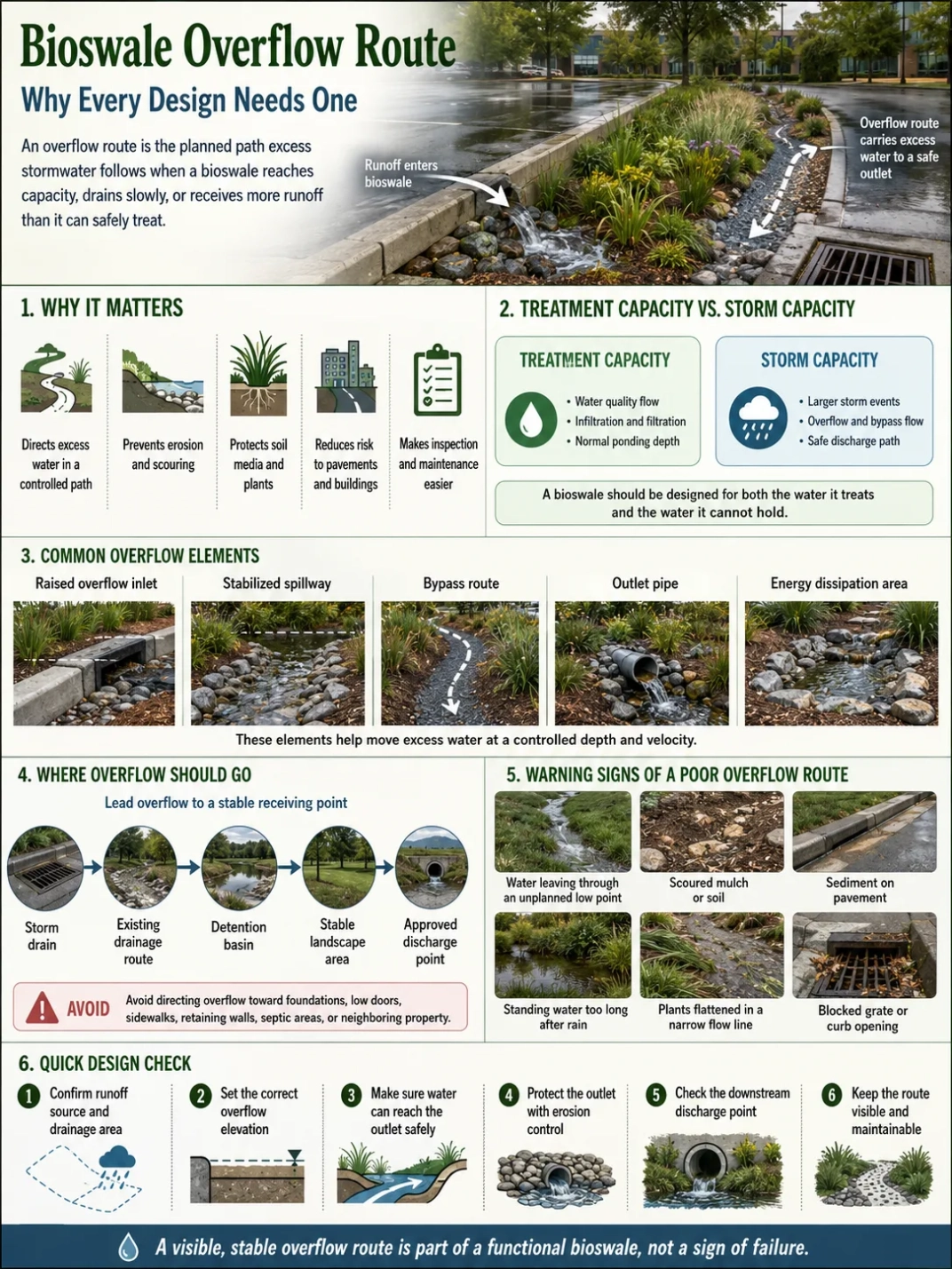
The overflow route is part of the safety logic. A bioswale should have a planned way to pass extra water during storms that exceed its working storage. That route may be a raised outlet, overflow structure, stabilized spillway, curb opening, or connection to another drainage feature, depending on the site.
Site Planning Note: Where runoff could move toward a building foundation, basement, neighboring property, public sidewalk, roadway, or utility area, the cross section should be reviewed with site-specific drainage in mind.
How the Layers Work Together During Rain
During rainfall, the bioswale section works in stages. First, runoff enters the vegetated channel. The surface shape spreads and slows the water. Sediment begins to settle or get trapped by stems, mulch, stones, and soil texture. Then water ponds shallowly above the surface while some of it infiltrates into the media.
As water moves through the soil layer, small particles can be filtered. Plants and soil organisms also support treatment processes, though the exact removal of pollutants varies by design, age, soil, vegetation, and runoff type. It is better to describe a bioswale as a system that can help filter and reduce runoff impacts rather than a device that removes every pollutant.
After passing through the media, water may enter native soil, move into a drainage aggregate layer, or reach an underdrain. If the bioswale fills faster than it can drain, excess water should move through the overflow route. This sequence is why the top shape and the buried layers need to be planned together.
Cross-Section Layers from Top to Bottom
A typical bioswale cross section can be read from the surface downward. The order below is common, but not every section includes every layer.
- Vegetation layer: grasses, sedges, rushes, shrubs, or other suitable plants that slow water and protect the surface.
- Surface protection layer: mulch, stone, matting, dense planting, or other protection where erosion risk is higher.
- Ponding zone: temporary storage above the soil surface during rainfall.
- Filter media or amended soil: the main rooting and filtering layer.
- Native soil interface: the contact zone where water may infiltrate into the existing ground.
- Drainage aggregate: a lower storage and conveyance layer used in some sections.
- Underdrain pipe: a perforated pipe used where controlled drainage is needed.
- Outlet or overflow connection: the planned route for water that leaves the bioswale.
This vertical order is useful, but water does not move only downward. During heavier rain, water may also move along the surface, across the bottom, through check dam openings, and toward overflow points. A good cross section supports both vertical infiltration and horizontal conveyance.
Where the Cross Section Can Fail
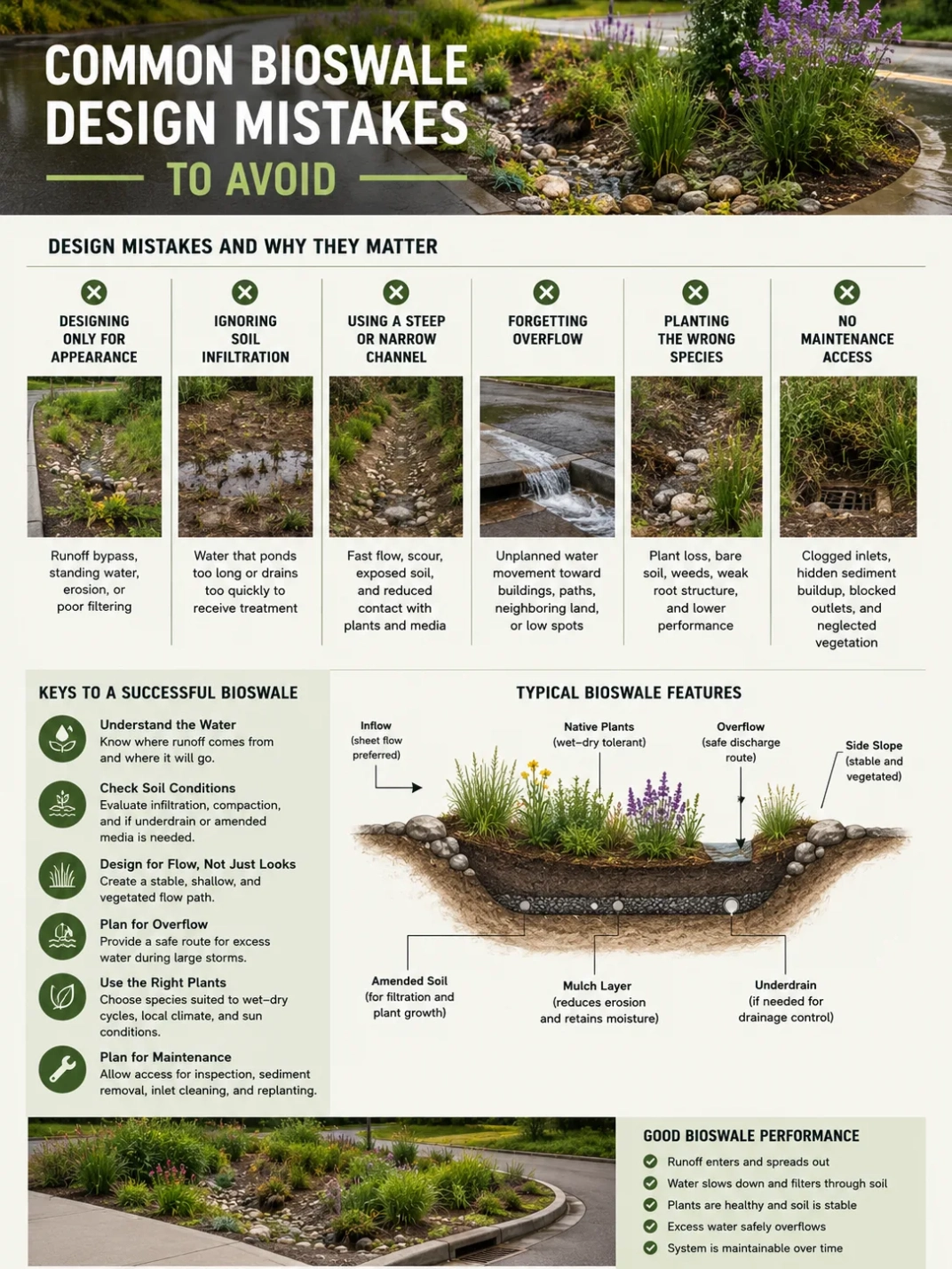
Many bioswale issues come from a mismatch between runoff volume, soil capacity, and channel shape. The most visible symptom may be standing water, bare soil, sediment buildup, or eroded side slopes. The cause may be deeper in the section.
- Compacted media: construction equipment or repeated foot traffic can reduce pore space.
- Blocked inlet: leaves, grit, trash, or sediment can prevent runoff from entering as planned.
- Poor flow spreading: concentrated water can cut a channel through the swale.
- Thin vegetation: exposed soil is more likely to erode and clog.
- Unclear overflow: excess water may bypass the system or collect in unwanted areas.
- Wrong soil for the goal: media that drains too slowly or too quickly can reduce performance.
- Sediment overload: runoff from bare soil, construction areas, or dirty pavement can clog the surface faster than expected.
These problems are not only maintenance issues. They often point back to the original section detail: inlet protection, slope, media selection, storage depth, drainage layer, and outlet planning.
Bioswale Cross Section and Rain Garden Section Compared
A bioswale and a rain garden can share some layers, especially where both use plants, amended soil, temporary ponding, and underdrains. The main difference is the role of flow. A rain garden is often a basin that collects runoff. A bioswale is usually a linear feature that also conveys water along its length.
That linear function changes the cross section. A bioswale must manage movement from inlet to outlet, not just storage in one depression. Side slopes, bottom width, flow path, check dams, and overflow routes become more visible parts of the design.
| Feature | Typical Cross-Section Focus | Main Difference |
|---|---|---|
| Bioswale | Linear vegetated channel with soil, storage, and a planned flow path. | Moves and treats runoff along its length. |
| Rain Garden | Planted basin with temporary ponding and infiltration or underdrainage. | Often collects water in a more basin-like shape. |
| Drainage Ditch | Open channel shaped mainly for conveyance. | Usually focuses more on moving water than filtering it through soil and plants. |
| French Drain | Underground trench with stone and pipe. | Works below the surface and does not rely on a planted treatment channel. |
| Dry Creek Bed | Stone-lined surface channel. | Can guide water, but may not include filter media, root zones, or bioretention layers. |
Residential Cross Sections
A residential bioswale section may receive runoff from a roof, downspout, driveway, patio, or yard slope. The section is often smaller than a roadside or parking lot bioswale, but the same details still matter: entry point, bottom shape, soil, plants, overflow, and distance from sensitive areas.
Roof runoff may arrive through a downspout extension or pipe, which can concentrate water at one point. Driveway runoff may carry grit and sediment. Yard runoff may bring soil particles during storms. The cross section should account for these different runoff sources rather than treating all water the same way.
Near homes, the overflow route deserves careful thought. Water should not be directed toward foundations, basement walls, neighboring lots, septic areas, or public walkways. Local drainage rules and site grading can affect what is allowed.
Public and Commercial Cross Sections
Roadside, sidewalk, campus, and parking lot bioswales often receive more sediment and more frequent flow than a small yard bioswale. Their cross sections may need stronger inlet protection, better maintenance access, defined curb cuts, stable side slopes, and clear overflow structures.
Hardscape runoff can enter quickly. A curb opening may send water into the swale with enough force to disturb soil or mulch. That is why the inlet zone often includes stone, a forebay, a level spreader, or dense vegetation. The goal is not to make the inlet look heavy; it is to spread energy before water reaches the main soil surface.
In public spaces, the cross section also affects visibility, trip concerns, vegetation height, inspection access, and sediment removal. A system that cannot be maintained will not keep its intended shape for long.
What to Check Before Planning a Cross Section
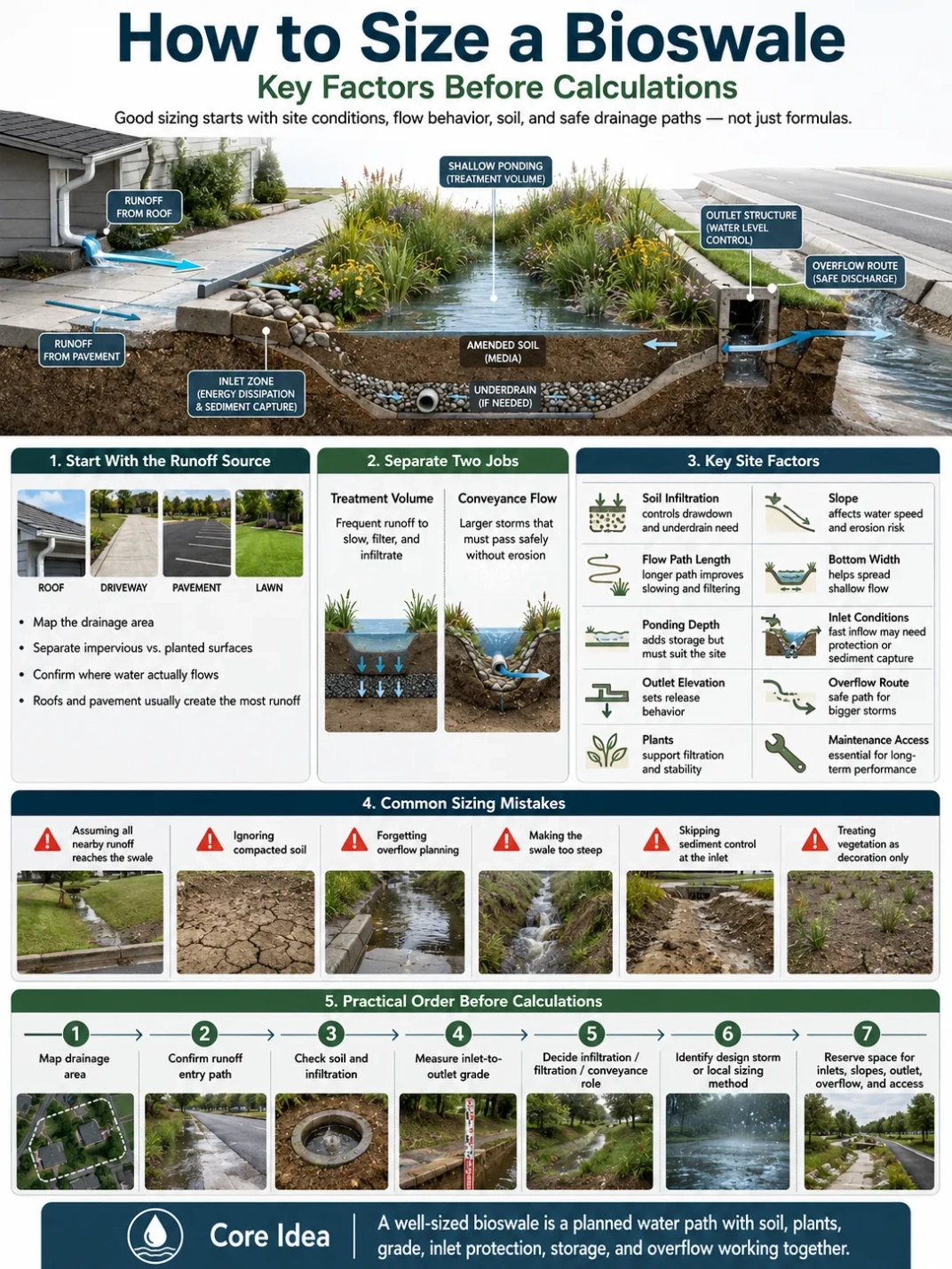
A bioswale section should respond to the site rather than copy a generic drawing. Before choosing layers or shape, the following checks help define what the section needs to do.
- Runoff source: roof, driveway, road, parking lot, sidewalk, lawn, or mixed area.
- Runoff path: whether water arrives as sheet flow, pipe flow, curb flow, or concentrated slope runoff.
- Soil condition: native texture, compaction, infiltration behavior, and signs of poor drainage.
- Available width: enough space for side slopes, bottom width, planting, and maintenance access.
- Outlet location: a safe place for overflow and underdrain discharge where used.
- Sediment load: whether the inlet needs a forebay or easier cleanout area.
- Planting zone: wet bottom, drier slopes, sun exposure, salt exposure, and local plant suitability.
- Local requirements: stormwater standards, setbacks, permits, and utility constraints where they apply.
These checks help keep the cross section connected to real hydrology. Without them, the drawing may look clean but fail to match the way water actually reaches the site.
Maintenance Details Hidden in the Cross Section
Maintenance is often thought of as surface work, but the cross section shapes how easy that work will be. A well-formed inlet can be cleaned. A broad bottom can be inspected. Stable side slopes can be planted and accessed. A visible overflow point makes it easier to notice blockage.
Routine inspection usually looks for sediment buildup, erosion, clogged inlets, damaged plants, mulch movement, standing water, and blocked outlets. The exact timing depends on rainfall, season, runoff source, plant establishment, and local expectations.
Standing water is a clue, not a diagnosis. It may come from compacted soil, fine sediment, a blocked underdrain, an outlet problem, a high water table, or a section that is receiving more runoff than it was shaped to handle.
Maintenance Note: The easiest sediment to remove is sediment caught near the inlet before it spreads through the whole soil surface. For runoff from pavement or bare soil areas, the inlet zone often needs closer attention.
Common Misunderstandings About Bioswale Sections
A Bioswale Is Not Just a Lower Strip of Landscaping
Plants help, but the section also needs soil structure, grade control, and a way to handle excess water. A planted low spot without a planned inlet, media layer, or overflow route may not perform like a bioswale.
More Depth Does Not Automatically Mean Better Performance
Depth must match drainage needs, soil behavior, plant roots, storage goals, and safe overflow. A deeper channel can create maintenance and access issues if it is not shaped well.
An Underdrain Does Not Remove the Need for Infiltration Thinking
Even with an underdrain, water still passes through the surface and soil layers. The media, vegetation, and inlet protection remain active parts of the system.
The Bottom Layer Cannot Fix a Poor Inlet
If runoff enters too fast or in one narrow stream, erosion and sediment movement may begin before water reaches the lower layers. The inlet edge is part of the cross section’s performance.
When Professional Review May Be Needed
Professional review is sensible when the bioswale receives runoff from a large hard surface, connects to a public drainage system, sits near a building foundation, affects a roadway or sidewalk, crosses utility areas, or must meet a local stormwater requirement. It may also be needed where soils are highly compacted, groundwater is shallow, slopes are steep, or overflow could affect nearby property.
This does not make bioswales overly complex. It means the cross section should match the risk level of the site. A small landscape feature receiving light yard runoff is different from a curbside bioswale handling road drainage or a commercial swale receiving parking lot runoff.
FAQ
What are the main layers in a bioswale cross section?
The main layers often include vegetation, surface protection, a temporary ponding zone, filter media or amended soil, native soil, and sometimes a drainage aggregate layer with an underdrain. The exact layers depend on soil, runoff source, drainage goals, and local requirements.
Does every bioswale cross section need an underdrain?
No. Some bioswales can drain into suitable native soil without an underdrain. An underdrain may be used where infiltration is limited, where controlled discharge is needed, or where site conditions call for a defined outlet.
Why is the shape of a bioswale important?
The shape affects how fast water moves, how evenly it spreads, how much contact it has with plants and soil, and whether erosion is likely. A broad, shallow shape often supports slower flow and better surface contact than a narrow, steep channel.
What is the function of the soil media layer?
The soil media layer supports plants, filters sediment, allows water to move downward, and provides space for roots and soil organisms. Its performance depends on texture, compaction, depth, organic matter, and how much sediment reaches the surface.
How is a bioswale cross section different from a rain garden section?
A rain garden is usually more basin-like, while a bioswale is often linear and also conveys runoff along its length. Because of that, a bioswale cross section must pay close attention to flow path, side slopes, inlets, outlets, and overflow behavior.
Can a bioswale cross section fix poor drainage by itself?
A well-planned section can help manage runoff, but it cannot solve every drainage issue. Soil compaction, high groundwater, steep slopes, blocked outlets, foundation concerns, and local drainage rules may require site-specific review.