Bioswales offer genuine stormwater benefits, but they are not a universal fix. A well-designed bioswale can slow runoff, remove common pollutants, and support groundwater recharge — but only when soil conditions, slope, sizing, and maintenance align with what the system actually requires. Understanding what bioswales do reliably, and where they fall short, helps in deciding whether one belongs on a given site.
The Real Work a Bioswale Does
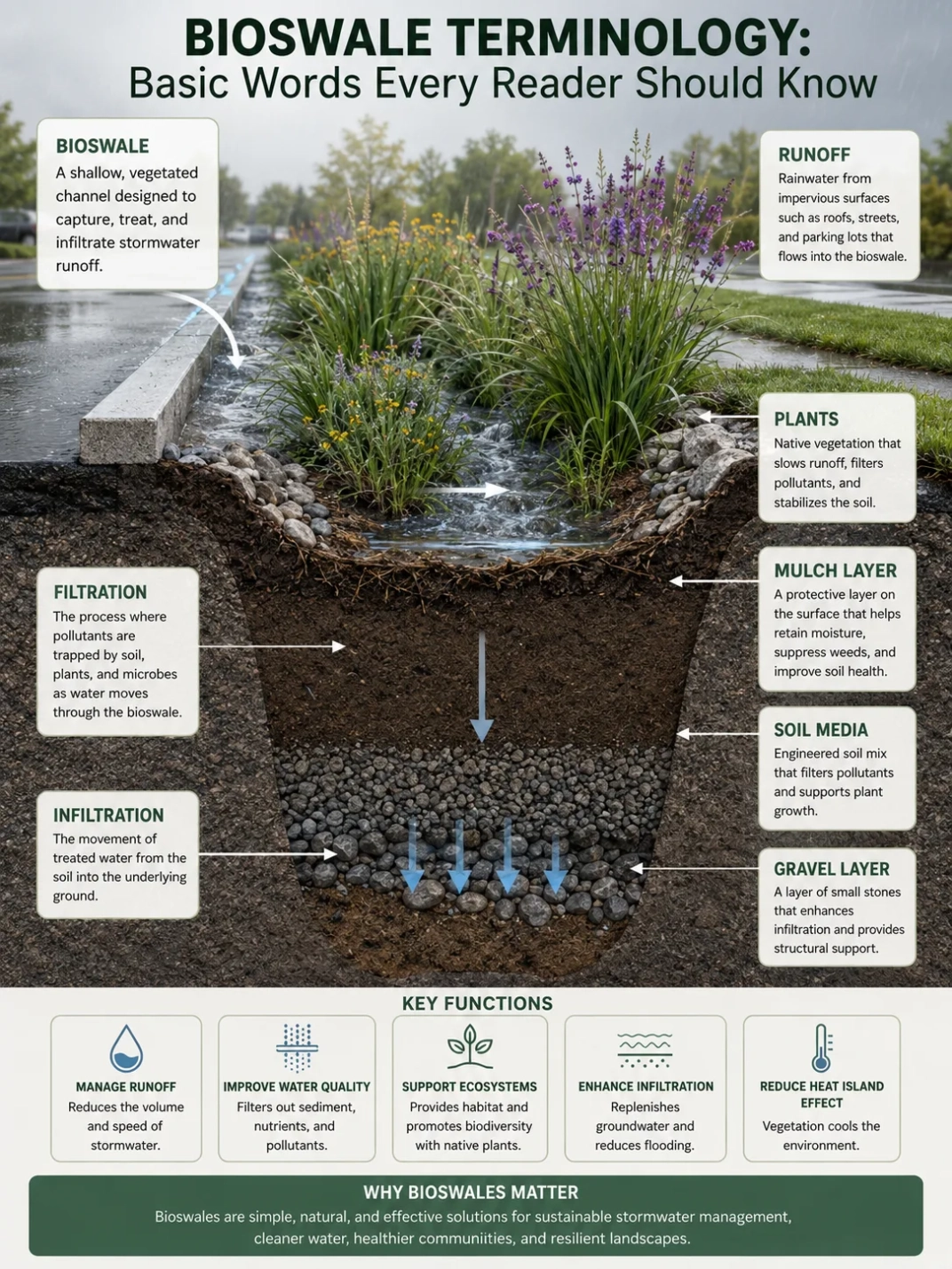
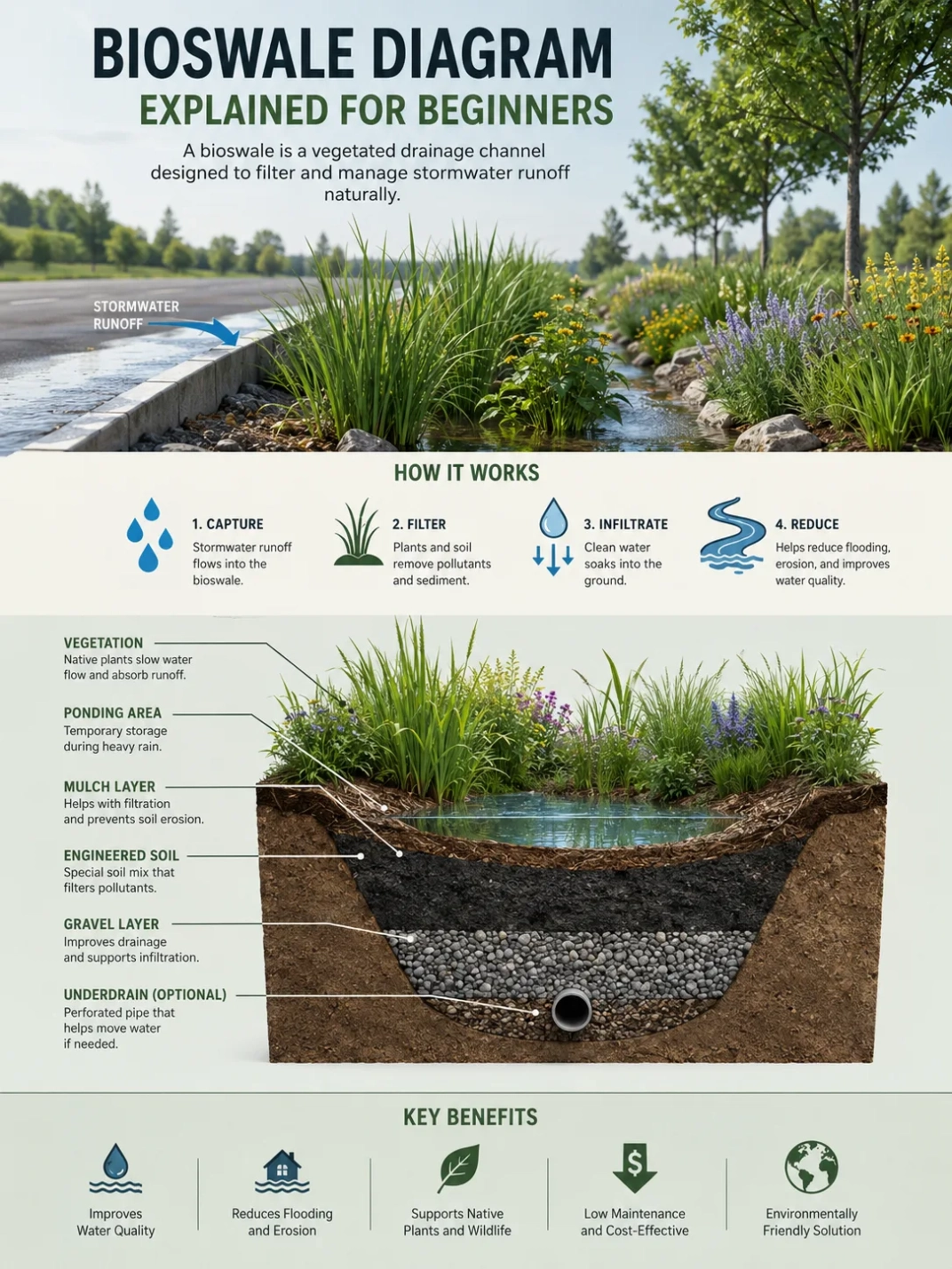
The primary function of a bioswale is to intercept stormwater runoff and move it more slowly across a vegetated surface, giving water time to infiltrate, filter, and settle. This process addresses two related but distinct problems: water quality and water volume.
On the quality side, bioswales can reduce concentrations of sediment, suspended solids, some heavy metals, and nutrients like nitrogen and phosphorus. These pollutants enter runoff from roads, parking lots, lawns, and rooftops. As water moves through vegetation and a well-structured soil profile, many particles settle out, and some dissolved pollutants are taken up by plants or bound to soil particles.
On the volume side, bioswales can reduce the total amount of runoff that reaches a downstream drain or waterway — but only to the extent that the underlying soil can absorb water. This makes infiltration rate a controlling variable. Where soils drain well, volume reduction can be meaningful. Where they don’t, a bioswale mainly delays runoff rather than reduces it.
Flow rate is the third function. By spreading runoff across a broad, vegetated channel rather than concentrating it in a pipe or hard ditch, a bioswale can reduce peak flow — the surge of water that causes the most erosive damage downstream.
Benefits and Limitations by Category
| Aspect | Benefit | Limitation |
|---|---|---|
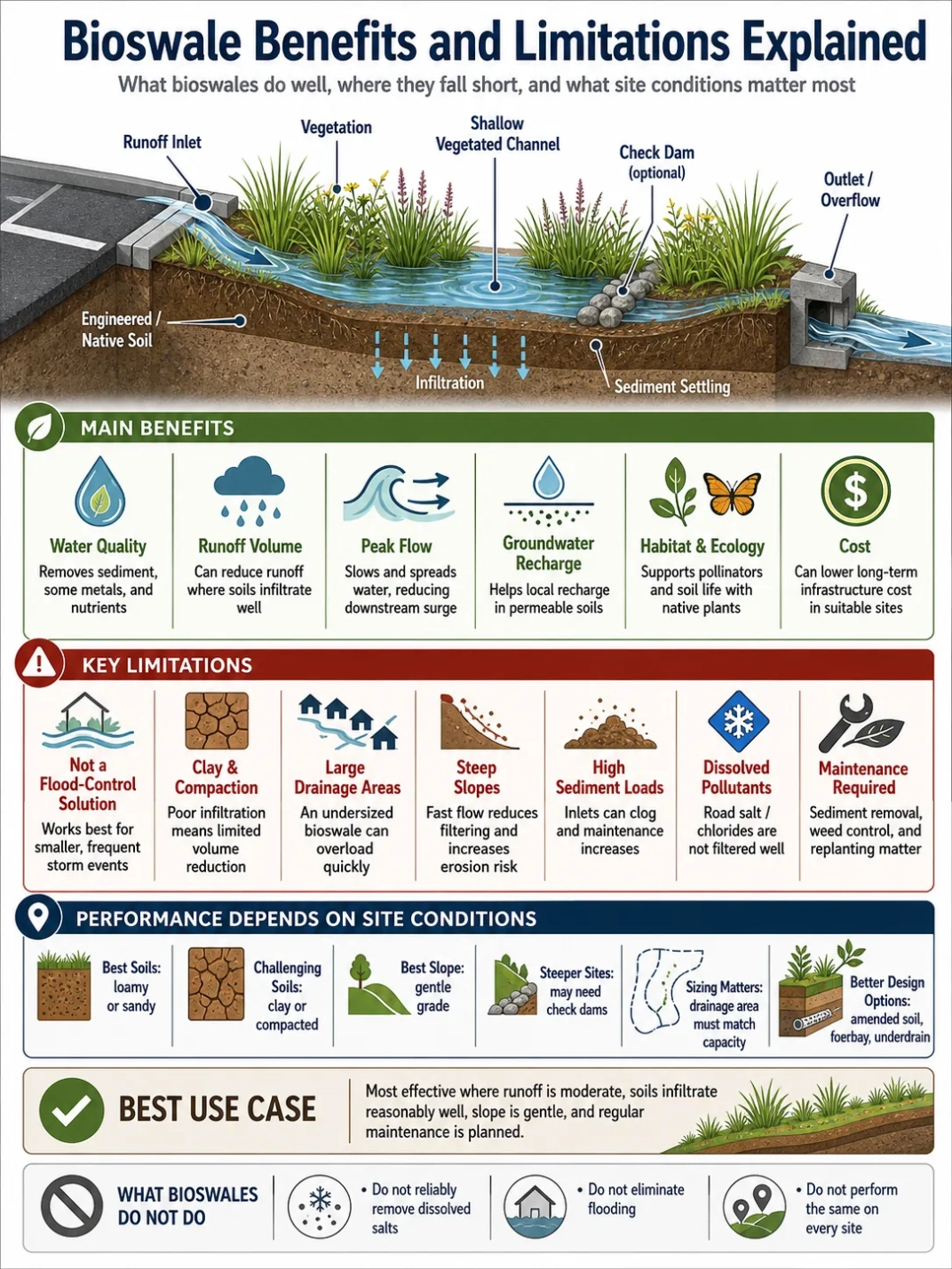
| Water Quality | Removes sediment, some metals, and nutrients from runoff | Dissolved pollutants like chlorides are not effectively filtered |
| Runoff Volume | Can reduce total runoff where soil infiltration is adequate | Limited volume capacity; not suited for large drainage areas alone |
| Peak Flow | Slows and spreads flow, reducing downstream surge | Effectiveness drops on steep slopes or during large storm events |
| Groundwater Recharge | Supports local recharge in permeable soils | Minimal recharge in clay or highly compacted soils |
| Habitat and Ecology | Supports pollinators, birds, and soil organisms when planted with native species | Poorly maintained bioswales can host invasive plants or persistent standing water |
| Maintenance | Lower long-term cost than piped systems in many cases | Requires regular inspection and periodic sediment removal |
| Installation | Often less expensive than underground drainage in suitable conditions | Underperforms without proper soil preparation, which adds upfront cost |
Where Performance Depends on Site Conditions
A bioswale’s performance is shaped more by what lies beneath it than by what’s planted in it. Vegetation improves filtration, slows flow, and stabilizes the channel — but the soil profile determines whether water actually moves into the ground or simply passes through and exits at the outlet.
Sites with loamy or sandy soils tend to support good infiltration. Sites with heavy clay or severely compacted soils often don’t. In those cases, a bioswale can still provide water quality benefits — the vegetated filter strip effect still works — but volume reduction will be minimal without design modifications like an engineered soil mix or an underdrain system.
Soil Note: Before planning a bioswale, a simple infiltration test — sometimes called a percolation test — can reveal whether native soil will support meaningful water absorption. In compacted or clay-dominated sites, the design may need to include decompaction, an amended soil mix, or an underdrain to function as intended.
Slope matters too. Bioswales work best on gentle grades — where the longitudinal slope is low enough to allow water to pond briefly in the channel rather than rush straight through. Check dams, small barriers placed across the swale at intervals, can help manage steeper sections by creating a series of level pools. Very steep sites, however, present real erosion and overflow risks that warrant careful design review.
Drainage area is another factor easy to underestimate. A bioswale is sized to handle a specific volume of runoff from a specific area. Directing too much impervious surface runoff — from a large parking lot or a steeply sloped roof — into an undersized bioswale overloads the system and accelerates sediment buildup and channel erosion near the inlet.
Limitations That Affect Real Projects
Volume Capacity Has a Ceiling
Bioswales are designed for smaller storm events — the frequent, moderate rainfall that makes up most of a region’s annual runoff. During large storms, they can overflow. This is expected behavior, not a design failure, as long as a safe overflow route is in place. But it does mean a bioswale alone cannot serve as a complete flood control solution.
Sites with large impervious cover, high runoff volumes, or intense storm profiles typically need bioswales as one part of a broader stormwater management system — alongside detention basins, bioretention cells, or similar infrastructure.
Clay Soil and Compaction
This is where many bioswales quietly underperform. Clay soils have low infiltration rates by nature. Construction activity often makes this worse by compacting the soil beneath a swale during grading and installation. A bioswale installed over compacted clay may look functional — plants grow, water flows through — but it infiltrates almost nothing. The runoff simply exits at the outlet, and the volume benefit disappears.
Addressing this requires decompacting the base soil before planting, using an amended growing medium above it, or incorporating an underdrain that allows water to exit gradually through a gravel layer rather than relying on native soil absorption. Each adjustment adds cost and design complexity.
High Sediment Inputs
Bioswales receiving runoff from bare construction sites, heavily trafficked gravel areas, or roads with high sand and debris loads can clog faster than expected. Sediment settles near the inlet and, over time, reduces both the hydraulic capacity and the infiltration rate of the channel.
Pre-treatment — a forebay or sediment trap placed before the main bioswale channel — can extend the system’s useful life by collecting coarse particles before they reach the vegetated area. Without it, inlets may need frequent cleanout, and the vegetated channel itself can become buried under accumulated sediment.
Slope Constraints
On steep terrain, water moves through a bioswale too quickly to filter effectively or infiltrate meaningfully. Erosion becomes a concern, particularly at the inlet where concentrated flow first enters the channel. Vegetative cover takes time to establish, and thin or sparse cover during that period leaves soil exposed to scour.
Check dams can help on moderately steep sections, but sites with pronounced grade changes may call for a different drainage approach — or a carefully planned combination of systems.
Maintenance Is Not Optional
A neglected bioswale often fails silently. Sediment accumulates, inlets clog, vegetation thins or gives way to weeds, and the system’s filtering capacity drops. What looks like a functioning green channel may be doing very little actual stormwater work.
Regular inspection — especially after significant rain events — helps catch problems early. Sediment removal, replanting bare areas, clearing inlets and outlets, and managing weeds are all part of keeping the system functional. This is not intensive work for a properly designed and established bioswale, but it is recurring work that should be planned for from the start.
Maintenance Note: Bioswales in public rights-of-way or commercial sites often have formal maintenance agreements. For residential installations, the responsibility falls to the property owner. Either way, long-term performance depends on that maintenance actually happening — and being documented if local compliance is required.
What Bioswales Do Not Do
A few common assumptions are worth correcting directly.
Bioswales do not reliably remove dissolved pollutants like road salt, chlorides, or some herbicides. These move with water through the soil rather than binding to particles or plant roots. For sites with heavy winter salt applications, water quality improvement will be partial at best.
Bioswales do not eliminate flooding. They manage smaller, frequent storm events well. They are not designed to handle peak flows from a major storm on their own, and sizing them as if they could leads to overflow, erosion, and structural problems downstream.
Bioswales also do not perform equally everywhere. Performance claims — sometimes expressed as percentage reductions in runoff volume or pollutant load — come from specific design conditions. A poorly sited, undersized, or unmaintained bioswale will typically achieve far less than published averages suggest.
When Another System May Fit Better
A rain garden or bioretention cell may suit smaller, more defined areas — particularly where the goal is volume reduction and the soil supports it, or where an engineered media layer is planned. These systems work on similar principles but are typically designed to pond water deliberately rather than convey it along a channel.
A detention basin or retention pond handles larger volumes and serves a flood management role that a bioswale cannot. Sites with large impervious areas or intense storm profiles often need these alongside any green infrastructure element.
A French drain or dry well may be more appropriate where the goal is simply to move water away from a structure or foundation, rather than filter it or slow its path along a surface route.
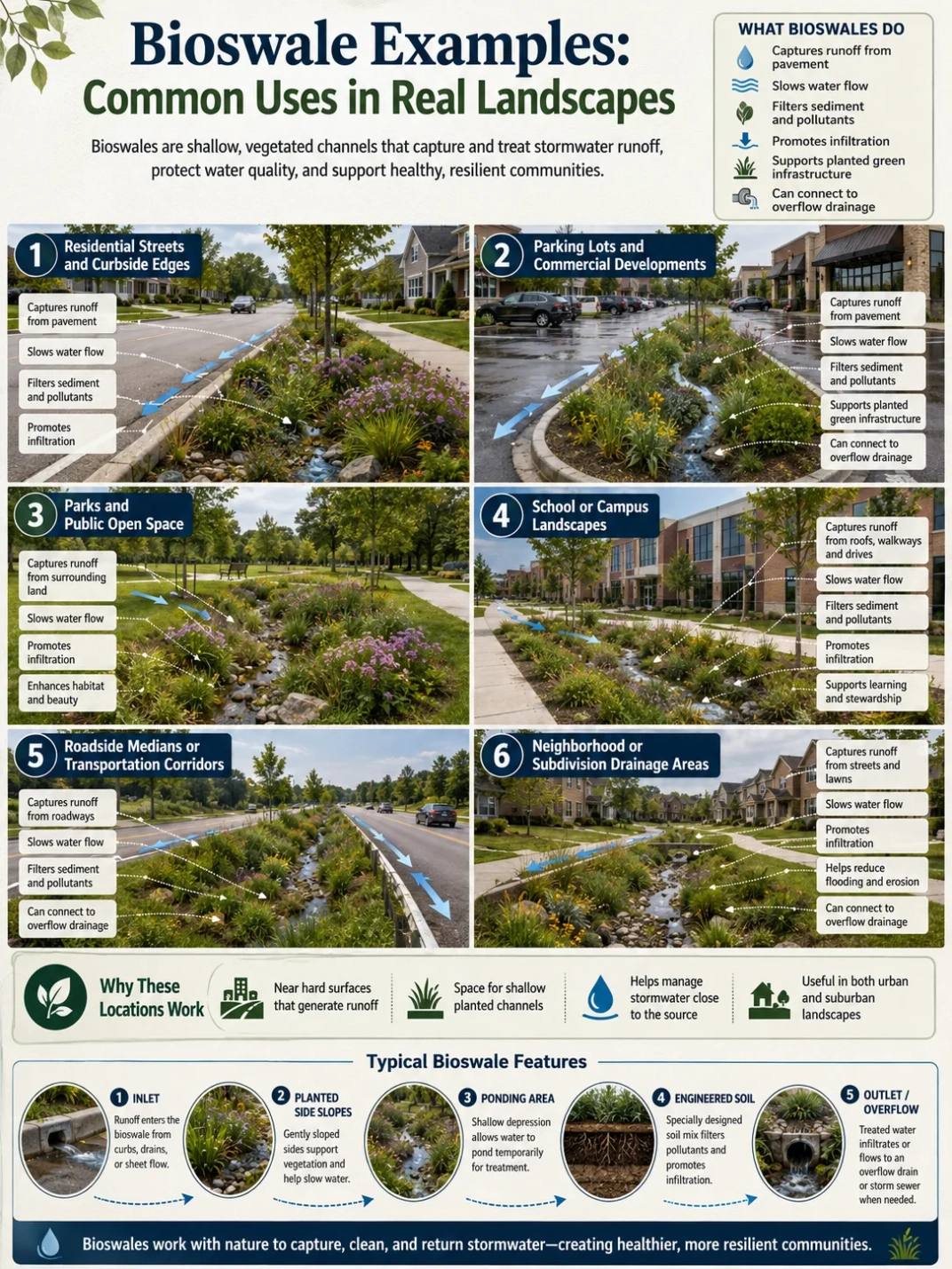
In practice, well-designed sites often combine approaches. A bioswale handles roadside or parking lot runoff, while a bioretention cell manages roof drainage nearby. Each system handles the work it’s best suited for.
Frequently Asked Questions
Do bioswales actually improve water quality?
Yes, in most well-designed cases. Bioswales can reduce sediment, suspended solids, some heavy metals, and nutrients like nitrogen and phosphorus. The degree of improvement depends on soil composition, vegetation density, flow rate, and how much contact time water has with the vegetated channel. Dissolved pollutants like road salt are not effectively captured by this type of system.
Can a bioswale handle large storm events?
Not on its own. Bioswales are designed to manage smaller, more frequent storms — often up to a one- or two-year storm event, depending on local design standards. Larger events require a safe overflow route and are typically managed through a broader stormwater system. Expecting a bioswale to absorb extreme rainfall alone leads to overflow and erosion problems.
Does clay soil make a bioswale ineffective?
Not necessarily, but it changes what the design requires. In native clay, infiltration is slow or negligible. A bioswale on clay can still filter water and slow peak flow, but volume reduction will be limited. Adding an amended soil layer, decompacting the base, or including an underdrain can restore function — at added cost and complexity. A bioswale installed directly into undisturbed clay without modifications will typically underperform on the volume side.
How often does a bioswale need maintenance?
Most functional bioswales benefit from at least two inspections per year — once in spring and once in fall — along with a check after heavy storms. Tasks include clearing inlets and outlets, removing accumulated sediment near the inlet, managing weeds, and replacing sparse or dead vegetation. The frequency increases in high-sediment environments or where the bioswale receives runoff from heavily trafficked surfaces.
Is a bioswale a good choice for a residential yard?
For many residential properties, a small bioswale can handle roof runoff from downspouts or driveway drainage effectively. The main factors to assess are available space, the natural slope of the yard, proximity to foundations or neighboring properties, and whether local rules require a permit. On sloped sites or where overflow could affect adjacent land, a professional review is worth having before installation.
What is the main limitation of bioswales compared to underground drainage?
Bioswales require surface space and suitable site conditions — something underground pipes do not. They also carry a visible maintenance requirement and can develop standing water or weed growth if neglected. In exchange, they offer water quality benefits, ecological value, and lower long-term infrastructure costs in many settings. Underground drainage moves water faster and requires less ongoing surface attention, but it provides no filtration and contributes directly to downstream runoff volumes.