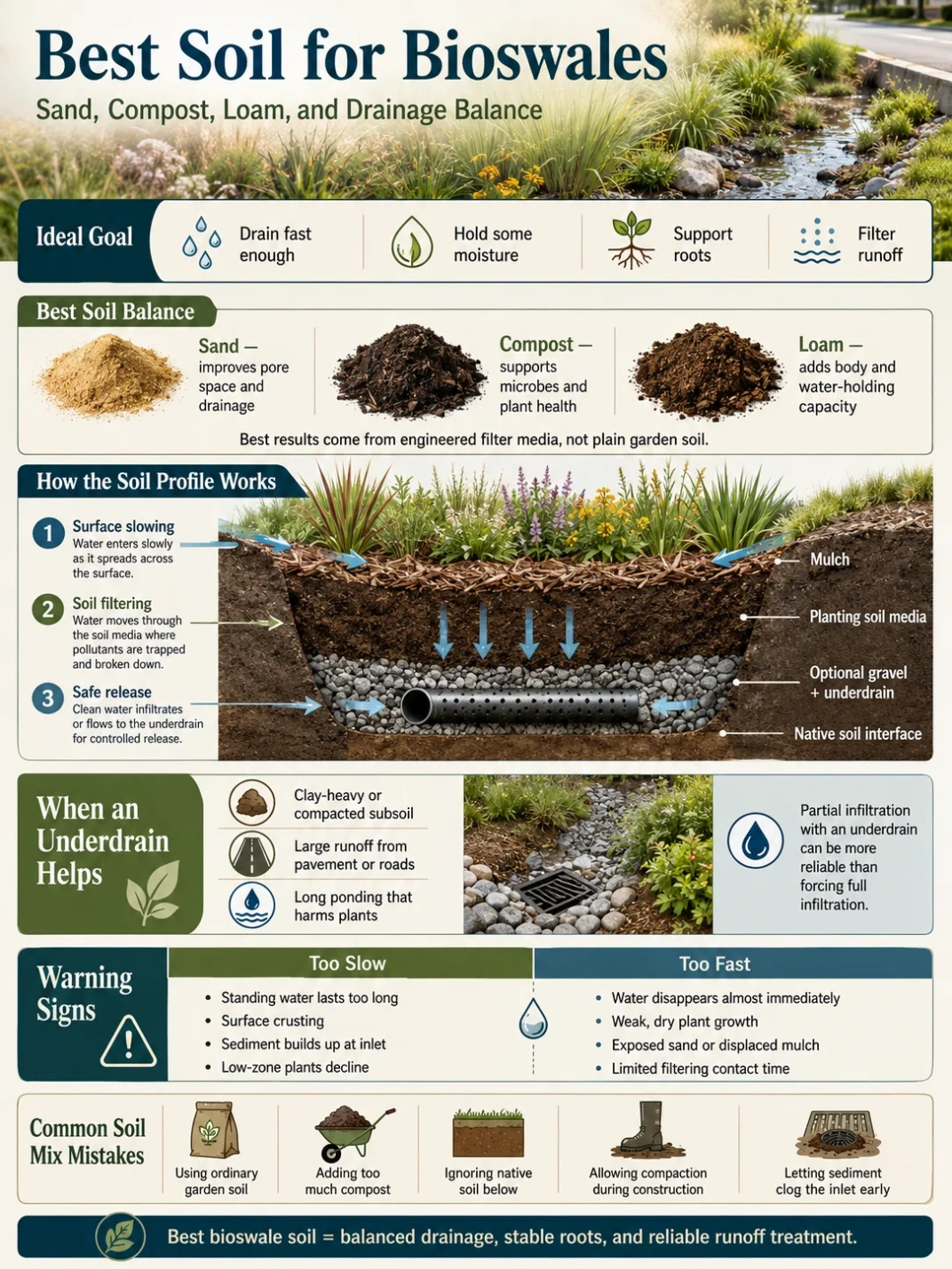
The best soil for bioswales is not plain garden soil, pure sand, or heavy compost. A good bioswale soil mix balances fast enough drainage, enough moisture holding capacity, and stable root support. Sand helps water move. Compost helps plants and soil life. Loam gives the mix body. The right balance depends on native soil, runoff volume, slope, rainfall pattern, and whether the bioswale uses an underdrain.
A bioswale has a harder job than a normal planting bed. It must accept stormwater runoff, slow it down, filter sediment, support vegetation, and release water without staying saturated for too long. Soil is where much of that work happens.
When the soil mix is too dense, water ponds and the surface can clog. When it is too sandy, water may move through too quickly and leave plants dry between storms. When compost is overused, the mix may settle, hold too much water, or add nutrients that the design is trying to manage. The best soil is a designed filter media, not a random blend.
What Soil Needs to Do in a Bioswale
A bioswale soil profile has two related jobs: hydraulic movement and water-quality treatment. Hydraulic movement means water can enter, spread, soak in, or drain away without causing long-term standing water. Water-quality treatment means runoff passes through a living, textured soil layer where sediment can settle and plants can take up water.
Those goals can pull in opposite directions. A very open sandy mix drains well but may offer less contact time. A dense loam may hold water and nutrients, but it can slow infiltration. A bioswale soil mix works best when it sits between those extremes.
| Soil Ingredient | Main Function | Possible Problem if Overused | Best Use in the Mix |
|---|---|---|---|
| Sand | Creates pore space and supports drainage through the soil media. | Can drain too quickly, dry out plants, and reduce filtering contact time. | Useful as the main drainage texture when paired with organic matter and some fine mineral content. |
| Compost | Adds organic matter, supports microbes, helps plants establish, and improves soil structure. | Can settle, float, clog, or contribute excess nutrients if unstable or overapplied. | Best used as mature, screened compost in a limited proportion suited to local stormwater rules. |
| Loam | Adds body, water holding capacity, and mineral content for roots. | Can become too slow-draining if it contains too much silt or clay. | Useful when the loam is sandy or well-structured, not compacted or clay-heavy. |
| Native Soil Interface | Controls how water leaves the bioswale into the ground below or beside it. | Slow native soil can cause long ponding unless drainage is added. | Should be tested or observed before assuming full infiltration will work. |
Why Pure Sand Is Not Enough
Sand is often the largest part of an engineered bioswale soil media because it gives the mix open pores. These pores help runoff move downward instead of sitting on the surface. Sand also reduces the chance that the soil will compact into a tight mass after repeated wetting.
But sand alone is not ideal. A nearly pure sand profile can act more like a drain than a filter. Water may pass through before roots, organic matter, and soil particles can interact with it. Plants may also struggle during dry periods because sand does not hold much moisture.
Soil Note: Sand for a bioswale should support drainage without turning the system into a bare infiltration trench. The goal is not just to move water away. The goal is to slow, filter, infiltrate, and support vegetation.
Coarse, clean sand can help with drainage, but the overall texture still needs enough fine material and organic matter to support plant roots. The exact blend should follow local stormwater guidance where a permitted project is involved.
The Role of Compost
Compost helps a bioswale behave like a living soil system rather than a sterile drainage layer. It improves soil structure, supports microbial activity, and helps young plants survive the wet-dry cycle common in stormwater landscapes.
Compost also helps bind some particles and supports root growth. In a vegetated swale, roots are not decoration. They help hold the soil surface, create small channels, and keep the media from becoming lifeless and compacted.
Too much compost can create problems. High organic content may settle after installation, reduce the final soil elevation, or hold water longer than expected. In some areas, compost selection also matters because nutrient-rich material can add phosphorus or nitrogen to runoff instead of helping manage it.
For this reason, bioswale soil media usually uses mature, stable, screened compost rather than fresh, woody, unfinished, or highly variable organic material. Compost should improve the soil, not dominate it.
Where Loam Fits into the Mix
Loam is often described as the balanced soil texture, but “loam” is not automatically right for a bioswale. Some loams drain well. Others contain enough silt or clay to become slow, sticky, and compacted after construction traffic or repeated saturation.
A sandy loam or loamy sand texture is often easier to manage in a bioswale than a heavy garden loam. It gives plants more support than pure sand while still allowing water to pass through the media. The difference matters most after several storm cycles, when weak soil structure begins to show.
Imported topsoil should be used with care. Topsoil can contain weed seed, debris, high clay content, excess nutrients, or inconsistent texture from load to load. A bioswale needs predictable soil behavior. That is why many constructed bioswales use an engineered soil media instead of ordinary landscape soil.
Drainage Balance: The Part That Makes the Soil Work
Good bioswale soil should accept runoff at the surface and then release it through infiltration, evapotranspiration, an underdrain, or a controlled outlet. The soil mix cannot be judged by texture alone. It must be matched to the whole drainage path.
A well-balanced bioswale soil profile usually supports three stages of water movement:
- Surface slowing: Vegetation, mulch, and the swale shape reduce runoff speed before water enters the soil.
- Soil filtering: Water moves through the root zone and filter media, where sediment and some pollutants can be reduced.
- Safe release: Water drains into native soil, an underdrain, or an overflow route when the system reaches capacity.
If any stage is missing, the soil may be blamed for a larger design issue. For example, a good soil mix can still fail if the inlet dumps high-velocity runoff into one spot. It can also fail if the outlet is too high, blocked, or absent.
When an Underdrain May Be Needed
An underdrain is a perforated pipe or drainage layer used to help remove water from the soil media. It is often considered where native soil drains slowly, where the bioswale receives runoff from a larger impervious surface, or where long ponding would harm plants or nearby use areas.
An underdrain does not mean the bioswale has failed. It can allow the surface soil to filter runoff while still giving the system a reliable drainage path. This is common in compacted urban soils, roadside areas, parking lots, and sites with clay-heavy subsoil.
Drainage Note: Full infiltration is not the only valid goal. In some sites, partial infiltration with an underdrain may be more stable than forcing water into slow or unsuitable native soil.
Where local rules require a liner, setback, underdrain, or overflow connection, the soil mix should be designed around those limits. A residential bioswale beside a driveway is not the same as a public bioswale receiving road runoff.
How Clay and Compaction Change the Soil Choice
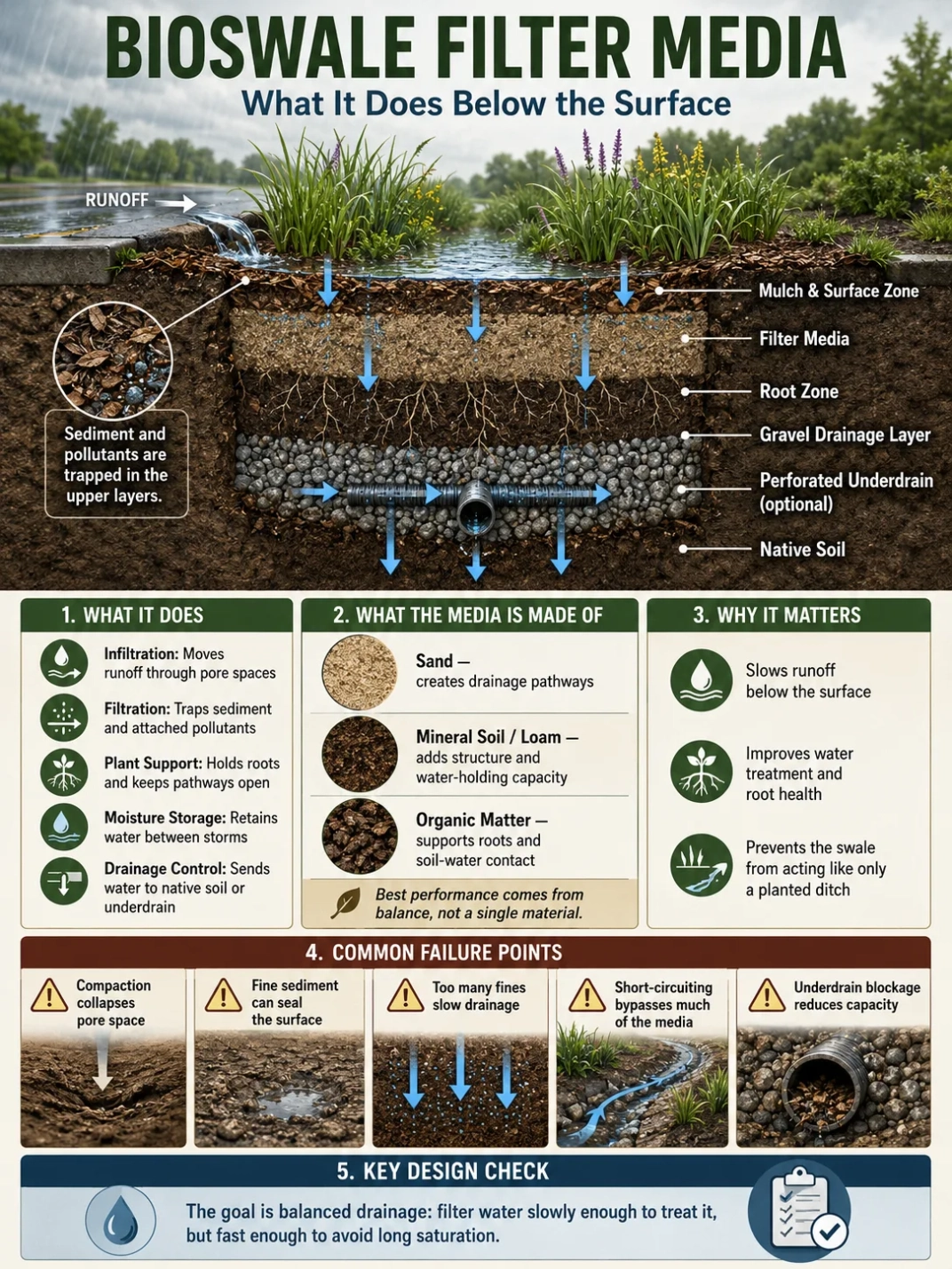
Clay is not automatically bad in a landscape, but too much clay in bioswale filter media can reduce infiltration and increase surface ponding. Fine particles can also migrate into pore spaces, especially when runoff carries sediment from bare soil, pavement edges, or construction areas.
Compaction can be just as damaging as clay content. Even a good sandy loam mix can perform poorly if heavy equipment drives over it, if it is installed while wet, or if the finished surface is walked on repeatedly before plants establish.
Soil compaction reduces pore space. Less pore space means slower drainage, weaker root growth, and more chance of standing water. The finished bioswale should be treated as a stormwater feature, not as spare access space.
Construction Practices That Protect the Soil
- Keep equipment out of the finished basin or channel where possible.
- Avoid placing soil media when it is overly wet.
- Do not smear or seal the bottom of the excavation with machinery.
- Keep sediment from nearby bare areas out of the bioswale during construction.
- Use erosion control until plants are established.
- Check the inlet and outlet after early storms, not only after planting day.
Layering: Soil Media, Mulch, Gravel, and Native Soil
A bioswale may look simple from above, but the soil profile can include several layers. The exact profile varies by design, but the purpose of each layer should be clear.
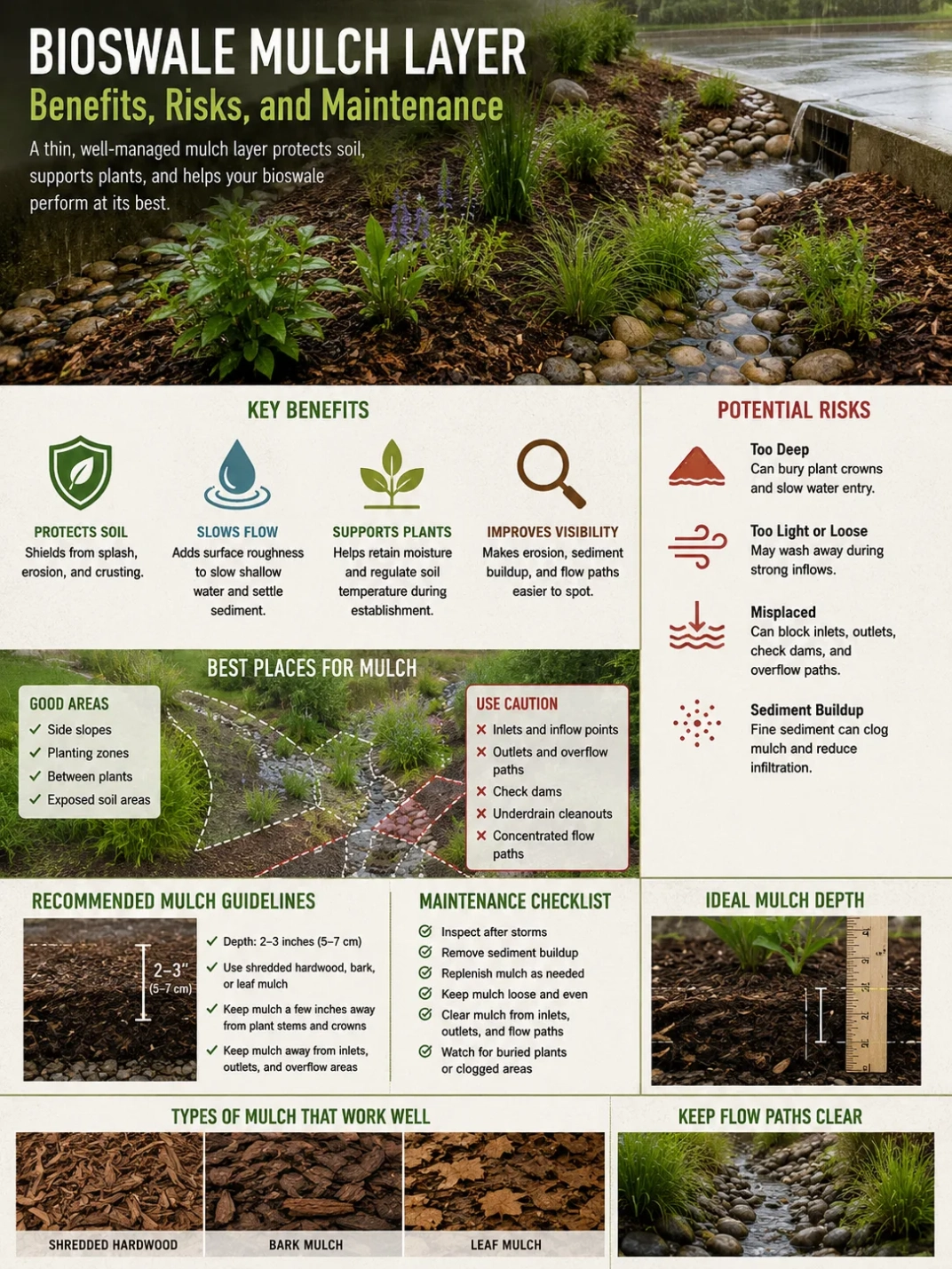
The planting soil media is the main filter and root zone. This is where sand, compost, and loam balance matters most. A surface mulch layer may help protect the soil from erosion, reduce crusting, and support plant establishment. In some designs, a gravel layer below the soil supports underdrain function.
These layers should not be mixed without reason. Gravel blended into planting soil can reduce root-zone consistency. Too much mulch mixed into the media can change drainage and settlement. Fabric placed in the wrong location can collect fine sediment and become a clogging plane.
Design Note: A bioswale soil profile should be easy to explain from top to bottom. If a layer has no clear purpose, it may not belong in the system.
Matching Soil to Runoff Source
The best soil for a bioswale also depends on where the water comes from. Roof runoff, driveway runoff, parking lot runoff, and roadside runoff do not behave the same way. They can differ in volume, sediment load, flow speed, and maintenance needs.
Roof runoff may enter from a downspout and arrive in pulses. Driveway runoff may carry grit, leaves, and small debris. Parking lot and roadside runoff often bring more sediment and may need pretreatment before water reaches the soil media.
Soil cannot fix every inlet problem. If runoff enters too fast, it can scour mulch, expose roots, or cut a channel through the bioswale. A stable inlet, stone apron, level spreader, curb cut detail, or forebay may be needed depending on the site.
Signs the Soil Mix Is Too Slow
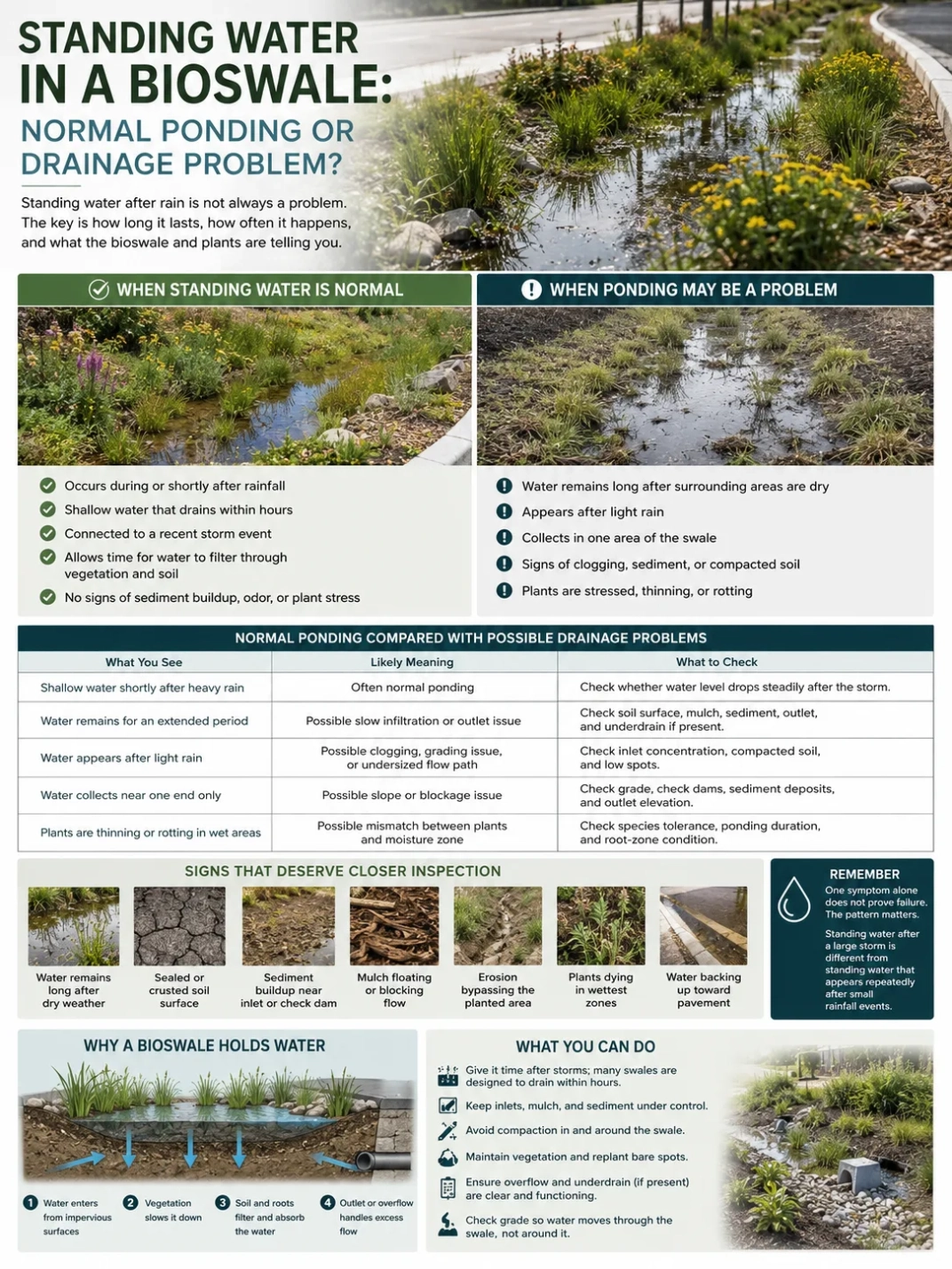
A bioswale is designed to hold water temporarily, but it should not behave like a permanent puddle unless it was specifically designed as a wet system. Long-lasting standing water may point to slow soil, clogged surface pores, compacted media, blocked underdrain flow, or poor outlet elevation.
Common signs of slow or clogged soil include:
- Water remains on the surface longer than the local design allows.
- The soil surface forms a crust after storms.
- Sediment builds up near the inlet.
- Plants decline in the lowest zone while upper-zone plants remain healthy.
- Mulch floats away or collects against the outlet.
- Water bypasses the planted area and cuts a narrow channel.
Before replacing the entire soil mix, check the simple causes first. Sediment at the inlet, buried outlets, compacted maintenance paths, and clogged surface mulch can make a suitable soil media look worse than it is.
Signs the Soil Mix Is Too Fast
Fast drainage can also cause problems. If water disappears almost immediately, the bioswale may offer little treatment contact time and plants may struggle between storms. This is more likely in very sandy media, shallow profiles, steep sites, or swales with direct short-circuiting from inlet to outlet.
Signs of overly fast movement include dry, weak plant growth in the lower channel, exposed sand after storms, mulch displacement, and limited sediment capture. In some cases, check dams, denser planting, a better inlet spread, or a revised soil blend may help slow the flow.
The goal is not to trap water for as long as possible. It is to create enough residence time for filtration and plant use while still draining safely.
Soil, Plants, and Roots Work Together
Bioswale soil should be chosen with plants in mind. A mix that drains well but dries out quickly needs plants that tolerate both wet pulses and dry gaps. A mix with more moisture holding capacity may support different species, especially in the lower channel.
Roots help keep the soil open and stable. Dense grasses, sedges, rushes, and suitable shrubs can reduce erosion, interrupt flow, and support soil structure. Native plants are often preferred where they fit the site, but plant choice should still consider sun exposure, salt exposure, drought tolerance, mowing needs, and local maintenance capacity.
Plants cannot fully overcome a poor soil profile. If the media is compacted, too clay-heavy, or constantly saturated, even well-chosen plants may thin out. Once plant cover declines, the soil surface becomes more exposed to erosion and clogging.
Residential Soil Choices vs. Public-Space Soil Choices
A small residential bioswale may be designed to manage roof or driveway runoff with a modest catchment area. The soil mix still matters, but the design may be simpler if overflow is safe, native soil is suitable, and local rules allow the work.
Public-space and commercial bioswales usually need more control. They may receive runoff from larger paved areas, have higher sediment loads, and require maintenance access. Soil media may need to meet a written specification, and the design may include pretreatment, an underdrain, overflow structures, and inspection points.
For areas near foundations, basements, retaining walls, neighboring properties, public sidewalks, or road drainage systems, site-specific review is sensible. Drainage changes should not move water toward places that cannot accept it.
How Bioswale Soil Differs from Rain Garden Soil
Bioswale soil and rain garden soil can be similar, especially when both use bioretention-style media. The difference is mostly in shape and flow behavior.
A rain garden is usually a basin or shallow depression that collects water in one area. A bioswale is usually longer and more linear, so it also conveys water along a flow path. That means bioswale soil often has to handle both vertical infiltration and sideways flow across the surface.
Because of that linear movement, bioswale soil must work with slope, inlet stability, vegetation density, and outlet control. A rain garden soil mix may not perform the same way if it is placed in a long channel with fast runoff and no flow spreading.
What to Check Before Choosing a Soil Mix
Before deciding on sand, compost, and loam proportions, the site should be understood. Soil media is only one part of the stormwater system.
- Native soil: Is the subsoil sandy, loamy, compacted, fill material, or clay-heavy?
- Runoff source: Is water coming from a roof, driveway, parking lot, road edge, or lawn?
- Flow speed: Will water enter gently, or will it arrive as concentrated runoff?
- Overflow route: Where will water go when the bioswale is full?
- Planting plan: Can selected plants tolerate both wet and dry periods?
- Maintenance access: Can sediment, leaves, and debris be removed without compacting the soil?
- Local rules: Do stormwater standards require a specific media, drawdown time, underdrain, or setback?
A soil mix that works on one site may not work on another. Native soil, rainfall intensity, slope, and outlet conditions can change the right balance.
Common Soil Mix Mistakes
Many bioswale problems begin before the first storm. The soil may look fine when installed, but weak choices show up after repeated runoff, plant stress, or sediment buildup.
Using Ordinary Garden Soil
Garden soil may contain too much silt, clay, organic matter, or weed seed. It may also compact during placement. A bioswale needs predictable drainage and filtration behavior.
Adding Too Much Compost
Compost is useful, but more is not automatically better. Excess organic matter can change drainage, settle over time, and add nutrients where nutrient control matters.
Ignoring the Native Soil Below
Even perfect filter media cannot drain well into a sealed or very slow subsoil unless the design includes another release path. The native soil interface matters.
Allowing Sediment to Enter Too Early
Construction sediment can clog the surface before the bioswale has a chance to work. Protecting the inlet during nearby grading or paving is part of soil protection.
Planting After the Soil Has Been Compacted
Plants need pore space. If the media is compacted before planting, roots may stay shallow and the bioswale may drain poorly.
Maintenance That Protects the Soil
Soil performance changes over time. Fine sediment, leaves, mulch movement, weeds, and plant dieback can all affect infiltration. Regular inspection helps keep the bioswale from becoming a shallow ditch with clogged soil.
Basic soil-related maintenance usually includes removing sediment near inlets, replacing displaced mulch, keeping outlets open, replanting bare areas, and avoiding foot or vehicle traffic through the channel. After larger storms, the inlet and lowest areas deserve extra attention.
If standing water becomes common, the answer is not always to add more sand. The cause may be surface clogging, a blocked underdrain, poor outlet elevation, or a compacted maintenance path. Soil replacement should come after the drainage path is checked.
FAQ
What is the best soil for bioswales?
The best soil for bioswales is usually an engineered, well-draining planting media that combines sand for drainage, limited mature compost for organic matter, and enough loam-like mineral content to support roots. The exact mix should match native soil, runoff source, climate, and local stormwater standards.
Can a bioswale use regular topsoil?
Regular topsoil can be risky because its texture and drainage may be inconsistent. Some topsoil is too silty or clay-heavy for reliable bioswale performance. If topsoil is used, it should be tested or carefully selected so it does not compact or drain too slowly.
Is sandy soil good for a bioswale?
Sandy soil can be useful because it supports infiltration, but pure sand is usually not enough. A bioswale also needs plant support, moisture retention, and filtering contact. Sand works best as part of a balanced filter media.
How much compost should be added to bioswale soil?
Compost should be used carefully and usually in a limited amount. Mature, screened compost can support plant growth and soil biology, but too much compost may settle, clog, hold excess water, or add nutrients. Local stormwater guidance may specify acceptable organic matter content.
Does a bioswale need an underdrain?
A bioswale may need an underdrain when native soil drains slowly, when runoff volume is high, or when long ponding would create maintenance or plant problems. Sites with well-draining native soil may not need one, but this depends on local conditions and design goals.
Why does water stay in my bioswale?
Water may stay in a bioswale because the soil is compacted, the surface is clogged with sediment, the media contains too much fine material, the outlet is blocked, or the native soil below drains slowly. The inlet, outlet, surface layer, and underdrain should be checked before assuming the entire soil mix is wrong.