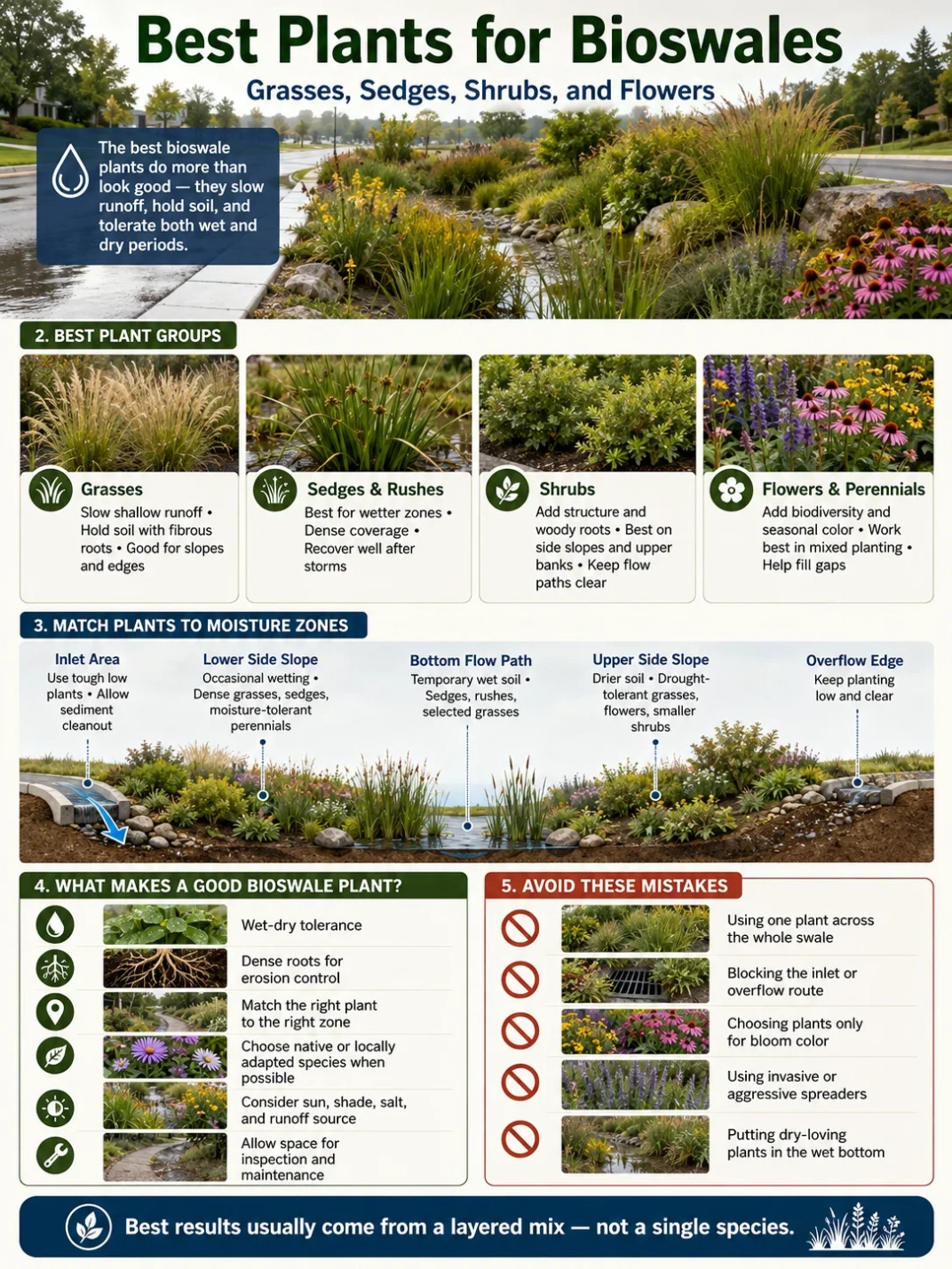
The best plants for bioswales are not chosen only for beauty. They need roots that hold soil, stems that slow shallow runoff, and enough tolerance for both temporary wet conditions and dry periods between storms. A good planting plan usually mixes grasses, sedges, rushes, shrubs, and flowering perennials so the bioswale can stay stable, readable, and maintainable through changing seasons.
A bioswale is a planted drainage feature, so vegetation is part of the system rather than decoration placed on top of it. The plants help shape water movement, protect soil media from erosion, trap sediment near the surface, and support infiltration where the soil and site design allow it.
No single plant list fits every bioswale. Plant choice depends on local climate, soil texture, sunlight, salt exposure, runoff source, standing water duration, maintenance capacity, and whether the swale serves a residential yard, street edge, parking area, or public landscape.
What Makes a Plant Good for a Bioswale?
A good bioswale plant can handle change. During a storm, its lower stems and roots may sit in shallow water. A few days later, the same area may be dry, sunny, and warm. Plants that need constantly wet soil may fail on the upper side slopes, while plants that dislike wet feet may fail in the low flow path.
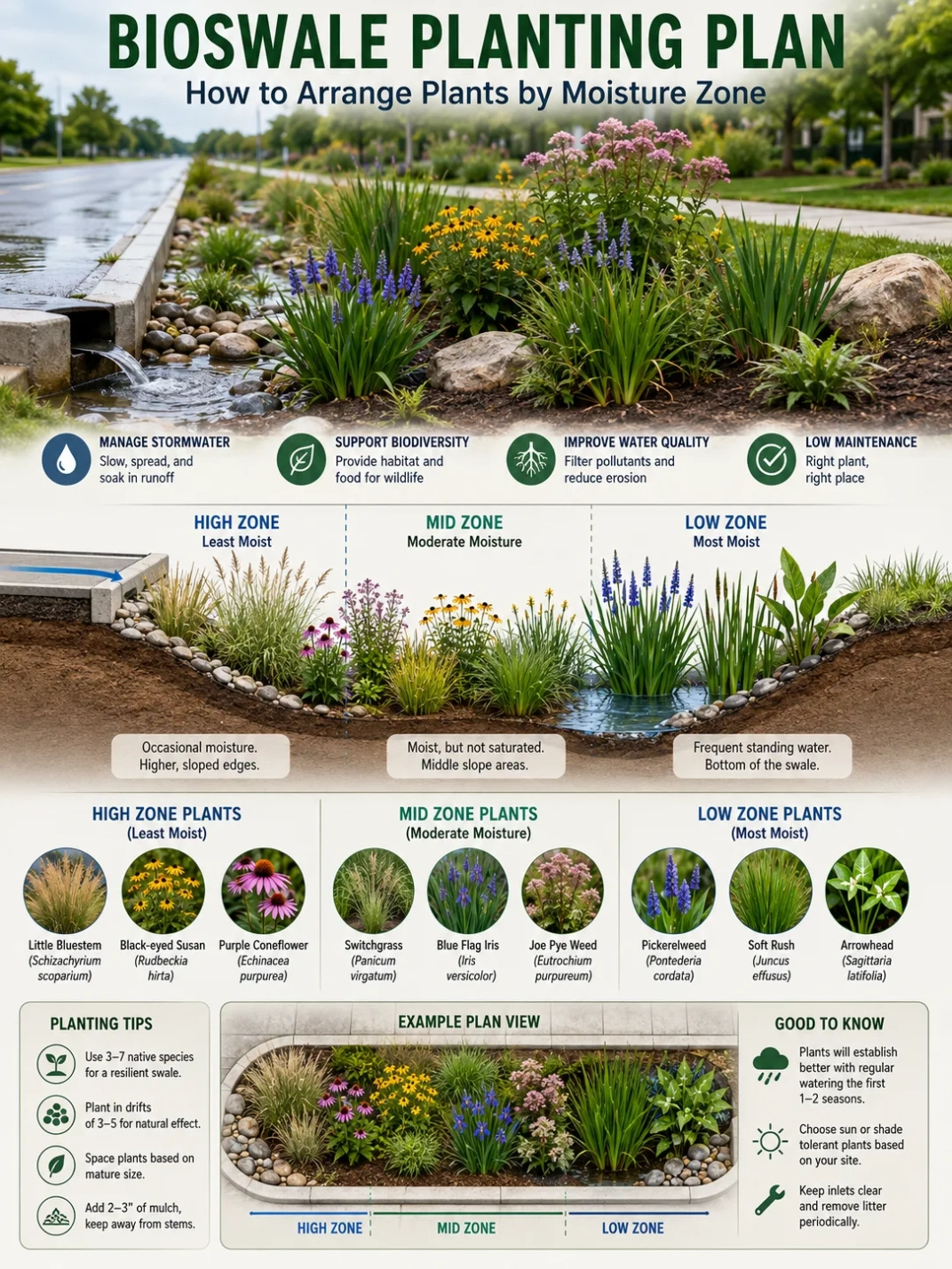
The strongest planting plans match plants to moisture zones inside the bioswale instead of treating the whole feature as one uniform garden bed.
- Bottom zone: the lowest flow path where temporary ponding is most likely after rain.
- Side slopes: sloped areas that may receive splash, sheet flow, and short wet periods but dry faster.
- Upper edge: the drier transition area between the bioswale and the surrounding landscape.
- Inlet area: the place where runoff enters and sediment often collects first.
- Outlet or overflow area: the route that must stay open so excess water can leave safely.
Root structure matters as much as leaf shape. Dense, fibrous roots help hold surface soil and reduce rilling on slopes. Deeper or spreading roots can support soil structure, though they still need enough soil volume and oxygen. Plant roots do not replace proper grading, soil media, overflow design, or erosion control, but they help those parts work together.
| Plant Group | Best Role in a Bioswale | Where It Often Fits | Main Caution |
|---|---|---|---|
| Grasses | Slow shallow runoff, hold soil, add upright structure | Bottom, side slopes, upper edges depending on species | Some species flop, spread too fast, or need seasonal cutting |
| Sedges | Stabilize wet-dry soil and provide dense groundcover | Bottom zone and lower side slopes | Moisture tolerance varies by species |
| Rushes | Tolerate periodic wet soil and help define the low flow path | Bottom zone, ponding-prone areas | May look sparse if placed in too-dry conditions |
| Shrubs | Add woody roots, height, habitat value, and visual structure | Side slopes, upper banks, wider swales | Can block inspection access or overflow routes if poorly placed |
| Flowers and Perennials | Support seasonal cover, pollinators, and visible plant diversity | Side slopes, upper edges, selected bottom areas | Some need more weeding and replacement during establishment |
Grasses for Bioswales
Grasses are often used in bioswales because many have fibrous root systems, flexible stems, and good tolerance for wind, sun, and moving water. In a swale, grasses can slow runoff near the surface and help keep soil particles from moving downstream.
The best grasses are usually clump-forming or well-behaved native species suited to local rainfall and soil conditions. They should be strong enough to stand through storms but not so tall or dense that they hide inlets, outlets, check dams, or maintenance problems.
Where Grasses Work Best
Grasses can work in several parts of a bioswale, but placement should follow moisture tolerance. Species that tolerate temporary wet soil may fit the lower channel. Drier upland grasses often belong on upper slopes and edges where ponding is less common.
- Near the inlet: shorter, dense grasses can help slow water and reduce bare soil, but sediment must still be removed when it builds up.
- Along side slopes: fibrous roots help protect the slope face from erosion.
- In wider swales: taller grasses can add structure, but they should not block sightlines or maintenance access.
Ornamental grasses chosen only for appearance can be risky if they lodge, form large dead centers, or require frequent cutting at the wrong time of year. A bioswale needs plants that remain useful after rainfall, not just attractive during a dry week.
Sedges and Rushes in Wet-Dry Zones
Sedges and rushes are especially useful in low areas where water may stand briefly after storms. They often have a finer, denser texture than many grasses, which can help cover soil and soften the transition between the bottom of the swale and the planted slopes.
Sedges are not just “small grasses.” They are a different plant group, and many species handle moisture patterns that would stress common turfgrass. Rushes can also work well in periodically wet zones, especially where the bioswale bottom receives repeated shallow flow.
Planting Note: sedges and rushes should still be matched to the real site. Some prefer wetter soil, some tolerate shade, and others need full sun. A plant that performs well in a rain garden in one region may not be the right bioswale plant in another.
Shrubs for Structure, Roots, and Seasonal Interest
Shrubs can make a bioswale look more intentional, especially in front yards, campus landscapes, parking lot edges, and public spaces. They add height, woody stems, deeper structure, and seasonal interest where there is enough room for mature growth.
The main mistake is using shrubs as if the bioswale were a normal landscape bed. Shrubs should not crowd the flow path, trap too much debris at the inlet, or block the overflow route. Mature size matters more than nursery size.
Where Shrubs Usually Fit
- Upper banks: useful where soil drains faster and plants are less exposed to standing water.
- Side slopes: suitable when the slope is stable and the shrub will not shade out lower plants too heavily.
- Wide bioswales: helpful for structure, especially when maintenance access remains clear.
- Public landscapes: useful for visual order, but spacing should allow inspection of sediment, erosion, and plant gaps.
Woody plants may be less suitable in narrow swales, very shallow drainage channels, or places where snow storage, road salt, heavy sediment, or mowing pressure can damage stems. In those settings, lower herbaceous planting may be easier to manage.
Flowers and Perennials That Support the System
Flowering perennials can add biodiversity, seasonal color, and pollinator value, but they should still earn their place functionally. A bioswale flower should tolerate the site’s moisture pattern, compete with weeds after establishment, and leave enough open visibility for inspection.
Flowers often work best as part of a mixed planting rather than as the whole design. When used alone, they may leave bare soil during dormancy or after stress. When combined with grasses, sedges, and low shrubs, they can add seasonal variety without carrying the whole job.
Good bioswale planting is usually layered. Low plants protect the soil. Medium plants slow water and fill gaps. Taller plants add structure where they will not interfere with drainage.
Native Plants and Local Adaptation
Native plants are often preferred for bioswales because they are adapted to regional climate, local wildlife relationships, and seasonal patterns. That does not mean every native plant is suitable for every bioswale. A dry prairie species may fail in the bottom of a wet swale. A wetland species may struggle on a hot upper slope.
The useful question is not only “Is it native?” It is “Is it native or locally adapted to this exact moisture zone, soil, sunlight, and maintenance plan?”
Invasive or aggressive plants should be avoided, especially near storm drains, waterways, public rights-of-way, and natural areas. Local extension services, native plant societies, landscape architects, municipal planting lists, and regional stormwater manuals may offer plant lists that are better suited to a specific area than a broad national list.
Matching Plants to Bioswale Moisture Zones
A bioswale may look like one planted strip, but the growing conditions can change across a few feet. The bottom may receive temporary ponding. The side slope may dry quickly. The upper edge may behave like a normal landscape bed. Planting should follow that pattern.
| Bioswale Zone | Likely Conditions | Suitable Plant Traits |
|---|---|---|
| Bottom Flow Path | Temporary wet soil, shallow runoff, sediment exposure | Wet-dry tolerance, flexible stems, dense roots, ability to recover after storms |
| Lower Side Slope | Occasional wetting, faster drying than the bottom | Erosion control, spreading or clumping roots, moderate moisture tolerance |
| Upper Side Slope | Drier soil, more exposure, less ponding | Drought tolerance, slope stability, good ground coverage |
| Inlet Area | Higher flow energy and sediment collection | Tough low plants, easy-to-clean spacing, resistance to burial by fine sediment |
| Overflow Edge | Needs clear water movement during larger storms | Low, stable planting that does not block the overflow route |
Planting the lowest zone with dry-loving plants is one of the fastest ways to create gaps. Planting the upper edge with wetland plants can cause a different kind of failure: weak growth during dry periods. The better approach is to create a gradient.
Root Structure and Stormwater Performance
Roots help a bioswale in several ways. They hold soil in place, create small pathways in the soil, support surface roughness, and help the planting recover after disturbance. Dense roots near the surface are especially useful where flowing water might otherwise expose soil media.
Root depth should not be oversold. Plants cannot fix a poorly graded swale, compacted subsoil, blocked outlet, or undersized overflow. Still, a well-rooted plant community can make the surface more stable and less prone to bare patches.
Soil Note: plant roots need oxygen as well as water. If the bioswale stays saturated for too long, even wet-tolerant plants may decline. If the soil is too compacted, roots may stay shallow and the planting may struggle to knit the surface together.
Sun, Shade, Salt, and Runoff Source
Runoff source changes plant stress. Roof runoff may be cleaner than runoff from a parking lot or roadside. Driveway and street runoff can carry sediment, grit, deicing salt in cold regions, and heat from pavement. Plants near curb cuts often face more stress than plants in a quiet residential swale.
Sun exposure also changes the plant list. A full-sun roadside bioswale may need tough grasses, sedges, and shrubs that can handle heat and dry periods. A shaded residential bioswale may need shade-tolerant sedges, woodland-edge perennials, or shrubs that do not require intense sun.
- Full sun: often supports a wider range of grasses, flowering perennials, and shrubs.
- Partial shade: may favor sedges, rushes, and selected shrubs depending on moisture.
- Roadside exposure: may require plants with tolerance for sediment, splash, salt, and reflected heat.
- Roof runoff: may allow a softer planting palette, but overflow and foundation setbacks still matter.
Plants to Avoid in Bioswales
Some plants create more maintenance than value in a bioswale. The wrong plant may spread into drainage paths, die after brief ponding, leave bare soil, or become difficult to inspect around inlets and outlets.
- Plants that need perfect drainage in the lowest part of the swale.
- Plants that require constant wet soil on upper slopes or dry edges.
- Aggressive spreaders that may crowd out other plants or move beyond the intended area.
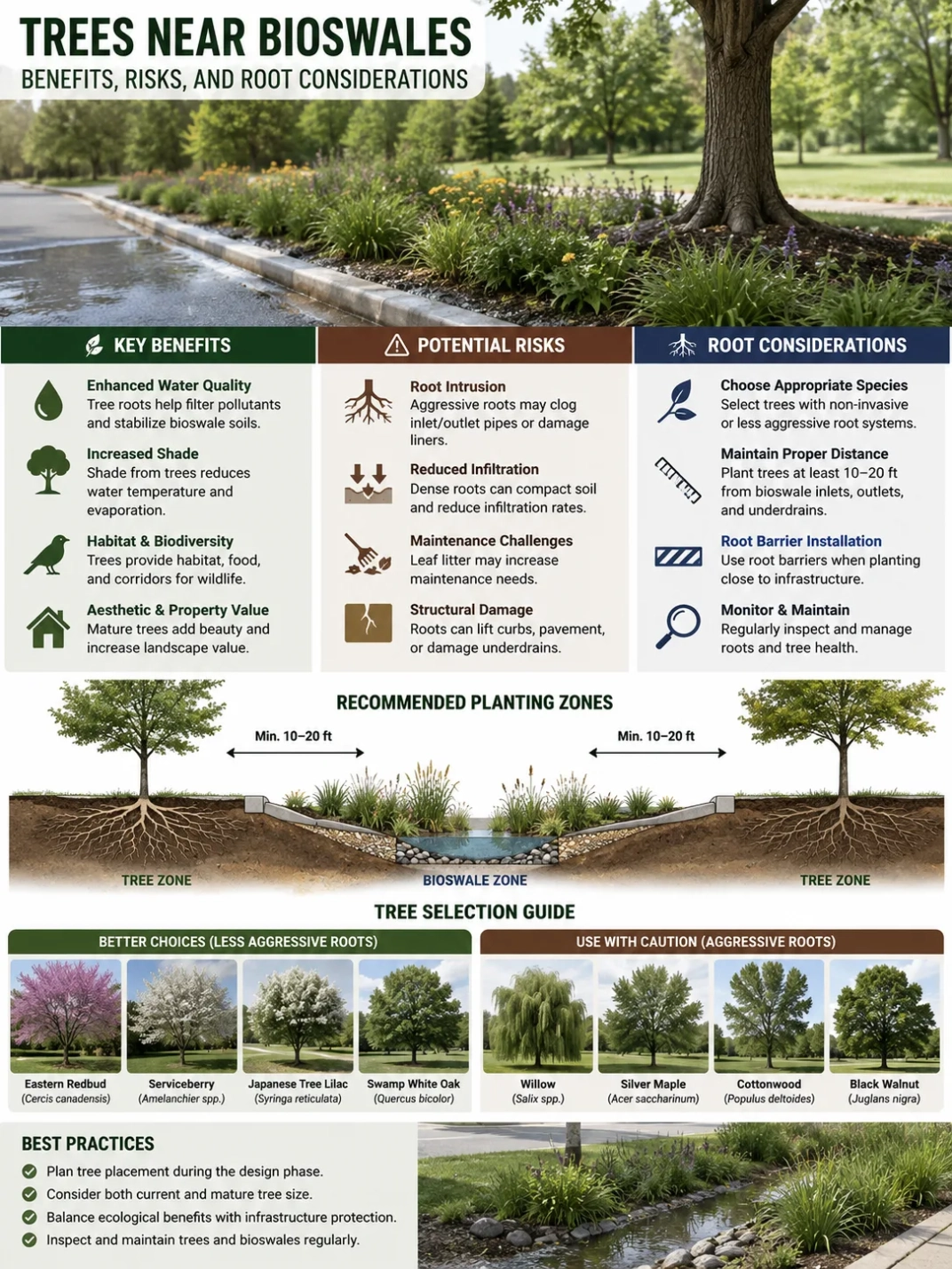
- Large shrubs or trees in narrow swales where they block flow, access, or visibility.
- High-maintenance ornamentals that need frequent replacement, staking, or special care.
- Known invasive species or plants restricted by local guidance.
Tree use needs extra care. Some large trees may work near or beside a broad bioswale if the design allows enough soil volume and protects drainage components. They are usually not a simple add-on for a narrow flow path, underdrain area, or small residential swale.
Planting Density and Establishment
A bioswale should not stay bare for long. Bare soil is vulnerable to erosion, weed pressure, and crusting. Dense planting helps cover the surface, but plants also need enough spacing to mature without crowding the drainage function.
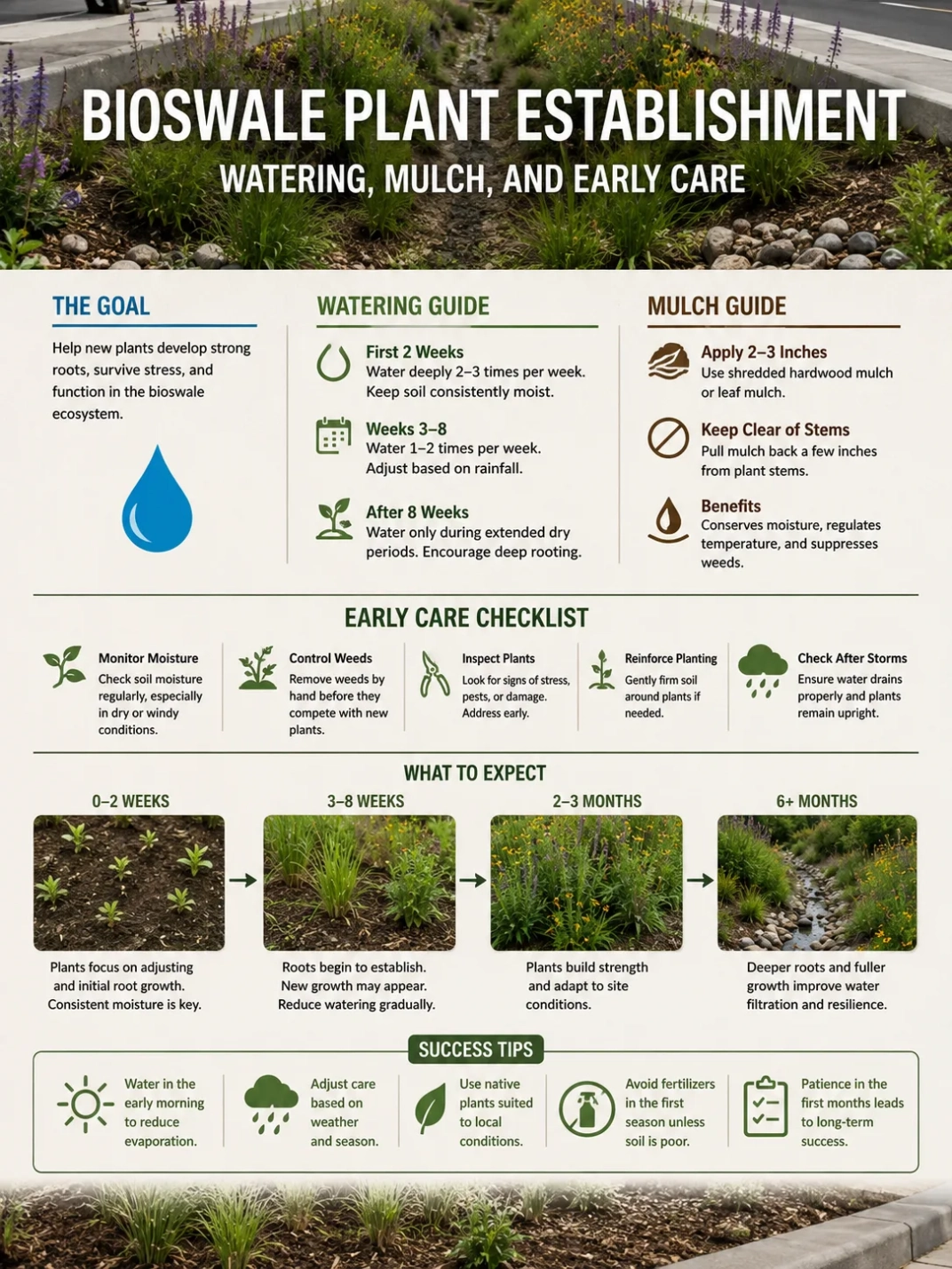
During establishment, even drought-tolerant plants may need watering until roots develop. The first growing season is often the most sensitive period. Mulch may help protect soil, but it should not float away, bury small plants, or clog the inlet or outlet.
Maintenance Note: young bioswales need inspection after storms. Look for plant washout, exposed soil, sediment piles, mulch movement, and areas where water cuts a narrow channel through the planting.
Residential and Public Bioswales Need Different Planting Logic
A small residential bioswale may focus on roof runoff, driveway runoff, or a low area in the yard. Planting can be more garden-like, but it still needs a safe overflow route and plants suited to the wettest and driest parts of the feature.
Public, roadside, and parking lot bioswales often face heavier sediment loads, more heat, more compaction pressure, and stricter maintenance needs. Planting in these settings should stay durable, easy to inspect, and compatible with sightlines and access.
Where runoff affects buildings, neighboring property, public drainage systems, sidewalks, or roadways, planting choice should be part of a broader drainage review. Plants can support performance, but they should not be used to hide a grading or overflow problem.
How Bioswale Planting Differs from a Rain Garden
Bioswales and rain gardens can use many of the same plant groups, but the planting logic is not identical. A rain garden often collects water in a basin-like area. A bioswale usually has a more defined flow path that moves runoff from one point to another while slowing and filtering it along the way.
That means bioswale plants must handle directional flow as well as temporary wet soil. Plants near the inlet and along the bottom may face more movement, sediment, and erosion stress than plants in a still basin.
A rain garden planting can sometimes focus more on basin zones. A bioswale planting must also respect the inlet, outlet, side slopes, check dams where used, and the overflow route.
A Practical Planting Mix
A balanced bioswale planting often uses several plant types rather than one species. This creates texture, root diversity, seasonal cover, and better resilience if one plant group struggles in a dry year or a wet season.
- Bottom zone: wet-dry tolerant sedges, rushes, and selected grasses.
- Lower slopes: dense grasses, sedges, and moisture-tolerant perennials.
- Upper slopes: drought-tolerant grasses, flowers, and smaller shrubs.
- Edges: plants that blend with the surrounding landscape while keeping the swale visible.
- Wider areas: shrubs used carefully for structure, screening, or seasonal interest.
The best final list should be regional. A useful bioswale plant in the Pacific Northwest, the Midwest, the Southeast, the Southwest, or a coastal area may be very different. Local plant performance matters more than a generic name on a list.
Common Planting Mistakes
Bioswale planting usually fails for plain reasons: wrong plant in the wrong moisture zone, too much bare soil, poor establishment care, or plants that block drainage components. These problems are easier to prevent than fix later.
- Using one plant across the whole swale. The bottom, slope, and edge usually need different tolerance ranges.
- Choosing plants only for bloom color. Flowers matter, but root structure and moisture tolerance matter more.
- Ignoring mature size. Shrubs and large grasses can close off access if placed too tightly.
- Leaving the inlet bare. Fast-moving runoff can expose soil and create small channels.
- Planting too close to the overflow route. Larger storms still need a clear path out.
- Skipping early maintenance. Weeds, sediment, and plant gaps are easier to manage before they spread.
Design Note: plants should make the drainage pattern easier to read, not harder. A well-planted bioswale still shows where water enters, how it moves, and where excess water leaves.
FAQ
What are the best plants for bioswales?
The best plants for bioswales are locally adapted grasses, sedges, rushes, shrubs, and flowering perennials that tolerate both temporary wet soil and dry periods. The right mix depends on the bioswale’s moisture zones, soil, sunlight, runoff source, and maintenance plan.
Do bioswales need native plants?
Native plants are often a strong choice because they may be better adapted to regional climate and local ecology. Still, they must match the exact site. A native plant that prefers dry soil may not work in the bottom of a bioswale, while a wetland plant may not fit a dry upper slope.
Are grasses or shrubs better for a bioswale?
Neither group is better in every case. Grasses and sedges are useful for surface coverage, erosion control, and shallow flow. Shrubs add structure and woody roots where there is enough room. Many bioswales work best with a mix of both, placed in the right zones.
Can flowers be used in a bioswale?
Flowers can be used in a bioswale when they tolerate the site’s wet-dry pattern and do not leave large bare areas. Flowering perennials usually work best when mixed with grasses, sedges, rushes, or shrubs so the planting remains stable outside the bloom season.
Should the bottom of a bioswale have different plants?
Yes. The bottom of a bioswale often receives more temporary ponding, sediment, and shallow flow than the side slopes or upper edge. Plants in that zone should tolerate periodic wet soil and recover after storms, while upper areas may need more drought-tolerant species.
What plants should not be used in a bioswale?
Avoid plants that cannot handle the site’s moisture pattern, known invasive species, aggressive spreaders, high-maintenance ornamentals, and large woody plants that block flow or inspection access. Local plant guidance is useful because problem species vary by region.