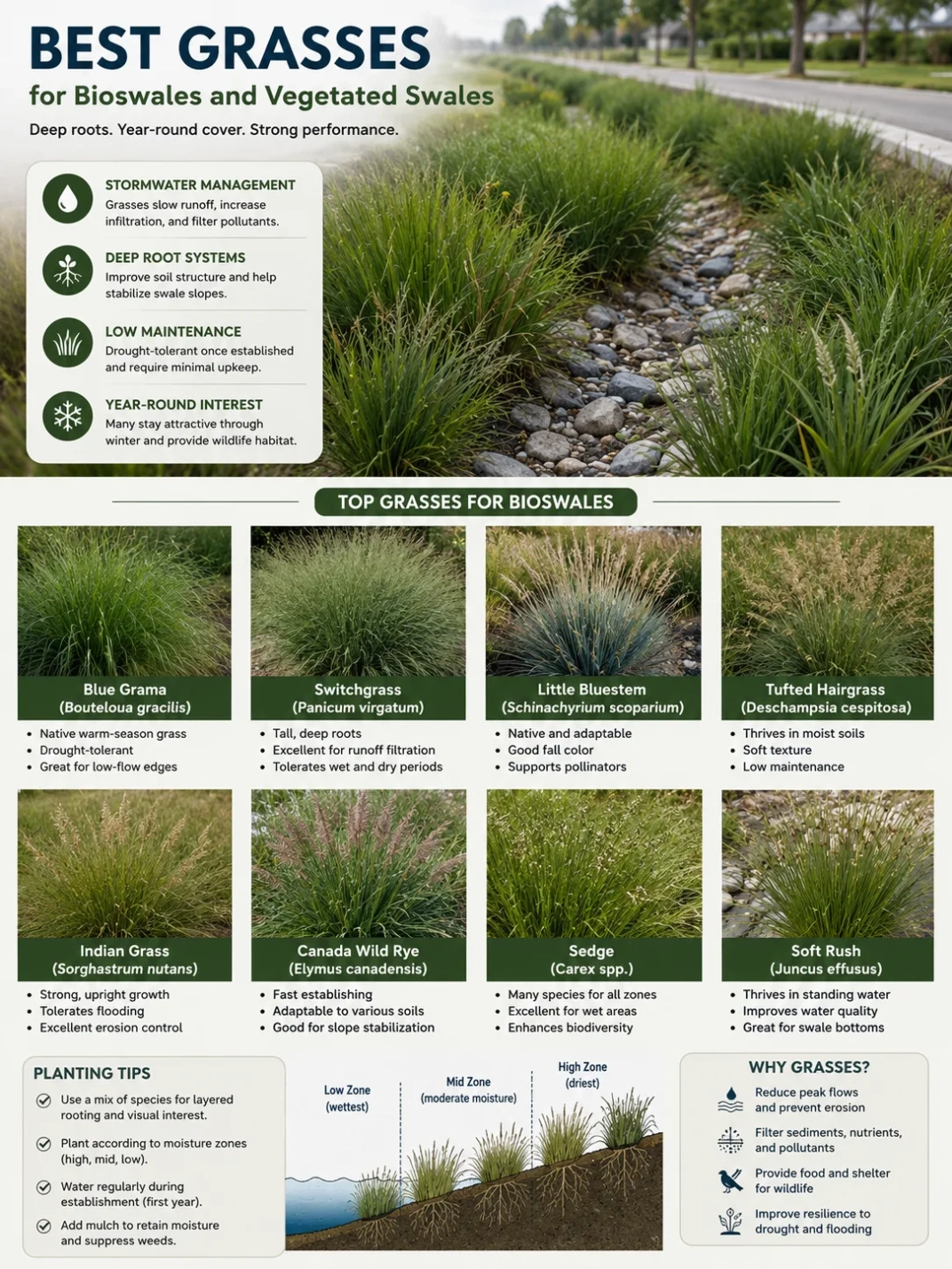
The best grasses for bioswales are dense, perennial, locally adapted species that can hold soil, slow shallow runoff, and recover after alternating wet and dry periods. Switchgrass, prairie cordgrass, tufted hairgrass, Virginia wildrye, red fescue, buffalograss, blue grama, and inland saltgrass can all be useful, but they do not belong in the same part of a swale or the same climate. The right choice depends on where water enters, how long the soil stays wet, whether salt is present, how the site will be mowed, and how quickly bare soil must be covered.
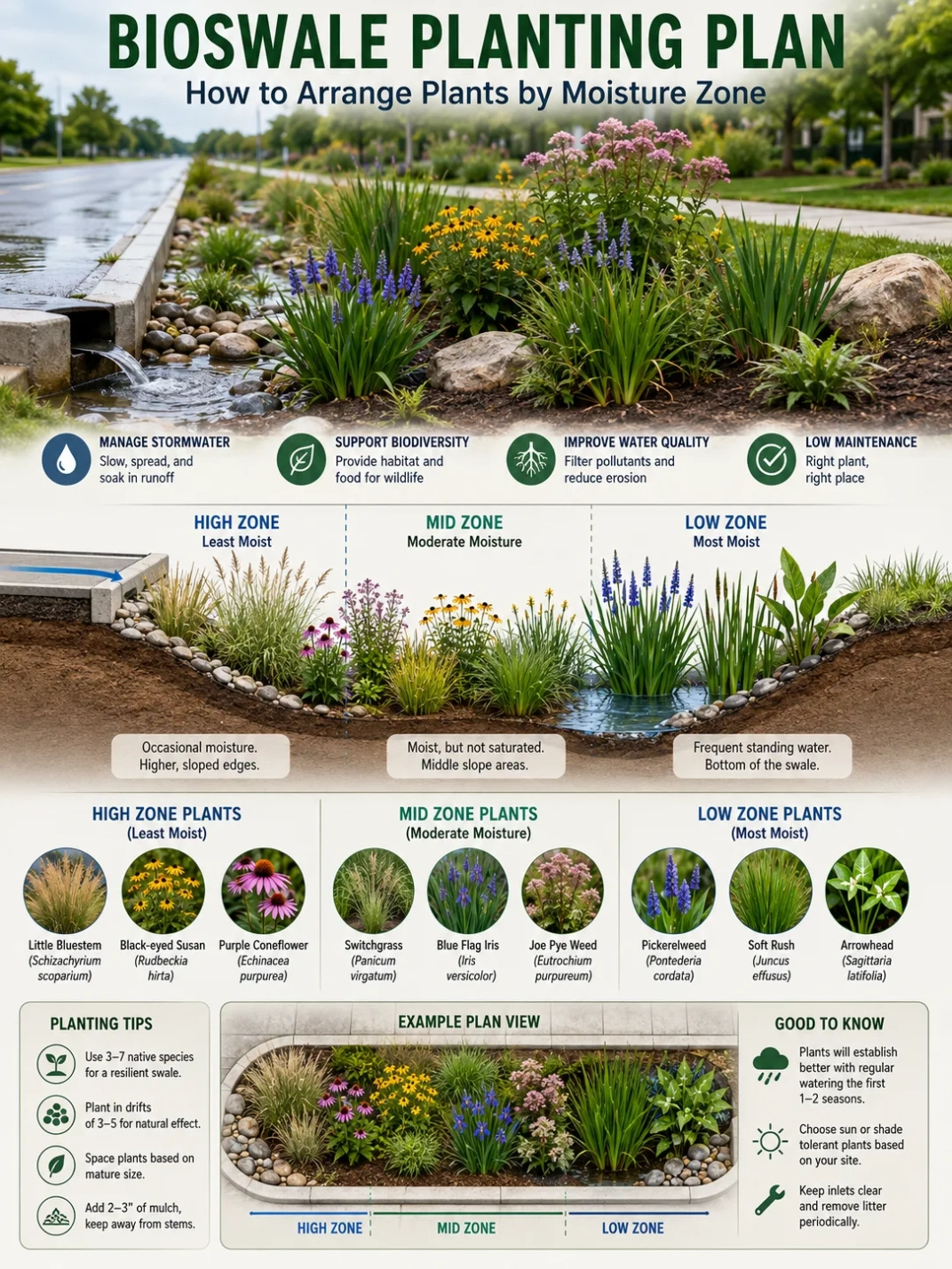
A useful planting plan treats the channel as several moisture zones rather than one uniform bed. The bottom receives the longest wetting and the strongest flow. The side slopes usually drain sooner. The upper edge may behave like ordinary dry landscape soil. A grass that thrives on the upper bank may thin out or rot in the flow line, while a wet-site grass may spread too strongly or grow too tall near a sidewalk.
What Makes a Grass Suitable for a Bioswale?
A bioswale grass does more than add green cover. Its stems and leaves create resistance that can slow shallow water. Its roots and crowns protect the soil surface. Dense growth can help trap sediment before it moves farther through the drainage system.
- Dense ground cover: Gaps expose soil to scour and allow small channels to form.
- Flexible but persistent stems: Upright growth helps interrupt sheet flow, even where mowing is part of the maintenance plan.
- Wet-and-dry tolerance: Many swales are wet for a short period after rain and dry between storms.
- Root and crown strength: Fibrous roots, rhizomes, or stolons can help hold the channel lining together.
- Local climate fit: Winter cold, summer heat, drought, rainfall timing, shade, and soil chemistry shape survival.
- Manageable height and spread: A plant must fit sight lines, sidewalks, curb openings, mowing access, and nearby planting areas.
Root depth alone is not enough. A deep-rooted bunchgrass may still leave open soil between crowns during establishment. A shorter sod-forming grass may protect the surface sooner. In many vegetated swales, a blend of growth forms works better than a single species planted from end to end.
| Grass or Group | Typical Strength | Likely Swale Zone | Main Limitation |
|---|---|---|---|
| Switchgrass | Deep fibrous roots, dense crowns, sediment capture | Bottom to side slope where locally adapted | Can become tall and may not suit narrow visibility zones |
| Prairie cordgrass | Wet-soil tolerance, stiff stems, strong rhizomes | Lower zone and wet flow line | Large stature and strong spread need space |
| Tufted hairgrass | Handles cool, moist, poorly drained sites | Bottom and lower side slopes | Best fit varies with climate and local ecotype |
| Virginia wildrye | Moist-soil tolerance, shade tolerance, quick early cover | Lower to middle zones | Often shorter-lived than some warm-season grasses |
| Red fescue | Low growth, fine texture, mowing tolerance | Upper sides and cooler, partly shaded edges | Not a good choice for prolonged saturation |
| Buffalograss and blue grama | Drought tolerance and low growth | Dry upper banks in suitable regions | Poor fit for a frequently wet channel bottom |
| Inland saltgrass | Salt tolerance, spreading growth, wet-saline soil use | Salt-affected lower or middle zones | Site and regional suitability must be checked |
Grass Choices for Different Swale Zones
Switchgrass
Switchgrass (Panicum virgatum) is one of the most useful native warm-season grasses for bioswales across much of the United States. It forms deep fibrous roots and dense crowns that help stabilize soil and trap sediment. It can handle a broad range of soil moisture conditions, but local ecotypes and cultivars differ in size, cold tolerance, moisture preference, and establishment behavior.
Switchgrass often fits the lower and middle parts of a swale where water arrives after storms but does not remain as a permanent pool. Taller forms need room. Near driveways, road intersections, or pedestrian crossings, a shorter local selection or a different species may be easier to manage.
Prairie Cordgrass
Prairie cordgrass (Spartina pectinata, also listed by some taxonomic sources as Sporobolus michauxianus) is a strong candidate for wet bottoms, drainage channels, and seasonally saturated soil. Its rhizomes form a firm underground network, and its stiff stems can remain effective against shallow flow.
This is not a small ornamental grass. It can grow tall, spread through rhizomes, and occupy more room than expected. It suits broad swales, wet edges, and restoration-style plantings better than tight residential strips beside paving.
Tufted Hairgrass
Tufted hairgrass (Deschampsia cespitosa) is a cool-season bunchgrass associated with moist meadows, wet ground, and poorly drained soils in many cooler regions. It can fit the lower swale zone where the soil is wet early in the growing season or remains moist longer than the surrounding landscape.
Its suitability changes by region. It is not a universal warm-climate answer, and locally native seed sources may be limited. Where it fits, it offers a finer texture than prairie cordgrass and can work in mixed plantings with sedges, rushes, and moisture-tolerant flowering plants.
Virginia Wildrye
Virginia wildrye (Elymus virginicus) prefers moist soils and can tolerate more shade than many warm-season prairie grasses. It is often useful along wooded drainage paths, partly shaded residential swales, and lower side slopes that receive periodic runoff.
It establishes earlier in the season than warm-season grasses and can provide useful cover while slower species develop. It may be shorter-lived, but it can reseed where seed heads are allowed to mature. Salt tolerance is limited, so it may not fit road edges that receive heavy deicing salt.
Red Fescue
Red fescue (Festuca rubra) is a cool-season, fine-leaved grass used for low-growing cover, erosion control, and turf-like areas. It tolerates mowing and can handle shade better than many sun-loving native prairie grasses. It is most useful on upper side slopes, shoulders, and cooler edges that drain after rain.
Red fescue should not be treated as a wet-bottom plant. It may tolerate somewhat poor drainage, depending on the type and site, but repeated long ponding can thin the stand. Its origin also matters: native status and ecological fit vary across its wide range and among commercial seed types.
Buffalograss and Blue Grama
Buffalograss (Bouteloua dactyloides) and blue grama (Bouteloua gracilis) are low, warm-season grasses suited to dry climates and upper swale banks in parts of the central and western United States. Buffalograss spreads by stolons and can form a low sod. Blue grama has a tufted growth form and is often used in mixed low-maintenance seedings.
These grasses are not good substitutes for wet-bottom species. Their value appears above the regular ponding line, where the soil dries quickly and irrigation is limited after establishment. Blue grama can leave more open space between plants than a dense sod, so erosion protection during establishment needs close attention.
Inland Saltgrass
Inland saltgrass (Distichlis spicata) is a spreading native grass adapted to saline and alkaline soils in many parts of North America. It can be useful where roadside runoff, deicing salts, saline irrigation water, or naturally salty soil limits other grasses.
Salt tolerance does not remove the need to assess drainage. High salt loads can still damage soil structure and nearby plants. Inland saltgrass also spreads through rhizomes, which can be helpful for surface cover but may require boundaries near formal planting beds.
Planting Note: A grass can be native to a country or state and still be poorly matched to a particular site. Local seed origin, elevation, rainfall pattern, soil texture, winter conditions, and expected ponding should guide the final choice.
Why Sedges and Rushes Often Belong in the Mix
Sedges and rushes are grass-like plants, but they are not true grasses. They still deserve attention because the wettest part of a bioswale may suit them better than turf grasses or upland prairie grasses. Many species form dense clumps or spreading root systems and tolerate repeated saturation.
A practical planting can use wet-tolerant sedges or rushes in the bottom, moisture-flexible grasses on the lower sides, and drought-tolerant grasses near the top. This zoned layout supports plant health without asking one species to tolerate every condition in the channel.
Species still need regional screening. Some wetland plants spread aggressively, and some commonly sold grasses are invasive in particular states or habitats. Reed canary grass, for example, has been used historically for erosion control but is invasive across many wet areas and should not be selected without clear local guidance.
Matching Grass Form to Water Movement
The most visible plant feature is height, but growth form often matters more for channel stability.
Sod-Forming Grasses
Rhizomatous or stoloniferous grasses spread sideways and can form a connected surface cover. This helps protect soil where runoff tends to concentrate. Their drawback is the same trait: they can move beyond the intended planting zone.
Bunchgrasses
Bunchgrasses grow from distinct crowns. They add texture, root mass, and upright stems, but young plantings may contain open soil between clumps. On a swale bottom, those gaps can become narrow flow paths unless the planting density, temporary cover, and erosion protection are planned well.
Tall, Stiff Grasses
Tall grasses can slow shallow flow and capture sediment, especially when stems remain standing. They can also block views, lean over walkways, collect litter, or require seasonal cutting. Use them where there is enough width and where maintenance crews can reach the channel without driving over the soil media.
A Better Way to Build a Grass Mix
A bioswale seed mix should be based on function, not a generic “native meadow” label. The mix needs enough compatible species to handle variation, but too many poorly matched species can raise cost without improving cover.
- Map the moisture zones. Mark the flow line, expected ponding area, lower sides, upper sides, and dry shoulder.
- Identify the runoff source. Roof water, driveway runoff, roadside runoff, and parking lot runoff bring different sediment and salt conditions.
- Choose the surface-cover strategy. Decide where a connected sod is needed and where bunchgrasses can be used safely.
- Check mature height. Keep sight lines, curb openings, signs, hydrants, doors, and sidewalks clear.
- Plan establishment cover. Seeded native grasses may take time to fill the ground. Temporary stabilization may be needed so runoff does not cut channels first.
- Set the mowing or cutting approach. The design should state whether grasses remain tall, receive periodic cutting, or are maintained as a shorter cover.
Design Note: Do not place a bunchgrass mix in a concentrated inlet and assume roots will prevent scour immediately. The inlet may need stone, a level spreader, dense sod, erosion-control material, or another site-specific stabilization method while vegetation develops.
Conditions That Change the Plant List
Clay or Compacted Soil
Clay soil is not automatically unsuitable, but compaction and slow drainage can keep the root zone wet longer than expected. Grass selection cannot correct a poorly prepared soil profile. The design may need soil loosening, amended filter media, an underdrain, or a different overflow plan, depending on site testing and local requirements.
Road Salt and Urban Runoff
Roadside swales may receive salt, grit, tire particles, and sediment. Salt-sensitive grasses can decline near curb cuts even when they perform well elsewhere. Select plants for the actual runoff source, and provide a place where coarse sediment can be removed before it buries the main planting.
Shade
Many tall warm-season grasses thin in heavy shade. Virginia wildrye and some fescues can fit partly shaded zones, but deep shade under dense tree canopies may call for a grass-sedge-forb mix rather than a grass-only design.
Dry and Semi-Arid Sites
In dry climates, the swale may experience intense short wetting followed by long dry periods. Drought-tolerant upper-bank grasses can reduce irrigation demand after establishment, while the bottom still needs plants that survive temporary inundation. A species described as drought tolerant may still need irrigation during its first growing period.
Where Grass Selection Commonly Fails
- Using one species across every moisture zone. The bottom and upper bank rarely behave the same way.
- Choosing by appearance alone. Fine texture or attractive seed heads do not show how a grass handles moving water.
- Ignoring establishment time. A good mature plant can still fail if bare soil erodes before roots develop.
- Planting aggressive spreaders in a narrow bed. Rhizomes can cross edging and enter adjacent beds.
- Relying on mowing without a mowing plan. Cutting too low can weaken crowns, expose soil, and change how water moves through the swale.
- Letting sediment bury the grass base. Deposited soil can redirect flow, smother plants, and reduce channel capacity.
- Using a regional seed mix without checking every species. A mix may contain plants that dislike ponding, shade, salt, or the local winter climate.
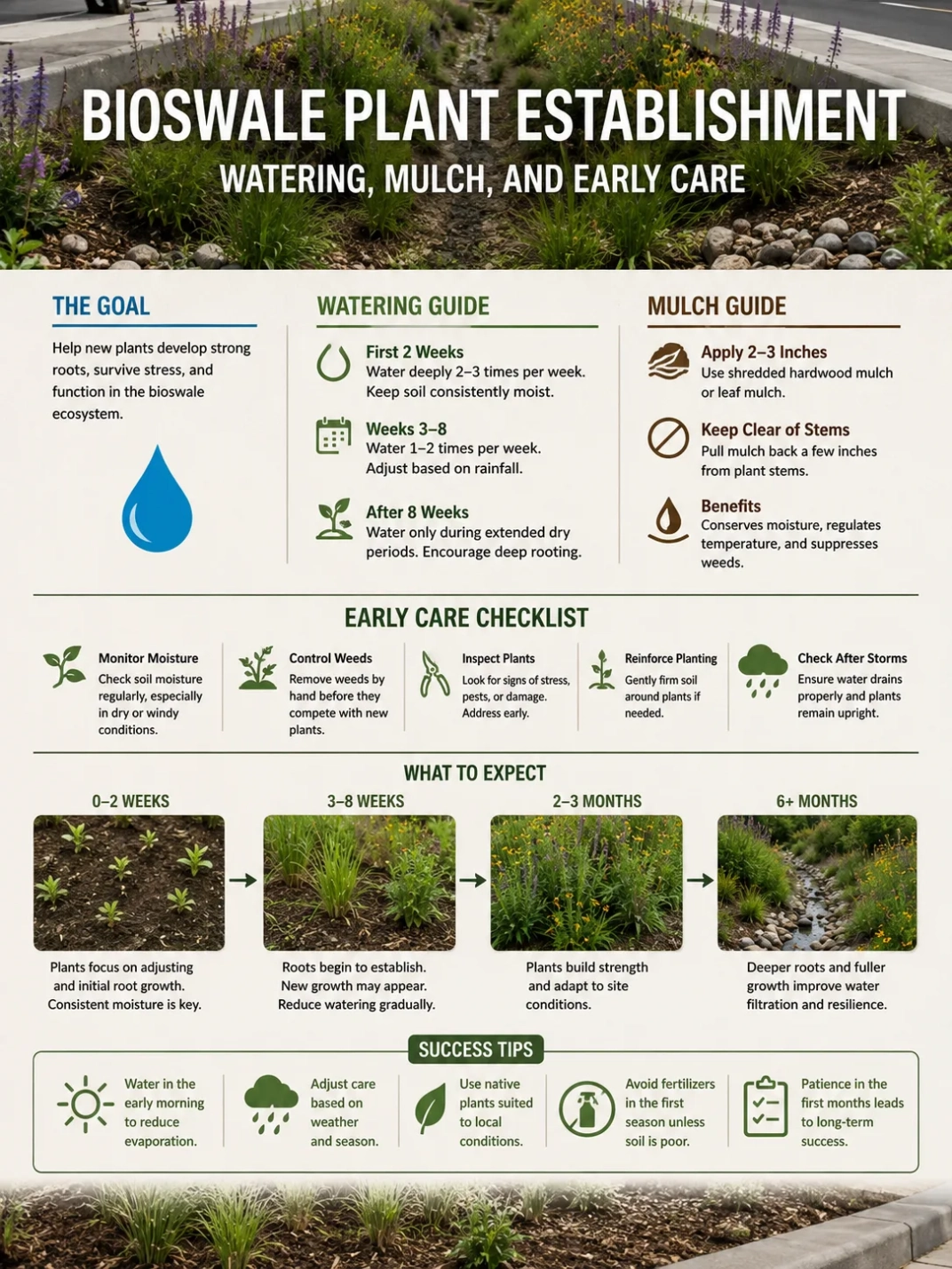
Maintenance Note: Inspect the grass cover after large storms and during the establishment period. Look for bare patches, flattened or buried plants, narrow erosion channels, blocked inlets, sediment deposits, and standing water that lasts longer than the design intended.
When Professional Review Is Worthwhile
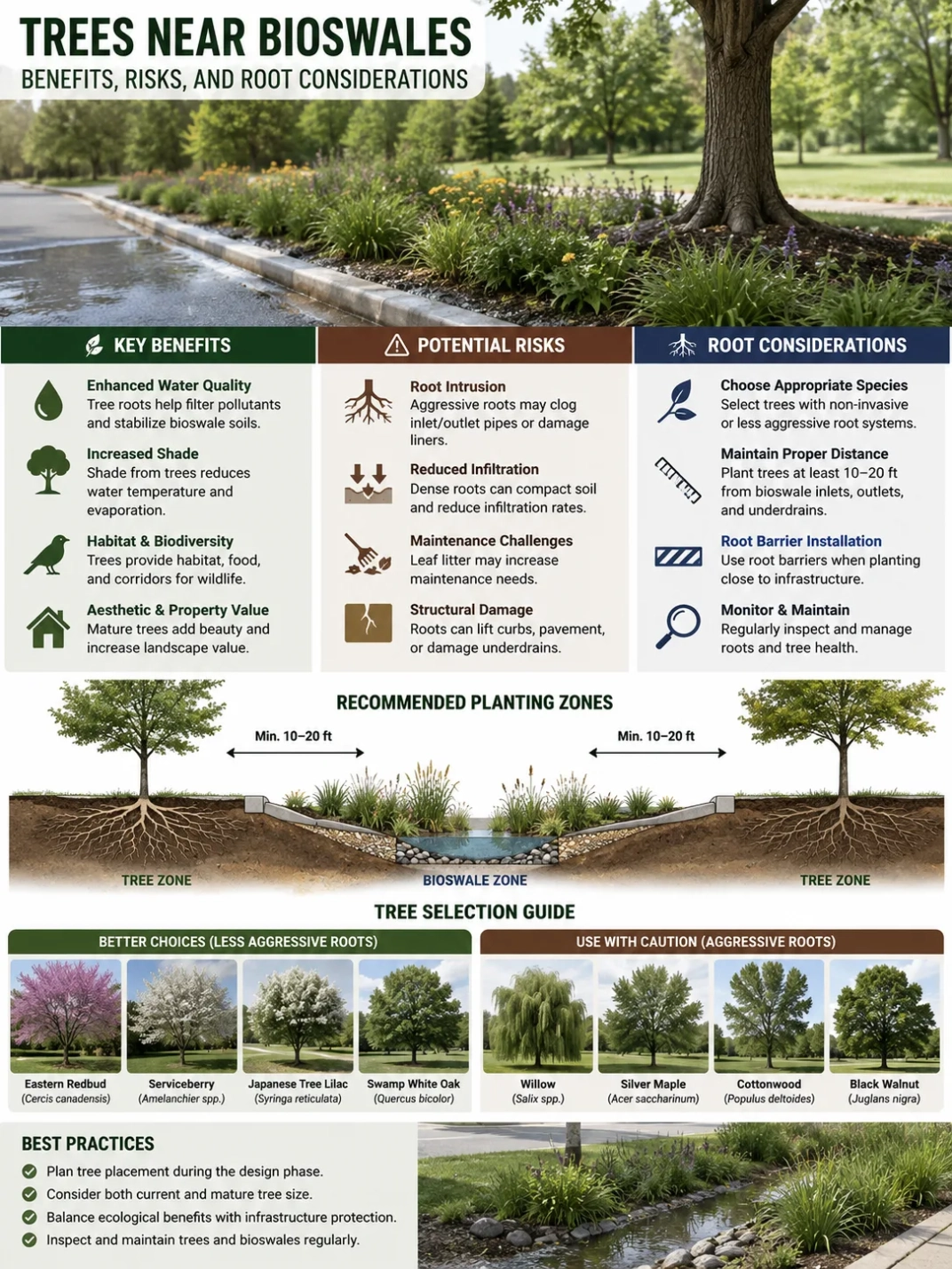
Plant selection should be coordinated with drainage design when a swale receives runoff from a road, parking lot, large roof, steep driveway, or other broad impervious surface. A landscape architect, civil engineer, soil specialist, or stormwater professional may need to review flow depth, velocity, inlet protection, overflow capacity, soil infiltration, underdrain needs, and maintenance access.
Residential projects also need care where water could move toward a foundation, basement, neighboring property, retaining wall, septic area, utility trench, or public right-of-way. A grass mix cannot make an unsafe overflow route acceptable. Local drainage rules and utility-location requirements may also shape where the swale can be built.
Frequently Asked Questions
What Is the Best All-Purpose Grass for a Bioswale?
There is no single all-purpose choice. Switchgrass is widely useful where it is locally adapted, but it may be too tall for some sites and too dry-loving or too wet-loving in a particular ecotype. A zoned mix usually fits real swale conditions better.
Can Ordinary Lawn Grass Be Used in a Vegetated Swale?
Lawn-type grass can work in a simple grassed swale when the design calls for regular mowing and the soil does not remain saturated for long periods. It may offer less habitat value and shallower rooting than a mixed native planting, and some turf species perform poorly under repeated ponding or road salt.
Should the Bottom of a Bioswale Use Grass, Sedges, or Rushes?
The answer depends on ponding duration, soil moisture, climate, and flow. True grasses can work in many bottoms, but sedges and rushes often fit the wettest zone better. A mixed lower-zone planting can provide denser cover across changing conditions.
Are Native Grasses Always Better for Bioswales?
Locally native grasses often match regional climate and can support local ecology, but native status does not guarantee a good fit for the flow line, soil, salt level, shade, or maintenance plan. Site suitability comes first, followed by local origin and ecological goals.
How Soon Should Grass Cover the Soil?
The channel needs protection from the start, but perennial native grasses may take time to form full cover. The establishment plan may include temporary cover, erosion-control material, plugs, sod, or staged runoff diversion, depending on the site.
Can a Grass Mix Fix Standing Water in a Bioswale?
Plants can use water and keep soil open through root growth, but they cannot correct every drainage problem. Persistent standing water may point to compacted soil, clogged media, a blocked outlet, a high groundwater table, an undersized underdrain, or a grading issue. The cause should be checked before replacing the plants.