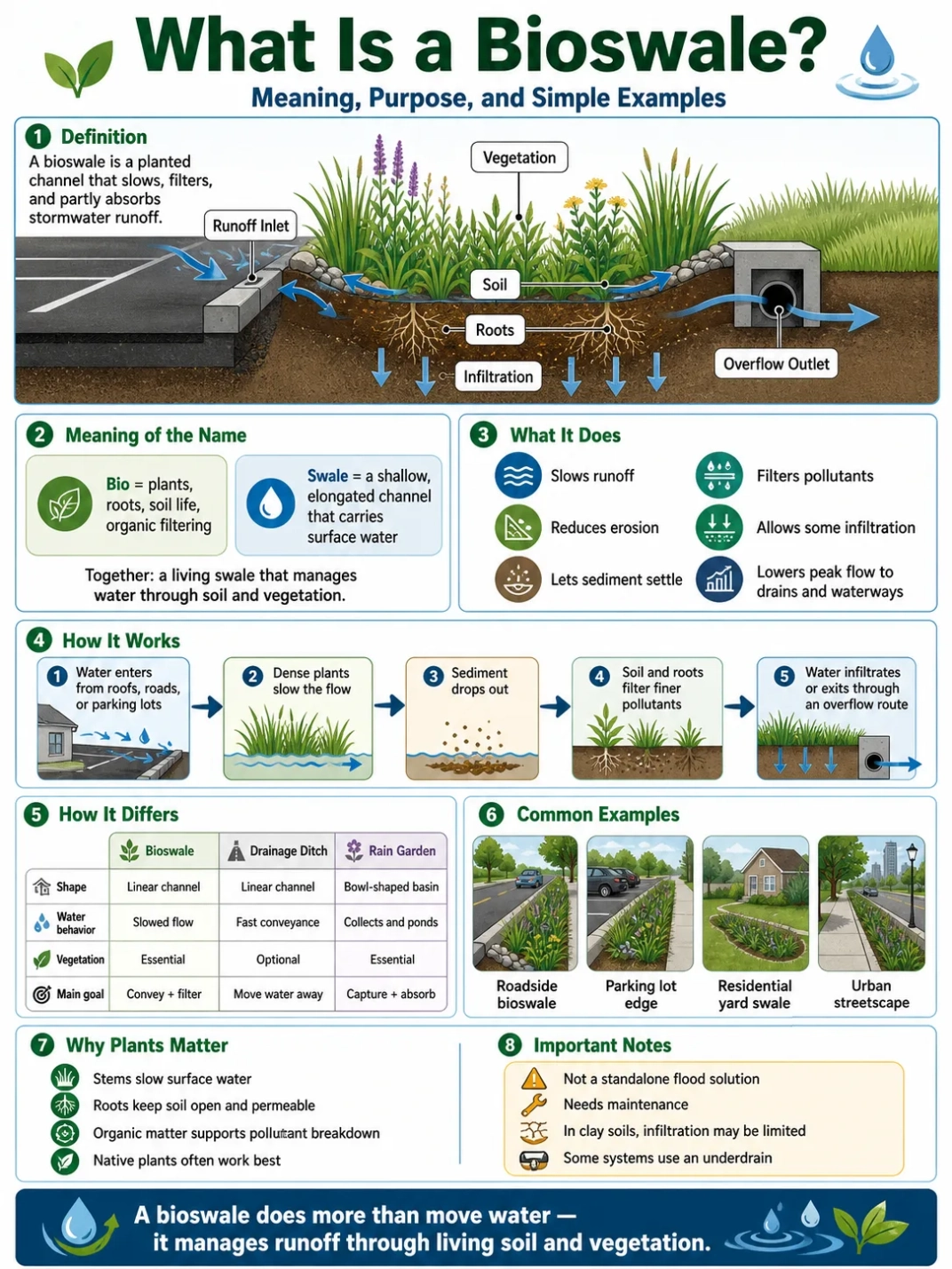
A bioswale is a planted channel that slows and filters stormwater runoff as it moves across the land surface. Unlike a standard drainage ditch — which moves water away as fast as possible — a bioswale is designed to hold water in contact with soil and vegetation long enough for sediment to settle, pollutants to filter out, and some portion of the runoff to soak into the ground. The result is a drainage system that manages water through living processes, not just pipes and concrete.
That distinction — between moving water and managing it — is what separates bioswales from most conventional drainage infrastructure.
Where the Name Comes From
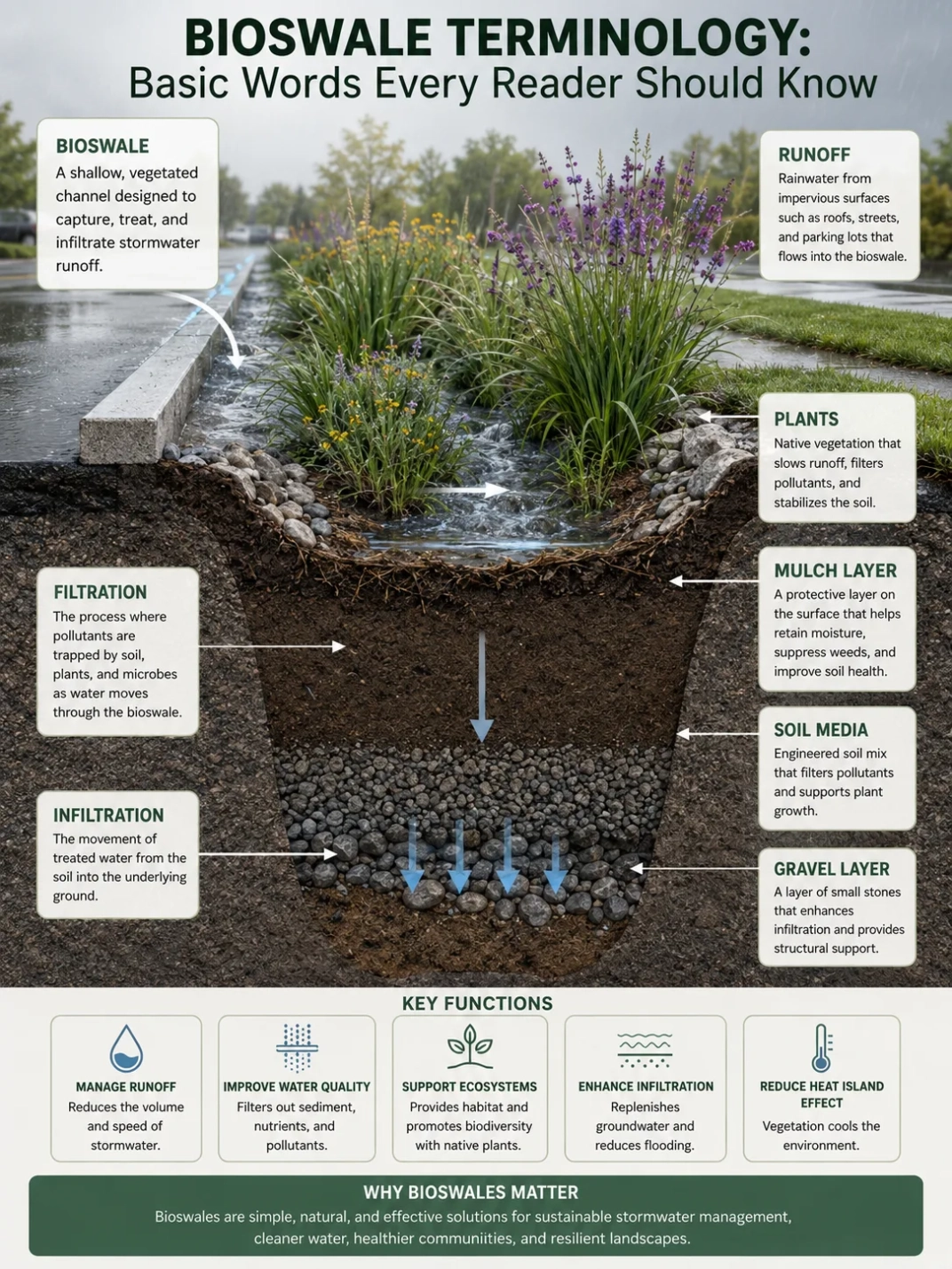
The word bioswale combines two straightforward terms. Bio points to the biological layer: the plants, roots, soil organisms, and organic material that do the actual filtering work. Swale is a landscape term for a shallow, elongated depression — a low channel that collects or directs surface water. Together, bioswale describes a living swale: a channel where biology, not just topography, shapes how water moves.
The term is used across stormwater management, landscape architecture, and low-impact development (LID). Depending on the region and local design standards, similar systems may be called vegetated swales, grassed swales, or bioretention swales. These names reflect slight differences in design or function, but the underlying concept is the same.
The Basic Purpose
Bioswales exist to solve a problem that comes with developed land: impervious surfaces. Rooftops, roads, parking lots, and driveways shed rain instead of absorbing it. That runoff carries speed, volume, and whatever it picks up along the way — sediment, oil, fertilizers, debris.
A bioswale intercepts that flow. Its purpose is not to eliminate runoff, but to:
- Slow the water down, reducing erosion and downstream flooding risk
- Give sediment time and space to settle out
- Filter pollutants through soil and plant roots
- Allow some water to infiltrate into the ground where soil conditions permit
- Reduce the volume and peak rate of runoff reaching storm drains or waterways
Not every bioswale achieves all of these at once. Performance depends on soil type, slope, plant cover, and local rainfall patterns. But the underlying goal — using a planted channel to manage runoff rather than just discharge it — stays consistent across designs.
How It Handles Water: The Short Version
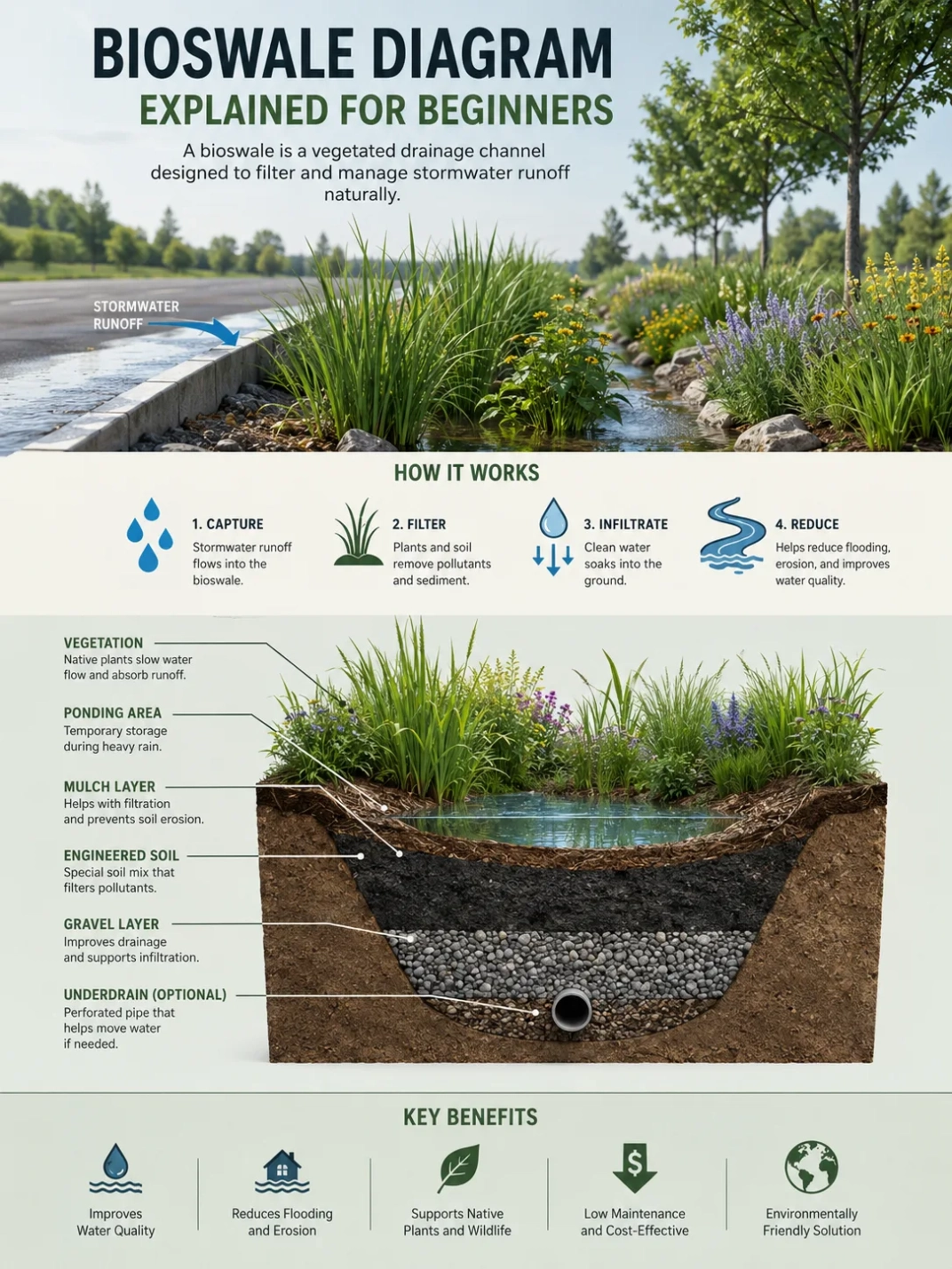
Water enters a bioswale at an inlet — often a curb cut, a gravel buffer strip, or a simple low-point opening at the edge of a paved area. It flows along the length of the channel, moving slowly through dense vegetation that adds friction and spreads the flow. As it slows, heavier particles settle to the bottom. The soil and plant roots below filter finer pollutants.
Depending on the design, water may exit at a defined outlet, soak into the ground along the channel, or both. Well-designed bioswales include an overflow route — a way for large storm events to exit safely without causing erosion or backing up onto adjacent surfaces.
The vegetation is not decorative. Dense, fibrous root systems keep the soil open and permeable. Stems and foliage slow the surface flow. Leaf litter and organic matter build up a layer that holds moisture and supports the microbial processes that break down certain pollutants over time.
Bioswale, Drainage Ditch, and Rain Garden: What Sets Them Apart
These three systems are often confused — and sometimes used interchangeably in informal conversation. They serve related but distinct purposes.
| Feature | Bioswale | Drainage Ditch | Rain Garden |
|---|---|---|---|
| Shape | Elongated channel | Elongated channel | Bowl-shaped depression |
| Water flow | Linear, slowed | Linear, fast | Collects and ponds |
| Vegetation | Required — part of function | Optional or minimal | Required — part of function |
| Infiltration goal | Partial to full | Usually none | Full |
| Primary purpose | Convey and filter runoff | Convey runoff quickly | Capture and absorb runoff |
| Slope requirement | Low, controlled | Variable | Flat base preferred |
The core difference between a bioswale and a standard drainage ditch is intent. A drainage ditch moves water. A bioswale manages it. The core difference between a bioswale and a rain garden is shape and behavior: a bioswale conveys flow along a channel; a rain garden collects flow in a fixed basin and lets it soak in place.
In practice, some systems sit between these definitions. A bioretention cell, for instance, is closer to a rain garden with engineered soil layers — it focuses on infiltration and deep filtration rather than linear conveyance. These distinctions matter when choosing the right system for a specific site.
Simple Examples of Bioswales in Use
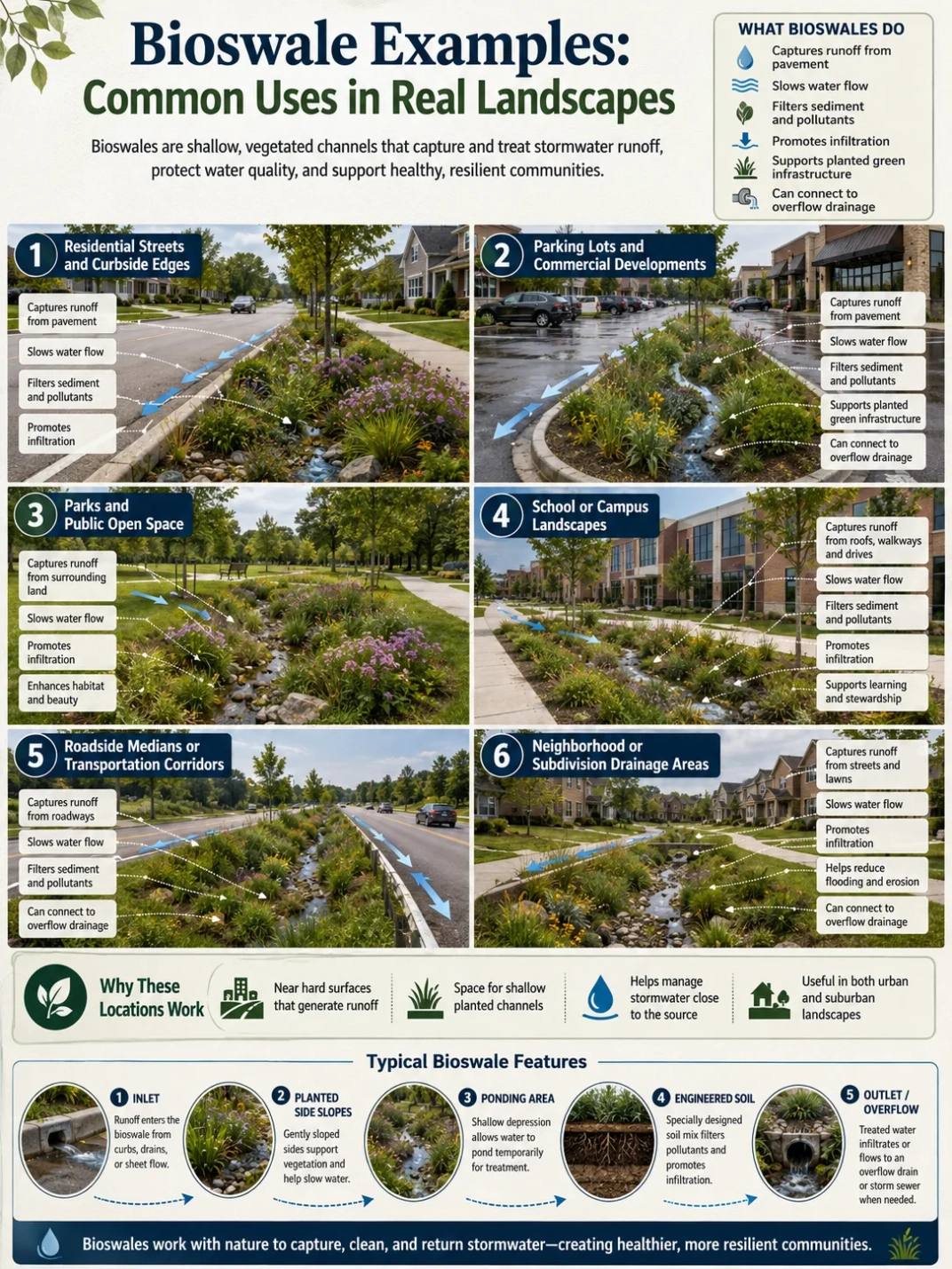
Bioswales appear in a wide range of settings. The size and design change, but the function stays the same.
Along Roadways and Parking Lots
One of the most common applications is the roadside or parking lot bioswale. These are narrow planted channels placed between a paved surface and a curb, median strip, or property edge. Runoff enters through low points or curb cuts, travels slowly through native grasses or sedges, and exits at a defined outlet or drains gradually through the soil.
In parking lots, bioswales can replace traditional curbed planters or concrete drainage channels. They reduce the volume of runoff that hits the storm sewer and filter oils, sediment, and other surface pollutants before that water travels further downstream.
In Residential Yards
Smaller bioswales show up in residential settings too — often along the edge of a driveway, at the base of a slope, or leading away from a downspout. A shallow planted swale running across a lawn can intercept and slow roof or driveway runoff before it reaches a property boundary or a storm drain at the street.
These residential versions are simpler in design but follow the same logic: slow the water, filter it, let it settle or soak in where possible.
In Public Spaces and Streetscapes
Bioswales have become a visible part of green streetscape design in many cities. They appear as planted strips within sidewalk corridors, boulevard medians, or along the edges of public plazas. These installations manage runoff from roads and pedestrian surfaces while also adding vegetation to otherwise hard environments.
Urban bioswales typically require more engineered soil mixes and stronger outlet structures to handle higher runoff volumes and heavier debris loads than residential or rural versions.
The Role of Plants
Vegetation is not optional in a bioswale — it is the mechanism. Without plants, a vegetated swale becomes just a ditch.
Plants slow water by creating physical resistance at the surface. Dense stems and foliage spread the flow laterally, reducing its speed and giving sediment time to drop out. Below the surface, root systems open channels in the soil that allow water to move downward. Deep-rooted species — many native grasses, sedges, and rushes — are especially effective at maintaining soil permeability over time.
Native plants are often recommended for bioswales because they are adapted to local wet-dry cycles, tend to establish deeper root systems, and generally require less ongoing input once they are settled in. That said, plant selection depends heavily on the region, the moisture conditions within the swale, and local species availability. There is no single plant list that works everywhere.
Planting Note: A common design error is selecting ornamental species that cannot tolerate periodic flooding or drought. Bioswale plants must handle both extremes — temporary inundation after storms and dry periods between events. Selecting for that range is more useful than selecting purely for appearance.
Where Bioswales Fit in Green Infrastructure
Bioswales are one piece of a broader approach called green infrastructure (GI) or low-impact development (LID). These approaches try to manage stormwater closer to where rain falls — using plants, soil, and natural processes instead of (or alongside) pipes, detention basins, and underground systems.
Other systems in this category include rain gardens, bioretention cells, permeable pavement, green roofs, and constructed wetlands. Bioswales often work alongside these systems rather than replacing them. A bioswale might carry runoff from a parking lot to a bioretention cell, or move water from a roof downspout toward a rain garden at the base of a yard.
In this context, a bioswale acts as a connector as much as a filter — it moves water while treating it, and delivers managed flow to the next part of a drainage system.
What Bioswales Do Not Do
Setting accurate expectations matters, especially for anyone considering a bioswale for a specific site.
A bioswale will not prevent flooding on its own. In a large storm event, it will likely reach capacity and overflow — which is expected, and why a safe overflow route is part of any sound design. A bioswale is sized for a specific range of storm events; events outside that range need other solutions.
A bioswale also will not infiltrate water if the underlying soil does not allow it. In areas with heavy clay soils or high groundwater, the infiltration rate may be very low. Those sites can still benefit from the slowing and filtering functions, but an underdrain — a perforated pipe below the soil layer — is often added so the system can drain between events rather than staying waterlogged.
And like any planted system, a bioswale needs maintenance. Plants need time to establish, sediment accumulates at inlets, and outlets can clog. A neglected bioswale loses function over time.
Frequently Asked Questions
What is the main purpose of a bioswale?
A bioswale is designed to slow, filter, and in many cases partially absorb stormwater runoff. It intercepts water from impervious surfaces like roads, parking lots, driveways, and rooftops, and manages it through vegetation and soil rather than routing it directly to a storm drain or waterway.
Is a bioswale the same as a drainage ditch?
No. A drainage ditch is built to move water away quickly. A bioswale is designed to slow water down, filter it through plants and soil, and often allow partial infiltration. Vegetation is a functional requirement in a bioswale, not an afterthought — that distinction is what separates the two systems.
How is a bioswale different from a rain garden?
A bioswale is a linear channel that conveys runoff along its length. A rain garden is a bowl-shaped depression that collects runoff and holds it in place until it soaks in. Both use plants and soil to manage water, but their shapes and behaviors differ. Bioswales move water; rain gardens capture it.
Can a bioswale work in clay soil?
A bioswale can still slow and filter runoff in clay soil, but infiltration will be limited. In those conditions, an underdrain — a perforated pipe below the soil layer — is often included so water can drain out between storm events rather than remaining pooled. Soil conditions should be assessed before designing a bioswale, especially on residential or sensitive sites.
Do bioswales need native plants?
Native plants are often the best choice because they are adapted to local rainfall patterns, periodic flooding, and dry spells — all conditions that occur in a functioning bioswale. They also tend to develop deeper root systems over time. The right plants depend on the region and site conditions; local guidance or a qualified landscape professional can help identify species suited to a specific location.
Can a homeowner build a small bioswale?
Small, simple bioswales in residential yards are within reach for many homeowners — particularly those placed along a driveway edge or to carry roof runoff away from a foundation. That said, slope, soil conditions, overflow routing, and proximity to structures or property lines all affect how a bioswale should be designed. For anything beyond a basic shallow swale, input from a landscape professional or drainage specialist is worth considering.